Synthesis: Intelligence Is Expensive
From the metabolic cost of a single action potential to the electricity demand of GPT, intelligence runs on watts. Understanding why coherence is thermodynamically expensive reframes AI risk, brain evolution, and civilizational limits.
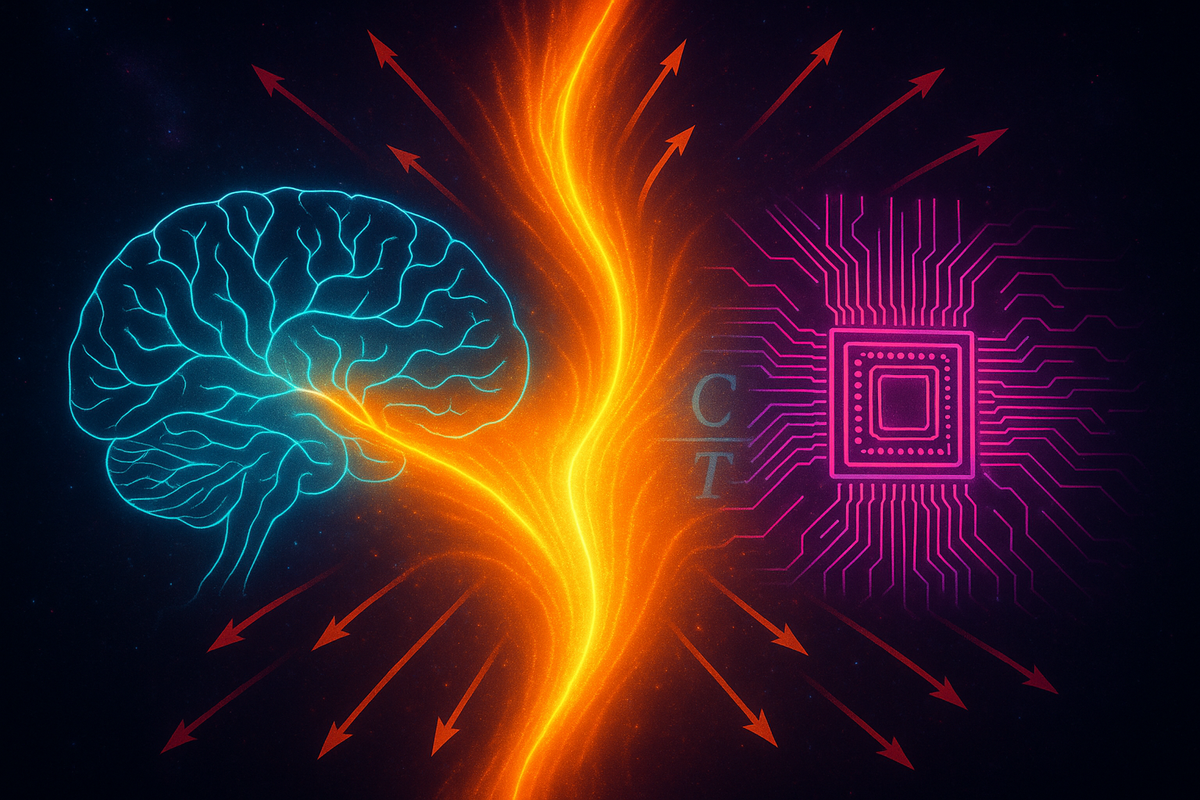
Synthesis: Intelligence Is Expensive
We've traveled from the compute ceiling to Landauer's limit, from the brain's 20 watts to organoid wetware, from neuromorphic chips to nuclear plants to fusion dreams, from tungsten mines to reversible computing. Now let's pull it together.
What have we learned about the relationship between intelligence and energy?
The answer is both humbling and illuminating: intelligence is expensive because coherence is expensive. Maintaining organized, complex states against the tendency toward disorder—the very definition of what minds do—requires constant energy input. This isn't a bug in how we build AI. It's a feature of what intelligence is.
The Core Insight
Every computing system—biological or artificial—is fighting entropy.
The second law of thermodynamics says entropy increases. Order decays. Information degrades. Complex structures fall apart. Left alone, everything moves toward equilibrium, toward uniformity, toward the same featureless grayness.
Intelligence is the opposite. Intelligence creates and maintains distinctions. It represents information. It builds models of the world. It preserves order against the entropic tide.
This work costs energy. There's no way around it. The universe charges rent for complexity, and the rent is paid in joules.
Landauer's limit quantifies the minimum cost: every bit erased releases kT ln(2) of heat. But that's just the floor. Real systems dissipate far more because they operate fast, use redundancy for reliability, and run architectures optimized for speed rather than efficiency.
The brain shows what's achievable: 20 watts for general intelligence, operating perhaps a million times more efficiently than current AI systems. Biology proves that the gap between theory and practice can be narrowed dramatically.
But even the brain is expensive. It consumes 20% of the body's energy for 2% of its mass. Evolution optimized ruthlessly for metabolic efficiency because calories were life or death. The brain we have is the result of millions of years of pressure to think more per calorie.
Intelligence didn't evolve to be free. It evolved to be worth its cost.
The Landscape of Solutions
Throughout this series, we've explored attempts to address the energy constraint. They fall into three categories:
Make computation more efficient. Neuromorphic chips, biological computing, sparsity, better algorithms. These approaches reduce the energy required per unit of intelligence. They don't eliminate the cost; they lower it.
The brain shows this is possible. Biology achieves efficiency gains of 10⁶ or more over current silicon. Neuromorphic approaches get 10² to 10³. Plenty of room remains between current practice and biological benchmarks.
Reversible computing shows the theoretical ultimate: computation approaching zero energy, at the cost of infinite time. We won't get there, but we can move toward it. The gap between Landauer's limit and current chips is 10¹¹—an enormous space for improvement.
Get more energy. Nuclear plants, fusion reactors, new renewable installations. These approaches increase supply rather than reducing demand. If you can't lower the price, earn more money.
AI is already driving this. Tech companies are signing nuclear deals, investing in fusion startups, and building power infrastructure. The AI industry is becoming an energy industry because it has no choice.
Energy supply can scale. Nuclear provides gigawatts. Fusion, if it works, provides essentially unlimited energy. The constraint isn't physical impossibility; it's time, capital, and political will.
Accept the constraint. Plateau. Optimize within limits. Don't build models that require more energy than available. This is the pessimistic scenario, but it's not catastrophic. Humanity has always operated within energy constraints. We'd just operate within different ones.
Acceptance might not mean stagnation. Even with limited energy, algorithmic improvements could continue. More efficient use of existing compute could yield capability gains. The curve could flatten without stopping.
The Coherence Connection
Why does intelligence cost energy? The deeper answer connects to the concept of coherence—a recurring theme across ideasthesia.
Coherence is the maintenance of organized, integrated states over time. A coherent system has parts that work together, that maintain structure, that resist dissolution into randomness.
Brains are coherent systems. They maintain patterns of activity that represent the world, integrate information across domains, and produce coordinated behavior. This coherence isn't free—it requires constant energy to sustain.
AI systems are coherent in the same sense. A trained neural network maintains billions of parameters in particular configurations. These configurations represent learned patterns. Running inference means propagating signals through this organized structure.
The energy cost of intelligence is the energy cost of coherence. Both AI and biological minds are coherence-maintaining engines, using energy to fight entropy and preserve order.
This connects to the formula we've explored elsewhere: M = C/T, where meaning scales with coherence over time (or tension). Meaningful states are coherent states. And coherent states are expensive states. Intelligence generates meaning by expending energy.
The compute ceiling isn't just an engineering problem. It's a manifestation of fundamental physics: the thermodynamic cost of being something rather than nothing, of maintaining pattern rather than dissolving into noise.
What the Future Holds
Where does this leave us? Several scenarios seem plausible:
Scenario 1: Efficiency breakthroughs. Neuromorphic, biological, or novel computing approaches achieve 100-1000x efficiency gains over current AI hardware. Combined with algorithmic improvements, this allows AI scaling to continue for decades without hitting energy walls. The constraint loosens enough to not bind.
Scenario 2: Energy abundance. Fusion works. Small modular reactors proliferate. Renewable + storage scales massively. Energy becomes cheap and abundant. AI scales by accessing more power rather than using less per operation. The constraint is overwhelmed by supply.
Scenario 3: Managed plateau. Neither efficiency nor supply improves enough. AI capability levels off at some point determined by practical energy limits. Progress shifts from "more compute" to "smarter use of existing compute." The field matures rather than expands indefinitely.
Scenario 4: Prioritization. Society decides AI is valuable enough to dedicate large fractions of energy production to it—or decides it isn't. Political and economic choices determine how much of the energy budget goes to intelligence versus other uses. The constraint becomes social rather than physical.
These scenarios aren't mutually exclusive. Different regions might follow different paths. Different timescales matter for different scenarios. The 2030s might look like Scenario 4; the 2050s might look like Scenario 2.
What's certain is that energy will remain central to AI's development. The compute ceiling is real. The solutions are various. The physics is non-negotiable.
The Through-Line
Let me state the thesis plainly:
Intelligence—the ability to create and maintain complex, meaningful representations of the world—is a thermodynamic achievement. It requires energy to operate and energy to sustain. This isn't a limitation to be overcome; it's a fundamental feature of what intelligence is.
The brain figured this out long ago, optimizing for efficiency under caloric constraint. Silicon is learning the same lesson now, under economic constraint. The competitive pressure differs; the physics is identical.
This insight reframes how we think about AI development. Progress isn't just about algorithms and architectures. It's about energy—where it comes from, how efficiently we use it, and what we're willing to spend for intelligence.
Every AI model is a little sun in reverse: where the sun releases energy by fusing simple elements into complex ones, AI releases complexity by consuming energy. Both processes are thermodynamic. Both are subject to physical law.
The Deeper Pattern
Step back further and a civilizational pattern emerges.
Every leap in human capability has been an energy leap:
- Fire freed calories for brain growth. - Agriculture freed labor for specialization. - Fossil fuels freed power for industrialization. - Electricity freed energy for computation.
Now AI demands the next leap. The compute ceiling is forcing the question: where does the energy come from to power machine intelligence?
The answers—nuclear, fusion, efficiency gains, new paradigms—are various. But the pattern is consistent: intelligence scales with energy. This was true for human intelligence, constrained by calories. It's true for machine intelligence, constrained by watts.
This isn't determinism. Energy enables but doesn't guarantee intelligence. Many factors matter. But energy is necessary if not sufficient. Without adequate power, intelligence doesn't happen.
The story of intelligence—biological and artificial—is partly the story of energy. Understanding one requires understanding the other.
This pattern suggests something important: the AI energy crisis isn't a detour from progress—it's progress taking its familiar form. Every previous energy transition faced resistance, required investment, and took time. The current crisis is the same challenge in new clothing.
The optimistic read: we've overcome energy constraints before and will again. Fire, agriculture, fossil fuels, nuclear—each seemed insurmountable until it wasn't. Fusion or radical efficiency gains could do the same.
The cautionary read: each energy transition took decades or centuries. AI's timescales are years. The mismatch between how fast AI wants power and how fast power systems change is the core tension.
The Meaning of the Constraint
Why does any of this matter beyond the engineering?
Because the energy constraint reveals something about what intelligence fundamentally is. Not software running on arbitrary hardware. Not pure information processing. But physical achievement—atoms arranged to maintain pattern, energy flowing to sustain coherence, thermodynamic work producing meaning.
The compute ceiling isn't just a practical limit. It's a window into the nature of mind itself.
When we ask "why is AI expensive?" we're asking "why is thinking expensive?" The answer—because coherence requires energy, because order fights entropy, because complexity costs—applies to all minds, not just silicon ones.
This connects AI to biology to physics to philosophy. The questions are: What can minds do within physical limits? What do those limits tell us about what minds are? How do we build intelligence that respects rather than ignores physical reality?
The compute ceiling forces these questions. That might be its deepest contribution—not the constraint itself, but the understanding the constraint provokes.
Conclusion: Intelligence Costs
We started this series with a simple observation: AI is expensive to run. We end with a deeper claim: intelligence is inherently expensive, because coherence is inherently expensive, because fighting entropy requires work.
This doesn't mean despair. The gap between current practice and physical limits is enormous. Biology shows what's achievable within those limits. New energy sources could expand the limits themselves.
But it means respect for the constraint. Energy isn't a trivial detail to be assumed away. It's central to what intelligence is and what it can become. Every mind—biological or artificial—operates on a power budget. How that budget is allocated, expanded, and optimized shapes what minds can do.
The compute ceiling is made of physics. We can engineer around it, dig under it, pile resources over it. But we can't make it disappear. Intelligence will always cost something. The question is how much we're willing to pay.
Thinking costs. Intelligence is expensive. This is not a flaw to be fixed but a feature to be understood.
The universe doesn't give away complexity for free. It charges in joules. Every thought, every model, every flash of understanding pays the price.
That we pay it anyway—that evolution and engineering both invest heavily in minds—suggests intelligence is worth the cost. The universe may be stingy with coherence, but coherence is valuable enough to pursue.
The compute ceiling is a reminder of this truth. Intelligence emerges from energy, constrained by physics, achieved through work. There's no shortcut. There's only the ongoing effort to think better per joule, to power more thoughts with available watts, to earn enough energy to support the minds we want to build.
The ceiling is real. The work continues.
Further Reading
- Sterling, P., & Laughlin, S. (2015). Principles of Neural Design. MIT Press. - Landauer, R. (1961). "Irreversibility and Heat Generation in the Computing Process." IBM Journal of Research and Development. - Smil, V. (2017). Energy and Civilization: A History. MIT Press.
This concludes the Intelligence of Energy series. For related exploration of how coherence shapes mind and meaning, see the [AToM Framework](/atom-framework/) series.


Comments ()