Jared Diamond: Why Societies Choose to Fail
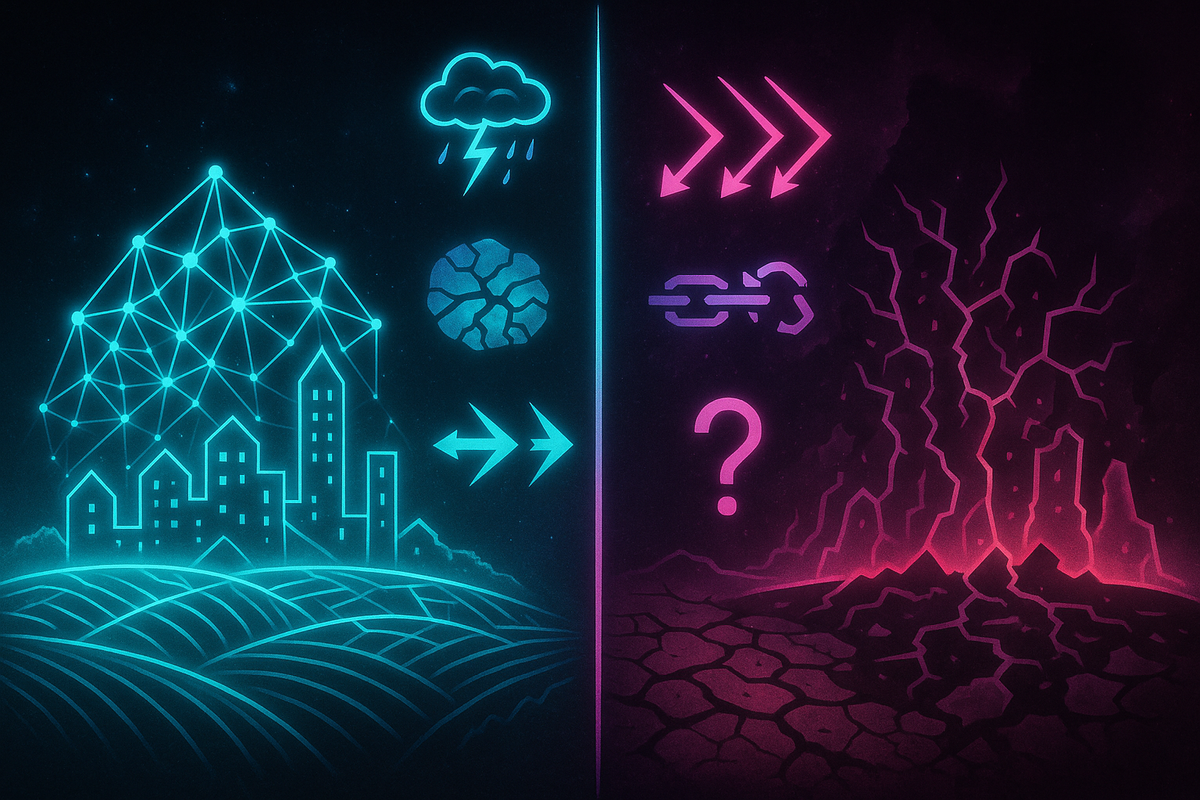
Jared Diamond studied twelve collapsed civilizations and found a consistent pattern: environmental degradation, climate shift, hostile neighbors, trade collapse, and — crucially — political choices that made decline irreversible.
Jared Diamond: Why Societies Choose to Fail
At some point, someone cut down the last palm tree on Easter Island.
Think about that for a moment. The island had been forested when Polynesians first arrived. Over centuries, the trees disappeared—cut for firewood, for construction, for the log rollers that moved those famous statues. By the time Europeans showed up in 1722, Easter Island was treeless. A few thousand impoverished people lived among giant stone heads they could no longer explain or move.
But here's what haunts me: that last tree didn't fall in a storm. Someone chose to cut it. They could see it was the last one. The stumps of every other palm were visible across the island. And still, someone raised an axe.
What was that person thinking?
This question sits at the heart of Jared Diamond's Collapse (2005), one of the most widely read books on civilizational failure. His argument is uncomfortable: societies don't just fail from external pressures. Sometimes they choose to fail—not consciously, not deliberately, but through a series of decisions that each made sense in the moment and summed to collective suicide.
Diamond is interested in what makes a society look at its own destruction and keep going.
The Five-Factor Framework
Diamond identified five factors that contribute to societal collapse:
Environmental damage. Self-inflicted wounds. Deforestation, soil erosion, water depletion, overfishing, species extinctions. Societies degrading the resource base they depend on.
Climate change. Natural shifts the society didn't cause but must survive. Droughts, floods, temperature changes. Not your fault, but absolutely your problem.
Hostile neighbors. External pressure. Weakened societies become targets. The barbarians don't cause collapse—they exploit it.
Decreased support from trading partners. Dependency creates vulnerability. If your survival depends on imports from elsewhere, and elsewhere has problems, so do you.
The society's response. How it perceives the other four factors and what it does about them.
The first four are circumstances. The fifth is agency. And Diamond's central argument is that while circumstances matter enormously, response matters more.
Two societies facing identical pressures can make different choices. One adapts. One doesn't. Why?
Easter Island: The Standard Story
Easter Island is Diamond's most famous case—and his most controversial.
The island sits alone in the Pacific, 2,300 miles from Chile, 1,300 miles from the nearest inhabited island. Polynesians settled it around 1200 AD. Over the following centuries, they developed a distinctive culture centered on the moai—those massive stone statues that have become symbols of mysterious lost civilizations.
The moai required wood. Lots of it. The statues were carved in quarries, then transported across the island on log rollers and erected on stone platforms. The largest weighed over 80 tons. Moving them without metal tools or wheels demanded enormous quantities of logs.
The island's palm forest provided the logs. It also provided canoes for fishing, wood for houses, fuel for cooking, erosion control for gardens. The trees were essential.
And the trees disappeared.
Pollen cores show the deforestation was gradual—generations of trees cut faster than they regenerated. The statue-building intensified even as the forest shrank. The clans that controlled the quarries competed to build larger, more impressive moai. The competition accelerated the extraction.
By the time the last trees were gone, so was the ability to build canoes, which meant the end of offshore fishing, which meant protein scarcity. The soil, no longer stabilized by roots, eroded. Crop yields fell. The population crashed. Violence increased. When Europeans arrived, they found an impoverished remnant amid monuments to a vanished prosperity.
Diamond's interpretation: Easter Island is a parable. An isolated society that destroyed its own foundation in plain sight, driven by competitive dynamics that nobody could stop even as everyone watched the forest shrink.
What Was That Person Thinking?
This is where Diamond gets psychologically interesting.
How do you cut down the last tree? Several mechanisms:
Creeping normalcy. Forest loss was gradual. Each generation saw slightly fewer trees than the one before. What counted as "normal" degraded over decades. By the time the last tree stood alone, the memory of forests was a distant story told by old people.
Landscape amnesia. The people who remembered different conditions died. Their knowledge wasn't transmitted. The degraded state became the only state anyone knew.
Rational individual action. For the person cutting that last tree, the logic was probably simple: I need firewood tonight. The tree is here. My family is cold. One more tree won't matter—and anyway, someone else will cut it if I don't.
Competition traps. The clan that stopped building statues would lose status to clans that continued. Unilateral restraint meant unilateral loss. Even if everyone knew the forest was dying, no one could afford to be first to stop.
Short-term vs. long-term. The firewood burns tonight. The collapse happens in fifty years. Humans discount the future. The immediate need outweighs the abstract long-term consequence, even when the long-term consequence is extinction.
Coordination failure. Even if every clan agreed the trees should be preserved, who enforces it? What mechanism coordinates restraint? Easter Island had no overarching authority that could impose collective limits. The commons was unmanaged.
These aren't failures of intelligence. Easter Islanders weren't stupid. They were caught in structural traps that intelligent people don't easily escape—traps we should recognize because we're in many of them right now.
Norse Greenland: Cultural Suicide
Diamond's most psychologically revealing case might not be Easter Island. It might be Norse Greenland.
The Norse colonized Greenland around 985 AD, establishing settlements that lasted over 400 years. Then they vanished. By 1450, the settlements were abandoned. The Norse were gone—dead or fled—while the Inuit who lived nearby survived and even thrived.
Same environment. Same climate shift (the Medieval Warm Period ending, the Little Ice Age beginning). Radically different outcomes.
Why did the Inuit survive while the Norse died?
The Inuit were Arctic specialists. They hunted seals and whales. They used kayaks and harpoons. They wore furs. Their entire culture was adapted to cold, ice, and marine mammals.
The Norse were European farmers transplanted to the edge of viability. They raised cattle and sheep. They grew hay. They built churches. They maintained their identity as Christian Europeans, even as that identity became progressively more maladaptive.
Here's what's remarkable: the Norse refused to adopt Inuit technologies. Archaeological evidence shows minimal borrowing between the cultures. The Norse knew the Inuit existed. They knew the Inuit survived. They apparently chose not to learn from them.
Why?
Diamond speculates: cultural identity. The Norse were Christian Europeans. They defined themselves against the pagan Inuit. Adopting Inuit ways would mean becoming something other than Norse—abandoning the very identity that made life meaningful.
There's archaeological evidence that Norse Greenlanders avoided eating fish—a low-status food in Norse culture—even during periods of severe food stress. They maintained status hierarchies and church construction even as their situation deteriorated. They kept being Norse right up until they stopped being alive.
The Inuit, facing the same cooling, thrived. The Norse, with their churches and cattle and rigid cultural identity, disappeared.
The Choice Architecture of Failure
Diamond's framework suggests that "choosing to fail" isn't about a single decision. It's about the architecture of choices—how decisions are structured, who makes them, what information is available, what incentives apply.
Elite decision-making. In stratified societies, the people making decisions often aren't the people suffering consequences. The chiefs who ordered statue construction weren't the workers quarrying stone. The lords maintaining Greenland's churches weren't the farmers starving through winter. Elites can insulate themselves from degradation—for a while. By the time elite interests align with collective survival, it may be too late.
Sunk costs. The Norse had invested generations in cattle farming, in churches, in European-style agriculture. Walking away meant admitting all that investment was wasted. Psychologically, economically, culturally—the pull of sunk costs made adaptation almost impossible.
Collective action problems. Even when individuals see the problem, they can't solve it alone. The Easter Island clan that stopped cutting would just lose to clans that continued. The Norse family that adopted Inuit ways would become social outcasts. Individual rationality traps you in collective irrationality.
Time horizons. Political leaders face elections, famines, and wars on timescales of years. Environmental degradation operates on timescales of decades or centuries. The incentive structures don't align. The problems that kill you eventually don't get prioritized over the problems that threaten you immediately.
Status quo bias. Humans have a deep tendency to prefer existing arrangements, even bad ones. The known degradation feels less threatening than unknown adaptation. "The devil you know."
The Societies That Didn't Fail
Diamond's argument gains power from his counter-examples—societies that faced similar pressures and survived.
Tokugawa Japan. By the early 1600s, Japan faced severe deforestation. Population had grown. Timber demand exceeded supply. The trajectory looked like Easter Island's.
But Japan responded. The Tokugawa shogunate implemented forest management policies: protected zones, replanting programs, strict harvesting rules, severe penalties for violation. Within two centuries, Japan's forests had recovered. A centralized authority recognized the threat, coordinated response, and enforced compliance.
Tikopia. A tiny Pacific island, less than two square miles, that has been continuously inhabited for 3,000 years. The Tikopians developed elaborate systems of population control (including infanticide during hard times), careful resource management, and social structures that maintained sustainability across millennia. They made harsh choices early to avoid harsher outcomes later.
New Guinea highlands. Traditional societies in the New Guinea highlands developed sophisticated agricultural systems that maintained productivity over thousands of years—terracing, fallow rotation, careful tree cultivation. They avoided the soil exhaustion that destroyed other tropical agricultures.
The pattern: societies that survive have mechanisms for perceiving long-term threats, making decisions that sacrifice short-term gains, and enforcing collective action. Societies that fail lack those mechanisms.
What determines whether a society has those mechanisms? Diamond doesn't have a complete answer, but he identifies some factors: centralized authority that can impose collective solutions (like Tokugawa Japan), cultural values that prioritize long-term survival over short-term status competition, and small enough scale that feedback loops are visible (like Tikopia, where you can literally see the whole island).
The uncomfortable implication: the features that make a society successful at expansion—competitive drive, short-term optimization, decentralized decision-making—may be exactly the features that make it vulnerable to self-destruction. The qualities that help you grow might be the qualities that kill you.
The Controversy
Diamond's Easter Island narrative has been challenged. Significantly.
Recent research suggests that rats—which arrived with the first Polynesian settlers—may have played a larger role in deforestation than human cutting. Rats eat palm seeds. Without seed regeneration, the forest couldn't recover even from modest harvesting.
Other researchers argue that the population collapse came primarily after European contact—from diseases and slave raids—not from pre-contact environmental degradation. The "Easter Island parable" might be overstated.
Diamond's broader framework has been criticized too. He may select cases that fit his environmental thesis while downplaying cases that don't. He may oversimplify complex collapses into neat stories. He may project Western concepts of environmental management onto societies that understood their situations very differently.
These criticisms have merit. The specific claims about Easter Island continue to be debated. Diamond may have told a cleaner story than the evidence supports.
But the core insight survives: societies can and do make choices that destroy their own foundations. The mechanisms exist—creeping normalcy, sunk costs, elite insulation, coordination failure, cultural rigidity. Whether Easter Island perfectly exemplifies them, the mechanisms are real.
The Contemporary Mirror
Diamond ends Collapse by applying his framework to modern industrial civilization.
The parallels he draws: climate change (degrading a global commons), soil depletion (unsustainable agriculture), water scarcity (aquifer depletion), biodiversity loss (ecosystem degradation). Environmental problems at scales Easter Island's chiefs couldn't have imagined, on timescales that exceed political attention spans.
We're cutting the trees. We can see the forest shrinking. The models show where it ends.
The optimistic case: we have capabilities past societies lacked. Scientific monitoring. Global communication. International institutions. Technology that can substitute for depleted resources.
The pessimistic case: we've had these capabilities for decades. The forest is still shrinking.
Diamond doesn't resolve this. He asks whether we're Easter Island—locked in competitive dynamics that nobody can stop—or Tokugawa Japan—capable of recognizing threats and coordinating response.
The answer isn't determined. It depends on choices that haven't been made yet.
But here's what Diamond's framework makes clear: the failure mode isn't mysterious. It's not incompetence or malevolence. It's intelligent people, making reasonable decisions, within structures that aggregate those decisions into catastrophe.
The Easter Islander who cut the last tree wasn't evil. They were cold, or hungry, or trying to support their family. They were doing what anyone would do in their position. And that's exactly the point.
The scariest thing about Diamond's analysis isn't that societies sometimes make bad choices. It's that the bad choices often don't feel bad. They feel normal. They feel necessary. They feel like there's no alternative.
The question Diamond leaves you with isn't "are we smarter than Easter Islanders?" We're not. Intelligence isn't the variable. The question is whether we have mechanisms—institutions, technologies, cultural practices—that can override the structural traps that intelligence alone cannot escape.
Do we?
Further Reading
- Diamond, J. (2005). Collapse: How Societies Choose to Fail or Succeed. Viking. - Diamond, J. (2019). Upheaval: Turning Points for Nations in Crisis. Little, Brown. - Hunt, T.L. & Lipo, C.P. (2011). The Statues That Walked: Unraveling the Mystery of Easter Island. Free Press.
This is Part 3 of the Collapse Science series. Next: "[EROI: The Number That Runs Everything](/eroi-energy-collapse/)."



Comments ()