Kardashev Scale: Civilizations as Energy Consumers
Nikolai Kardashev's 1964 framework for classifying civilizations by energy use was meant for SETI research. It accidentally became one of the sharpest lenses we have for understanding where humanity actually stands in the cosmos.
Kardashev Scale: Civilizations as Energy Consumers
In 1964, Soviet astronomer Nikolai Kardashev asked a simple question: if we're searching for extraterrestrial intelligence, what should we look for?
His answer: power consumption.
A sufficiently advanced civilization, Kardashev reasoned, would be detectable by its energy signature. Civilizations don't just think and communicate—they transform energy. And the more advanced they are, the more energy they transform. The scale of a civilization is the scale of its power consumption.
This idea—classifying civilizations by their energy use—turns out to be one of the most clarifying frameworks for thinking about where humanity stands and where it might go.
The Three Types
Kardashev proposed three types of civilization:
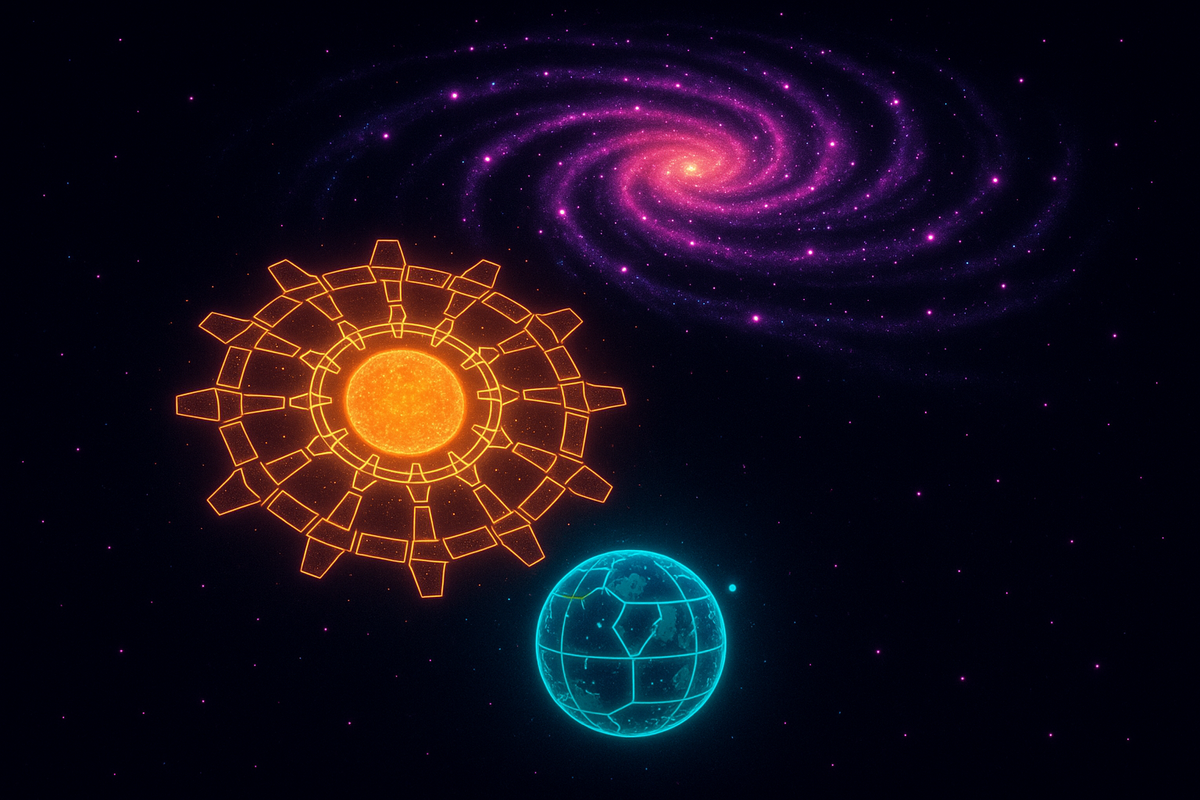
Type I: A civilization that harnesses all the energy available on its home planet. For Earth, this means capturing the full 174 petawatts of solar energy hitting our atmosphere, plus whatever geothermal and tidal energy is available. Total: roughly 10^17 watts.
Type II: A civilization that harnesses the full energy output of its home star. The Sun emits about 3.8 × 10^26 watts. A Type II civilization would capture most or all of this—perhaps with a Dyson sphere or swarm of collectors surrounding the star.
Type III: A civilization that harnesses the energy of its entire galaxy. The Milky Way contains about 100 billion stars. A Type III civilization would somehow tap into them all—roughly 10^37 watts.
Each step is a factor of roughly 10 billion increase in power consumption. The scale is not arithmetic but logarithmic. Type II is to Type I as Type I is to a campfire.
Where does humanity stand? We currently consume about 18 terawatts (1.8 × 10^13 watts) of primary energy globally. That puts us at roughly Type 0.73 on an extended Kardashev scale.
We're not even Type I yet. We haven't mastered our own planet's energy budget.
Why Energy Is the Right Metric
You could classify civilizations by many things: population, territory, knowledge, military power, cultural sophistication. Why energy?
Because energy is the currency of transformation. Everything a civilization does—build, move, compute, communicate—requires energy. More energy means more capacity to do things. Energy is the common denominator underlying every other measure of capability.
Knowledge without energy is impotent. You can know how to build a starship, but without enough energy, you can't build it. You can have the algorithm for general AI, but without power to run the data centers, it remains theoretical.
Population doesn't scale capabilities directly. A billion people with medieval technology are less capable than a million with modern technology. What amplifies human capability is available energy per capita.
Territory is meaningless without access. Controlling a vast area means nothing if you can't extract resources, transport goods, or project power. All of which require energy.
Energy is also measurable, comparable across contexts, and governed by hard physical limits. The laws of thermodynamics apply equally to alien civilizations and human ones. Energy is the objective substrate beneath the subjective categories we typically use.
This is why astronomers looking for extraterrestrial intelligence think in Kardashev terms. They're not searching for radio broadcasts of alien philosophy. They're searching for infrared signatures—waste heat from massive energy transformation. A Type II civilization would produce a detectable thermal glow.
The Transitions
The gaps between Kardashev types are vast, but even partial progress matters.
From our current ~0.73 to Type I (~1.0) requires roughly a 60-fold increase in energy consumption. If we maintained the 20th century's growth rate (about 2% per year), we'd reach Type I in about 200 years.
This transition involves capturing essentially all the solar energy hitting Earth—through solar panels, or orbital collectors, or some future technology. It means harnessing fully the geothermal, tidal, and nuclear energy available. It probably requires fusion power, since fission fuels are limited.
A Type I civilization has no energy scarcity on its home planet. All environmental and resource constraints become engineering problems with known solutions. Climate change, for instance, becomes a trivially solvable problem when you have 10^17 watts at your disposal.
From Type I to Type II requires capturing stellar output, not just planetary input. This is a qualitative leap: from living on what falls on your planet to harvesting what the star emits. It requires megastructures on astronomical scales—probably built by self-replicating robotic systems, since no biological workforce could construct them.
A Type II civilization has essentially unlimited energy for any conceivable planetary-scale project. It could move planets, terraform worlds, run computations at scales we can barely imagine. Interstellar travel becomes energetically feasible.
Type III is almost beyond coherent speculation. Harnessing a galaxy's energy output means controlling billions of stellar systems, coordinating across distances measured in tens of thousands of light-years. The lag times alone make Type III civilizations conceptually strange to think about.
What Energy Enables
Each Kardashev transition doesn't just mean "more power." It enables qualitatively new capabilities.
Type I capabilities: - Complete control of planetary weather and climate - No energy poverty anywhere on the planet - Computation at scales sufficient for comprehensive planetary simulation - Industry that recycles everything—entropy is managed, not surrendered to - Near-indefinite energy storage, smoothing all production/consumption mismatches
Type II capabilities: - Interstellar travel (the energy required to accelerate starships is immense) - Dyson-scale engineering—building structures at the scale of solar systems - Computation potentially sufficient for uploading or simulating entire civilizations - Time horizons extending to stellar lifespans (billions of years) - Relocation if the home star becomes problematic
Type III capabilities: - Galactic-scale coordination (requiring either faster-than-light communication or distributed patience) - Engineering the galaxy's structure—reshaping stellar neighborhoods - Computational power that's hard to even characterize - Effective immortality as a civilization (distributed across enough systems that no single catastrophe can end it)
Notice that each level makes the previous level's problems trivial. A Type I civilization looks at climate change the way we look at firewood shortages. A Type II civilization looks at planetary disasters the way we look at local weather.
The Great Filter Perspective
The Kardashev scale has a disturbing implication: if civilizations naturally progress through these stages, where are they?
The Milky Way is 13 billion years old. It would take a Type III civilization perhaps a few million years to colonize the entire galaxy—assuming expansion at even a fraction of the speed of light. Millions of years is a blip in cosmic time. Any civilization that started a few million years before us should have filled the galaxy by now.
Yet we see no evidence of Type III civilizations. No galaxy-spanning infrared signatures. No clearly artificial structures. The silence is called the Fermi Paradox.
The Kardashev framing suggests a "Great Filter" somewhere in the progression from dead matter to Type III civilization. Either it's extremely rare for intelligence to arise at all, or it's extremely difficult to transition between Kardashev levels, or Type III civilizations choose to be undetectable for reasons we don't understand.
One uncomfortable possibility: the filter is ahead of us, not behind us. Perhaps many civilizations reach Type 0.7 or so and then destroy themselves—through nuclear war, environmental collapse, or some technology we haven't invented yet. The very capabilities that could lift a civilization to Type I might instead be turned inward.
We're the only data point we have. We can't know if our trajectory is typical or exceptional. But the Kardashev framework at least lets us ask the question precisely: what prevents civilizations from climbing the energy ladder?
Energy and Meaning
Here's where the Kardashev scale connects to the series we've been building.
Every energy transition in human history—fire, agriculture, fossil fuels, electricity—has expanded what humans could do and think. More energy means more surplus. More surplus means more people freed from subsistence labor. More non-subsistence people means more specialists, more innovations, more cultural elaboration.
The Kardashev scale extends this logic to cosmic timescales.
If meaning requires minds, and minds require energy, then the capacity for meaning scales with energy availability. A Type II civilization can support more minds, more complex thoughts, more elaborate cultures than a Type I. A Type III civilization, more still.
This isn't to say that energy is meaning. But energy is the substrate on which meaning becomes possible. More energy creates more room for whatever meaning-making civilizations might do.
The inverse is also true: energy decline means meaning decline. A civilization falling down the Kardashev ladder—losing energy capacity—loses the ability to maintain its complexity. This is what collapse looks like from an energy perspective: not running out of ideas, but running out of the capacity to implement them.
Where We Stand
Humanity at Type 0.73 is a species still climbing out of its cradle.
We've mastered fire, agriculture, and fossil fuels. We've begun harnessing nuclear power. We're rapidly deploying solar and wind. The pieces for reaching Type I are visible, even if the assembly is incomplete.
The challenges are obvious: climate change threatens to destabilize the systems that enable current energy consumption. Resource conflicts could waste energy on destruction rather than construction. Short-term thinking could prevent the long-term investments Type I requires.
But the opportunity is also clear. This is the transition generation. The choices made in the next few decades will determine whether humanity continues climbing or stalls—or worse.
The Kardashev scale provides perspective. Our political conflicts, our economic anxieties, our cultural debates—these matter, but they're happening within a much larger context. The question isn't just whether we'll have clean energy or fossil fuels. It's whether we'll complete the transition to planetary-scale civilization or join whatever list of species that tried and failed.
The next article looks at the specific technologies that could enable this transition: fusion, advanced fission, and scaled solar. The path to Type I isn't theoretical anymore. The physics is understood. What remains is engineering, economics, and will.
Further Reading
- Kardashev, N. (1964). "Transmission of Information by Extraterrestrial Civilizations." Soviet Astronomy. - Dyson, F. (1960). "Search for Artificial Stellar Sources of Infrared Radiation." Science. - Sagan, C. (1973). "On the Detectability of Advanced Galactic Civilizations." Icarus.
This is Part 8 of the Energy of Civilization series. Next: "[Back to the Future: Fusion, Fission, and Solar](/energy-future-fusion-solar/)."



Comments ()