Applications: Why Linear Algebra Runs the Modern World
Linear algebra isn't just abstract math — it's the computational backbone of machine learning, computer graphics, physics simulations, and economics. Here's why it runs everything.
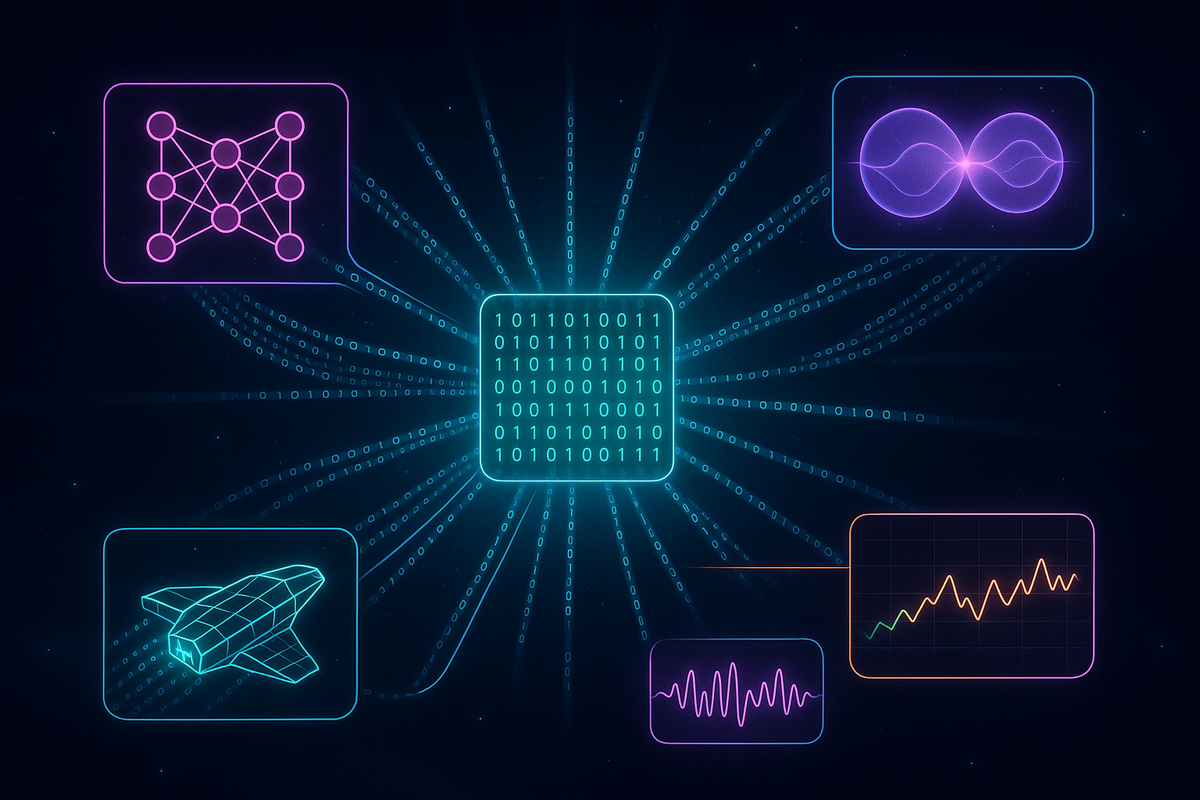
You've learned the machinery. Now see what it builds.
Linear algebra isn't abstract mathematics that occasionally touches reality. It's the computational substrate of modern civilization. Machine learning, computer graphics, quantum mechanics, economics, signal processing—all linear algebra, all the way down.
This isn't metaphor. These systems literally compute matrix multiplications, find eigenvalues, solve linear systems. The mathematics you've learned is the mathematics they run on.
Machine Learning: Matrices All the Way Down
A neural network is a sequence of matrix multiplications with nonlinear functions between them.
That's it. That's the secret.
The Forward Pass:
Each layer of a neural network computes: output = activation(W × input + b)
Where W is a weight matrix, b is a bias vector, and activation is a nonlinear function like ReLU or sigmoid.
The weight matrix W transforms input vectors into output vectors. Training adjusts W so these transformations produce useful results.
A network with three hidden layers of sizes 512, 256, 128 is doing matrix multiplications:
- 784 × 512 matrix (input to first hidden)
- 512 × 256 matrix (first to second)
- 256 × 128 matrix (second to third)
- 128 × 10 matrix (third to output)
That's over 600,000 matrix entries. Training finds values that make the network recognize digits, translate languages, or generate images.
The Backward Pass:
Gradient descent—how networks learn—is linear algebra too. The gradient is a vector of partial derivatives. Backpropagation computes gradients by chain rule, which reduces to matrix multiplications with transposed weight matrices.
Why It Works:
Linear transformations are differentiable. Differentiable operations can be optimized by gradient descent. The nonlinear activations add expressiveness; the linear transformations make it trainable.
Modern AI is linear algebra plus a little nonlinearity, computed at massive scale.
Computer Graphics: Transforming Worlds
Every 3D object you see on a screen got there through matrix multiplication.
The Graphics Pipeline:
A 3D model is a collection of vertices—points in space. Each vertex is a 3D vector (x, y, z). To display the model:
- Model transform: Place the object in the world (translate, rotate, scale)
- View transform: Move everything relative to camera position
- Projection transform: Flatten 3D to 2D screen coordinates
- Viewport transform: Map to actual screen pixels
Each step is a matrix multiplication. Compose them all into a single matrix M, and every vertex v becomes Mv on your screen.
Homogeneous Coordinates:
A trick: add a fourth coordinate w. Points become (x, y, z, 1). Now translation—which isn't linear—becomes a matrix multiplication:
[1 0 0 tx] [x]   [x + tx]
[0 1 0 ty] [y] = [y + ty]
[0 0 1 tz] [z]   [z + tz]
[0 0 0 1 ] [1]   [  1   ]
Rotation, scaling, shearing, translation, perspective projection—all become 4×4 matrices. All composable by multiplication.
GPU Acceleration:
Graphics cards are designed for one thing: parallel matrix multiplication. Thousands of cores, each doing the same operation on different data. This is why GPUs train neural networks so well—they're linear algebra machines.
Quantum Mechanics: States as Vectors
Quantum mechanics is linear algebra in complex vector spaces. This isn't interpretation—it's the mathematical formalism.
States as Vectors:
A quantum state is a vector in a Hilbert space. The state of an electron's spin is a vector in ℂ². The state of a hydrogen atom is a vector in an infinite-dimensional space.
Superposition—the weird quantum thing where particles are in multiple states at once—is just vector addition: |ψ⟩ = α|0⟩ + β|1⟩ is a linear combination of basis states.
Measurements as Inner Products:
The probability of measuring a particular outcome is the squared magnitude of an inner product. ⟨φ|ψ⟩ gives the amplitude; |⟨φ|ψ⟩|² gives the probability.
Evolution as Unitary Matrices:
Time evolution is unitary transformation: |ψ(t)⟩ = U(t)|ψ(0)⟩. Unitary means U†U = I—the transformation preserves probability (vector length).
Observables as Hermitian Matrices:
Physical quantities (position, momentum, energy) are Hermitian operators. Their eigenvalues are possible measurement outcomes. Their eigenvectors are the states where that outcome is definite.
The entire formalism of quantum mechanics—states, measurements, evolution, observables—is linear algebra with complex numbers.
Economics: Input-Output Models
Wassily Leontief won the 1973 Nobel Prize for input-output analysis. It's a matrix model of an economy.
The Setup:
An economy has n sectors. Each sector produces output that becomes input for other sectors. Steel goes to automobiles, automobiles go to transportation, transportation goes to retail...
Let A be the matrix where aᵢⱼ is the amount of sector i's output needed to produce one unit of sector j's output.
If d is the vector of final demand (what consumers want), and x is total production:
x = Ax + d
Production equals intermediate demand (what sectors need from each other) plus final demand (what consumers want).
Solving the Economy:
Rearranging: (I - A)x = d
So: x = (I - A)⁻¹d
The matrix (I - A)⁻¹ is the Leontief inverse. It tells you the total production needed (including all intermediate steps) to satisfy final demand.
This is a linear system. Economics is linear algebra.
Signal Processing: Frequencies as Basis Vectors
A signal—sound, radio, image—can be decomposed into frequency components.
Fourier Transform:
Any periodic signal can be written as a sum of sines and cosines. These are basis vectors in a function space. The Fourier transform finds the coefficients—the coordinates in this basis.
In finite dimensions (digital signals), this becomes the Discrete Fourier Transform: a matrix multiplication. The DFT matrix has complex exponentials as entries.
Why It Matters:
In the frequency basis, many operations become simple. Filtering? Multiply by a diagonal matrix. Compression? Keep only the large coefficients. Convolution? Multiplication in frequency domain.
Changing basis—from time to frequency—transforms hard problems into easy ones.
FFT:
The Fast Fourier Transform computes the DFT in O(n log n) instead of O(n²). It exploits the structure of the DFT matrix. This single algorithm enables digital audio, image compression, wireless communication, and much more.
Data Science: Dimensionality Reduction
Real datasets have thousands of dimensions. Each dimension is a feature: age, income, purchase history, browsing behavior...
But often, data lies near a lower-dimensional subspace. Finding this subspace is linear algebra.
Principal Component Analysis (PCA):
Compute the covariance matrix of your data. Find its eigenvectors. These are the principal components—directions of maximum variance.
Project data onto the top k eigenvectors. You've reduced from n dimensions to k, preserving as much variance as possible.
This is eigenvalue decomposition applied to data. The eigenvectors of the covariance matrix reveal the structure.
Singular Value Decomposition (SVD):
Any matrix M can be factored: M = UΣV^T
U and V are orthogonal matrices. Σ is diagonal with singular values.
SVD is the Swiss Army knife of data analysis:
- Low-rank approximation (compression)
- Noise reduction
- Recommender systems
- Latent semantic analysis
Netflix's recommendation engine, Google's search algorithm, image compression—all use SVD.
Control Systems: Stabilizing Dynamics
A dynamical system evolves over time. Linear systems: x(t+1) = Ax(t)
Stability:
Does the system converge, diverge, or oscillate? Check the eigenvalues of A.
- All eigenvalues inside unit circle → stable (converges to zero)
- Any eigenvalue outside unit circle → unstable (diverges)
- Eigenvalues on unit circle → neutral (oscillates)
Eigenvalue analysis tells you system behavior without simulating.
Controllability:
Can you steer the system to any state? Check if the controllability matrix [B AB A²B ... Aⁿ⁻¹B] has full rank.
Observability:
Can you determine internal state from outputs? Check if the observability matrix has full rank.
Aircraft autopilots, industrial processes, power grids—all designed using linear algebra of dynamical systems.
Cryptography: Linear Algebra Over Finite Fields
Modern cryptography uses linear algebra in unexpected spaces.
Error-Correcting Codes:
Data transmitted over noisy channels gets corrupted. Error-correcting codes add redundancy so errors can be detected and fixed.
Reed-Solomon codes, used in CDs, DVDs, QR codes, are based on polynomial evaluation—which is matrix multiplication over finite fields.
Lattice Cryptography:
Post-quantum cryptography (secure against quantum computers) often uses hard problems in lattices—discrete subgroups of ℝⁿ.
Finding the shortest vector in a lattice, or the closest lattice point to a given point, are computationally hard. These problems are linear algebra in disguise.
Why Linear Algebra Everywhere?
Three reasons:
1. Linearity is the first approximation.
Near any point, any smooth function looks linear. So locally, any system is approximately linear. And linear systems we can solve.
2. Linearity composes.
Linear transformations compose via matrix multiplication. You can build complex systems from simple pieces and still analyze them.
3. Computers compute linear algebra fast.
Matrix multiplication is highly parallelizable. GPUs do it blazingly fast. The mathematics computers are best at is the mathematics we use most.
The Unifying Thread
All these applications share a common structure:
- Represent things as vectors
- Transform with matrices
- Find special directions (eigenvectors) or optimal representations (SVD)
- Solve systems or optimize
The specific context varies—pixels, quantum states, economic sectors, signals—but the mathematical operations are identical.
This is why linear algebra is worth learning deeply. Master it once, apply it everywhere. The same eigenvalue decomposition that stabilizes a control system also compresses images and reveals data structure.
Linear algebra is the common language of modern applied mathematics.
This is Part 11 of the Linear Algebra series. Next: "Linear Algebra Synthesis: The Architecture of Structure."
Part 11 of the Linear Algebra series.
Previous: Basis and Dimension: The Coordinates of Abstract Spaces Next: Synthesis: Linear Algebra as the Language of Structure-Preserving Maps
Comments ()