Linear First-Order: The Integrating Factor Method
Linear first-order differential equations look messy until you multiply both sides by the right function. That integrating factor makes the left side a perfect derivative — suddenly the equation almost solves itself.
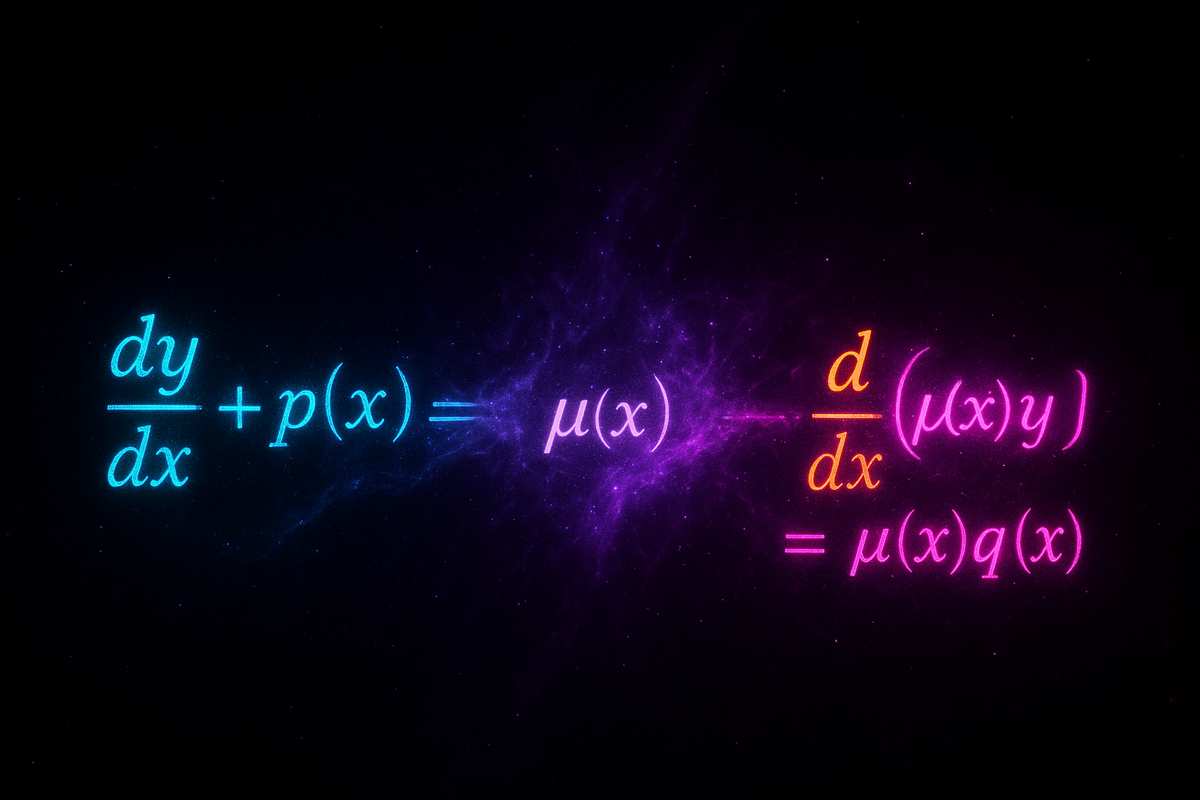
Linear first-order differential equations are everywhere. Electric circuits, mixing problems, population models with immigration, Newton's cooling with external heat sources—all linear first-order.
Standard form: dy/dx + P(x)y = Q(x)
The key word is "linear." The unknown function y and its derivative dy/dx appear to the first power only. No y², no (dy/dx)², no products like y·(dy/dx).
This linearity unlocks a systematic solution method: the integrating factor technique.
What Makes an Equation Linear
A first-order ODE is linear if it can be written as:
dy/dx + P(x)y = Q(x)
where P(x) and Q(x) are functions of x alone (or constants).
Linear examples:
dy/dx + 2y = 3 (P(x) = 2, Q(x) = 3)
dy/dx + (1/x)y = x² (P(x) = 1/x, Q(x) = x²)
dy/dx + (cos x)y = sin x (P(x) = cos x, Q(x) = sin x)
Nonlinear examples:
dy/dx + y² = x (y² makes it nonlinear)
dy/dx + xy = y(dy/dx) (product of y and dy/dx)
Linearity is structural. If y and dy/dx appear only to the first power and not multiplied together, it's linear.
Standard Form
Always convert to standard form: dy/dx + P(x)y = Q(x)
Example: x dy/dx - 2y = x³
Divide by x: dy/dx - (2/x)y = x²
Now it's in standard form with P(x) = -2/x and Q(x) = x².
Standard form makes the solution method mechanical.
The Integrating Factor Method
The idea: multiply the equation by a cleverly chosen function μ(x) that makes the left side a perfect derivative.
If dy/dx + P(x)y = Q(x), multiply by μ(x):
μ(dy/dx) + μP(x)y = μQ(x)
We want the left side to equal d/dx[μy].
By product rule: d/dx[μy] = μ(dy/dx) + (dμ/dx)y
Comparing with our equation, we need:
μP(x)y = (dμ/dx)y
So: dμ/dx = μP(x)
This is a separable equation in μ:
dμ/μ = P(x)dx
ln|μ| = ∫P(x)dx
μ(x) = e^(∫P(x)dx)
This is the integrating factor.
The Solution Process
Step 1: Write in standard form dy/dx + P(x)y = Q(x).
Step 2: Compute integrating factor μ(x) = e^(∫P(x)dx).
Step 3: Multiply equation by μ:
μ(dy/dx) + μP(x)y = μQ(x)
Left side simplifies to d/dx[μy], so:
d/dx[μy] = μQ(x)
Step 4: Integrate both sides:
μy = ∫μQ(x)dx + C
Step 5: Solve for y:
y = (1/μ)[∫μQ(x)dx + C]
Done.
Example 1: Basic Linear Equation
Solve: dy/dx + 2y = 6
Step 1: Already in standard form. P(x) = 2, Q(x) = 6.
Step 2: Integrating factor:
μ = e^(∫2 dx) = e^(2x)
Step 3: Multiply by μ:
e^(2x)(dy/dx) + 2e^(2x)y = 6e^(2x)
Left side is d/dx[e^(2x)y]:
d/dx[e^(2x)y] = 6e^(2x)
Step 4: Integrate:
e^(2x)y = ∫6e^(2x)dx = 3e^(2x) + C
Step 5: Solve for y:
y = 3 + Ce^(-2x)
General solution: y = 3 + Ce^(-2x)
As x → ∞, y → 3 (equilibrium value).
Example 2: Variable Coefficients
Solve: dy/dx + (1/x)y = 3x
Step 1: Standard form. P(x) = 1/x, Q(x) = 3x.
Step 2: Integrating factor:
μ = e^(∫(1/x)dx) = e^(ln|x|) = |x| = x (assuming x > 0)
Step 3: Multiply by μ = x:
x(dy/dx) + y = 3x²
Left side is d/dx[xy]:
d/dx[xy] = 3x²
Step 4: Integrate:
xy = ∫3x²dx = x³ + C
Step 5: Solve for y:
y = x² + C/x
General solution: y = x² + C/x
Example 3: Initial Value Problem
Solve: dy/dx - y = e^x with y(0) = 2
Step 1: Standard form. P(x) = -1, Q(x) = e^x.
Step 2: Integrating factor:
μ = e^(∫-1 dx) = e^(-x)
Step 3: Multiply by e^(-x):
e^(-x)(dy/dx) - e^(-x)y = e^(-x)·e^x = 1
Left side is d/dx[e^(-x)y]:
d/dx[e^(-x)y] = 1
Step 4: Integrate:
e^(-x)y = x + C
Step 5: Solve for y:
y = xe^x + Ce^x
Step 6: Apply initial condition y(0) = 2:
2 = 0 + C, so C = 2.
Particular solution: y = xe^x + 2e^x = e^x(x + 2)
Why It Works
The integrating factor μ(x) converts the left side into a derivative:
μ(dy/dx) + μP(x)y = d/dx[μy]
This is possible because:
d/dx[μy] = μ(dy/dx) + (dμ/dx)y
If we choose μ such that dμ/dx = μP(x), then:
d/dx[μy] = μ(dy/dx) + μP(x)y
which matches our equation after multiplying by μ.
It's a designed construction. We engineer μ specifically to collapse the left side into a single derivative, which we can then integrate directly.
Homogeneous vs Nonhomogeneous
A linear equation is homogeneous if Q(x) = 0:
dy/dx + P(x)y = 0
Homogeneous equations are separable:
dy/y = -P(x)dx
ln|y| = -∫P(x)dx + C₁
y = Ce^(-∫P(x)dx)
This is the complementary solution (also called homogeneous solution).
A linear equation is nonhomogeneous if Q(x) ≠ 0:
dy/dx + P(x)y = Q(x)
The general solution is:
y = y_c + y_p
where:
y_c= complementary solution (solution to homogeneous equation)y_p= particular solution (any solution to nonhomogeneous equation)
The integrating factor method automatically gives you the full general solution.
Example: Homogeneous Equation
Solve: dy/dx + 3y = 0
This is separable:
dy/y = -3dx
ln|y| = -3x + C₁
y = Ce^(-3x)
Alternatively, using integrating factor:
μ = e^(∫3 dx) = e^(3x)
Multiply: e^(3x)(dy/dx) + 3e^(3x)y = 0
d/dx[e^(3x)y] = 0
Integrate: e^(3x)y = C
y = Ce^(-3x)
Same answer, two methods.
Applications
RC Circuit:
Voltage across capacitor: dV/dt + V/(RC) = V_in/R
This is linear first-order. Using integrating factor with P = 1/(RC), you solve for V(t).
Mixing with Inflow/Outflow:
Tank with inflow concentration c_in and outflow concentration Q/V:
dQ/dt + (r/V)Q = r·c_in
Linear first-order in Q.
Newton's Cooling with External Heat:
dT/dt + kT = kT_a + H(t)
where H(t) is external heating. Linear in T.
All solved by integrating factor.
When Integrating Factor Gets Messy
Sometimes ∫μQ(x)dx can't be computed in elementary functions.
Example: dy/dx + y = e^(x²)
Integrating factor: μ = e^x
Multiply: d/dx[e^x y] = e^x · e^(x²) = e^(x² + x)
Integrate: e^x y = ∫e^(x² + x)dx
But ∫e^(x² + x)dx has no elementary antiderivative.
In such cases:
- Leave answer in integral form:
y = e^(-x)∫e^(x² + x)dx - Use numerical integration
- Use series methods
The method still works conceptually; it's just the integration that's hard.
Variation of Parameters
Another perspective: variation of parameters.
For homogeneous equation dy/dx + P(x)y = 0, solution is y = Ce^(-∫P dx).
For nonhomogeneous, let the "constant" vary: y = C(x)e^(-∫P dx).
Substitute into original equation and solve for C(x). This gives the same result as integrating factor but with different framing.
It's conceptually elegant: the nonhomogeneous term perturbs the constant into a function.
Reduction of Order Connection
The integrating factor method is a special case of a more general technique called reduction of order, which works for higher-order linear equations.
For first-order, it's overkill. But the underlying principle—multiplying by a function to simplify structure—extends to second-order and beyond.
Standard Mistakes
Mistake 1: Forgetting to convert to standard form before computing μ.
If equation is 2dy/dx + 4y = 6, you must divide by 2 first: dy/dx + 2y = 3.
Mistake 2: Dropping the constant of integration.
When you integrate d/dx[μy] = μQ, you get μy = ∫μQ dx + C. Don't forget +C.
Mistake 3: Not simplifying μ.
If ∫P dx = ln|x|, then μ = e^(ln|x|) = |x|. Often you can drop absolute value by choosing domain (e.g., x > 0).
Mistake 4: Misidentifying P(x) and Q(x).
In dy/dx + P(x)y = Q(x), everything multiplying y goes into P, everything else into Q.
When to Use Integrating Factor
Use integrating factor if:
- Equation is first-order
- Equation is linear (y and dy/dx to first power only)
- You can integrate
∫P(x)dxand∫μQ(x)dx
If equation is nonlinear, integrating factor won't work. You'd need other techniques (Bernoulli substitution, exact equations, numerical methods).
Summary of Method
- Write
dy/dx + P(x)y = Q(x) - Compute
μ(x) = e^(∫P(x)dx) - Multiply equation by μ
- Recognize left side as
d/dx[μy] - Integrate:
μy = ∫μQ dx + C - Solve for y
It's algorithmic. Once you identify it as linear, the method is mechanical.
Next up: second-order linear ODEs, where things get more complex but the principles extend.
Part 5 of the Differential Equations series.
Previous: Separable Equations: When Variables Can Be Pulled Apart Next: Second-Order Linear: Springs and Oscillations
Comments ()