Linear Transformations: Functions That Preserve Structure
Every matrix multiplication is secretly a transformation of space: stretching, rotating, reflecting. Linear transformations give that geometric intuition rigorous footing — and make abstract algebra suddenly visual.
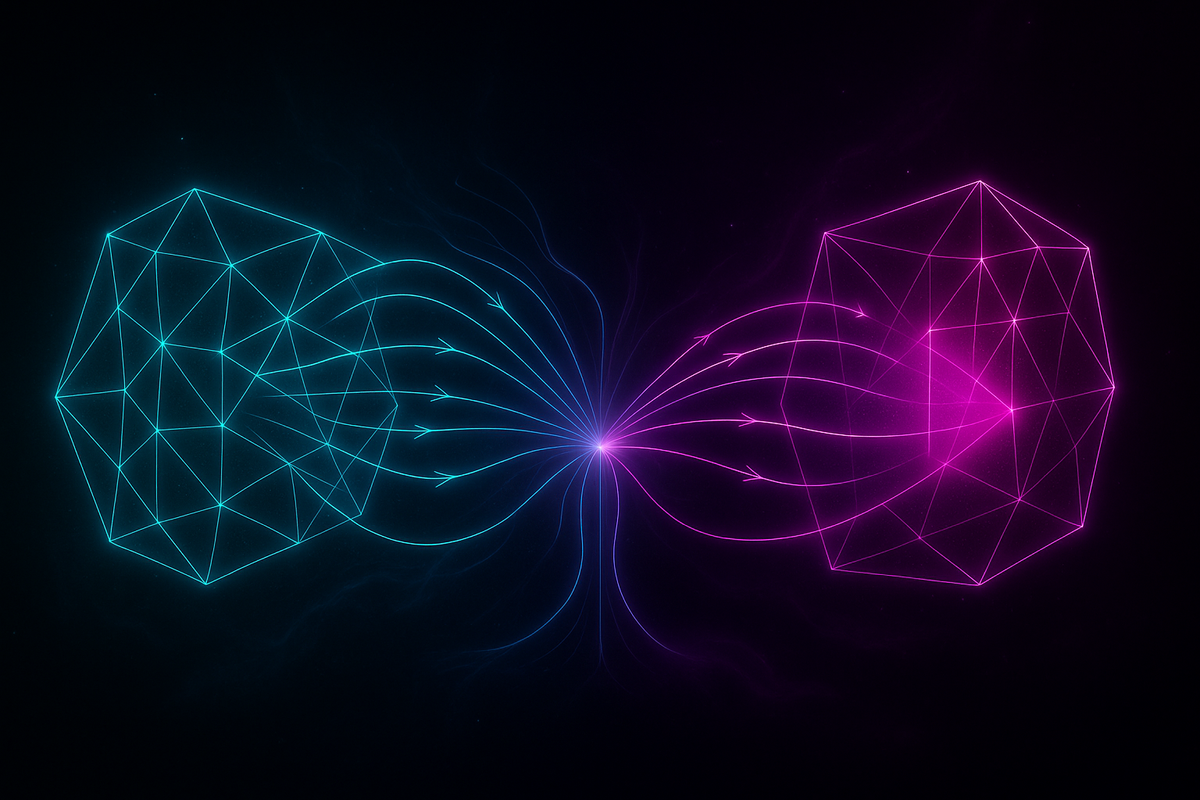
A linear transformation is a function between vector spaces that respects the vector space operations.
Add two vectors, then transform. Or transform each, then add. Same result.
Scale a vector, then transform. Or transform, then scale. Same result.
That's linearity. And it's the key property that makes transformations tractable.
The Definition
A function T: V → W between vector spaces is linear if:
- T(u + v) = T(u) + T(v) for all vectors u, v in V
- T(cv) = cT(v) for all scalars c and vectors v in V
These can be combined: T(au + bv) = aT(u) + bT(v).
The transformation preserves linear combinations. Structure in, structure out.
Matrices Are Linear Transformations
Every matrix defines a linear transformation:
T(v) = Av
Matrix-vector multiplication satisfies both properties:
- A(u + v) = Au + Av
- A(cv) = cAv
Conversely, every linear transformation between finite-dimensional spaces can be represented by a matrix.
Choose bases for V and W. The matrix of T has columns that are the images of basis vectors (expressed in the W basis).
Matrices and linear transformations are the same thing, just viewed differently:
- Matrix: computational recipe (numbers in a grid)
- Linear transformation: abstract function (preserves structure)
Examples
Rotation
T: ℝ² → ℝ² that rotates every vector by angle θ.
Linear? Yes. Rotating (u + v) is the same as rotating u and v separately, then adding. Rotating 2v gives twice the rotated length.
Matrix:
| cos(θ)  -sin(θ) |
| sin(θ)   cos(θ) |
Differentiation
T: polynomials → polynomials defined by T(p) = p' (the derivative).
Linear? Yes. (f + g)' = f' + g' and (cf)' = cf'.
The derivative is a linear transformation on the vector space of polynomials.
Integration
T: continuous functions → continuous functions defined by T(f) = ∫₀ˣ f(t) dt.
Linear? Yes. Integral of sum = sum of integrals. Integral of scalar multiple = scalar multiple of integral.
Projection
T: ℝ³ → ℝ² that drops the z-coordinate: T(x,y,z) = (x,y).
Linear? Yes. (x₁+x₂, y₁+y₂, z₁+z₂) maps to (x₁+x₂, y₁+y₂).
This is a projection—it loses information (the z-coordinate).
Not Linear: Common Mistakes
Translation is not linear.
T(v) = v + b for a fixed vector b ≠ 0.
Check: T(0) = 0 + b = b ≠ 0.
Every linear transformation sends 0 to 0. Translation doesn't.
Squaring is not linear.
T(x) = x².
Check: T(2) = 4, T(3) = 9, but T(2+3) = T(5) = 25 ≠ 4 + 9 = 13.
Linearity fails immediately.
Kernel and Image
Two fundamental subspaces associated with any linear transformation T: V → W:
Kernel (null space): ker(T) = {v in V : T(v) = 0}
Everything that gets mapped to zero. Always a subspace of V.
Image (range): im(T) = {T(v) : v in V}
Everything you can reach by applying T. Always a subspace of W.
The kernel measures how much T "collapses." The image measures how much of W you can hit.
The Rank-Nullity Theorem
For T: V → W with V finite-dimensional:
dim(ker(T)) + dim(im(T)) = dim(V)
Nullity + Rank = Dimension of domain.
What does this mean?
dim(V) is the total degrees of freedom you start with. dim(im(T)) is how many directions survive the transformation (the rank). dim(ker(T)) is how many directions get collapsed (the nullity).
The degrees of freedom partition: some survive, some collapse. Nothing is created; nothing extra is lost.
Injective, Surjective, Bijective
Injective (one-to-one): Different inputs give different outputs.
T is injective ⟺ ker(T) = {0} ⟺ the only thing mapping to zero is zero.
Surjective (onto): Every element of W is hit.
T is surjective ⟺ im(T) = W.
Bijective: Both injective and surjective. One-to-one correspondence.
If T is bijective, it has an inverse T⁻¹ that's also linear.
For square matrices: invertible = bijective = det ≠ 0.
Composition of Linear Transformations
If S: U → V and T: V → W are linear, then T ∘ S: U → W is linear.
(T ∘ S)(v) = T(S(v))
This is why matrix multiplication represents composition. If S has matrix A and T has matrix B, then T ∘ S has matrix BA.
Note the order: apply S first (rightmost matrix), then T (leftmost matrix).
Change of Basis
The same linear transformation can be represented by different matrices, depending on your choice of basis.
If P is the change-of-basis matrix from basis B to basis B', and A represents T in basis B, then:
A' = P⁻¹AP
represents T in basis B'.
The transformation is intrinsic. The matrix depends on coordinates.
Why Linear Transformations Matter
Linearity is tractable.
Linear transformations are completely determined by their action on a basis. If you know where T sends the basis vectors, you know where it sends everything (by linearity).
Linear transformations compose predictably (matrix multiplication).
Linear transformations have structured kernels and images (subspaces, not arbitrary sets).
Linear transformations can be classified (by rank, eigenvalues, singular values).
Nonlinear functions are harder. Linear functions are easy—and most interesting functions are linear locally (via derivatives).
The Pattern
Here's the conceptual arc:
- Vector spaces are the arenas
- Vectors are the objects
- Linear transformations are the maps between arenas
- Matrices are the computational representations of those maps
The transformation is the concept. The matrix is the calculation. They're the same thing viewed through different lenses.
Understanding both—and moving fluidly between them—is what it means to understand linear algebra.
This is Part 9 of the Linear Algebra series. Next: "Basis and Dimension: The Coordinates of Abstract Spaces."
Part 9 of the Linear Algebra series.
Previous: Vector Spaces: The Abstract Playground of Linear Algebra Next: Basis and Dimension: The Coordinates of Abstract Spaces
Comments ()