Log Rules: Why Multiplication Becomes Addition
Before computers, logarithms were the killer app: multiply two enormous numbers by adding their logs instead. That's not a trick — it's a deep property of how exponents work.
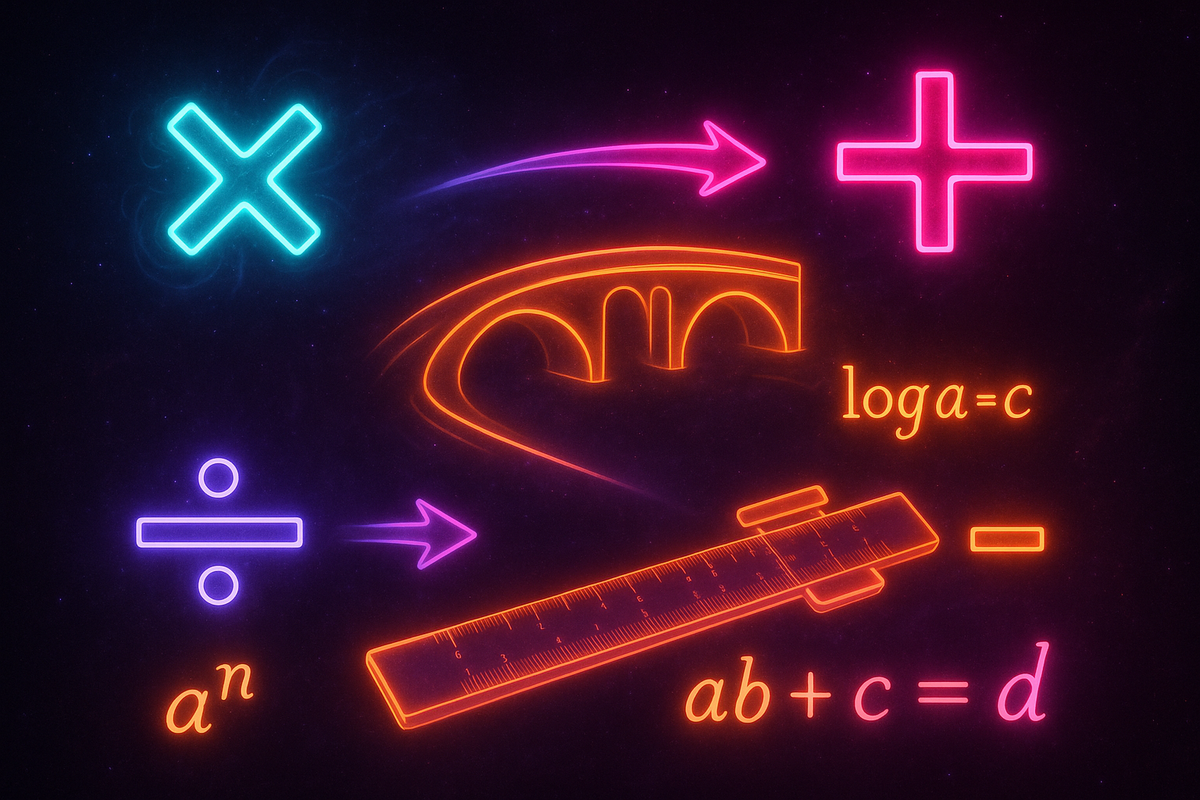
Logarithms turn multiplication into addition.
This is the most important log rule—and it's not arbitrary. It's a direct consequence of how exponents work.
When you multiply powers of the same base, you add exponents: 2³ × 2⁴ = 2⁷.
Logarithms are exponents. So when you take the log of a product, you're adding exponents.
log(a × b) = log(a) + log(b)
This single rule made logarithms the most powerful computational tool for 400 years.
The Product Rule
log_b(xy) = log_b(x) + log_b(y)
Proof: Let log_b(x) = m and log_b(y) = n.
Then x = bᵐ and y = bⁿ.
So xy = bᵐ × bⁿ = b^(m+n).
Taking log_b: log_b(xy) = m + n = log_b(x) + log_b(y). ∎
Example: log(100 × 1000) = log(100) + log(1000) = 2 + 3 = 5
Check: 100 × 1000 = 100,000 = 10⁵. ✓
The product rule is why slide rules work. To multiply two numbers, you add their logarithms.
The Quotient Rule
log_b(x/y) = log_b(x) - log_b(y)
Division becomes subtraction, just as multiplication becomes addition.
Proof: x/y = x × y⁻¹, so: log_b(x/y) = log_b(x) + log_b(y⁻¹) = log_b(x) + (-1)log_b(y) = log_b(x) - log_b(y). ∎
Example: log₂(32/8) = log₂(32) - log₂(8) = 5 - 3 = 2
Check: 32/8 = 4 = 2². ✓
The Power Rule
log_b(xⁿ) = n × log_b(x)
Powers become multiplication.
Proof: Let log_b(x) = m, so x = bᵐ.
Then xⁿ = (bᵐ)ⁿ = b^(mn).
Taking log_b: log_b(xⁿ) = mn = n × log_b(x). ∎
Example: log(1000³) = 3 × log(1000) = 3 × 3 = 9
Check: 1000³ = 10⁹. ✓
The power rule is especially useful for solving equations with x in an exponent.
The Root Rule
log_b(ⁿ√x) = log_b(x)/n
Roots become division.
This is just the power rule with n = 1/n:
log_b(x^(1/n)) = (1/n) × log_b(x) = log_b(x)/n
Example: log₄(√64) = log₄(64)/2 = 3/2 = 1.5
Check: √64 = 8 = 4^1.5 ✓
Summary of Rules
| Operation | Log Rule | Example |
|---|---|---|
| Product | log(xy) = log(x) + log(y) | log(2×3) = log(2) + log(3) |
| Quotient | log(x/y) = log(x) - log(y) | log(8/2) = log(8) - log(2) |
| Power | log(xⁿ) = n·log(x) | log(2³) = 3·log(2) |
| Root | log(ⁿ√x) = log(x)/n | log(√4) = log(4)/2 |
The pattern: multiplicative operations become additive operations.
Why These Rules Exist
The log rules aren't memorized facts—they're consequences of exponent rules.
| Exponent Rule | Corresponding Log Rule |
|---|---|
| bᵐ × bⁿ = b^(m+n) | log(xy) = log(x) + log(y) |
| bᵐ / bⁿ = b^(m-n) | log(x/y) = log(x) - log(y) |
| (bᵐ)ⁿ = b^(mn) | log(xⁿ) = n·log(x) |
Logarithms inherit the properties of exponents because logarithms are exponents.
Common Mistakes
Mistake 1: log(x + y) ≠ log(x) + log(y)
There is NO rule for the log of a sum. You cannot simplify log(x + y).
log(2 + 3) = log(5) ≈ 0.699 log(2) + log(3) ≈ 0.301 + 0.477 = 0.778
Not equal!
Mistake 2: log(x - y) ≠ log(x) - log(y)
Same problem. The log of a difference has no simplification.
Mistake 3: (log x)² ≠ log(x²) ≠ 2 log(x)
(log x)² means square the result: [log(10)]² = 1² = 1
log(x²) = 2 log(x) means double the log: log(100) = 2 log(10) = 2
Using Rules to Expand
Expand log expressions into sums and differences:
Example: log(x²y³/z)
= log(x²y³) - log(z) (quotient rule) = log(x²) + log(y³) - log(z) (product rule) = 2log(x) + 3log(y) - log(z) (power rule)
Example: ln(√(ab)/c²)
= ln(√(ab)) - ln(c²) (quotient rule) = (1/2)ln(ab) - 2ln(c) (power and root rules) = (1/2)[ln(a) + ln(b)] - 2ln(c) (product rule) = (1/2)ln(a) + (1/2)ln(b) - 2ln(c)
Using Rules to Condense
Combine sums and differences into single logarithms:
Example: 3log(x) - 2log(y) + log(z)
= log(x³) - log(y²) + log(z) (power rule) = log(x³/y²) + log(z) (quotient rule) = log(x³z/y²) (product rule)
Example: 2ln(a) + ln(b) - (1/2)ln(c)
= ln(a²) + ln(b) - ln(√c) = ln(a²b) - ln(√c) = ln(a²b/√c)
Solving Equations with Log Rules
Example: Solve log(x) + log(x-3) = 1
Combine: log(x(x-3)) = 1 Meaning: x(x-3) = 10¹ = 10 Solve: x² - 3x - 10 = 0 → (x-5)(x+2) = 0 x = 5 or x = -2
Check domain: log requires positive arguments. x = 5: log(5) + log(2) = defined ✓ x = -2: log(-2) = undefined ✗
Answer: x = 5
Example: Solve 2^(x+1) = 3^(x-1)
Take log of both sides: (x+1)log(2) = (x-1)log(3) x·log(2) + log(2) = x·log(3) - log(3) x·log(2) - x·log(3) = -log(3) - log(2) x(log(2) - log(3)) = -log(6) x = -log(6)/(log(2) - log(3)) = log(6)/(log(3) - log(2)) ≈ 4.42
Why This Matters
The log rules made computation possible before calculators.
To multiply 3,847 × 9,263:
- Look up log(3847) ≈ 3.585
- Look up log(9263) ≈ 3.967
- Add: 3.585 + 3.967 = 7.552
- Look up antilog: 10^7.552 ≈ 35,640,000
The actual answer is 35,641,361. Close enough for engineering.
This is how scientists, engineers, and navigators calculated for centuries. The log rules reduced tedious multiplication to simple addition.
Today, the rules still matter for:
- Solving exponential equations
- Simplifying expressions
- Understanding logarithmic scales
- Working with information theory
The deep truth: logarithms convert multiplicative relationships to additive ones. That's not just a calculation trick—it's a fundamental change of perspective.
Part 2 of the Logarithms series.
Previous: What Is a Logarithm? The Inverse of Exponentiation Next: Common Logarithms: Base 10 and Scientific Notation
Comments ()