Synthesis: Logarithms as the Language of Growth and Scale
Every exponential curve has a logarithm underneath it. This synthesis shows why logs aren't just a math trick — they're nature's native language for growth, decay, and scale.
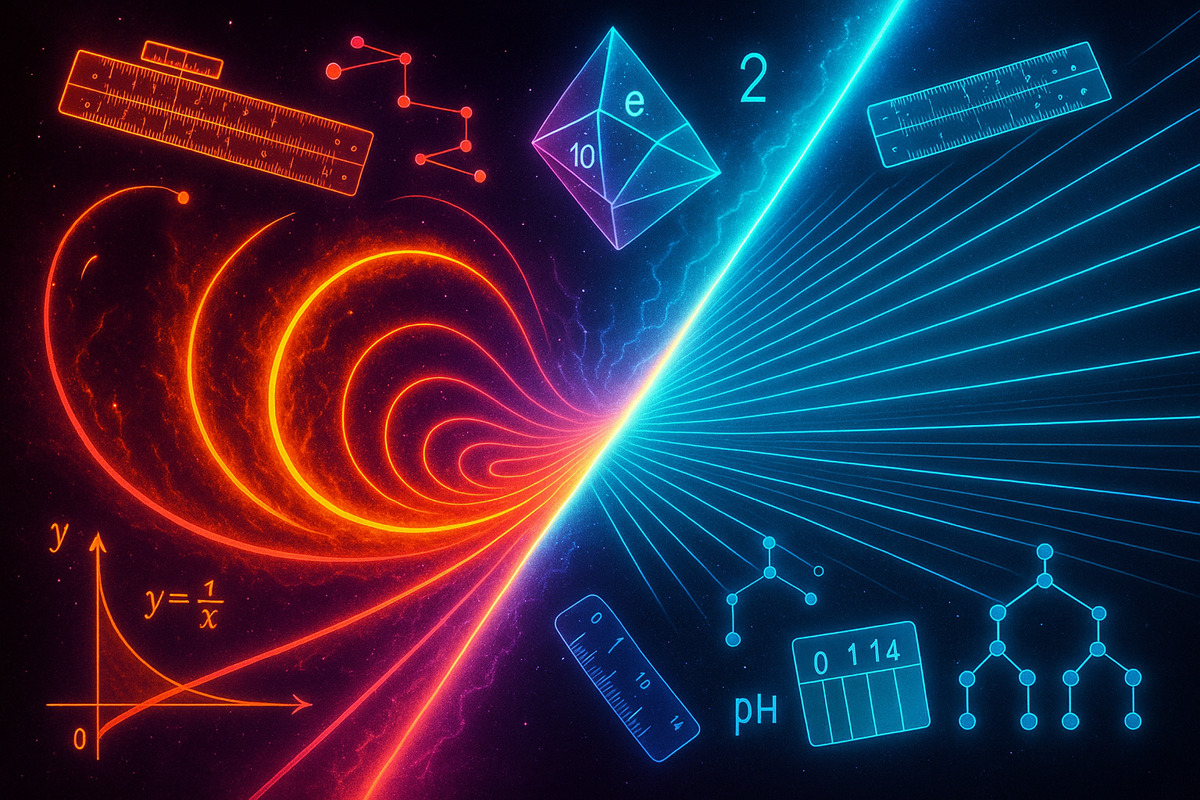
Logarithms transform multiplication into addition, revealing the hidden structure of exponential growth.
That's the whole story. Everything else—the rules, the applications, the different bases—follows from this single insight.
When quantities multiply rather than add, when growth is proportional to size, when scales span orders of magnitude, logarithms are the natural language. Not because mathematicians decreed it, but because the universe often works multiplicatively, and logarithms are how we think about multiplication with the same ease we think about addition.
This series has explored logarithms from definition to application. Now we synthesize: what is the unified understanding that emerges from seeing logarithms whole?
The Core Transformation
log_b(xy) = log_b(x) + log_b(y)
This is the soul of logarithms. Multiplication becomes addition.
Exponentiation becomes multiplication: log_b(xⁿ) = n × log_b(x)
Division becomes subtraction: log_b(x/y) = log_b(x) - log_b(y)
These aren't separate rules. They're all manifestations of the same principle: logarithms translate the multiplicative world into the additive world.
Why does this matter? Because addition is easy. We understand addition intuitively. We can visualize it on a number line. We can compute it quickly. Multiplication is harder—until we have logarithms to convert it.
Before calculators, logarithm tables and slide rules let people multiply large numbers by adding their logs. The transformation wasn't just theoretical; it was practical technology for centuries.
Three Bases, One Concept
Base 10 — Powers of ten, human-scale measurement
- log₁₀(1000) = 3 → "three orders of magnitude"
- Decibels, pH, Richter scale
- Matches our decimal intuition
Base e — Continuous processes, calculus
- ln(x) has derivative 1/x
- d/dx(eˣ) = eˣ
- Natural for growth, decay, compound interest
Base 2 — Binary choices, information
- log₂(8) = 3 → "three doublings" or "three bits"
- Computing, information theory
- Matches binary architecture
These aren't three different subjects. They're one subject viewed through three lenses. The change of base formula log_b(x) = ln(x)/ln(b) shows they're all proportional to each other.
Choosing a base is like choosing units. Meters vs. feet, celsius vs. fahrenheit. The underlying reality is the same; only the numbers change.
The Inverse Relationship
Logarithms and exponentials are mirror images:
If bˣ = y, then log_b(y) = x.
Exponentiation asks: "What do I get when I raise b to the power x?" Logarithm asks: "What power of b gives me y?"
They undo each other:
- b^(log_b(x)) = x
- log_b(bˣ) = x
This inverse relationship is why logarithms solve exponential equations. When the variable is in the exponent, logarithms bring it down. When you need to find doubling times, half-lives, or growth rates, logarithms are the tool.
Every exponential growth problem has a logarithmic solution hiding inside it.
The Calculus Connection
The natural logarithm has a unique status in calculus:
d/dx[ln(x)] = 1/x
No constant factors, no complications. The simplest possible derivative for any logarithm.
∫(1/x)dx = ln|x| + C
The antiderivative of 1/x is the natural log. This is why ln appears constantly in physics and engineering—integration of 1/x happens everywhere.
You can even define ln this way: ln(x) = ∫₁ˣ (1/t)dt
The natural log is the accumulated area under the curve y = 1/t. This geometric definition connects logarithms to integration at the deepest level.
For other bases, constant factors appear:
- d/dx[log₁₀(x)] = 1/(x × ln(10))
- d/dx[log₂(x)] = 1/(x × ln(2))
The natural log is special because e is defined to make the derivative clean.
Logarithmic Scales
When quantities span huge ranges, logarithmic scales compress them into manageable form:
| Scale | Quantity | Range | Log Compression |
|---|---|---|---|
| Decibels | Sound intensity | 10¹² | 0-120 dB |
| pH | H⁺ concentration | 10¹⁴ | 0-14 |
| Richter | Earthquake energy | 10⁹ | 0-9 |
| Magnitude | Star brightness | 10¹⁶ | -27 to +30 |
These scales aren't arbitrary conventions. They reflect that:
- The quantities ARE multiplicative in nature
- Human perception is often logarithmic (Weber-Fechner law)
- Equal ratios deserve equal treatment
A factor of 10 increase should look the same whether you're going from 1 to 10 or from 1,000,000 to 10,000,000. Logarithmic scales enforce this symmetry.
Information Is Logarithmic
Shannon's insight: information is the logarithm of surprise.
H = -∑ pᵢ log₂(pᵢ) bits
Why logarithmic? Because information must add when independent events combine. A coin flip (1 bit) plus a die roll (2.58 bits) gives 3.58 bits total. Only logarithms satisfy: f(a) + f(b) = f(a×b).
This isn't convention. It's mathematical necessity. Information theory is built on the same logarithmic foundation as everything else.
Compression algorithms, channel capacity, entropy calculations—all logarithmic. The digital age runs on logarithms.
The Ubiquity of Multiplicative Processes
Why do logarithms appear everywhere? Because multiplication is fundamental to how the universe works:
Growth: Populations multiply, not add. Each generation is a factor times the previous.
Decay: Radioactive atoms don't lose a fixed amount per second; they lose a fixed fraction.
Finance: Interest compounds multiplicatively. Returns compound multiplicatively.
Physics: Wave amplitudes multiply through media. Signal-to-noise ratios are multiplicative.
Biology: Cell division is multiplication. Evolutionary fitness is multiplicative.
Perception: We perceive ratios, not differences. Twice as loud, half as bright.
Additive processes are simpler to understand but rarer in nature. Most natural processes scale proportionally—and proportional scaling is multiplicative.
Logarithms are the mathematics of proportional change.
The Unified View
Here's what emerges when you see logarithms as a whole:
1. Logarithms are a coordinate system. They map the multiplicative world onto the additive world, where we can do arithmetic easily.
2. All bases are equivalent. Base 10, base e, base 2—they're related by constant factors. Choose based on context, not fundamental difference.
3. Logarithms and exponentials are dual. Every exponential equation has a logarithmic form. Every logarithmic scale describes exponential structure.
4. The natural log is calculus-privileged. ln appears whenever you differentiate or integrate because e makes the math clean.
5. Logarithmic perception is natural. Our senses evolved to detect proportional changes. The mathematics matches our neurology.
6. Information requires logarithms. You cannot define information theory without them. The additivity of information demands it.
What Logarithms Teach
Beyond the formulas, logarithms teach a way of thinking:
Think in ratios. "How many times larger?" is often more meaningful than "how much larger?"
Think in orders of magnitude. The difference between 10 and 100 is the same as between 1,000,000 and 10,000,000—both are 10×.
Think in growth rates. Exponential processes are characterized by their rate, and logarithms extract that rate.
Think in bits. Information is uncertainty reduced, measured logarithmically.
These mental habits are useful far beyond mathematics class. Business growth, scientific measurement, risk assessment, signal processing—logarithmic thinking appears everywhere because multiplicative structure appears everywhere.
The Transformation That Reveals Structure
The logarithm is not just a function. It's a lens that reveals hidden patterns.
When data looks curved on a linear plot but straight on a log plot—that's exponential growth revealed.
When a relationship looks complex until you log both axes—that's a power law emerging.
When signals spanning millions vary from hundreds—that's where decibels make sense of chaos.
Logarithms don't create structure. They reveal the multiplicative structure that was always there, hidden behind the overwhelming span of raw numbers.
John Napier invented logarithms in 1614 to help with astronomical calculations. He couldn't have known that 400 years later, the same tool would measure earthquakes, encode digital music, quantify information, and underpin the mathematics of entropy.
He discovered not just a computational trick, but a fundamental feature of how quantities relate to each other when multiplication is the natural operation.
Logarithms are how we think about a multiplicative universe with additive minds.
Part 8 of the Logarithms series.
Comments ()