Long Non-Coding RNA: The Dark Matter of the Genome
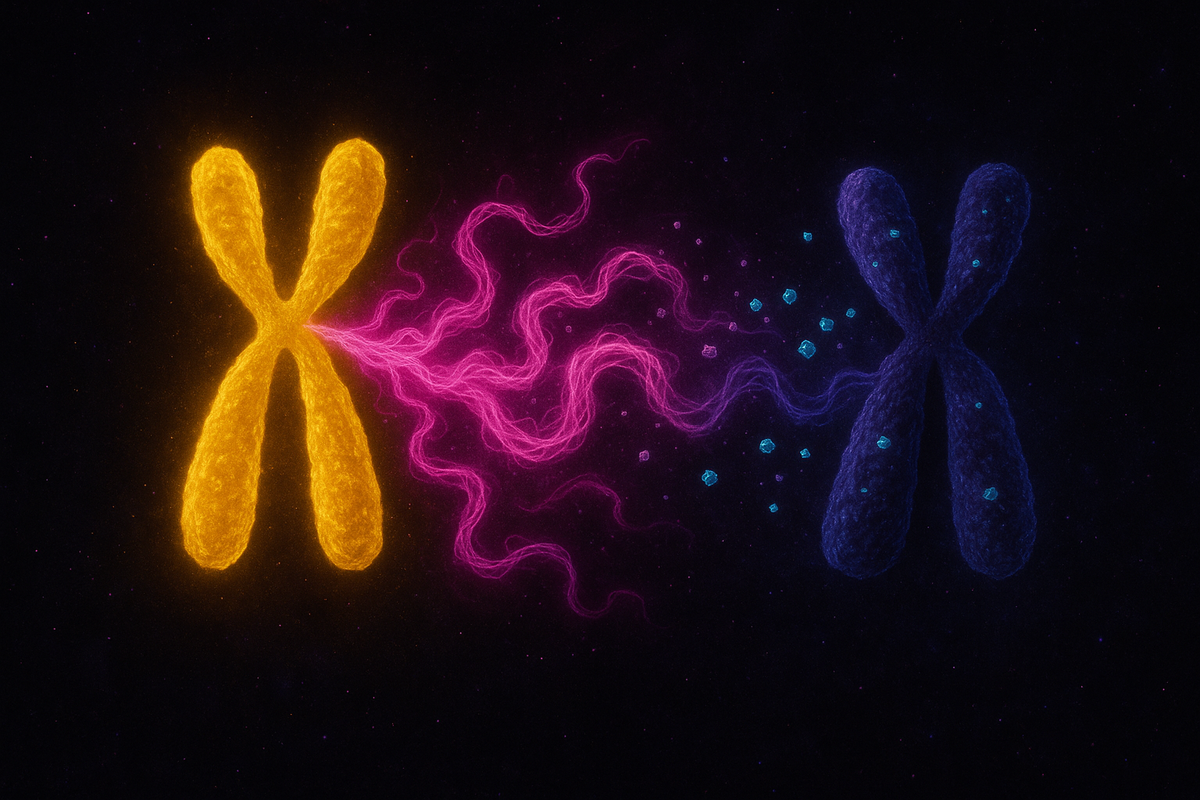
lncRNAs were once dismissed as transcriptional noise. We now know they scaffold chromatin architecture, silence whole chromosomes (X-inactivation runs on one), and regulate development. The dark matter of the genome is turning on lights.
Long Non-Coding RNA: The Dark Matter of the Genome
In 2012, a massive genomics consortium called ENCODE published its results. They'd spent years cataloging every functional element in the human genome—every piece of DNA that actually does something, not just the protein-coding genes. The headline finding: about 75-80% of the human genome gets transcribed into RNA. Wait. Only 2% of the genome codes for proteins. So what's the other 75%? For a long time, the answer was assumed to be "junk." Transcriptional noise. Evolutionary debris. Useless copying errors that never got cleaned up. Sure, some RNA was structural (ribosomal RNA, transfer RNA), and some was regulatory (microRNAs), but the vast majority was probably nothing. We were wrong. Most of that non-coding RNA isn't noise. It's signal. There are at least 16,000 long non-coding RNAs in the human genome—molecules over 200 nucleotides long that don't code for proteins but aren't junk either. They're functional. They regulate development, control gene expression, and organize the three-dimensional structure of chromosomes. We found the dark matter of the genome. It's made of RNA we didn't know mattered.
The Discovery Cascade
The first lncRNAs were discovered piecemeal, each one a standalone curiosity. H19 was found in 1984—an RNA expressed from the imprinted region of chromosome 11, somehow involved in regulating nearby genes. Nobody knew what it did. It didn't code for protein. It was just... there. XIST was characterized in 1991. This one does something dramatic: it silences one of the two X chromosomes in female mammals. Without XIST, X-inactivation fails. The RNA physically coats the chromosome and triggers silencing machinery. One molecule, one chromosome turned off. HOTAIR came later, in 2007. It's transcribed from the HOX gene cluster—the master regulators of body patterning—and helps establish the patterns that determine where your arms go versus your legs. It works by recruiting chromatin-modifying complexes to specific genomic locations. These early lncRNAs were discovered one at a time, each through painstaking investigation. But starting around 2008-2012, high-throughput RNA sequencing changed everything. Instead of finding lncRNAs individually, researchers could sequence the entire transcriptome and ask: what's being transcribed? The answer: thousands of things we'd never noticed. The GENCODE consortium, FANTOM project, and others cataloged lncRNA after lncRNA. Many were tissue-specific—expressed only in brain, or only in heart, or only during a particular developmental window. Many were conserved across species, suggesting functional importance. Many correlated with disease states. The genome was full of active, regulated transcription we hadn't been paying attention to.
What They Do
This is where things get complicated. lncRNAs don't do one thing—they do many things, through diverse mechanisms. Some generalizations: Chromatin regulation. Many lncRNAs interact with chromatin-modifying complexes—the proteins that add or remove chemical marks on histones, affecting gene accessibility. By binding these complexes and guiding them to specific genomic locations, lncRNAs can turn genes on or off. XIST does this. HOTAIR does this. Many others do too. Transcriptional regulation. Some lncRNAs act at the level of transcription itself—affecting whether RNA polymerase initiates, elongates, or terminates. They can activate nearby genes (cis-regulation) or genes on different chromosomes (trans-regulation). Post-transcriptional regulation. lncRNAs can affect mRNA processing, stability, and translation. They can compete with microRNAs for binding sites, effectively soaking up microRNAs and preventing them from silencing their targets. This is called the "competing endogenous RNA" hypothesis. Scaffolding. Some lncRNAs serve as structural platforms, bringing together multiple proteins that need to interact. The RNA itself might not do much; it just holds the party together. Enhancer function. Some lncRNAs are transcribed from enhancer regions—sequences that boost gene expression from a distance. These "eRNAs" may be part of how enhancers work, not just byproducts of their activity. Nuclear organization. The nucleus isn't a homogeneous bag of DNA and proteins. It has subcompartments—nucleoli, speckles, paraspeckles, Cajal bodies. lncRNAs help organize some of these structures. This functional diversity is what makes lncRNAs hard to study. You can't assume that understanding one tells you much about another. Each may have evolved to fill a different niche.
XIST: The Paradigm
Let's look at XIST in detail, because it illustrates how powerful lncRNA-mediated regulation can be. Female mammals have two X chromosomes; males have one X and one Y. To equalize gene dosage between sexes, one X chromosome in females gets silenced early in development. The entire chromosome—over 150 million base pairs—becomes transcriptionally inert. XIST makes this happen. Early in embryonic development, cells start expressing XIST from one X chromosome (randomly chosen). The XIST RNA—about 17,000 nucleotides long in humans—doesn't leave the nucleus. Instead, it spreads along the chromosome it was transcribed from, coating it. As XIST spreads, it recruits protein complexes that modify histones, add DNA methylation, and physically compact the chromosome. The coated X becomes a dense, inactive structure called a Barr body. Once established, the silencing is maintained for life. Every cell derived from that embryo inherits the same silenced X. The RNA was the initial signal; the epigenetic marks are the memory. This is a whole-chromosome silencing event triggered by a single RNA. XIST doesn't encode a protein. It doesn't even encode a small functional RNA. It is the functional molecule—17 kilobases of structured RNA that serves as a scaffold, a recruiter, and an organizer. One RNA silences 1,000 genes. That's regulatory power.
The Conservation Puzzle
Here's something puzzling about lncRNAs: they're poorly conserved. Protein-coding genes are typically highly conserved across species. The hemoglobin gene in humans is recognizably similar to the hemoglobin gene in mice, chickens, even zebrafish. This conservation makes sense—proteins are complex machines, and most changes break them. lncRNAs are different. Their sequences evolve rapidly. The same lncRNA in human and mouse may share only fragments of sequence similarity, or none at all. Does this mean lncRNAs aren't important? Not necessarily. Several explanations have been proposed: Functional conservation without sequence conservation. Maybe what matters isn't the exact sequence but the secondary structure, or the genomic location, or the ability to bind certain proteins. Different sequences could achieve the same function. Lineage-specific functions. Some lncRNAs may have evolved recently to fill species-specific regulatory niches. They're important, but only in certain lineages. Most lncRNAs aren't functional. The cynical view: maybe most of the cataloged lncRNAs really are transcriptional noise, and only a minority do anything. We're looking at a haystack with needles in it. The truth is probably a mix. Some lncRNAs, like XIST, are clearly functional and essential. Others may be evolutionary experiments in progress. Sorting the signal from the noise is an ongoing challenge.
lncRNAs in Disease
When you find a new class of regulatory molecules, you ask: what happens when they go wrong? Cancer shows widespread lncRNA dysregulation. MALAT1 is overexpressed in multiple cancer types and correlates with metastasis. HOTAIR is overexpressed in breast cancer and predicts poor outcomes. PVT1 is amplified in many cancers and promotes cell proliferation. Are these lncRNAs driving cancer, or just along for the ride? The evidence suggests at least some are causal—knockdown experiments reduce tumor growth, overexpression promotes it. They're not just markers; they're players. Neurological disease involves lncRNAs too. The brain expresses thousands of lncRNAs, many tissue-specific. Some are implicated in Alzheimer's, Huntington's, and psychiatric disorders. The lncRNA BACE1-AS, for example, regulates expression of the BACE1 gene, which is involved in Alzheimer's pathology. Cardiovascular disease has lncRNA connections. MIAT is associated with myocardial infarction risk. ANRIL, located in a genomic region associated with coronary disease, affects cell proliferation and inflammatory responses. Development requires lncRNAs. Knockouts of specific lncRNAs in mice cause developmental defects—problems with brain formation, limb patterning, and organogenesis. The disease associations make the field therapeutically relevant. If an lncRNA promotes cancer, maybe you can target it. If an lncRNA protects against neurodegeneration, maybe you can boost it. The dark matter has clinical implications.
The Technical Challenge
Studying lncRNAs is hard. Several factors conspire against researchers: Low expression. Many lncRNAs are expressed at only a few copies per cell—far less than abundant mRNAs. Detecting them requires sensitive methods. Nuclear localization. Many lncRNAs stay in the nucleus, which makes them harder to study with standard RNA biochemistry methods optimized for cytoplasmic molecules. Lack of sequence conservation. You can't easily find orthologous lncRNAs across species by sequence comparison, making it hard to use model organisms. No clear rules. With proteins, you can often predict function from sequence—homology to known proteins, identifiable domains. lncRNAs lack this predictability. Each one needs individual characterization. Redundancy and compensation. Knockout experiments sometimes show no phenotype—not because the lncRNA lacks function, but because other molecules compensate. The regulatory network is resilient. The field has developed new tools: CRISPR-based deletion, RNA pulldown and mass spectrometry to identify binding partners, single-cell RNA-seq to catch rare transcripts, computational methods to predict function. Progress is being made, but slowly. We're trying to understand 16,000+ molecules, each potentially unique, using tools optimized for protein-coding genes. It's like cataloging a rainforest with binoculars designed for open plains.
Rethinking the Genome
The existence of lncRNAs forces a reconception of what the genome is. The old picture: genes are regions of DNA that encode proteins. Most of the genome is non-coding—"junk" that accumulated over evolution, selfish elements, broken copies of ancient genes. The new picture: the genome is a complex regulatory system where protein-coding genes are just part of the story. The "non-coding" regions encode RNAs that regulate everything else. The junk is full of instructions. This doesn't mean every transcribed region is functional—there's probably genuine noise mixed in. But the proportion of the genome that's functional is much higher than we thought. The genome isn't mostly dead weight. It's mostly regulatory. The Central Dogma was: DNA makes RNA makes protein. The update: DNA makes RNA, and RNA does a lot more than make protein.
The Information Layer
Here's a way to think about it. Protein-coding genes encode the machinery of the cell—the enzymes, structural proteins, and signaling molecules that do the physical work. There are about 20,000 of these in humans. lncRNAs may encode the software layer—the regulatory logic that determines which machinery runs when, where, and how much. There are at least 16,000 of these, possibly more. This division makes a certain sense. Building a cell requires both hardware and software. The hardware (proteins) needs to be robust, highly optimized, conserved across species—you can't easily mess with a working enzyme. The software (regulatory RNAs) can be more flexible, species-specific, and rapidly evolving—you can experiment with regulation without breaking the basic machinery. The genome codes for both. We spent fifty years focused on the hardware. Now we're discovering the software.
Further Reading
- Rinn, J. L., & Chang, H. Y. (2012). "Genome Regulation by Long Noncoding RNAs." Annual Review of Biochemistry.
- Statello, L., Guo, C. J., Chen, L. L., & Huarte, M. (2021). "Gene regulation by long non-coding RNAs and its biological functions." Nature Reviews Molecular Cell Biology.
- Brockdorff, N. (2013). "Noncoding RNA and Polycomb recruitment." RNA.
- ENCODE Project Consortium. (2012). "An integrated encyclopedia of DNA elements in the human genome." Nature.
This is Part 5 of the RNA Renaissance series. Next: "Circular RNA: The Newly Discovered Layer."


Comments ()