Mantra, Yantra, Mudra: Technologies of Coherence Cultivation
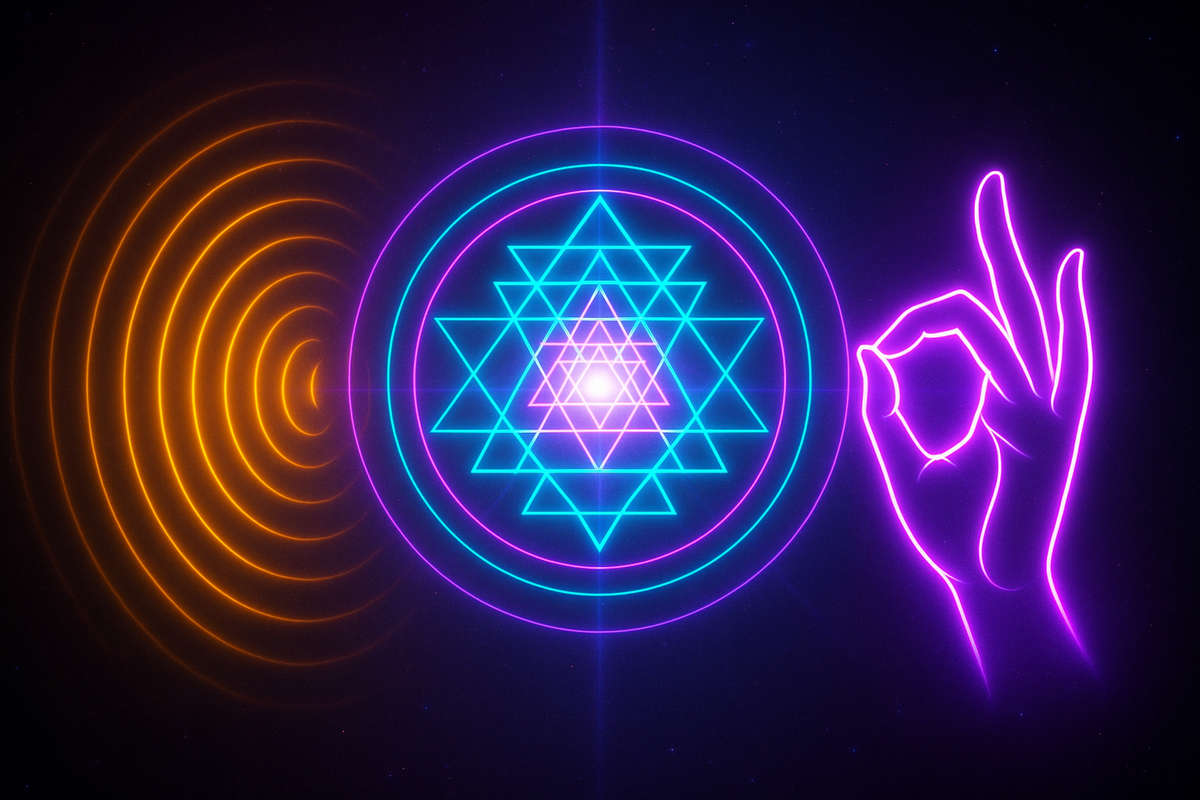
Mantra, yantra, and mudra can be re-read as a coherence toolkit: sound entrains oscillation, visual geometry focuses attention, and hand mudra activates specific physiological states. Ancient tech, modern framing.
Mantra, Yantra, Mudra: Technologies of Coherence Cultivation
Series: Tantra Epistemology | Part: 7 of 10
Tantric practice involves specific technologies—not metaphorically, but precisely. A mantra is technology. A yantra is technology. A mudra is technology. Each represents a refined method for inducing particular coherence states through systematic manipulation of attention, sensation, and nervous system dynamics.
This isn't mysticism dressed as engineering—it's engineering that predates scientific frameworks by more than a millennium. These practices were developed through systematic experimentation: try this sound, this image, this gesture; observe the effects; refine; iterate. The result is a toolkit of interventions for working directly with the felt architecture of consciousness.
Understanding how these technologies work—what they're actually doing in coherence terms—makes them more accessible and more precisely applicable.
Mantra: Entrainment Through Sound
A mantra is a sound or phrase repeated systematically, either aloud or internally. The most familiar example is "Om," but traditional tantric practice involves thousands of specific mantras, each supposedly producing different effects.
The standard explanation treats mantras as either meaningless (just tools for focusing attention) or mystically charged (carrying inherent sacred power). Both miss the actual mechanism.
Mantras work through several simultaneous channels:
Rhythmic entrainment. Repetition of sound at regular intervals entrains neural oscillations. Your brain begins firing in synchrony with the rhythm. This is basic neuroscience—external rhythmic stimulation can phase-lock neural activity, creating more coherent patterns than occur spontaneously.
Breath regulation. Chanting mantras forces particular breathing patterns. Long exhalations (required for sustained sound) activate parasympathetic tone. Specific breath rhythms produce specific autonomic effects. The mantra is partly a breath-training device.
Semantic satiation. When you repeat a word hundreds or thousands of times, it loses semantic meaning. "Om Namah Shivaya" stops being about Shiva and becomes pure vibration. This loosens the grip of conceptual mind, creating space for non-discursive awareness.
Somatic resonance. Different sounds vibrate in different parts of the body. "Om" resonates in the chest and head. "Ram" hits the solar plexus. "Lam" vibrates low in the pelvis. These aren't mystical properties—they're acoustic physics. The sounds create somatic stimulation that draws attention to specific regions.
Attentional anchor. The mantra provides a stable object for attention. Every time the mind wanders, you return to the sound. This builds concentration while reducing rumination.
Identity reinforcement. Mantras often involve statements of aspiration or recognition: "I am that," "Om Mani Padme Hum" (roughly: the jewel in the lotus of the heart). Repeated thousands of times, these become deeply grooved cognitive patterns, shifting background identity frames.
The sophistication lies in the interaction of these mechanisms. A well-designed mantra simultaneously entrains rhythm, regulates breath, focuses attention, creates somatic stimulation, and reinforces particular cognitive-emotional patterns. It's multi-system intervention packaged in a simple sound.
Yantra: Attractor Geometry for Visual Attention
A yantra is a geometric diagram used for meditation—typically intricate patterns of triangles, circles, and lotus petals arranged in symmetrical configurations. The most famous is the Sri Yantra: nine interlocking triangles forming 43 smaller triangles, contained within concentric circles and a square frame with four doors.
Yantras aren't just pretty. They're carefully constructed attractor fields for visual attention.
Here's how they work:
Perceptual complexity. A good yantra is complex enough to engage sustained attention but ordered enough to permit stable focus. Too simple (a blank circle) and the mind wanders. Too complex (random noise) and attention can't organize. The yantra hits the sweet spot.
Nested symmetry. The hierarchical structure—patterns within patterns, each level maintaining symmetry—creates natural entry points at different scales. You can focus on the whole, zoom into details, or track the relationships between levels. This flexibility keeps practice alive over time.
Implied motion. Interlocking triangles create the perception of movement—some pointing up, others down, creating dynamic tension even in a static image. This gives the mind something to track without requiring actual motion.
Center and periphery. Most yantras have a clear central point (bindu) surrounded by progressively more elaborate structure. The practice often involves either starting at the periphery and moving inward (gathering concentration) or starting at center and expanding outward (radiating awareness). This creates a natural progression.
Symbolic overload. Traditional yantras are loaded with symbolic meaning—each triangle represents a deity or cosmic principle, each color carries significance. For practitioners steeped in the tradition, this adds layers of contemplative content. But the yantra works even without knowing the symbolism, purely through its visual-attentional properties.
In coherence terms, the yantra functions as a training field for organizing visual attention into stable, coherent patterns. The same neural networks that learn to hold the yantra's structure become better at maintaining coherent attention generally. The practice generalizes.
Mudra: Somatic Triggers for State Activation
A mudra is a gesture—usually involving the hands and fingers, but sometimes the whole body. Traditional texts describe hundreds of mudras, each associated with specific energetic effects or symbolic meanings.
The mechanism is more straightforward than mantra or yantra: mudras exploit the two-way coupling between body configuration and mental state.
Embodied cognition. Physical posture influences cognitive and emotional states. This isn't controversial—standing in a power pose increases testosterone and confidence; slumping decreases them. Mudras apply this principle with precision.
Interoceptive focusing. Hand mudras create subtle proprioceptive sensations—fingers touching, pressure at contact points, small muscle activation. These sensations provide an anchor for attention similar to breath. But unlike breath, you create them intentionally, giving a sense of agency.
Ritual anchoring. If you consistently use a particular mudra during a particular practice (say, chin mudra—thumb and index finger touching—during meditation), the gesture becomes a trigger. Forming the mudra begins activating the state before you even start the practice. This is classical conditioning applied to contemplative states.
Symbolic meaning. For practitioners who know the tradition, mudras carry associations. Abhaya mudra (palm raised, fingers up) represents fearlessness. Dhyana mudra (hands nested, thumbs touching) represents meditation. These associations function as priming—the gesture evokes the quality even before you experience it.
Energy channeling. In tantric theory, mudras direct prana through particular pathways. While that specific claim is untestable, the phenomenology is real: different mudras feel different energetically. Chin mudra (receptive, contemplative) feels different than vajra mudra (fingers interlaced, powerful) even though both are just hand positions. The configuration somehow influences the felt sense of energy.
The practical value is immediate: mudras provide portable, subtle interventions. You can form a mudra in a meeting, on the subway, anywhere. The gesture itself begins shifting state.
The Package: Combined Technologies
The real sophistication emerges when you combine technologies. Traditional tantric practice rarely uses just mantra or just yantra—it layers them.
Consider a standard practice structure:
1. Mudra establishes the physical frame and begins activating the appropriate state.
2. Pranayama (breath practice) regulates the nervous system and increases energy availability.
3. Mantra entrains attention and creates rhythmic coherence while reinforcing particular cognitive patterns.
4. Visualization (which might include a yantra or deity form) organizes perceptual attention into stable patterns.
5. Intention (dedication of the practice to a particular goal or recognition) provides motivation and direction.
Each component addresses a different system—somatic, respiratory, auditory, visual, cognitive. Together they create multi-system entrainment toward a particular coherence configuration.
This is sophisticated engineering. Instead of trying to directly force a state ("be compassionate!" rarely works), you create conditions across multiple systems that naturally evoke that state. The compassion arises not through willpower but through the coherence configuration the practices establish.
Why Tradition Matters (And Doesn't)
Traditional practices were refined over centuries. Thousands of practitioners tried variations, kept what worked, discarded what didn't. The surviving practices represent evolutionary selection pressure—they're still around because they reliably produce effects.
This means traditional forms deserve respect. When a mantra has been used for a thousand years, there's probably a reason. The specific sound pattern, the traditional pronunciation, the associated visualizations—these weren't arbitrary. They were refined.
But tradition also accumulated layers of cultural context, sectarian politics, and magical thinking. A mantra might work because of its acoustic properties, but the tradition might claim it works because it's the name of a god. Both can be true (the name choice affects the acoustic properties), but you don't need to believe in the god to use the sound effectively.
This creates space for intelligent adaptation. You can:
Use traditional practices directly if you're comfortable with the cultural and religious context. This has the advantage of accessing the full depth of the tradition, including teacher lineages and interpretive frameworks.
Strip the technology from its cultural context and use it purely as technique. This loses some of the depth but makes the practice more accessible and avoids problems of cultural appropriation or religious commitment.
Create new technologies using the same principles. If you understand that mantras work through rhythmic entrainment, breath regulation, and semantic satiation, you can construct new mantras for contemporary purposes. If you understand that yantras work through visual-attentional organization, you can design new yantras. The principles are portable.
The key is understanding what's essential (the mechanism) versus what's contingent (the specific cultural expression).
Practical Applications
These technologies aren't just for monastics. They're immediately applicable:
For anxiety: A simple mantra practice (even just counting breaths with subvocalized numbers) provides rhythmic entrainment and attentional anchoring, both of which reduce anxious rumination. Five minutes of mantra can shift state more reliably than trying to "think differently."
For focus: A yantra or visual anchor (could be traditional, could be a mandala coloring book, could be a simple geometric form) trains sustained attention in a way that generalizes. People who practice with yantras often report improved concentration in other domains.
For presence: Simple mudras (hands in lap, thumbs touching) combined with breath awareness create immediate grounding. This is accessible anywhere, requires no equipment, and becomes more effective with repetition.
For state transitions: Creating a personal mudra associated with a particular state (calmness, creativity, confidence) allows you to trigger that state more quickly over time. The mudra becomes a somatic anchor.
For collective practice: Mantra chanting in groups produces stronger entrainment than solo practice. The multiple voices and nervous systems begin synchronizing, creating collective coherence that individuals experience as more powerful than their personal practice.
The technologies work whether or not you believe in their traditional framework. They're not magic—they're systematic interventions in coherence dynamics using sound, image, and gesture.
Design Principles for Personal Practice
If you're creating your own practice rather than following tradition:
Simplicity first. Start with simple forms before adding complexity. A single-word mantra before elaborate multi-part invocations. A simple geometric form before intricate yantras. Basic mudras before elaborate combinations.
Consistency matters. The technologies work through repetition. Five minutes daily beats one hour weekly. The entrainment and conditioning effects accumulate with regular exposure.
Multi-sensory integration. Combining modalities (sound + image + gesture) produces stronger effects than any single channel. Even simple combinations (a breath-counting mantra while holding a mudra) are more powerful than isolated techniques.
Personalization. What works for others might not work for you. Some people respond strongly to sound, others to visual forms, others to somatic gestures. Experiment to find what creates the most noticeable shift for your nervous system.
Embodied feedback. The only real test is phenomenology. Does this practice produce the felt sense of increased coherence? Do you feel more integrated, grounded, clear? If not, adjust or try something else.
The technologies are tools, not dogma. Use them in service of coherence, and they'll serve you well.
This is Part 7 of the Tantra Epistemology series, exploring tantric philosophy and practice through the lens of coherence geometry.
Previous: Working with Valence: Transformation Through Rather Than Around
Next: Kashmir Shaivism: The Philosophy Beneath the Practice
Further Reading
- Beck, Guy. Sonic Theology: Hinduism and Sacred Sound. University of South Carolina Press, 1993.
- Khanna, Madhu. Yantra: The Tantric Symbol of Cosmic Unity. Thames & Hudson, 1979.
- Flood, Gavin. The Tantric Body: The Secret Tradition of Hindu Religion. I.B. Tauris, 2006.
- Hirschi, Gertrud. Mudras: Yoga in Your Hands. Weiser Books, 2000.
Comments ()