The Matrix and Wormholes: Neo Had More Choices
Dune gave us a deterministic universe where prescience is a curse. The Matrix gave us a simulated one where the exit might be real. The physics each story borrows shapes what kind of freedom its heroes can reach for — and what that says about us.
The Matrix and Wormholes: Neo Had More Choices
In 1999, the Wachowskis released The Matrix—a film that would define the sci-fi imagination of its era.
The hero, Neo, discovers that reality is a simulation and that he might be "The One"—a messianic figure prophesied to end the war between humans and machines. Like Paul Atreides, Neo faces a destiny. Like Paul, he gains extraordinary powers.
But here's the difference: Neo actually escapes.
Paul Atreides could see all the paths and couldn't avoid the jihad. Neo takes the paths that shouldn't exist. He bends the rules. He finds the exits. He's not trapped in an attractor basin—he's playing a game with exploitable glitches.
What changed between 1965 and 1999? The physics. The paradigm. The possibility space.
Late-90s Physics
The Matrix reflects the physics of its moment.
Quantum mechanics was becoming pop culture. The observer effect, Schrödinger's cat, many-worlds interpretation—these were filtering into educated consciousness. Reality was starting to seem more malleable.
Virtual reality was a real technology (primitive, but real). The idea that reality could be simulated was no longer purely theoretical.
Wormholes and exotic physics were legitimate research topics. Kip Thorne's work on traversable wormholes suggested that spacetime itself might have shortcuts, loopholes, hacks.
The internet was teaching people that reality had a code—and that code could be manipulated, hacked, exploited.
The paradigm had shifted. The universe wasn't just a chaotic system with attractors. It was more like a computer simulation—a rule-based construct with exploitable boundaries.
Neo's Expanded Possibility Space
Paul Atreides operated in a world of dynamics—flows, basins, attractors. His options were constrained by the system's tendency toward certain states.
Neo operates in a world of rules—code that can be understood, manipulated, broken. His options include doing things the rules shouldn't allow.
The Matrix is hackable. Neo learns to see the code, manipulate the physics, do impossible things. He doesn't work within the system's constraints—he exploits the system's vulnerabilities.
This is a different metaphysics. Not the thermodynamic universe running toward equilibrium. Not the complex system settling into attractors. But the computational universe that can be debugged, jailbroken, rewritten.
The One as Exploit
The prophecy of "The One" in The Matrix is a prediction that someone will find the exploits.
The machines have created a system—the Matrix—with rules. But any system with rules has edge cases. Any simulation has boundary conditions. Any code has bugs.
The One is the person who finds these bugs and uses them. Not fighting the system on its terms—subverting the system's terms entirely.
When Neo stops bullets, he's not applying superior force. He's exploiting a glitch. The bullet physics only work if you believe in them. Stop believing, and the physics stop applying.
When Neo flies, he's not overcoming gravity. He's realizing gravity is a rule in a simulation—a rule that doesn't bind you if you can access the code layer.
The One isn't prophesied because destiny is fixed. The One is prophesied because the system has exploits, and someone will eventually find them.
Escape Routes Paul Didn't Have
Compare Neo's options to Paul's.
Paul could see the paths but was constrained to paths within the system. The dynamics flowed toward jihad because the system—political, religious, ecological—had that attractor. Paul couldn't hack the system. He could only navigate it.
Neo operates at the meta-level. He's not constrained to paths within the Matrix. He can alter the Matrix itself. He's not running through a maze—he's editing the maze's code.
This reflects different paradigmatic assumptions:
Paul's universe: dynamics are fundamental. The laws of physics, biology, society create flows that individuals navigate. Power means influencing flows. Escape means finding channels the flows don't reach.
Neo's universe: rules are fundamental. The laws are code that can be inspected, exploited, rewritten. Power means access to the code layer. Escape means stepping outside the rule-system.
The 1999 Possibility Expansion
The Matrix appeared at a unique cultural moment.
The internet had demonstrated that reality had layers. Behind the graphical interface was HTML. Behind the operating system was machine code. The world had become legible as a stack of abstractions.
Quantum physics had gone mainstream. The idea that observation affected outcome, that reality might be indeterminate until measured, that parallel worlds might exist—these were no longer specialist knowledge.
Transhumanist ideas were circulating. The human condition might be hackable. Consciousness might be transferable. Death might be a technical problem.
The cultural mood was: reality is more malleable than we thought. Systems that seemed fixed might have backdoors. Laws that seemed absolute might be local. Fate might be a bug, not a feature.
The Matrix crystallized this mood into narrative. If reality is a simulation, then the apparently fixed rules are actually arbitrary code. And code can be rewritten.
The Prophecy Problem
The Matrix has a prophecy—and it plays games with it.
The Oracle tells Neo he's not the One. This seems to be a fixed future. But then Neo acts in ways that make the prophecy untrue—and eventually makes it true anyway.
The sequels complicate this further. The prophecy turns out to be a system of control. The One is a recurring anomaly that the machines have learned to manage. Neo is the sixth version of this pattern.
But Neo breaks the pattern. He makes choices that the previous Ones didn't make. He refuses the architect's binary. He finds a third option.
This is significant. Paul Atreides couldn't break his pattern. The attractor was too deep. Neo can break his pattern—because the rules, being code, can be rewritten, and Neo gains write access.
The Wormhole Metaphor
Late-90s physics popularized wormholes—shortcuts through spacetime.
In classical physics, if you want to get from A to B, you traverse the space between them. No shortcuts.
In general relativity with exotic matter, you might create a wormhole—a tunnel through spacetime that connects A to B directly, bypassing the intervening space.
This is metaphorically what Neo does. He doesn't traverse the possibility space from A to B. He finds wormholes—direct connections that skip the normal paths.
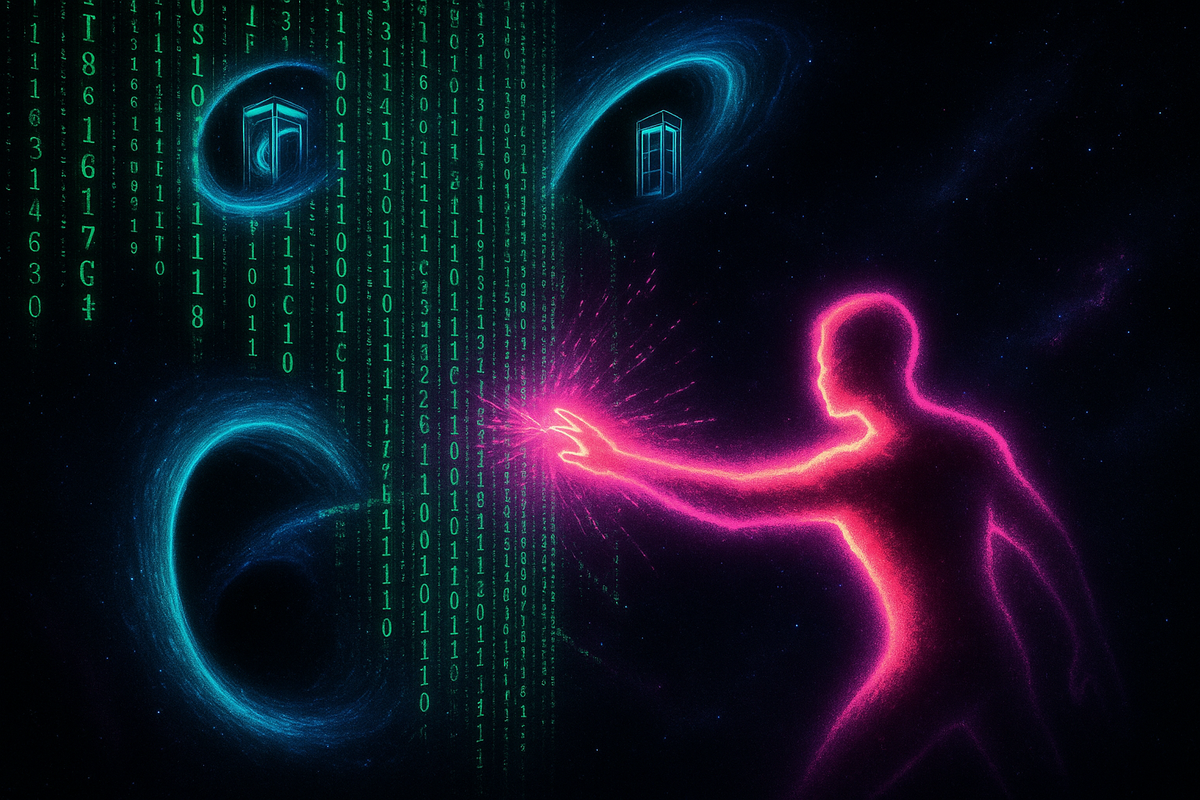
The phone booths in The Matrix are literal wormholes—exits from the simulation that bypass the simulated physics. The training programs are wormholes—ways to gain capability without the normal developmental trajectory.
The paradigm says: shortcuts exist. You don't have to follow the rules. You can find the exceptions, the exploits, the tunnels that skip the normal route.
The Dark Side of Infinite Options
But there's a problem with the Matrix physics: if everything is hackable, nothing has weight.
In Dune, the jihad matters because it cannot be escaped. The deaths are real because the attractor is inescapable. The tragedy has weight because the physics are constraining.
In The Matrix, death is provisional. Rules are malleable. Even the simulation itself can be rebooted.
The sequels struggle with this. When Neo can stop bullets, how do you create tension? When death in the Matrix isn't real death, what are the stakes?
The answer the sequels give—humans can die in the Matrix if they believe they're dying, the real world has real constraints—is philosophically interesting but dramatically unsatisfying.
Expandable possibility space makes narrative harder. If the hero can hack their way out of anything, why do we care if they're in danger?
This is the cost of the paradigm shift. Dune gives you tragedy. The Matrix gives you escape. But escape, infinitely available, becomes cheap.
What Neo's Choices Mean
Here's the reading:
The Matrix reflects a moment when the cultural imagination believed in expanded possibility. Reality seemed hackable. Constraints seemed negotiable. The right knowledge could unlock doors that weren't supposed to exist.
This was the dot-com moment. The "anything is possible" moment. The moment when it seemed like clever people with the right access could rewrite the rules.
Twenty-five years later, that optimism has dimmed. We've learned that some systems have attractors that clever hacking doesn't escape. Climate change isn't a bug to be patched. Inequality isn't a glitch to be exploited around.
Neo had more choices than Paul because the paradigm had shifted. But the paradigm has shifted again. The contemporary imagination is more Dune than Matrix—more interested in systemic traps than in heroic hackers.
The Comparison
Paul Atreides: sees the future, cannot escape the attractor basin, trapped by dynamics he can see but not alter.
Neo: sees the code, can exploit the rules, escapes by accessing layers Paul couldn't reach.
The difference isn't character. It's paradigm.
Herbert wrote from systems-and-ecology thinking: complex dynamics, emergent behavior, attractors.
The Wachowskis wrote from computation-and-code thinking: rules, exploits, simulation.
Both are valid physics metaphors. Both generate different narrative possibilities. And reading them side by side reveals how the cultural imagination shifted between the mid-60s and the late-90s—and what each era believed about the possibility of escape.
Further Reading
- The Wachowskis (1999). The Matrix. Warner Bros. - Thorne, K. (1994). Black Holes and Time Warps. W.W. Norton. - Irwin, W. (ed.) (2002). The Matrix and Philosophy. Open Court.
This is Part 4 of the Science Fiction Mirror series. Next: "[The MCU and Quantum Branching: Maximum Optionality](/mcu-quantum-branching/)."
Comments ()