Maxwell's Demon: The Thought Experiment That Wouldn't Die
A tiny demon sorts molecules by speed, creating order for free — or so it seems. Physicists spent 150 years killing Maxwell's Demon, and the answer turned on the nature of information itself.
Maxwell's Demon: The Thought Experiment That Wouldn't Die
In 1867, James Clerk Maxwell proposed a thought experiment that should have been resolved in a decade. It took 115 years.
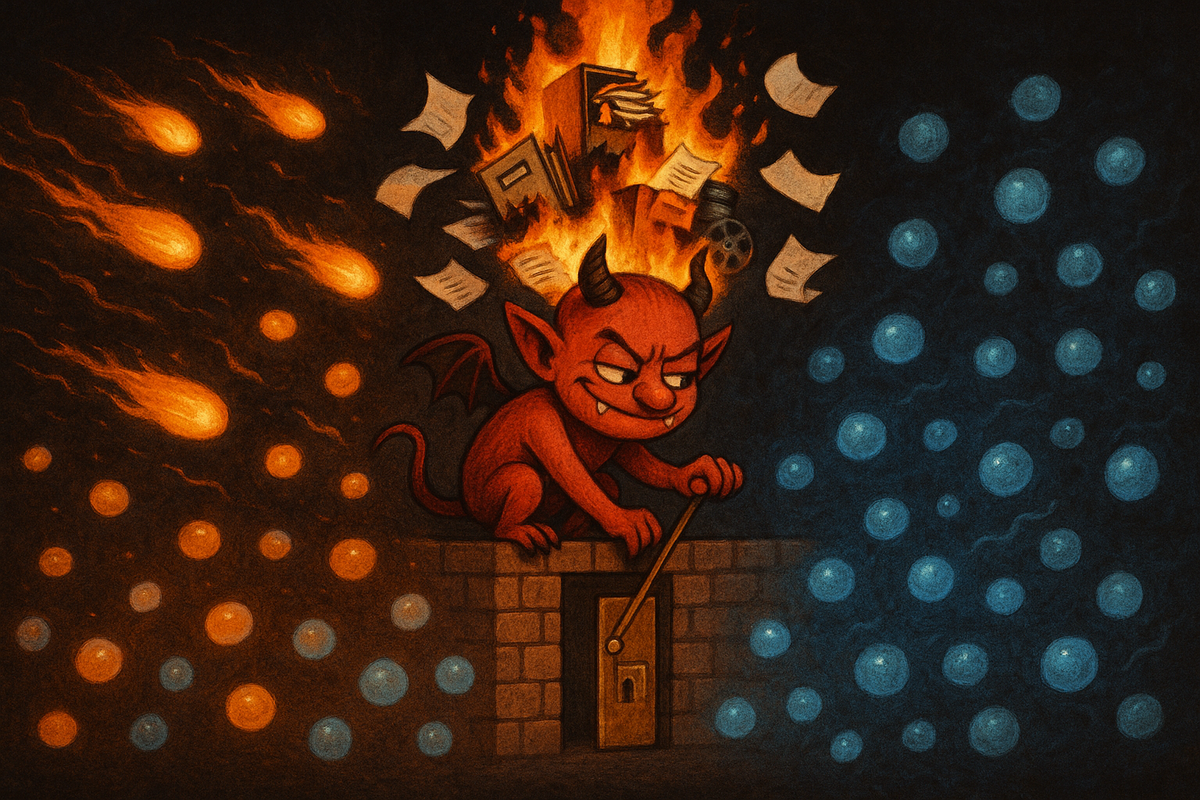
Imagine a box of gas divided by a wall with a tiny door. A demon—a tiny, intelligent being—watches molecules approach. When a fast molecule comes from the left, the demon opens the door to let it pass right. When a slow molecule comes from the right, it opens the door to let it pass left.
After enough time, fast molecules concentrate on the right (hot), slow molecules on the left (cold). A temperature gradient appears from nothing. The demon seems to violate the Second Law—decreasing entropy without doing work.
What's wrong with this picture?
The Problem
The Second Law is absolute: entropy never decreases in an isolated system. Heat doesn't spontaneously flow from cold to hot. You can't get something for nothing.
Yet Maxwell's demon appears to achieve exactly this. It creates a temperature difference—usable for work—from uniform gas. No work input, just information about molecule speeds.
Maxwell called it a "very observant and neat-fingered being." He wasn't trying to break thermodynamics. He wanted to show that the Second Law is statistical, not absolute. A sufficiently clever being might exploit fluctuations.
But the demon raised a deeper question: Is information physical? Can knowledge alone circumvent thermodynamics?
The pebble: Maxwell's demon isn't a cute paradox. It's the question that gave birth to information physics: Where does the entropy go when you measure something?
Early Attempts at Resolution
Smoluchowski's Fluctuations (1912)
Marian Smoluchowski pointed out that any mechanism for the door would be subject to thermal fluctuations. If the demon uses a tiny door, thermal motion would make the door swing randomly, letting molecules through chaotically. The fluctuations would dissipate any advantage.
This was true but unsatisfying. What if the demon is gentle enough? What about measurement?
Szilard's Engine (1929)
Leo Szilard simplified Maxwell's demon to its essence. Imagine a one-molecule gas. The demon measures which side of the box the molecule is in, then inserts a piston on the empty side. The molecule expands and does work (pushing the piston). Remove the piston, measure again, repeat.
Each cycle extracts kT ln 2 of work from thermal motion—apparently for free.
Szilard's insight: the measurement must somehow cost entropy. He proposed that acquiring one bit of information costs at least kT ln 2 of entropy increase. But he couldn't specify where this cost was paid.
The pebble: Szilard saw that information has a thermodynamic price. He just couldn't find the cash register.
Brillouin: The Cost of Observation (1951)
Léon Brillouin tried a different approach. The demon needs to see the molecules. To see them, it must illuminate them with light. But the gas is at equilibrium with its environment—any light used for measurement must be hotter than the gas, or it would provide no information.
The hot light adds entropy faster than the demon removes it. No net gain.
This resolved some cases but not all. What if the demon uses passive detection? What if measurement doesn't require energy input?
Bennett and Landauer: The Cost of Erasure (1961-1982)
The definitive resolution came from computing theory.
In 1961, Rolf Landauer showed that erasing information—not acquiring it—is the irreducible thermodynamic cost. Erasing one bit requires dissipating at least kT ln 2 joules of energy. You can measure for free, in principle. But forgetting has a price.
In 1982, Charles Bennett applied this to Maxwell's demon. The demon can measure molecular speeds and open doors for free. No entropy cost there. But to operate repeatedly, the demon must record information (which molecule went where), and eventually its memory fills up.
To continue operating, the demon must erase old memories. And erasure costs entropy. The total entropy increase from erasure exceeds the entropy decrease from sorting molecules.
The Second Law survives because forgetting is expensive.
The pebble: Maxwell's demon isn't defeated by measuring—it's defeated by memory. To run indefinitely, it must forget, and forgetting produces entropy.
Why Erasure Costs Energy
Consider a bit of memory that can be 0 or 1. Erasure means setting it to a known state (say, 0). Before erasure: two possible states. After erasure: one possible state.
The number of microstates decreased by half. Entropy dropped by k ln 2. The Second Law demands this entropy appear elsewhere—as heat dissipated to the environment.
You can't escape this by clever mechanism. The physical states corresponding to 0 and 1 must merge into one. That merging releases energy into the environment, carrying entropy with it.
This is Landauer's principle: information is physical, and destroying information creates heat.
Information Is Physical
Landauer's insight goes beyond demon exorcism. It establishes that information is not abstract—it's embodied in physical states.
- A bit stored in a transistor: physical (electron arrangements) - A bit stored in neural synapses: physical (molecular configurations) - A bit stored in magnetic domains: physical (spin orientations)
Information requires physical substrate. Manipulating information manipulates physics. Thermodynamics applies to computation.
This connects: - Thermodynamics: entropy, heat, work - Computing: bits, erasure, reversibility - Black hole physics: Bekenstein-Hawking entropy
The demon paradox wasn't solved by retreating from physics—it was solved by extending physics into information.
Reversible Computing
Landauer's principle doesn't say all computation costs energy—only irreversible computation (erasure). In principle, you can compute without erasing, preserving all information, approaching zero energy cost.
Reversible computing designs circuits that never discard information. Every operation can be run backward. No erasure, no Landauer cost.
In practice, reversible computing is hard. Circuits become complex, and perfect reversibility is impossible. But the theoretical possibility is profound: computation doesn't require energy; forgetting does.
Bennett showed that any computation can be made reversible by keeping a record and uncomputing backward. The cost shifts from energy to memory (and time).
Experimental Verification
In 2012, Eric Lutz and colleagues at the University of Augsburg confirmed Landauer's principle experimentally. They trapped a colloidal particle in a two-well potential (representing 0 and 1), erased the bit by forcing the particle into one well, and measured the heat dissipation.
Result: exactly kT ln 2, as Landauer predicted. The demon is really dead.
Further experiments have verified the connection between information and thermodynamics in superconducting qubits, molecular motors, and DNA processing. The physics of information is not philosophy—it's measurable.
Maxwell's Demon in Biology
Living cells are full of Maxwellian systems:
Molecular motors selectively transport molecules, seemingly violating equilibrium. But they're powered by ATP hydrolysis—they pay the entropy tax in chemical energy.
Proofreading enzymes correct DNA replication errors with surprising accuracy. The extra accuracy comes from extra ATP consumption—spending energy to reduce uncertainty.
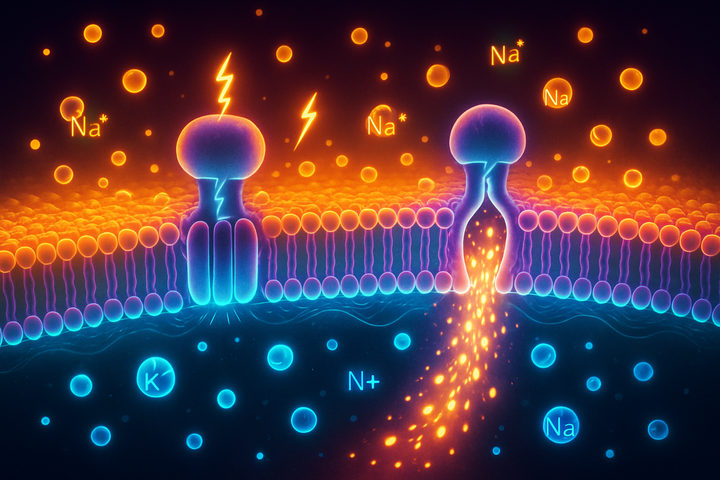
Ion channels select specific ions, creating concentration gradients. They're maintained by active pumps that consume ATP.
Biology doesn't escape thermodynamics; it has learned to manage information flows within thermodynamic constraints. Every cellular operation pays Landauer's price somewhere.
The Demon in Computing
Modern computers dissipate far more than the Landauer limit. A current processor dissipates about 10⁻¹⁵ joules per logic operation; the Landauer limit at room temperature is about 10⁻²¹ joules. We're a million times above minimum.
This overhead comes from: - Irreversible logic (NAND, NOR gates destroy information) - Transistor switching losses - Current leakage - Clock distribution
As transistors shrink and energy constraints tighten, Landauer's limit becomes relevant. Ultimate efficiency requires rethinking computation from thermodynamic first principles.
Black Holes and Information
The demon reached cosmology through black holes.
Jacob Bekenstein showed that black holes have entropy proportional to their surface area. Stephen Hawking showed they radiate. But when matter falls into a black hole, what happens to its information?
If information is destroyed (swallowed and gone), entropy decreases. If information is preserved (somehow encoded in radiation), the Second Law survives.
This "black hole information paradox" remains contentious. But Maxwell's demon is the conceptual ancestor—it established that information and entropy are inseparable.
Lessons from the Demon
Maxwell's demon teaches:
1. Information is physical. Bits require atoms, processing requires energy, measurement has thermodynamic consequences.
2. The Second Law is subtle. You can't violate it by being clever with information. The costs are just hidden in memory and erasure.
3. Thermodynamics connects everything. From molecular gases to computers to black holes, the same laws apply.
4. Thought experiments have bite. A 150-year-old puzzle drove fundamental discoveries in information physics.
The pebble: Maxwell intended a minor illustration of statistical mechanics. He got a century-long research program that connected physics to information, entropy to erasure, and computation to thermodynamics.
Further Reading
- Leff, H. S. & Rex, A. F. (2002). Maxwell's Demon 2: Entropy, Classical and Quantum Information, Computing. CRC Press. - Bennett, C. H. (1982). "The thermodynamics of computation—a review." International Journal of Theoretical Physics, 21(12), 905-940. - Landauer, R. (1961). "Irreversibility and heat generation in the computing process." IBM Journal of Research and Development, 5(3), 183-191.
This is Part 7 of the Laws of Thermodynamics series. Next: "[Synthesis: Why the Laws of Thermodynamics Are Really One Law](/thermodynamics-synthesis/)"

Comments ()