The MCU and Quantum Branching: Maximum Optionality
Marvel's multiverse isn't just plot convenience — it's a philosophical trap. When quantum branching means every outcome happens somewhere, death loses meaning and narrative stakes collapse. Maximum optionality, zero consequence.
The MCU and Quantum Branching: Maximum Optionality
In 2019, Avengers: Endgame became the highest-grossing film of all time.
Its time-travel mechanics are explicitly quantum. Tony Stark solves time travel using a "möbius strip" model derived from quantum mechanics. The heroes travel to the past without creating paradoxes because every trip creates a branching timeline. The multiverse is real.
By 2021, Loki, Spider-Man: No Way Home, and Doctor Strange in the Multiverse of Madness had made the multiverse the organizing principle of the MCU. Every choice creates a branch. Every possibility exists somewhere. The universe is not one thing but an infinite proliferation of timelines.
This is the quantum paradigm fully absorbed into pop culture. And it has a problem: when everything is possible, nothing matters.
The Quantum Multiverse Goes Mainstream
The many-worlds interpretation of quantum mechanics has been around since Hugh Everett proposed it in 1957.
The basic idea: when a quantum measurement has multiple possible outcomes, the universe doesn't "choose" one. Instead, it splits into branches—one for each outcome. All possibilities are realized, just in different branches.
For decades, this remained a specialist concern. Most people didn't know about it, and even physicists debated whether it was real or just a mathematical convenience.
Then pop culture discovered it.
Sliding Doors (1998), Run Lola Run (1998), The Butterfly Effect (2004), Source Code (2011)—films explored branching realities with increasing sophistication. Video games with multiple endings (from Chrono Trigger to Mass Effect) made players accustomed to choosing between branches.
The MCU is the culmination of this trend. It's not exploring branching as a concept—it's assuming branching as the default physics. Of course there are infinite timelines. Of course other versions of characters exist. Of course death can be undone by accessing another branch.
Maximum Optionality
Here's what the quantum multiverse offers: maximum optionality.
In a single-timeline universe, choices are exclusive. You can go to college or start a business. You can marry this person or that person. You can take the job in New York or the job in Seattle. The path not taken is lost.
In a multiverse, every path is taken somewhere. You went to college and started the business—just in different branches. The you who married one person exists alongside the you who married another. Nothing is truly lost because everything is realized.
This seems liberating. No regret! Every choice contains all choices! You can always access the version where things went differently!
But there's a cost.
The Stakes Problem
When everything is possible, stakes collapse.
Avengers: Infinity War ended with Thanos killing half of all life in the universe. Billions died. The heroes lost. It was emotionally devastating.
Then Endgame reversed it. Time travel, quantum mechanics, collect the stones before Thanos, snap everyone back. The deaths were undone.
And audiences felt... something complicated. Relief, yes. Satisfaction at the clever solution. But also a subtle emptiness. The deaths weren't real. They were just one branch that could be overwritten.
When death isn't permanent, what is sacrifice? Tony Stark dies at the end of Endgame—but other versions of Tony exist in other timelines. Black Widow dies—but the multiverse contains infinite Black Widows.
The MCU tries to maintain emotional weight by saying "our" timeline's version is special. But the logic of the multiverse undermines this. If there are infinite yous, what makes this you matter?
The Coherence Drain
The multiverse also drains narrative coherence.
Classic narrative builds toward resolution. Events accumulate. Consequences persist. The story has a shape that emerges from what happened and can't unhappen.
Multiverse narrative loses this. Events don't accumulate—they branch. Consequences don't persist—they exist in some branches and not others. The story can have any shape because any alternative can be accessed.
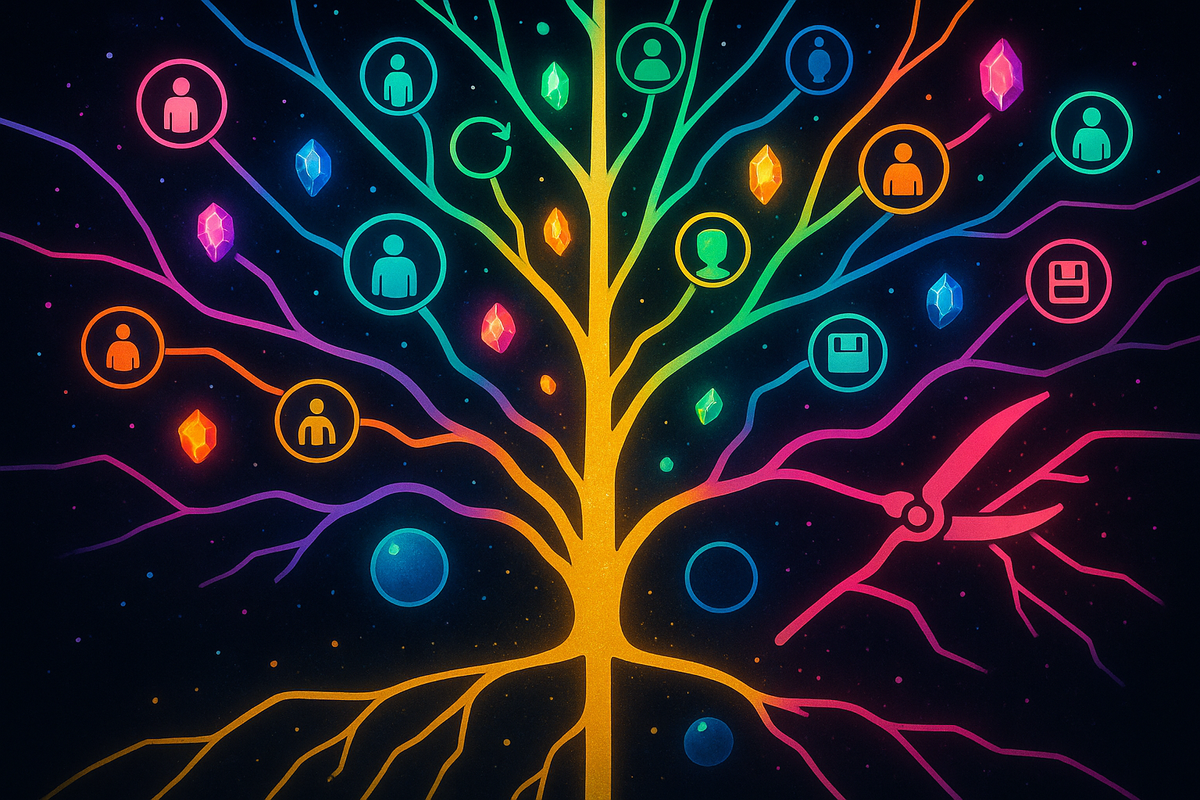
Loki explores this explicitly. The Time Variance Authority prunes timelines that deviate from the "Sacred Timeline." This is the narrative itself trying to maintain coherence—to prevent the story from dissolving into infinite equally-valid variants.
But the logic of the multiverse resists coherence. If everything that can happen does happen somewhere, then narrative is just one arbitrary path through an infinite possibility space. Why does this path matter more than others?
The Commitment Problem
There's a deeper issue: commitment becomes meaningless in a multiverse.
Commitment requires foreclosing options. To commit to one person, you give up others. To commit to one career, you give up alternatives. Commitment has weight because it's exclusive.
But if every option is realized somewhere, you haven't really given up anything. You've just entered one branch while another you entered a different branch. There's no sacrifice because there's no foreclosure.
This affects how we think about character. A hero who sacrifices everything for a cause is meaningful in a single universe—they gave up what they could have had. In a multiverse, another version of them didn't sacrifice. The heroism is diluted.
The multiverse is a fantasy of having it all. But "having it all" means nothing matters because nothing is given up.
The Video Game Aesthetic
The MCU's multiverse logic is essentially video game logic.
In video games, death is temporary. You respawn. You load a save. You try again. The game continues until you find a path that works.
This makes games playable. But it also gives them a specific emotional register. The stakes aren't real in the way novel-stakes or film-stakes traditionally are. You're iterating toward success in a space where failure is just a delay.
The MCU imports this logic into cinema. Characters die and come back. Timelines are rewritten. Failures are retry-able.
For audiences raised on video games, this feels natural. For audiences expecting traditional narrative, it feels weightless.
The paradigm shift is generational. Younger audiences who grew up with save-points and respawns experience multiverse narratives differently than audiences who grew up with linear, consequence-persistent storytelling.
The Commercial Logic
There's a non-philosophical explanation for the MCU's multiverse: it solves business problems.
How do you keep a franchise going when actors age out of roles? Bring in variants from other timelines.
How do you handle continuity errors accumulated over 20+ films? Different timelines have different rules.
How do you create endless content? Infinite timelines = infinite stories.
The multiverse is a continuity cheat code. It allows the studio to do anything without breaking canon, because every contradictory thing exists in some branch.
This is commercially brilliant and narratively corrosive. The more you lean on the multiverse to solve plot problems, the less the plot holds together. The more variants appear, the less the original matters.
What the MCU Says About Now
The MCU reflects the contemporary imagination.
Commitment is scary. A generation facing unprecedented optionality (in careers, relationships, identities) finds relief in stories where you don't have to choose—where all paths are taken.
Consequences feel unjust. If bad outcomes can be rewritten, shouldn't they be? The multiverse is a fantasy of consequence-escape.
Death is negotiable. In an era of life extension research, cryonics, and digital resurrection, permanence feels old-fashioned.
The multiverse paradigm matches a cultural mood that's uncomfortable with limits, suspicious of finality, and hungry for optionality.
But the paradigm has a cost. Meaning requires limits. Sacrifice requires foreclosure. Narrative requires that some things can't be undone.
The MCU's multiverse is entertaining. But its physics make tragedy impossible and heroism diluted. If everything is possible, then nothing—not even death—carries full weight.
The Counter-Paradigm
Some contemporary fiction pushes back.
Christopher Nolan's films (Interstellar, Tenet) explore branching and paradox while maintaining that choices matter and consequences persist.
Everything Everywhere All at Once (2022) embraces the multiverse explicitly but finds meaning through commitment—through choosing this version, this relationship, this life, despite knowing alternatives exist.
The counter-paradigm says: yes, other possibilities exist, but meaning comes from committing to one. The infinite branches are the context; the choice of branch is the content.
This may be where the imagination is heading. Not back to the single universe, but forward to a multiverse where choice despite optionality becomes the source of meaning.
The Paradigmatic Reading
Paul Atreides: constrained by attractors, can see but not escape.
Neo: can hack the rules, finds escape routes.
MCU heroes: everything is possible, but everything is therefore weightless.
Three paradigms. Three possibility spaces. Three different narrative textures.
Dune: tragedy of inescapable dynamics. The Matrix: thriller of exploitable code. MCU: spectacle of infinite optionality.
Each reflects what its era believed about choice, constraint, and consequence. Each shows us the cultural imagination processing what physics means for human possibility.
Further Reading
- Everett, H. (1957). "Relative State Formulation of Quantum Mechanics." Reviews of Modern Physics. - Carroll, S. (2019). Something Deeply Hidden: Quantum Worlds and the Emergence of Spacetime. Dutton. - McMillan, G. (2023). "The MCU's Multiverse Problem." Wired.
This is Part 5 of the Science Fiction Mirror series. Next: "[Asimov's Psychohistory: Statistics as Prophecy](/asimov-psychohistory-statistics/)."
Comments ()