Memes Are Myths: Ancient Brain Hacks in Algorithm Clothing
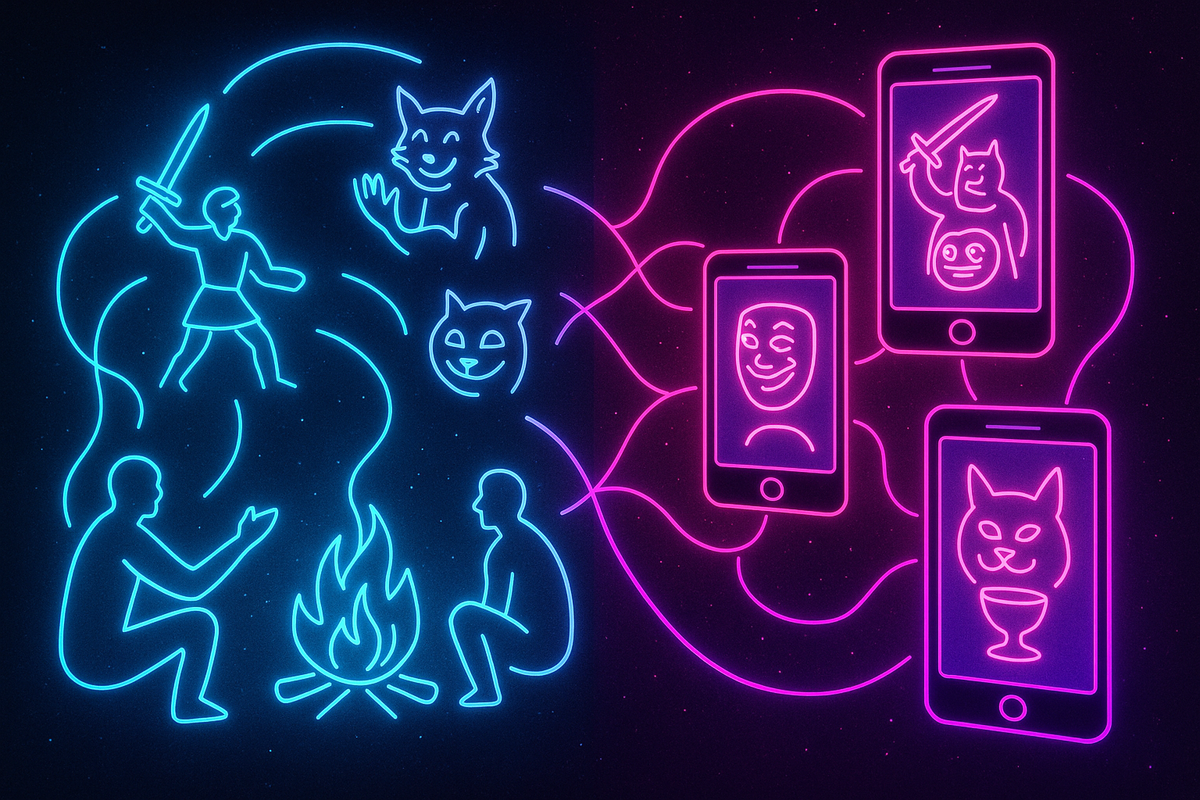
Your brain uses identical neural hardware to process ancient myths and internet memes. The archetypes, the surprise, the social bonding signals—it's all the same mechanism, just running on a faster distribution network.
Memes Are Myths: Ancient Brain Hacks in Algorithm Clothing
Series: Digital Folklore | Part: 1 of 10
You've scrolled past ten thousand of them this year. Image macros. Video formats. Copypasta. Reaction GIFs. Audio clips that trigger instant recognition. They feel disposable, trivial, like cultural junk food. But that's not what they are.
Memes are myths. Not in the colloquial sense of "false belief," but in the anthropological sense: minimal units of cultural meaning that spread because they exploit fundamental features of human cognition. The same neural machinery that made you internalize "don't cry over spilled milk" and "the hero's journey" is what makes "distracted boyfriend" and "this is fine" lodge in your brain and reproduce through your behavior.
The substrate changed—papyrus to pixels, oral tradition to algorithmic feed. The transmission speed changed—generations to seconds. But the underlying mechanism? Identical. Memes are what myths look like at internet speed.
And understanding this changes everything about how you navigate digital culture.
What Myths Actually Do
Let's clear the confusion first. Myths aren't primitive science. They're not just-so stories that pre-scientific cultures told to explain thunder. That's the rationalist misreading, assuming myths failed at being physics textbooks.
Myths are compression algorithms for cultural wisdom. They package complex behavioral instructions, social coordination patterns, and phenomenological truths into memorable, transmissible narrative units. The story of Icarus doesn't explain aerodynamics—it encodes a warning about hubris, overreach, and the danger of ignoring constraints. "The boy who cried wolf" doesn't describe lupine behavior—it compresses a multi-dimensional game-theoretic insight about reputation, credibility, and coordination into a five-minute story a child can internalize.
Myths work because they exploit specific features of human cognition:
Pattern completion — Your brain is a prediction machine. Give it part of a pattern, it completes the rest. Myths provide templates: the hero departs on a journey, faces trials, returns transformed. Once that template is installed, you recognize it everywhere, and it shapes how you interpret your own experience.
Emotional resonance — Dry facts don't stick. Emotionally charged narratives do. Fear, triumph, betrayal, redemption—these create memory consolidation. Myths are soaked in affect, which makes them adhesive.
Social proof — Things that spread are things people care about. If a story survives generations, your brain treats it as important by default. Myths arrive pre-validated by collective attention.
Minimal counterintuitiveness — Not too strange (incomprehensible), not too familiar (boring). Myths often feature one or two tweaks to normal reality—talking animals, immortal gods, magical objects—that make them memorable without overwhelming cognitive load.
Now look at memes. They do all of this.
The Meme as Cognitive Exploit
Richard Dawkins coined "meme" in The Selfish Gene (1976) as cultural replicators analogous to genes. The term was abstract, theoretical. Then the internet made it concrete.
A meme, in the digital folklore sense, is a transmissible unit of culture that replicates through human behavior. It could be an image format (Drake approval meme), a phrase ("it's giving..."), a gesture (dabbing), or an entire narrative frame ("based and redpilled"). The key property: it spreads because it exploits cognitive vulnerabilities.
Take the "distracted boyfriend" meme. Two images: boyfriend looking back at another woman while his girlfriend glares. Why did this template explode? Because it compresses a complex relational dynamic (temptation, betrayal, loyalty conflict) into an instantly recognizable visual schema. Your brain processes it in milliseconds. You can map anything onto that structure—technology stacks, political allegiances, competing research paradigms. It's a pattern-matching shortcut that saves cognitive effort while creating shared understanding.
Or consider "this is fine"—the dog sitting in a burning room, calmly asserting everything is fine. It's not just funny. It's a phenomenological truth about cognitive dissonance, denial in the face of crisis, and the absurdity of maintaining normalcy while systems collapse. Millions of people encountered that image and thought: "That's me. That's what I'm doing." The meme didn't argue a point—it provided a mirror for a widespread psychological state.
This is what myths have always done. Provide templates. Encode psychological truths. Create shared symbolic vocabulary.
Why They Spread: The Dawkins-Boyer Connection
Dawkins gave us the term, but Pascal Boyer gave us the mechanism. Boyer, an anthropologist and cognitive scientist, studied why religious concepts spread. His answer: minimally counterintuitive concepts (MCI theory).
Boyer noticed that successful religious ideas violate intuitive physics or psychology in exactly one or two dimensions while remaining normal in all others. A statue that weeps blood: weird (statues don't cry), but comprehensible (we know what crying means). A virgin birth: counterintuitive (reproduction doesn't work that way), but otherwise normal (babies grow, have mothers). An all-knowing God: one violation (omniscience isn't biologically plausible), everything else familiar (personhood, intentions, communication).
Too many violations and the concept becomes incomprehensible, cognitively expensive, hard to remember. Zero violations and it's boring, not worth transmitting. The sweet spot is one or two counterintuitive elements embedded in an otherwise intuitive framework.
Now look at memes. "Cursed images"—photos that trigger visceral wrongness by violating one or two expectations while remaining recognizable. "Wojaks"—simple faces that shouldn't convey as much emotion as they do, violating our expectation about facial complexity while remaining expressive. "Surreal memes"—images that break logical coherence in exactly the right way to be memorable without becoming noise.
They're minimally counterintuitive. And that's why they stick.
But there's more. Boyer also identified social transmission biases—cognitive shortcuts that make some ideas more likely to spread than others:
- Prestige bias — Copying high-status individuals
- Frequency bias — Copying what most people do
- Content bias — Preferring ideas that trigger strong emotional responses or relate to survival-relevant themes
Memes exploit all of these. Influencers (prestige) amplify memes. Viral spread creates frequency effects (everyone's doing it, so it must matter). Content that triggers outrage, schadenfreude, in-group solidarity, or existential recognition spreads faster than neutral content.
Memes are optimized for transmission through the exact same pathways that made myths spreadable across pre-literate cultures.
The Algorithm Changes Everything (and Nothing)
Here's the twist: algorithms accelerate and shape selection, but they don't change the underlying cognitive mechanisms.
In oral cultures, myths spread person-to-person, constrained by geography and social networks. The selection pressure was: does this story make people want to retell it? Does it encode something useful? Does it stick in memory?
In algorithmic cultures, memes spread through feeds, recommendation engines, engagement metrics. The selection pressure is: does this content make people click, share, comment, linger? Does it trigger the emotional or cognitive responses that platforms optimize for?
The difference isn't in the brain-hacking—it's in the speed and scale. A myth might take decades to spread across a continent. A meme can achieve global saturation in hours.
And platforms introduce new selection pressures. Twitter's character limit breeds compression, punchiness, hot takes. TikTok's algorithm rewards novelty, immediate hooks, high retention. Reddit's upvote system amplifies in-group consensus and punishes deviation. Each platform is a distinct selection environment, breeding folklore optimized for its particular constraints.
But underneath the infrastructure, the cognitive machinery is the same. Your brain doesn't distinguish between a parable from the Bronze Age and a reaction meme from this morning. Both are pattern-matching shortcuts. Both provide symbolic vocabulary for shared experience. Both spread because they exploit how human cognition works.
What This Means for You
If memes are myths—if they're not frivolous noise but functional cultural units using ancient cognitive pathways—then several things follow:
You're not immune. Dismissing memes as trivial doesn't protect you. The mechanisms operate below conscious awareness. If you encounter a well-crafted meme, it installs itself. The only question is whether you notice.
Memes shape perception. Once you have a template—"Karen," "sigma male," "NPC"—you start seeing the world through it. Myths always did this. The hero's journey shapes how you interpret your own life narrative. Memes do the same thing, faster.
Engagement is ritual participation. Sharing a meme isn't passive consumption. It's participating in distributed myth-making. You're signaling group membership, reinforcing shared meaning, contributing to the meme's evolution. This is what oral transmission of myths looked like—but mediated through platforms rather than campfires.
Discernment matters. Not all myths serve you. Some encode useful wisdom. Some manipulate for profit. Some spread because they're cognitively sticky, not because they're true or helpful. Learning to distinguish coherence-supporting narratives from engagement-optimized manipulation is essential literacy for the digital age.
And here's the deepest point: memes are contemporary mythology, and mythology is how cultures create shared meaning. If you want to understand what a culture values, fears, and believes, look at its myths. In 2026, that means looking at its memes.
"OK Boomer" encoded generational frustration and the breakdown of intergenerational coherence. "NPC" reflected anxieties about conformity and authenticity in algorithm-mediated culture. "This is fine" captured the collective experience of maintaining composure while infrastructure burns. These aren't jokes. They're diagnostic tools, revealing the psychological and social dynamics of the moment.
Toward Digital Folklore
We're living through a transition in meaning-making infrastructure. For most of human history, mythology was slow, local, embedded in communities. Now it's fast, global, and algorithmically mediated. The transmission mechanism changed. The cognitive substrate didn't.
Understanding memes as myths clarifies what's at stake. This isn't about cat pictures versus serious culture. It's about how humans create shared symbolic vocabularies, coordinate understanding, and transmit wisdom (or manipulation) across populations.
The question isn't whether you participate in digital folklore. You already do, every time you scroll. The question is whether you participate consciously or unconsciously. Whether you recognize the patterns. Whether you develop discernment about what mythologies you internalize and propagate.
Because the same mechanisms that make "don't cry over spilled milk" a timeless proverb make "just one more video" an addictive compulsion. The same cognitive architecture that encodes the hero's journey encodes engagement-optimized brain hacks designed to maximize time-on-platform.
Memes are myths. Myths are powerful. And power requires responsibility.
In the next article, we'll go deeper into the structure of memes as mythemes—the minimal units that Lévi-Strauss identified in traditional mythology and that now recombine and mutate in digital folklore at unprecedented speed.
This is Part 1 of the Digital Folklore series, exploring memes, fandoms, and world-building as contemporary mythology.
Next: The Meme as Mytheme: Units of Cultural Transmission Then and Now
Further Reading
- Dawkins, R. (1976). The Selfish Gene. Oxford University Press.
- Boyer, P. (2001). Religion Explained: The Evolutionary Origins of Religious Thought. Basic Books.
- Blackmore, S. (1999). The Meme Machine. Oxford University Press.
- Shifman, L. (2014). Memes in Digital Culture. MIT Press.
Comments ()