You're Outnumbered: The Bacteria Running Your Body
The human microbiome isn't a stable ecosystem — it's a dynamic negotiation between hundreds of species and your immune system. What tips that balance toward health or disease is one of the most active areas in current biology.
You're Outnumbered: The Bacteria Running Your Body
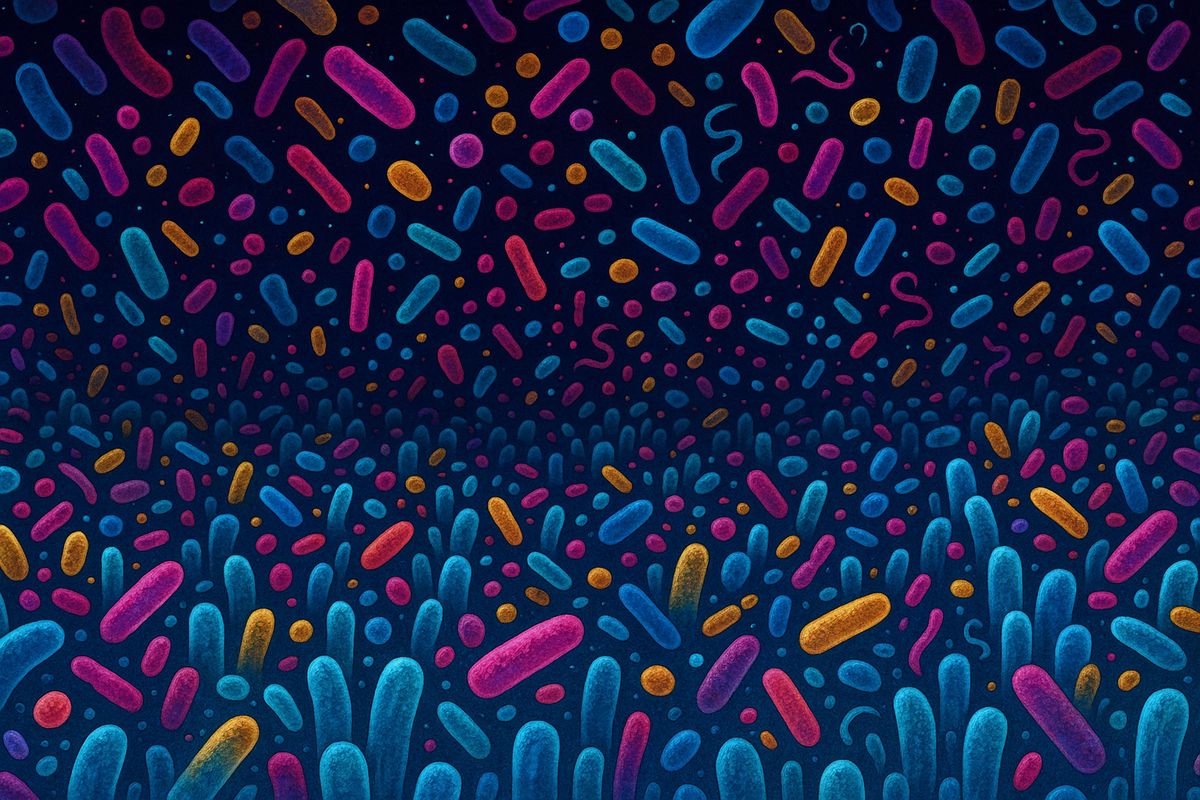
The numbers are dizzying. Your body contains approximately 38 trillion bacteria. That's about the same as the number of human cells—maybe slightly more, maybe slightly less, depending on how you count. But the number isn't the point. The point is that you're roughly half bacteria by cell count. By gene count, it's not even close. Your human genome contains about 20,000 genes. The collective genome of your microbiome—the microbiome's "metagenome"—contains 2-20 million genes, depending on the estimate. You carry 100 times more microbial genes than human genes. Where did these organisms come from? What are they doing? And why does it matter? Welcome to your microbiome. You've been hosting it your entire life. It's time to meet the guests. You're not a single organism. You're a superorganism—a host plus its microbial partners, functioning as an integrated whole.
How You Acquired Your Microbiome
You weren't born with a microbiome. You picked it up. In the womb, the fetus is essentially sterile (though some recent research questions this). Birth is the first major colonization event. Babies born vaginally acquire bacteria from the mother's birth canal—primarily Lactobacillus species. Babies born by C-section miss this exposure and instead are colonized by skin bacteria. This matters. C-section babies have different microbiome compositions that persist for months or years. Some studies link C-section birth to higher rates of asthma, allergies, and obesity—possibly mediated through microbiome differences. The associations are real but the causality is debated. After birth, colonization continues rapidly:
- Breastfeeding provides both bacteria (from the skin, from milk itself) and oligosaccharides that feed specific bacterial species. Human milk contains sugars that human enzymes can't digest—they exist specifically to nourish infant gut bacteria.
- Environment matters. Pets, siblings, household surfaces, outdoor exposure—all contribute to microbial diversity.
- Diet shapes the developing microbiome. Introduction of solid foods triggers major shifts.
By age 2-3, the gut microbiome resembles an adult pattern. But it remains dynamic—changing with diet, antibiotics, illness, age. Your microbiome is acquired, not inherited. The bacterial community you're carrying was assembled from your environment over the first years of life.
What They're Doing
The microbiome isn't passive. It's metabolically active—collectively more active than your liver. Digestion. Human enzymes can't break down many complex carbohydrates—fiber, resistant starch, certain plant polysaccharides. Gut bacteria can. They ferment these compounds, producing short-chain fatty acids (SCFAs) like butyrate, acetate, and propionate. SCFAs nourish the gut lining, regulate inflammation, and provide energy. Fiber isn't just bulk. It's food for your bacteria, and their metabolites affect your health. Vitamin synthesis. Gut bacteria produce vitamins K and B12, biotin, folate, and other compounds that you absorb. Animals raised germ-free (without microbiomes) develop vitamin deficiencies unless supplemented. Drug metabolism. Gut bacteria modify pharmaceuticals—sometimes activating them, sometimes inactivating them. The efficacy of certain drugs depends on which bacteria you carry. Personalized medicine may eventually account for microbiome composition. Bile acid transformation. The liver produces bile acids; gut bacteria transform them into secondary bile acids with different properties. These transformations affect lipid metabolism, inflammation, and even immune signaling. Neurotransmitter production. Gut bacteria synthesize neurotransmitters including serotonin, dopamine, and GABA. Most of the body's serotonin is produced in the gut. Whether bacterial neurotransmitters directly affect the brain is debated, but gut-brain signaling is real. Immune modulation. The microbiome constantly trains the immune system—teaching it to tolerate commensals while remaining vigilant against pathogens. This education is critical, especially in early life. The gut microbiome isn't a separate system. It's integrated with your metabolism, your immunity, your neurology.
The Diversity Factor
Microbiome diversity—how many different species you carry—appears to matter. Higher diversity is generally associated with better health outcomes. Lower diversity is associated with conditions including inflammatory bowel disease, obesity, type 2 diabetes, and depression. Why would diversity matter? Several hypotheses: Functional redundancy. With many species, multiple microbes can perform each function. If one species declines, others compensate. The system is resilient. Niche filling. Diverse communities fill ecological niches completely, leaving no room for pathogens to establish. An "open" microbiome is vulnerable. Broader metabolic capabilities. More species means more collective enzymes, more metabolic pathways, more potential functions. Modern life may reduce microbiome diversity. Antibiotics kill bacteria indiscriminately. Processed diets lack the fiber that feeds diverse communities. Sanitation reduces environmental exposure. The "Western microbiome" may be impoverished compared to traditional populations. Studies of hunter-gatherer communities and rural populations in developing countries consistently find higher microbiome diversity than urban Westerners. We may be missing something. The modern microbiome might be a depleted ecosystem—still functional, but less resilient and less capable than our ancestors'.
Antibiotics and Disruption
Antibiotics are miracle drugs. They're also microbiome disruptors. A single course of antibiotics can dramatically reduce gut bacterial diversity. Some species recover; others may be permanently lost. The microbiome after antibiotics isn't the same as before—even months later. This isn't always harmful. If you have a life-threatening bacterial infection, antibiotics are clearly worth the microbiome disruption. But routine antibiotic use—for viral infections, minor illnesses, prophylactically—has cumulative effects. Early-life antibiotics are particularly concerning. Several studies link antibiotic exposure in infancy to higher rates of asthma, allergies, and obesity later in childhood. The developing microbiome and immune system may be especially vulnerable. The gut microbiome can also harbor antibiotic resistance genes. Heavy antibiotic use selects for resistant bacteria. The microbiome becomes a reservoir of resistance that can transfer to pathogens. None of this means antibiotics are bad. It means they're powerful tools with consequences. Use them when needed, not casually.
Diet: The Main Lever
If you want to change your microbiome, change your diet. Fiber is the primary food for fermentative bacteria. High-fiber diets promote diverse, SCFA-producing communities. Low-fiber diets starve these bacteria and shift composition toward different species. Fermented foods contain live bacteria—yogurt, kefir, sauerkraut, kimchi, miso. These bacteria may colonize transiently or provide benefits during their passage. The evidence for specific fermented foods is variable, but the general principle is sound. Diversity of plant foods seems to matter. A study found that people who eat 30+ different plant foods per week have more diverse microbiomes than those who eat 10 or fewer. Variety feeds variety. Red meat and processed foods are associated with microbiome profiles linked to inflammation. The mechanisms may involve bacterial metabolism of certain nutrients. Artificial sweeteners have been shown in some studies to alter microbiome composition and glucose tolerance. The evidence is mixed but worth noting. Diet changes can shift microbiome composition within days, though some effects take longer. The microbiome is remarkably responsive to what you eat. The microbiome is the interface between diet and health. What you eat doesn't just nourish you—it nourishes your bacterial partners, who then influence your physiology.
The Individuality Problem
Here's a complicating factor: microbiomes are highly individual. Two healthy people can have dramatically different gut bacteria. There's no single "healthy microbiome"—there's a range of configurations compatible with health. This makes research hard. If you're testing whether a probiotic works, the effect might depend on who the person is, what bacteria they already have, and what ecological niches are available. A probiotic that helps one person might do nothing for another. Personalized microbiome medicine is the goal: understand your specific microbiome, design interventions tailored to it. We're not there yet. Current tools and understanding are too crude. But individuality also suggests opportunity. Your microbiome isn't fixed. It can be changed. If we understand it better, we might be able to steer it toward healthier states.
What We Don't Know
Let's be honest about the gaps. Causation versus correlation. Many microbiome-disease associations are correlational. Does dysbiosis (abnormal microbiome) cause disease, or does disease cause dysbiosis? Both directions probably occur, but disentangling them is hard. Which species matter? We can catalog who's there, but we often don't know which species are functionally important and which are passengers. Mechanisms. For many microbiome effects, we don't know the mechanisms. How exactly does gut microbiome affect brain function? Multiple pathways—vagal nerve, immune signaling, metabolites—but specifics are unclear. Therapeutic applications. Beyond fecal transplants for C. diff, microbiome-based therapies are mostly unproven. Probiotics have limited evidence. Precision microbiome engineering is conceptual. The field is young. The first big microbiome studies were only 15 years ago. Understanding is advancing rapidly, but claims often outpace evidence.
The Superorganism
Here's the paradigm shift. You're not a human with hitchhikers. You're a superorganism—a composite entity, part human and part microbial, functioning as an integrated whole. The microbiome isn't foreign. It's part of you, evolutionarily and functionally. Humans evolved with microbiomes. The partnership is ancient. Your physiology assumes microbial partners are present. This reframing matters. Killing bacteria isn't always good. Sterility isn't health. The goal isn't to eliminate microbes but to cultivate the right ones. Health is ecological. You're tending an ecosystem, not maintaining a machine.
Further Reading
- Human Microbiome Project Consortium. (2012). "Structure, function and diversity of the healthy human microbiome." Nature.
- Sender, R., Fuchs, S., & Milo, R. (2016). "Revised Estimates for the Number of Human and Bacteria Cells in the Body." PLOS Biology.
- Sonnenburg, J., & Sonnenburg, E. (2015). The Good Gut: Taking Control of Your Weight, Your Mood, and Your Long-Term Health. Penguin.
- Lynch, S. V., & Pedersen, O. (2016). "The Human Intestinal Microbiome in Health and Disease." New England Journal of Medicine.
This is Part 1 of the Microbiome Revolution series, exploring the bacterial world within us. Next: "The Gut-Brain Axis: Your Second Brain."


Comments ()