Living With Your Multitudes: A Coherence Synthesis
The holobiont framing isn't metaphor — it has testable predictions. Your microbiome is a functional organ that coevolved with you, and the coherence between host and microbes is as important as the genetics of either.
Living With Your Multitudes: A Coherence Synthesis
Series: Microbiome Revolution | Part: 8 of 8 Primary Tag: FRONTIER SCIENCE Keywords: microbiome, holobiont, coherence, ecosystem, health, symbiosis
The Ecosystem Self
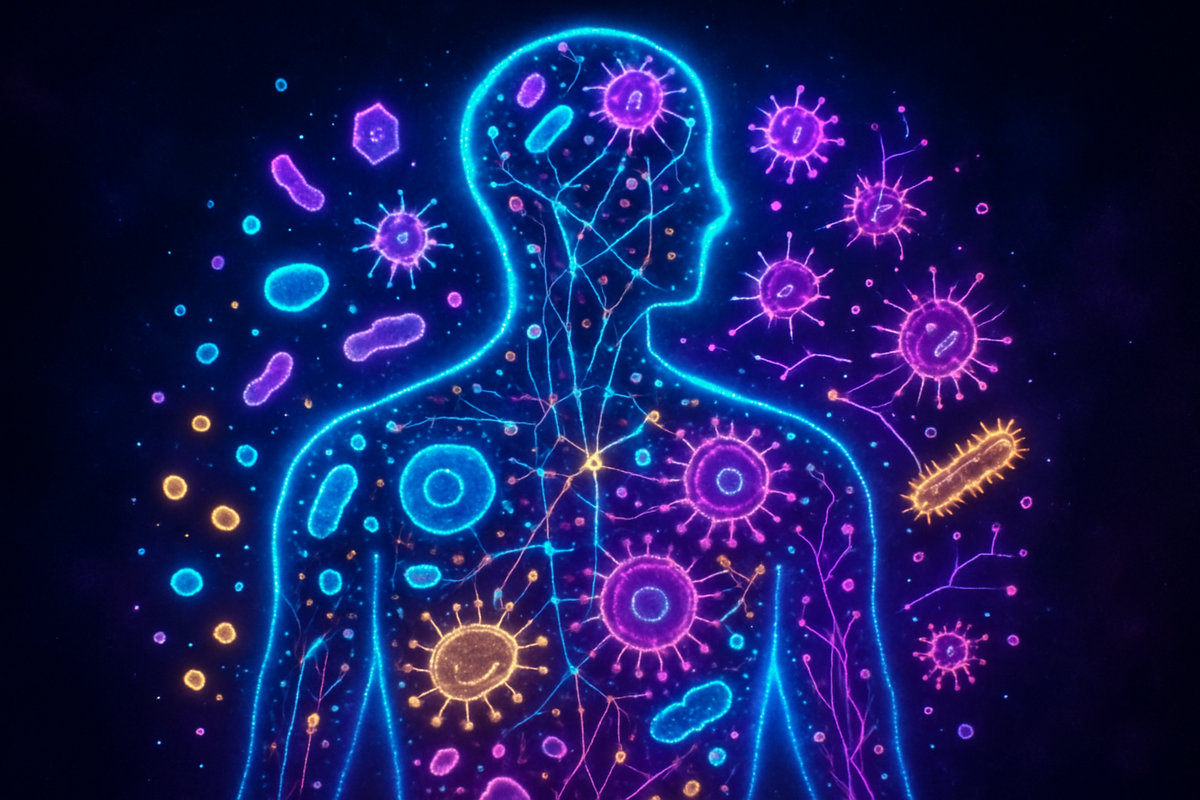
The first implication is that the self is porous. You didn't earn your microbiome. You inherited it—from your mother during birth, from family members during infancy, from every environment you've ever inhabited. It's shaped by every antibiotic you've taken, every meal you've eaten, every pet you've owned, every soil you've walked on. And it's constantly changing. Your microbiome today isn't your microbiome from ten years ago. Species rise and fall. New bacteria colonize and leave. The community drifts, perturbed by events, settling into new configurations. Yet there's continuity. Your microbiome is distinctively yours—stable enough over time to identify you, personal enough to resist standardization. It's like a river: always flowing, never the same water, yet recognizably the same river. The philosophical implications are strange. If your microbiome influences your mood, your cognition, your food preferences—and it does—then who exactly is making your choices? The bacteria didn't ask permission before shaping your cravings. The gut-brain axis operates below conscious awareness. Some of what you call "you" is bacterial influence on neural function. This isn't threatening. It's clarifying. The unified self was always a convenient fiction. What we experience as singular identity is actually distributed processing—neurons, glia, hormones, immune cells, and bacteria all contributing to the emergent pattern we call consciousness. You contain multitudes. And the multitudes contain you.
The Coherence Frame
Throughout this series, we've used "coherence" as a lens. Let's make explicit what that means. A coherent system is one whose parts maintain stable relationships through dynamic interaction. Not static—dynamic. A coherent system can be perturbed and return to equilibrium. It can adapt to changing conditions while preserving essential patterns. It resists dissolution into chaos without freezing into rigidity. The microbiome is a paradigm case of coherence: Internal coherence: The microbiome maintains itself through competitive relationships (bacteria compete for resources), cooperative relationships (some bacteria feed others' waste products), predatory relationships (phages regulate bacterial populations), and community-level properties (diversity promotes stability). No central controller orchestrates this—it's emergent coordination. Host-microbiome coherence: The microbiome and host are coupled. The immune system calibrates to the microbiome; the microbiome responds to immune signals. Diet shapes bacterial composition; bacteria shape nutrient extraction and appetite. Stress hormones alter the gut; gut signals alter brain function. These bidirectional couplings create a unified system. Coherence as health: The pattern across microbiome research is remarkably consistent. Health associates with diversity, stability, and appropriate responsiveness. Disease associates with reduced diversity, instability, and dysregulated responses—what we might call incoherence. Inflammatory bowel disease: incoherent gut ecosystem, unstable community structure, inappropriate immune activation. Allergies and autoimmunity: incoherent immune training, failure to calibrate tolerance appropriately. Obesity and metabolic disease: incoherent metabolic signaling, disrupted energy homeostasis. Mental health disorders with microbiome associations: incoherent gut-brain axis, dysregulated neurotransmitter production. The specific bacteria involved vary. The pattern doesn't. Coherence is health. Incoherence is disease.
Beyond Reductionism
Microbiome science is fundamentally anti-reductionist. The reductionist dream was that we'd identify the cause of disease—a gene, a pathogen, a deficiency—and fix it. One target, one intervention. This worked brilliantly for some conditions. Smallpox is caused by variola virus; eliminate the virus, eliminate the disease. Phenylketonuria is caused by a single gene mutation; control phenylalanine intake, prevent damage. But most chronic diseases don't work this way. They're not caused by single factors. They emerge from system-level dysregulation. The reductionist lens keeps looking for the bacteria that causes obesity, the gene that causes depression, the toxin that causes autism. And keeps not finding them—because they're asking the wrong kind of question. The microbiome teaches a different lesson: it's the pattern, not the parts. No single bacterial species is universally beneficial or harmful. Context matters. A bacterium that helps in one community might harm in another. A species that's beneficial at certain abundance becomes problematic at overgrowth. The whole configuration—which species, in what proportions, with what functions, in what host—determines outcome. This is why probiotic interventions so often disappoint. Throwing a few bacterial species into a complex ecosystem rarely shifts the system's attractor state. It's like trying to fix traffic congestion by adding a few specific cars. And it's why ecosystem-level interventions—fecal transplant, dietary fiber, fermented foods—sometimes work dramatically. They don't target specific components; they shift the entire landscape.
The Limits of Current Understanding
Let's be honest about what we don't know. We can describe, but barely predict. We can characterize microbiome composition in health and disease. We can identify associations. But we can't reliably predict who will develop which condition based on microbiome data, or design interventions that reliably work for specific individuals. We understand correlation better than causation. Most microbiome-disease associations are correlational. Does the microbiome cause the disease, does the disease cause the microbiome shift, or does a third factor cause both? Establishing causation requires intervention studies, which are harder and slower. Individual variation swamps population trends. Population-level findings often don't translate to individuals. The microbiome that's "healthy" varies so much between people that defining a universal target is probably impossible. We know gut best, and gut imperfectly. Skin, oral, respiratory, urogenital microbiomes are less studied. The virome and mycobiome (fungal communities) are even further behind. We're seeing pieces of a picture whose whole we can't yet resolve. Mechanisms remain mysterious. For most microbiome-health associations, we don't know the molecular mechanisms. We can observe that microbiome composition predicts outcome, but the causal chain connecting bacterial community to physiological effect is often black-boxed. The microbiome field is young. Genomic methods that made it possible have only been affordable for about fifteen years. We're in the descriptive phase, building maps of what exists. The mechanistic and therapeutic phases will follow, but slowly.
Practical Wisdom From Incomplete Science
What can you actually do with this knowledge? Dietary fiber is the closest thing to a universal recommendation. Across studies, populations, and conditions, higher fiber intake associates with microbiome diversity and better health outcomes. This isn't complicated: eat vegetables, legumes, whole grains, fruits. Diversity of plant foods feeds diversity of bacteria. Fermented foods are probably beneficial and certainly not harmful. The evidence is weaker than for fiber, but the traditional pattern is consistent: cultures with high fermented food consumption have lower rates of many chronic diseases. Yogurt, kefir, sauerkraut, kimchi, miso, kombucha—these aren't magic, but they're probably good. Avoid unnecessary antibiotics. When you need antibiotics, take them. But "need" should be defined by medical necessity, not convenience. Every antibiotic course disrupts the microbiome. For self-limiting infections that would resolve anyway, the microbiome cost may exceed the benefit. Early life matters disproportionately. If you're making decisions about childbirth, infant feeding, or antibiotic use in young children, the microbiome implications are real. Vaginal birth, breastfeeding when possible, limited antibiotic exposure, and diverse environmental contact (pets, outdoor play, farms if accessible) all support microbiome development. Stress management is microbiome management. Chronic stress disrupts the gut through well-characterized pathways. Whatever reduces your stress—exercise, meditation, social connection, therapy—likely benefits your microbiome. Skepticism toward miracle cures. Any product claiming to revolutionize your microbiome with a simple intervention is almost certainly overselling. The system is too complex for easy fixes. This doesn't mean nothing works; it means be wary of anything that promises too much.
The Medicine of the Future
Where is this heading? Personalized microbiome medicine. Instead of generic probiotics, interventions tailored to your specific microbiome composition. This requires cheap sequencing (already available), algorithms that can predict responses (not yet available), and validated interventions (in development). Defined microbial consortia. Instead of fecal transplants with their infectious disease risks and lack of standardization, designed combinations of specific bacterial strains for specific conditions. The first of these are entering clinical use for C. diff; more will follow. Phage therapy. Precision bacterial killing without antibiotic side effects. The antibiotic resistance crisis is driving investment; the science is advancing. Within a decade, phage therapy will likely be routine for some infections. Dietary prescriptions. Not diet fads, but evidence-based dietary patterns for specific conditions, designed to shift microbiome composition toward therapeutic targets. This already works for some conditions (ketogenic diet for epilepsy involves microbiome changes); it will expand. Integration with other "omics". Microbiome data combined with genomics, metabolomics, proteomics, and electronic health records to build comprehensive models of individual health. This is the long-term vision of precision medicine. Mental health applications. Psychobiotics—microbial interventions for psychiatric conditions—are in early development. The gut-brain axis is bidirectional. If we can learn to drive it therapeutically, some mental health conditions might become partly treatable through the gut. This is fifteen to thirty years out for most applications. The science is real, but translation takes time.
What It Means to Be a Holobiont
Let's end with the philosophical question we started with. You are a holobiont. A multi-species collective. A human genome plus thousands of microbial genomes in constant interaction. What does this mean? It means health is ecology. You're not a machine that can be repaired part by part. You're an ecosystem that maintains itself through dynamic relationships. Health care becomes ecosystem management—cultivating conditions that favor beneficial configurations rather than targeting specific components. It means boundaries are negotiable. Where do "you" end and "not you" begin? The bacteria in your gut are genetically foreign but functionally integral. The mitochondria in your cells were once free-living bacteria. The endogenous retroviruses in your genome were once infectious agents. Life's boundaries are fuzzy, permeable, continuously renegotiated. It means we're not alone. Even in solitude, you're in relationship. Trillions of organisms depend on you for habitat; you depend on them for function. The self that feels isolated is actually teeming with collaborative activity. It means evolution is layered. Your human genome changes slowly. Your microbiome can shift in days. This faster-evolving layer lets you adapt to new environments, new diets, new challenges faster than genetic evolution alone could. You carry an evolutionary accelerator. It means meaning is distributed. If the microbiome influences mood, cognition, behavior—and it does—then meaning-making isn't purely a neural activity. It's a systems property. Your sense of the world is co-constructed by organisms that have no sense at all. Somehow, meaning emerges from the whole.
The Pebble We Started With
Eight essays ago, we began with a simple observation: you are outnumbered. The bacteria in your body exceed your human cells. The viruses exceed both. We've traced what this means across domains. The gut as the center of microbial mass. The brain as an endpoint of gut signaling. Fecal transplants as ecosystem restoration. Probiotics as mostly hype with pockets of promise. The immune system as microbiome student. The virome as bacterial predator and regulator. The skin, mouth, and other sites as distinct biomes in a connected landscape. Through it all, one pattern: coherence is health, incoherence is disease. Systems that maintain themselves through dynamic balance function well. Systems that lose their coupling, their diversity, their self-regulatory capacity become pathological. This isn't a new truth. Traditional medicine traditions have known for centuries that health is balance, that the body is an interconnected whole, that healing requires restoring harmony. What's new is the molecular detail. We can now see what "balance" means at the microbial level. We can sequence coherence. We can measure harmony. The microbiome revolution isn't a paradigm shift away from scientific medicine. It's an expansion of scientific medicine to encompass what was always true but hidden: we are not individuals. We are ecosystems. We are communities. We contain multitudes. And those multitudes, properly tended, contain us.
Further Reading
- Gilbert, J.A. & Lynch, S.V. (2019). "Community ecology as a framework for human microbiome research." Nature Medicine.
- Zmora, N., Suez, J., & Elinav, E. (2019). "You are what you eat: diet, health and the gut microbiota." Nature Reviews Gastroenterology & Hepatology.
- Bordenstein, S.R. & Theis, K.R. (2015). "Host biology in light of the microbiome: ten principles of holobionts and hologenomes." PLOS Biology.
- Lynch, S.V. & Pedersen, O. (2016). "The Human Intestinal Microbiome in Health and Disease." New England Journal of Medicine.
- Sonnenburg, J. & Sonnenburg, E. (2016). The Good Gut. Penguin.
This concludes the Microbiome Revolution series. For more Frontier Science explorations of cutting-edge biology, visit the Series Hub.


Comments ()