Mind Beyond the Brain: The 4E Revolution in Cognitive Science
Cognition isn't brain-bound computation — it's embodied, embedded, enacted, and extended. The 4E revolution changed what it means to have a mind, and neuroscience is still catching up.
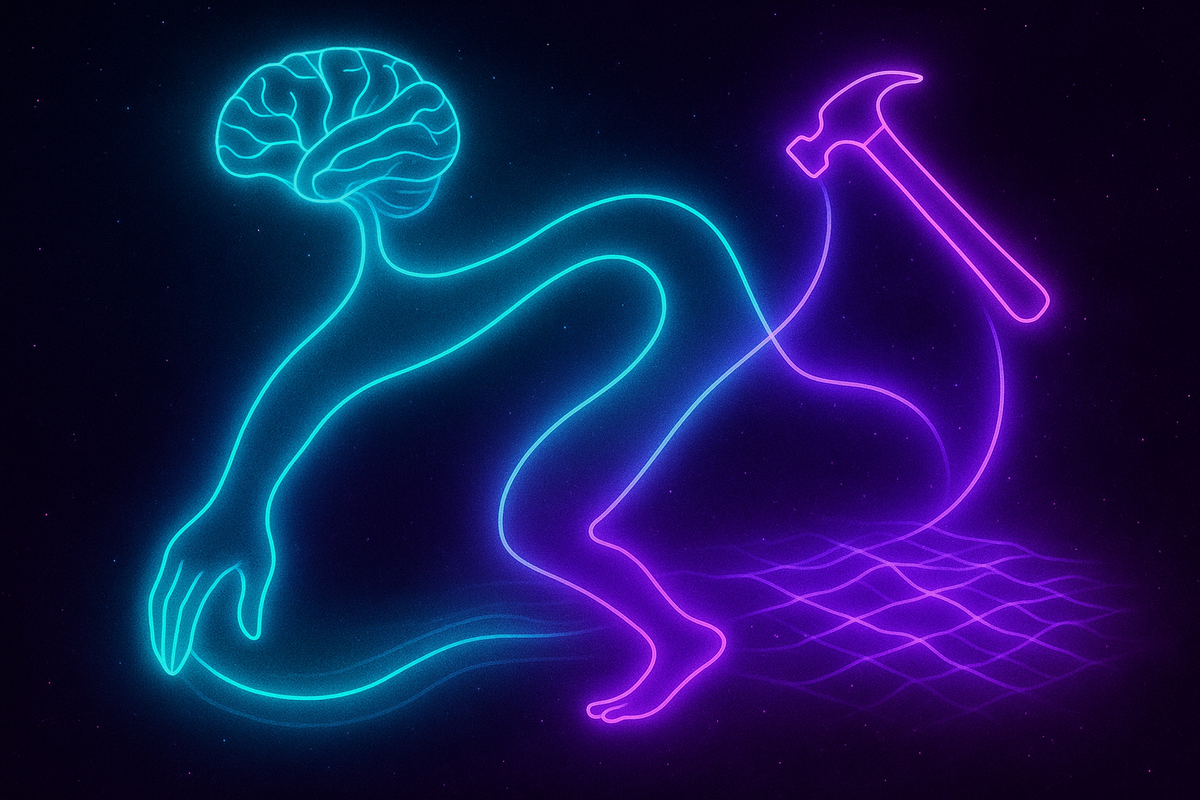
Mind Beyond the Brain: The 4E Revolution in Cognitive Science
Series: 4E Cognition | Part: 1 of 9
For most of the twentieth century, cognitive science had a brain problem. Not a lack of brains to study—plenty of those—but a tendency to look only at what happened inside the skull and call everything else "environment." Cognition was computation. Thinking was information processing. The mind was software running on neural hardware, isolated from the messy world outside.
Then something shifted.
A loose coalition of researchers—philosophers, neuroscientists, roboticists, anthropologists—started asking uncomfortable questions. What if cognition doesn't happen in the brain but through the brain's coupling with body and world? What if the boundaries we draw around "mind" are more about conceptual convenience than natural joints in reality?
This is the 4E revolution: the recognition that cognition is fundamentally embodied, embedded, enacted, and extended. Not four separate claims, but four faces of a single reorientation—away from brain-bound computation and toward understanding minds as dynamic patterns emerging from organism-environment coupling.
The shift sounds abstract. The consequences are profound. If 4E theorists are right, then autism isn't a broken brain but a different body-environment fit. Anxiety isn't a neural malfunction but a coherence mismatch between prediction and sensation. Intelligence doesn't require neurons at all—it requires the right kind of coupling.
This is cognitive science after the skull stops being the boundary.
The Cartesian Theater and Why It Had to Close
René Descartes gave us a compelling image: a theater of the mind where sensory information gets projected onto an internal screen for the conscious self to observe. The image stuck—not because it was right, but because it felt right. It preserved the intuition that thinking happens "in here" while the world stays "out there."
Cognitive science inherited this architecture. Early AI researchers built systems that took input, processed it internally, then generated output. Early neuroscientists looked for where perception "becomes" conscious experience. The whole research program assumed a clear inside/outside boundary, with cognition happening on the inside.
The problem: the more carefully you look, the harder it becomes to say where "inside" ends.
Consider catching a baseball. Classical cognitive science would model this as: visual input → internal computation → motor output. But actual catchers don't compute trajectories—they run to keep the ball at a constant visual angle. The world does much of the computational work. The cognition is distributed between brain, body, and environment.
Or consider expert navigation. Polynesian wayfinders cross thousands of miles of open ocean without instruments, using stars, wave patterns, bird behavior. Are they doing complex internal computation? Or are they embedded in an environment rich with navigational information, reading structure that's out there?
The classical model makes cognition mysteriously expensive. The 4E model makes it explicable: minds don't replicate the world internally—they couple with it.
The Four E's: Not Labels But Lenses
Embodied: Cognition depends on the kind of body you have. You think through your body, not just with your brain.
Embedded: Cognition depends on environmental structure that supports and scaffolds processing. The world is part of the cognitive system.
Enacted: Cognition is sense-making through action. You don't perceive then act—perception and action are coupled in ongoing loops.
Extended: Cognitive processes can literally extend beyond biological boundaries into tools, technologies, and social systems.
These aren't competing theories—they're complementary perspectives on the same underlying reality. A reality where boundaries between mind and world are more negotiable than we thought.
Embodied: The Body That Thinks
Your hand isn't a peripheral device for your brain. Your gut isn't just processing food—it's processing information that shapes mood and decision. The particular morphology of your body—its size, weight distribution, sensory resolution—structures what you can perceive and how you can act.
This sounds obvious until you realize how radical it is. If cognition is embodied, then there's no such thing as "pure" abstract thought. Even mathematics happens through spatial metaphors (numbers on a line), bodily action (counting on fingers), and visceral intuition (this solution "feels" right).
Bodies aren't housing for minds. Bodies are part of minds.
Embedded: The World That Computes
You don't need to remember everything—you can write things down. You don't need to track complex patterns internally—you can arrange the environment to make patterns visible. Chess masters don't memorize positions through brute force—they exploit the structure of legal moves embedded in the game itself.
Embeddedness means that intelligence isn't measured by isolated processing power but by how well systems exploit environmental regularities. An ant navigating to food doesn't need an internal map—it follows pheromone gradients. The "cognition" is in the coupling.
This has implications for AI. Systems trained in impoverished environments become brittle. Systems embedded in rich structure become robust. Intelligence emerges from fit, not from internal complexity alone.
Enacted: Perception Through Action
You don't see then move. You move in order to see. Perception is an achievement—something you do, not something that happens to you.
Francisco Varela, Evan Thompson, and Eleanor Rosch's The Embodied Mind (1991) made this explicit: cognition is enaction—the bringing forth of a world through sensorimotor engagement. What you perceive depends on what you're trying to do. The perceptual world is enacted through the particular ways you couple with it.
Consider color perception. Is color "out there" in wavelengths? Not really—wavelengths are continuous, but color categories aren't. Is color "in here" in neural firing? Not exactly—different organisms with different needs carve the spectrum differently. Color is enacted through the coupling of organism and environment.
This dissolves the subject-object dichotomy. There's no neutral observation point. Every perception is already action-inflected.
Extended: The Mind That Leaks
In 1998, Andy Clark and David Chalmers published "The Extended Mind," arguing that cognitive processes can literally include non-biological elements. When you use a notebook to store information, that notebook isn't helping your memory—it is part of your memory system.
The criterion: functional equivalence. If a process plays the same functional role as internal cognition, it counts as cognition, regardless of where it's located.
This means smartphones extend working memory. Spreadsheets extend calculation. Languages extend reasoning. Social networks extend attention. The mind doesn't stop at the skull—it sprawls across whatever substrate reliably couples to support cognitive function.
Critics object: where does it end? If mind extends into tools, does it extend into the whole universe? The 4E response: boundaries are real but context-dependent. The relevant system is determined by the coupling—tight, reliable, functionally integrated coupling makes something part of the cognitive system.
Why 4E Matters: Beyond Neurocentric Reductionism
The default assumption in cognitive science is still neurocentric: if you want to understand cognition, study brains. The 4E revolution says: that's like trying to understand flight by studying bird muscles while ignoring air.
Neurodiversity Reframed
Autism becomes less "social cognition deficit" and more "different sensorimotor coupling." If cognition is enacted through particular body-environment loops, then autistic individuals aren't missing something—they're enacting different sensorimotor worlds.
Stimming isn't pathological—it's coherence maintenance through rhythmic coupling. Preference for predictable environments isn't rigidity—it's adaptive given higher sensory precision. The deficit model dissolves when you stop locating cognition exclusively in neural computation.
Therapy as Environmental Restructuring
If cognition is embedded, then therapeutic interventions don't need to target brains directly. Changing environmental structure—lighting, sound, spatial organization—changes cognition. This is obvious to anyone with ADHD who works better in coffee shops, or anyone with anxiety who calms near water.
The mystery isn't why environment affects cognition. The mystery is why we ever thought it didn't.
AI as Coupling, Not Simulation
Current AI systems are mostly disembodied—language models trained on text, vision models trained on images. They achieve impressive performance but remain brittle because they don't enact cognition through sensorimotor loops.
Robotics researchers know this. Rodney Brooks's subsumption architecture showed that intelligent behavior emerges from situated agents coupling with environments, not from complex internal representation. Behavior-based robotics works because it respects embodiment, embeddedness, and enaction.
The next generation of AI won't be larger language models—it will be embodied agents learning through interaction.
The Geometry of Extended Coherence
In AToM terms, 4E cognition is the recognition that coherence doesn't respect anatomical boundaries. The relevant system for maintaining prediction-action loops can include body, tools, environment, social structures—whatever is tightly coupled enough to function as an integrated whole.
Embodiment means coherence is maintained through body-brain coupling. You can't separate neural dynamics from proprioceptive feedback, autonomic regulation, gut-brain signaling. The coherence manifold includes the whole organism.
Embeddedness means environmental structure reduces internal processing demands. You maintain coherence by offloading computation onto reliable external regularities—gravity, object permanence, social conventions.
Enaction means coherence emerges through sensorimotor loops, not internal representation. You don't build models then act—you act, perceive the consequences, adjust. The coherence is in the coupling.
Extension means the coherence boundary can literally extend beyond skin. When tools become transparent—when you stop thinking about the pen and just write—they've been incorporated into the prediction-action loop. The system maintaining coherence includes the tool.
This is why losing a phone feels like losing part of yourself. It's not metaphor. It was part of the system maintaining your cognitive coherence.
What's Coming: The Series Ahead
This series explores each E in depth, then examines their intersection with active inference, neurodiversity, and coherence geometry:
Part 2: Embodied Cognition — How physical bodies shape minds. From gut-brain coupling to the role of gesture in thinking.
Part 3: Embedded Cognition — How environmental structure supports cognition. From epistemic actions to distributed intelligence.
Part 4: Enacted Cognition — Perception as action-dependent sense-making. From sensorimotor contingencies to the enactive origins of meaning.
Part 5: Extended Cognition — When mind leaks into world. From cognitive scaffolding to the extended mind hypothesis.
Part 6: The Boundaries of Mind — Where does cognition stop? The theoretical debates about extending too far.
Part 7: 4E Meets Active Inference — How embodied free energy minimization unifies the E's through a single mathematical framework.
Part 8: 4E Cognition and Neurodiversity — Reframing difference through embodied, embedded, enacted, extended lenses.
Part 9: Synthesis — 4E cognition and the distributed nature of coherence. Why AToM requires minds beyond brains.
Further Reading
- Varela, F. J., Thompson, E., & Rosch, E. (1991). The Embodied Mind: Cognitive Science and Human Experience. MIT Press.
- Clark, A., & Chalmers, D. (1998). "The Extended Mind." Analysis, 58(1), 7-19.
- Chemero, A. (2009). Radical Embodied Cognitive Science. MIT Press.
- Gallagher, S. (2017). Enactivist Interventions: Rethinking the Mind. Oxford University Press.
- Thompson, E. (2007). Mind in Life: Biology, Phenomenology, and the Sciences of Mind. Harvard University Press.
This is Part 1 of the 4E Cognition series, exploring how cognitive science moved beyond the brain.
Comments ()