Synthesis: The Symbiont Within
The mitochondria story connects endosymbiosis, maternal inheritance, oxidative stress, and the evolution of multicellular life. Here's how those threads weave into a single, stranger picture of what you are.
Synthesis: The Symbiont Within
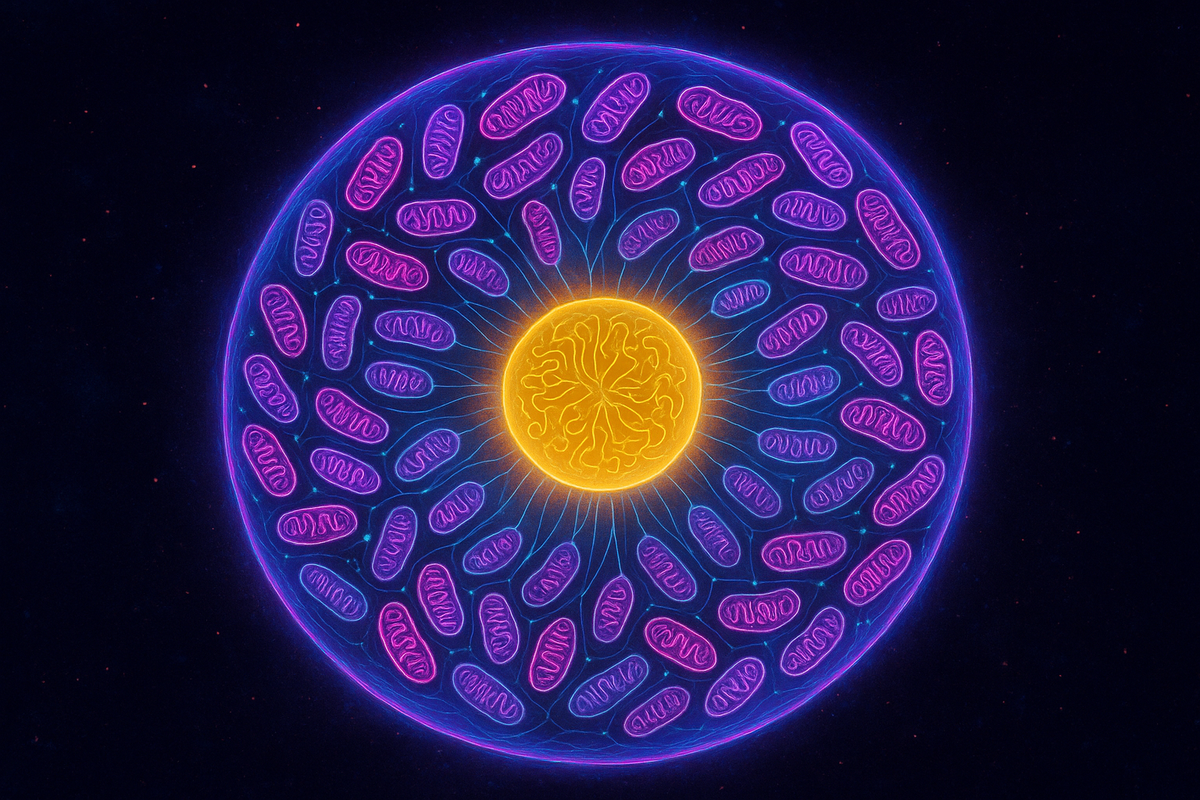
Let's pull it together. We've traced mitochondria from their bacterial origins to their central role in cellular energy, from their separate genome to their implications for aging and disease, from their quality control systems to their presence at the heart of cancer metabolism, from their inheritance patterns to the radical technology that allows us to swap them between individuals. Now the synthesis: what does it mean to be a collaboration? You are not one organism. You are a partnership that has been running for two billion years.
The Energy Paradigm
Mitochondria made complex life possible. Before the merger, cells were limited by surface area. Energy production happened at the cell membrane. To get more energy, you needed more membrane. But more membrane meant larger cells, which meant logistical problems: longer diffusion distances, more material to maintain, less efficient organization. Mitochondria broke the constraint. By internalizing energy production, cells could pack far more ATP-generating capacity into the same volume. The inner mitochondrial membrane, folded into cristae, provides enormous surface area. A single cell can contain thousands of mitochondria. This surplus energy funded everything that came after: the complex cytoskeleton, the elaborate gene regulation, the ability to phagocytose (engulf other cells), the evolution of multicellularity and differentiated tissues. Bacteria have been around for nearly four billion years. They've never independently evolved true complexity—no tissues, no organs, no nervous systems. They couldn't. They didn't have the power. Energy is the constraint on complexity. Mitochondria broke the constraint. All complex life follows.
The Vulnerability
The deal has costs. Mitochondria are necessary and dangerous. They produce the reactive oxygen species that drive aging. Their DNA mutates faster than nuclear DNA, accumulating damage over a lifetime. When they malfunction, they can trigger cell death or cancer. Their quality control systems—mitophagy, biogenesis—must operate continuously or dysfunction accumulates. The electron transport chain is a tightly coupled system. Damage anywhere cascades. The proton gradient that powers ATP synthesis also creates the oxidative pressure that degrades the system over time. The engine wears itself out. NAD+ declines with age, and mitochondrial function declines with it. The sirtuins that depend on NAD+ lose activity. DNA repair falters. The vicious cycles of aging spin up. The power plant that enabled complexity also contains the seeds of its degradation. Energy and entropy are coupled.
The Inheritance Pattern
Mitochondria are inherited maternally. Your mitochondrial genome came from your mother's egg. The sperm's mitochondria were destroyed. This creates an unbroken maternal lineage reaching back through every ancestor who passed through a female body, all the way to Mitochondrial Eve and beyond, to the original merger. The maternal inheritance pattern has evolutionary logic—it avoids competition between lineages—but it creates problems. There's no sexual recombination to purge bad mutations. The mitochondrial genome has to maintain itself through selection on individuals, not through the shuffling that nuclear DNA enjoys. Mitochondrial diseases cascade through maternal lines. Heteroplasmy creates random outcomes—siblings with wildly different mutation loads. The genetic counseling for affected families is agonizing. And now we can intervene. Mitochondrial replacement therapy allows us to switch the mitochondrial lineage while keeping the nuclear genome. Three genetic contributors, two legal parents, one healthy child. We're learning to edit the partnership. The implications are still unfolding.
Identity and Cooperation
The mitochondrial story is, at its core, a story about cooperation. Two organisms merged. Neither survived independently—the free-living bacterium became the mitochondrion; the host cell became the eukaryote. What emerged was something new, something neither could have been alone. This isn't the typical Darwinian narrative of competition and survival. It's a narrative of fusion and interdependence. The fittest weren't the most competitive; they were the most cooperative. Lynn Margulis saw this clearly. She spent her career arguing that symbiosis—not just competition—was a major force in evolution. The eukaryotic cell is Exhibit A. Cooperation at the cellular level made complex life possible. Evolution is not only about struggle. It's also about partnership.
Coherence at the Cellular Level
The AToM framework sees meaning as emerging from coherence—from patterns that integrate information and maintain themselves over time. Mitochondria are central to cellular coherence. Energy coherence: ATP levels must be maintained within bounds. Too low, and the cell starves. Too high, and resources are wasted. The elaborate regulation of oxidative phosphorylation, the feedback from AMP/ATP ratios, the signaling through AMPK—all maintain metabolic coherence. Quality coherence: Damaged mitochondria must be cleared. Mitophagy identifies and destroys dysfunctional organelles. Biogenesis replaces them. The cell maintains its mitochondrial population not by preserving the same organelles forever but by continuously renewing them. Genomic coherence: The nuclear and mitochondrial genomes must cooperate. Mito-nuclear coevolution has fine-tuned their interaction over billions of years. When they're mismatched—as in some hybrids or when mitochondria are swapped between lineages—dysfunction can follow. Coherence is not stasis. It's dynamic stability maintained through continuous activity. Mitochondria are where much of that activity happens.
The Metabolism of Complexity
Here's a way to think about what mitochondria do. Complexity requires organization. Organization requires energy. Energy comes from capturing order from the environment and dissipating entropy. Mitochondria are entropy dissipaters. They take high-energy electrons from food and cascade them down to oxygen, capturing some of the energy as a proton gradient, then converting that gradient into ATP. The overall effect is to take chemical order (glucose) and convert it into useful work (ATP) plus waste heat (entropy exported to the environment). This is thermodynamics. It's also what makes you possible. The complexity of your brain—100 billion neurons, 100 trillion synapses, trillions of signaling events per second—is paid for by mitochondrial ATP production. The complexity of your immune system, your genome, your development from a single cell to an organized body—all paid for in ATP. Complexity is expensive. Mitochondria pay the bill.
What Mitochondria Teach
The mitochondrial story teaches several lessons: Origins matter. We are built from an ancient symbiosis. The structure of our cells reflects a history we share with all eukaryotes—a history that goes back to a singular merger event two billion years ago. We carry our history in every cell. Cooperation can be more powerful than competition. The merger that created eukaryotes wasn't a victory of one organism over another. It was a partnership that created something greater than either partner. Evolution includes symbiosis. Constraints shape possibilities. Energy limits what life can do. The mitochondrial merger lifted energy constraints and enabled complex life. Other constraints—perhaps we haven't identified them yet—may be limiting what we can become. Maintenance is ongoing. The mitochondrial partnership requires continuous upkeep. Quality control, genome coordination, damage clearance—the relationship persists because both parties invest in maintaining it. Coherence requires work. Identity is complicated. The boundary between self and other blurs at the cellular level. Your mitochondria are not entirely you. They have their own genome, their own interests. You are a collaboration, not a single unified entity.
The Open Questions
Much remains unknown—and the frontiers are expanding. Why do we age? Mitochondria are deeply involved, but causation remains disputed. Does mtDNA damage drive aging, or is it a consequence? The mitochondrial mutations that accumulate with age correlate with dysfunction, but correlation isn't causation. Mice engineered to have higher mtDNA mutation rates do age faster—but the mutations accumulate in patterns that don't quite match natural aging. Does NAD+ decline matter, and can restoring it help? Clinical trials are underway. The mitochondrial theory of aging is plausible but unproven—and may be only part of a larger story. What controls mitochondrial dynamics? Mitochondria fuse, divide, and move within cells in response to signals we're only beginning to understand. The proteins involved—mitofusins, OPA1, Drp1—are identified, but the regulatory logic is incompletely mapped. How does the cell decide which mitochondria to keep and which to destroy? What sensors detect dysfunction? How do mitochondrial networks communicate across cellular space? The emerging field of mitochondrial medicine depends on answers we don't yet have. What is the full function of mitochondria? We keep discovering new roles. Mitochondria handle calcium, mediating cell signaling. They produce metabolites that regulate gene expression. They activate the immune system through released mtDNA. They decide whether cells live or die through apoptosis pathways. Are there functions we haven't identified yet? Almost certainly. The organelle that was once dismissed as a simple power plant turns out to be a signaling hub, a metabolic integrator, a decision-maker. Can we therapeutically manipulate mitochondria? Beyond MRT, researchers are pursuing mitochondrial transplantation—injecting healthy mitochondria into failing tissue. It sounds improbable, but early results in cardiac ischemia are intriguing. Gene therapy targeting mtDNA mutations is in development. Small molecules that boost mitochondrial biogenesis are in trials. The targets are there. The interventions are still largely preclinical. The gap between "mitochondrial dysfunction causes disease" and "we can fix mitochondrial dysfunction" remains wide. What are the long-term consequences of MRT? The first children born through mitochondrial replacement are still young. We won't know the full safety profile for decades. Will the donor mitochondria function perfectly with the recipient's nuclear genome? Will there be mito-nuclear incompatibilities we can't predict? The technology is advancing faster than our ability to assess long-term outcomes. Can we reprogram the mitochondrial genome? CRISPR works in the nucleus; mitochondria have been harder to reach. But base editors and other technologies are starting to enable targeted mtDNA modifications. If we can edit mitochondrial mutations, the therapeutic implications are profound. If we can enhance mitochondrial function beyond normal, the enhancement implications are even more so.
The Symbiont Within
Two billion years ago, a bacterium took up residence inside another cell. It gave up its independence. It transferred most of its genes. It became an organelle. But it kept its essential function: generating ATP through oxidative phosphorylation. It kept its own genome, its own replication, its own inheritance pattern. The deal worked. It's still working, in every eukaryotic cell on Earth. You are not a single organism. You are a partnership. Your thoughts, your movements, your very existence depend on the continuous cooperation between your nuclear genome and the remnants of that ancient bacterial symbiont. The mitochondria are not you. They're your partners. They're the bacterial engines that make your complexity possible. Two become one. One becomes possible. The story continues in every cell of your body, right now, billions of times per second, until it doesn't.
Further Reading
- Lane, N. (2015). The Vital Question: Energy, Evolution, and the Origins of Complex Life. W.W. Norton.
- Margulis, L. (1998). Symbiotic Planet: A New Look at Evolution. Basic Books.
- Wallace, D. C. (2013). "A Mitochondrial Bioenergetic Etiology of Disease." Journal of Clinical Investigation.
- Nicholls, D. G. (2013). Bioenergetics. Academic Press.
This concludes the Mitochondria Mythos series. The bacterial engines at the heart of complex life have powered our evolution, shaped our aging, and raised questions about identity, inheritance, and what it means to be a living thing. The symbiont within continues its work.
Comments ()