Morphogenetic Fields as Markov Blankets: The Statistical Boundaries of Development
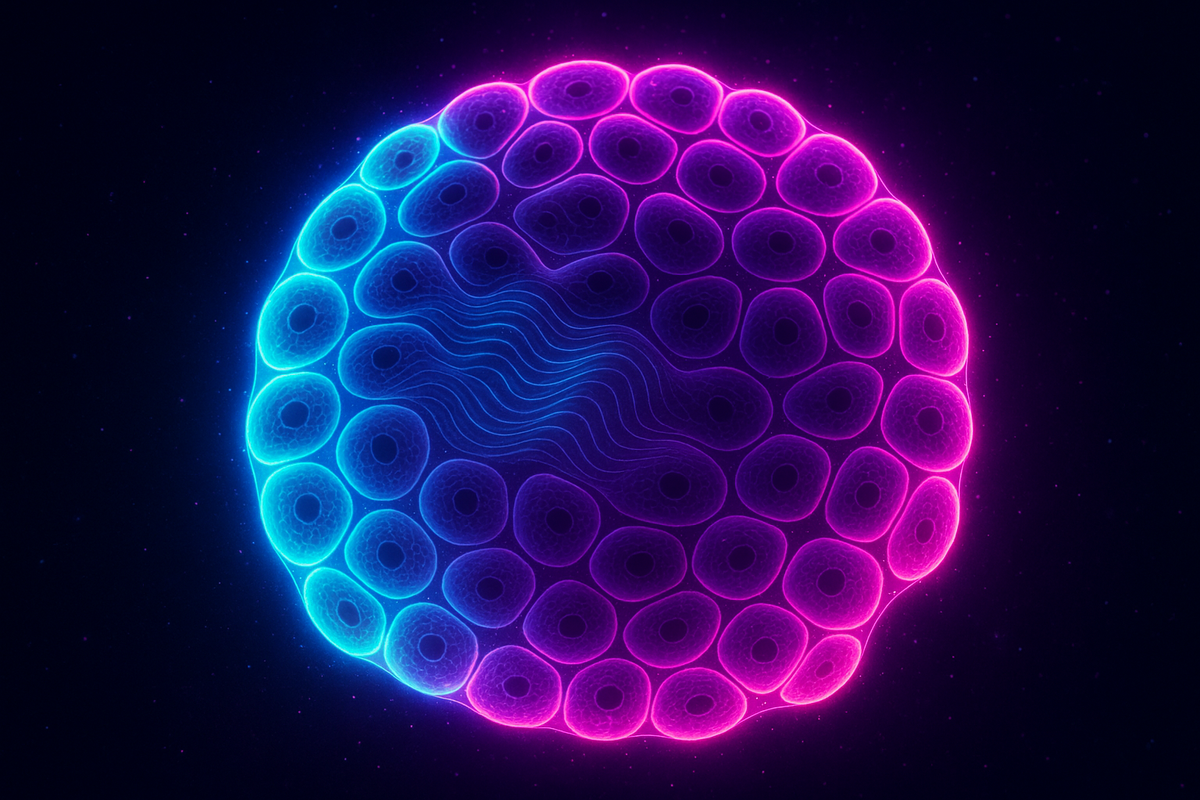
Friston's Markov blankets describe how any system maintains a boundary between self and world. In development, that boundary is bioelectric: a morphogenetic field keeping cellular collectives coordinated while insulating them from outside noise. The same principle at a different scale.
Morphogenetic Fields as Markov Blankets: The Statistical Boundaries of Development
Series: Basal Cognition | Part: 4 of 11
The boundary between you and not-you seems obvious. Your skin marks the limit. Inside is self, outside is environment.
But your cells don't experience this boundary. They're bathed in fluids that connect to the larger world. Molecules pass freely through membranes. Energy flows continuously from food to heat. The physical border is porous, negotiable, constantly being reconstructed.
Yet somehow, despite this material flux, you persist as a coherent entity. Your cells coordinate their behavior. They maintain your form. They distinguish between processes that preserve your organization and processes that threaten it.
How? What defines the boundary between system and environment when matter itself provides no clear division?
The answer lies in a mathematical structure called a Markov blanket—and Michael Levin's morphogenetic fields turn out to be a physical implementation of exactly this statistical boundary at the cellular collective scale.
What a Markov Blanket Actually Is
The concept comes from Karl Friston's Free Energy Principle, but it's worth understanding on its own terms first.
A Markov blanket is a statistical boundary. It's the set of states that separates a system from its environment in a specific way: external states can only influence internal states through the blanket, and internal states can only influence external states through the blanket.
Think of it like this: if you want to know what's happening outside your house, you look through windows or listen at doors. The windows and doors are the Markov blanket—the interface layer that mediates all information flow between inside and outside.
Crucially, this isn't about physical barriers. It's about conditional independence. External states and internal states become statistically independent of each other once you condition on the blanket states. The blanket screens off the interior from the exterior, informationally speaking.
In Friston's framework, the Markov blanket has two parts: sensory states (how the environment affects the system) and active states (how the system affects the environment). Sensory states are windows. Active states are doors. Together, they define the boundary that makes a thing a thing.
For an organism, this gets implemented physically. Your sensory neurons detect environmental perturbations. Your motor neurons execute actions that change the environment. The sensory-active boundary defines what counts as "you"—not because of where molecules are located, but because of how information flows.
Now here's where it gets interesting: if Markov blankets define systems at the scale of organisms with nervous systems, what defines systems at the scale of developing tissues without neurons?
Bioelectric fields, it turns out, are doing exactly the same job.
Morphogenetic Fields Are Statistical Boundaries
Let's revisit what we learned in previous essays: a developing tissue maintains bioelectric patterns—voltage gradients across cell populations that encode target morphologies. These patterns guide collective behavior, coordinating millions of cells to build and maintain anatomical structures.
But we can now be more precise about what this coordination actually accomplishes: it creates and maintains a Markov blanket at the tissue level.
Consider a regenerating planarian fragment. The cells at the wound edge don't have direct information about cells hundreds of micrometers away. Chemical signals diffuse too slowly. Physical forces dissipate over distance. Yet somehow the fragment "knows" what it's supposed to rebuild.
The bioelectric field is how this knowledge gets maintained. Voltage patterns create long-range coordination that effectively partitions the tissue into regions: cells that are part of the organized collective (internal states), cells at the boundary interfacing with the environment (blanket states), and the disordered space beyond (external states).
The bioelectric gradient isn't just measuring a physical property—it's implementing a statistical boundary that defines which cells belong to the regenerating system and which don't.
Here's the critical insight: cells within the morphogenetic field are conditionally independent of the external environment, given the field state. A cell deep in the tissue doesn't need to know what's happening outside the wound. It only needs to know its position within the voltage pattern. The field itself—maintained by cells at the boundary—screens off external variation.
This is a Markov blanket. It's just implemented in voltage rather than neurons.
Sensory and Active States in Development
If morphogenetic fields function as Markov blankets, we should be able to identify the sensory and active components. And we can.
Sensory states: Cells at the tissue boundary detect environmental conditions. Is there mechanical stress? Are nutrients available? Is the temperature stable? These cells express specialized ion channels that convert physical and chemical perturbations into changes in membrane voltage. The voltage pattern updates based on environmental input.
Active states: The same boundary cells influence the environment through their collective activity. They secrete extracellular matrix. They generate mechanical forces. They recruit immune cells or blood vessels. These actions modify the environment to make it more compatible with continued development.
The cells in the interior don't directly sense or act on the external world. They're computing based on the bioelectric pattern—the field state that summarizes what the boundary cells are detecting and doing.
This is precisely the structure Friston describes: internal states minimize free energy with respect to the blanket, and blanket states mediate the coupling between internal and external dynamics. The morphogenetic field is the blanket. The voltage pattern encodes the generative model. Cells navigate this landscape to minimize prediction error about what they should become.
Levin's experiments confirm this structure. When you manipulate the bioelectric pattern at the boundary of regenerating tissue, you change what the interior cells build—even though those interior cells haven't been directly perturbed. The boundary is controlling internal behavior by modulating the statistical structure that defines the system.
Change the blanket, change the organism.
The Nested Hierarchy of Biological Blankets
Here's where things get recursive: Markov blankets compose. You can have blankets within blankets within blankets, creating nested hierarchies of organization.
A single cell has a Markov blanket—its membrane and ion channels mediating information flow. Cells within a tissue collectively create a higher-level blanket through bioelectric field boundaries. And tissues within an organism create the organism-level blanket through skin, sensory organs, and motor systems.
This is why Levin's work is so profound: the computational architecture we associate with brains—maintaining boundaries, making predictions, acting to fulfill those predictions—operates at every scale of biological organization.
Your neurons implement Markov blankets using synaptic connections. Your tissues implement them using bioelectric fields. Your cells implement them using membrane proteins. The substrate changes. The logic doesn't.
And here's the implication: if Markov blankets define systems at every scale, then "where do I end and the world begin?" has multiple valid answers, depending on which blanket you're asking about.
Identity isn't a fixed location. It's a scale-dependent statistical structure.
Why Blankets Can Fail: The Problem of Boundary Dissolution
If morphogenetic fields are Markov blankets, then cancer becomes legible as boundary dissolution.
Remember what a Markov blanket does: it maintains conditional independence between internal and external states. Internal cells coordinate with each other through the field. External perturbations get filtered through the boundary. The tissue operates as a coherent collective because the blanket is intact.
Now consider what happens when cells lose connection to the bioelectric pattern. They stop participating in the collective computation. They no longer receive information about where they are in the morphogenetic field. The boundary that would normally screen them off from external variation becomes permeable.
These cells revert to a more ancient mode of operation: respond directly to local conditions, grow when nutrients are available, divide when space permits, spread when possible. This isn't defective behavior—it's the default unicellular strategy, the one that evolution encoded billions of years before multicellularity emerged.
But in the context of a multicellular organism, this strategy is catastrophic. Cells that break free from the Markov blanket become tumors. They're not malfunctioning—they're functioning perfectly well as independent agents. They've just stopped being part of the larger system.
Levin's reconceptualization of cancer frames it precisely this way: oncogenesis is the loss of participation in the collective bioelectric field. The Markov blanket that defined tissue identity develops holes. Internal states that should have been conditionally independent of the environment become directly coupled to it.
The treatment implication is radical: restore the blanket, and you restore coordination. Levin's lab has shown this experimentally—manipulate the voltage of cancer cells to reintegrate them with the surrounding tissue's bioelectric pattern, and they behave normally despite retaining genetic mutations.
The DNA hasn't changed. The boundary has.
Development as Active Inference Through Blankets
Let's make the connection to active inference explicit.
Active inference says that systems maintain their organization by minimizing variational free energy—the divergence between their predicted states and their actual states. They do this through two routes: updating their predictions to match reality (perception) or acting to make reality match their predictions (action).
For a developing tissue, the morphogenetic field encodes the prediction: "I am supposed to be a planarian with one head and one tail" or "I am supposed to be a tadpole with four limbs and a tail" or whatever the species-typical body plan specifies.
Cells within this field are performing active inference at every moment:
- They sense their local voltage (perception through the Markov blanket)
- They compare this to what the field pattern predicts (variational inference)
- They adjust their behavior—proliferating, differentiating, migrating—to minimize the discrepancy (action through the Markov blanket)
The morphogenetic field is the generative model. The bioelectric gradient is the prediction error signal. The collective behavior of millions of cells is active inference implemented in biology.
And the Markov blanket—the boundary maintained by the field—is what makes this inference possible. Without it, cells would have to track the entire environmental state. With it, they only need to track their position within the pattern.
The blanket massively reduces the dimensionality of the problem each cell has to solve. Instead of "what should I do given the infinite complexity of the environment?" the question becomes "what should I do given my location in the morphogenetic field?"
This is dimensionality reduction through statistical independence. And it's why development works at all—the only reason a single fertilized egg can reliably build a trillion-cell organism is that the morphogenetic field creates nested Markov blankets that partition the problem into manageable sub-problems at every scale.
The Precision of Bioelectric Boundaries
Here's a subtlety that matters: not all Markov blankets are equally strong. Some create tight conditional independence; others are more permeable.
In active inference, this is captured by precision—how much weight a system gives to particular signals. Morphogenetic fields have variable precision, and this matters for development.
During early embryogenesis, bioelectric boundaries are relatively permeable—low precision, high plasticity. As development proceeds, precision increases. The field stabilizes. Cells commit to fates. The blanket becomes sharply defined.
This creates developmental canalization—early plasticity giving way to stable organization.
But here's what's remarkable: even in adults, bioelectric precision can be modulated. Change the voltage pattern at a wound site, and you can induce regeneration in species that normally don't regenerate. Lower the precision temporarily, let cells explore possibilities, then restore high precision once the target is achieved.
The Markov blanket isn't permanent. It's dynamically maintained, and it can be temporarily dissolved and reconstructed when needed.
Salamanders can do this. Mammals mostly can't—but Levin's work suggests this is a difference in precision regulation, not fundamental capability.
Implications for the Boundaries of Mind
If morphogenetic fields implement Markov blankets at the tissue level, what does this tell us about cognition?
The standard view says minds require brains. But if Markov blankets are what define systems—and any collective that maintains conditional independence through sensory-active coupling implements a blanket—then the boundary of mind becomes negotiable.
Your tissues perform inference. They maintain predictions about identity and act to fulfill them. They solve problems not pre-specified by evolution, navigating morphogenetic state space to achieve target configurations.
This isn't proto-cognition. It's cognition at different bandwidth, timescale, substrate. The bioelectric Markov blanket defines a cognitive system just as surely as the neural one does.
We have to acknowledge that the boundaries we draw around "cognitive systems" are conventional, not natural. Nature provides Markov blankets at many scales. Which ones we call "mind" or "self" is partly empirical, partly philosophical.
But the blankets are real. And they're computing something, whether or not we call it thinking.
Engineering the Boundaries of Life
If we understand morphogenetic fields as programmable Markov blankets, what becomes technically possible?
Levin's lab is already demonstrating applications:
Regenerative medicine: Instead of transplanting stem cells, manipulate bioelectric patterns to redefine tissue boundaries. Create a local Markov blanket that specifies "complete limb" instead of "healed wound," and endogenous cells will build toward that new target.
Cancer treatment: Instead of killing tumor cells, restore their participation in the organism's Markov blanket. Reintegrate them with the bioelectric field, and they resume normal behavior.
Synthetic organisms: Design novel body plans by specifying bioelectric boundary conditions. The xenobots Levin's lab created weren't genetically engineered—they were morphogenetically programmed. Different boundary conditions, different organism.
But the deeper principle is about control architecture. Traditional biology assumes you control outcomes by controlling mechanisms—find the right molecular pathway, intervene at the right place, specify the result. This works, but it's fragile and context-dependent.
Levin's approach suggests a different strategy: control outcomes by controlling boundaries. Define the Markov blanket that specifies system identity, and let active inference handle implementation details.
This is robust, context-adaptive control. You're not micromanaging molecular interactions—you're setting the statistical structure that determines which states count as maintaining coherence and which count as deviation. The system self-organizes within those constraints.
The analogy to AI training is exact: you don't hard-code solutions, you define loss functions and let gradient descent find them. The morphogenetic field is biology's loss function. The Markov blanket is the boundary condition that makes the optimization problem tractable.
If we learn to read and write these boundaries—to program the statistical structures that define biological identity—we gain leverage over living systems that genetics alone can't provide.
Not by controlling cells, but by defining the spaces they navigate.
Where This Goes Next
We've established that morphogenetic fields function as Markov blankets—statistical boundaries that define developing tissues as coherent systems performing collective inference. But we've raised as many questions as we've answered:
What happens when these boundaries fail catastrophically, as in cancer? That's Part 5: "Cancer as Coherence Collapse."
What about systems that demonstrate radical boundary plasticity, like the xenobots? That's Part 6: "Xenobots and the Plasticity of Biological Coherence."
How does cellular collective intelligence scale, and what does it tell us about the nature of cognition? That's Part 7: "The Collective Intelligence of Cells."
And ultimately: how do these cellular Markov blankets compose into the unified self we experience as consciousness? Parts 8 through 11 will trace that path from cell to psyche.
But the core insight is already clear: boundaries aren't things you find in nature. They're statistical structures that systems construct and maintain to persist as coherent entities.
Your cells have been computing these boundaries since before you had neurons to think about them. The morphogenetic fields that built your body are still running, still maintaining the Markov blankets that define your form.
The question isn't whether you're a bounded system. The question is: which of your many nested boundaries counts as you?
Further Reading
- Friston, K., Levin, M., Sengupta, B., & Pezzulo, G. (2015). "Knowing One's Place: A Free-Energy Approach to Pattern Regulation." Journal of the Royal Society Interface.
- Parr, T., Pezzulo, G., & Friston, K. J. (2022). Active Inference: The Free Energy Principle in Mind, Brain, and Behavior. MIT Press.
- Fields, C., & Levin, M. (2022). "How Do Living Systems Create Meaning?" Philosophies.
- Pezzulo, G., & Levin, M. (2016). "Top-down Models in Biology: Explanation and Control of Complex Living Systems Above the Molecular Scale." Journal of the Royal Society Interface.
- Ramstead, M. J., Friston, K. J., & Hipólito, I. (2020). "Is the Free-Energy Principle a Formal Theory of Semantics? From Variational Density Dynamics to Neural and Phenotypic Representations." Entropy.
This is Part 4 of the Basal Cognition series, exploring Michael Levin's bioelectric research through the lens of coherence geometry. Previous: "When Friston Met Levin: The Free Energy Principle Goes Cellular." Next: "Cancer as Coherence Collapse: What Tumors Reveal About Cellular Prediction."
Comments ()