Motor Prosthetics: Restoring Movement
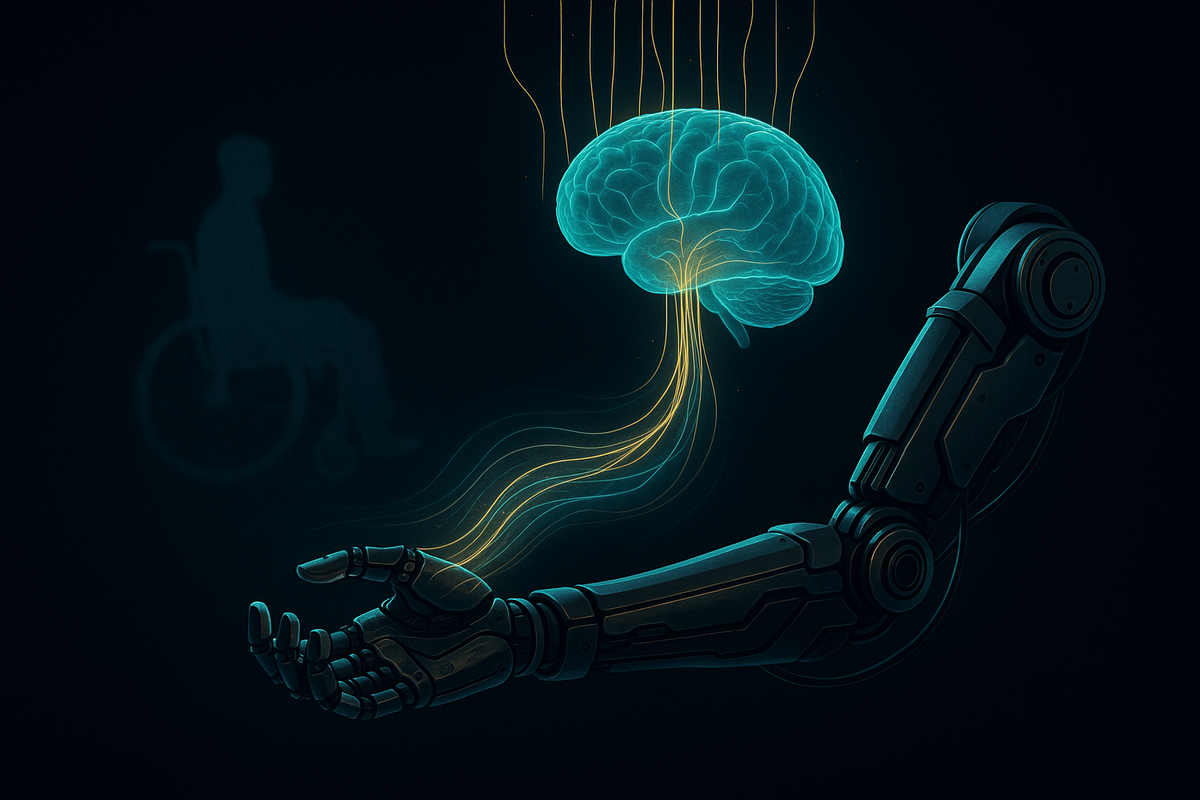
The motor cortex keeps firing even after the spinal cord is severed. Brain-computer interfaces intercept those signals, decode intended motion, and relay commands to prosthetic limbs or bypass systems — letting paralyzed patients move again, sometimes with startling dexterity.
Motor Prosthetics: Restoring Movement
In 2006, Matthew Nagle became the first human to control a computer cursor with an implanted brain electrode array. He had been paralyzed from the neck down after a stabbing four years earlier. Now, with 96 tiny electrodes in his motor cortex, he could move a cursor across a screen just by thinking about it. But what happened next was even more remarkable: Nagle controlled a prosthetic hand. He opened and closed it. He grabbed objects. He manipulated things in the world—not through his own paralyzed limbs but through a robotic surrogate connected directly to his brain. That was almost two decades ago. The technology has advanced dramatically since. But the core insight—that motor intention can be decoded from brain activity and translated into physical action—remains one of the most consequential discoveries in neuroscience. Your brain doesn't know the difference between moving your hand and moving a robot's hand. With the right interface, neither does the robot.
How Movement Starts in the Brain
To understand motor BCIs, you need to understand how the brain generates movement. The motor cortex—a strip of tissue running across the top of the brain—contains a map of the body. Neurons in one region control the face. Neurons in another control the arm. Another controls the leg. It's called the "motor homunculus," and it's weirdly disproportionate: the face and hands have huge representations, because we have such fine control over those areas. When you decide to move your hand, neurons in the corresponding area of motor cortex become active. They fire in patterns that encode the intended movement—direction, speed, force. These signals travel down the spinal cord to motor neurons that contract muscles. If your spinal cord is damaged, those signals never reach the muscles. The neurons in motor cortex are still firing—you're still intending the movement—but nothing happens downstream. Your brain is trying to send a message that can't get through. A motor BCI intercepts that message before it hits the roadblock. Electrodes in the motor cortex pick up the neural activity. Algorithms decode what movement was intended. The decoded intention drives whatever output device you've connected—a cursor, a robotic arm, a wheelchair, potentially even electrical stimulators that bypass the spinal injury and activate muscles directly. The brain is still trying to move the body. The BCI listens in and completes the circuit.
The Decoding Problem
Here's where it gets technically fascinating: how do you figure out what movement someone intended from a bunch of electrical signals? The brain doesn't encode movement in a simple code. There's no neuron that fires for "move hand left" and another for "move hand right." Instead, populations of neurons encode information distributed across many cells. Each neuron responds to many different aspects of movement—direction, speed, starting position, target position. You have to look at the pattern across many neurons simultaneously. The breakthrough came from research in the 1990s and 2000s by scientists like Andrew Schwartz at Pittsburgh and Krishna Shenoy at Stanford. They discovered that you could train a decoder—essentially a statistical model—to predict intended movement direction from the collective activity of motor cortex neurons. The decoder learns from training data. The patient attempts specific movements while the system records neural activity. Over many trials, a machine learning algorithm learns the mapping between neural patterns and movement directions. After training, when the patient thinks about moving in a new direction, the decoder predicts what direction that is. Modern decoders are impressively accurate. In controlled conditions, paralyzed patients can hit targets on a screen with around 95% accuracy. They can control robotic arms well enough to perform tasks like grasping objects and bringing food to their mouths. The decoding isn't perfect. There's still jitter, still uncertainty, still moments where the system misinterprets the signal. But it's good enough to be useful. And it keeps getting better. We're not reading thoughts. We're reading patterns—patterns that the brain conveniently puts in a relatively accessible location.
The Star Patients
Let me introduce you to some of the people who've pushed this technology forward. Jan Scheuermann (Pittsburgh, 2012) had spinocerebellar degeneration that left her unable to move her arms or legs. Researchers implanted two Utah arrays in her motor cortex. Within months, she was controlling a robotic arm with ten degrees of freedom—more than any previous BCI patient. She fed herself chocolate for the first time in nine years. She high-fived President Obama (with the robotic arm) when he visited the lab. In later experiments, Jan demonstrated something even more remarkable: she could control the arm not just for reaching and grasping but for complex manipulations. She stacked blocks. She served imaginary cake. She demonstrated that the brain's motor planning capacity extends seamlessly to robotic surrogates. Erik Sorto (Caltech, 2015) was paralyzed by a gunshot. But the Caltech team tried something different: they implanted electrodes not in the primary motor cortex but in the posterior parietal cortex (PPC), a region involved in movement planning rather than movement execution. The theory was that PPC signals might be higher-level—intentions rather than specific muscle commands. And it worked. Erik controlled a robotic arm well enough to drink a beer by himself. "I was surprised at how easy it was," he said. "I just think about moving my hand and it moves." Dennis DeGray (Stanford, ongoing) has been using a BCI since 2016, following a spinal cord injury in 2007. He's become one of the most experienced BCI users in the world. Dennis has participated in experiments on everything from typing speed (he holds the record for brain-typing, at over 90 characters per minute) to complex cursor control. He's a genuine collaborator with the research team at Stanford, providing feedback that shapes how the technology develops. Johnny Matheny (Johns Hopkins, 2015-present) lost his arm to cancer. His case is different—instead of paralysis, he had an amputation. But BCIs can help here too. Electrodes interface with the nerves in his residual arm and a robotic prosthetic provides replacement function. He can control individual fingers, grip objects, and perform fine motor tasks. Each of these patients pushed the boundary of what motor BCIs could do. Together, they proved that the brain can learn to control robotic systems as naturally as it once controlled biological limbs.
The Brain's Plasticity
Here's what constantly amazes the researchers: how quickly patients adapt. Jan Scheuermann could make coordinated reaching movements with the robotic arm within a week of implantation. After a few months, she moved with a fluidity that surprised everyone. The brain is plastic—it adapts its control signals to whatever feedback it receives. This works both ways. When patients first get the implant, their neural patterns are different from typical movement-related activity because they've been paralyzed for years. The brain has reorganized. But it reorganizes again once there's an output to control. New patterns emerge. The decoder adapts. The patient improves. It's a dance between brain and machine. The brain learns what signals the decoder responds to. The decoder learns what patterns the brain produces. Over weeks and months, they tune to each other. The brain doesn't care if it's controlling a hand or a robot. It cares about feedback. Give it feedback, and it will learn.
From Cursor to Limb
The progression of motor BCI capability tells a story of increasing ambition. Phase 1: Cursor control. The earliest demonstrations showed patients moving a cursor on a screen. This was groundbreaking but limited—essentially a replacement for a mouse. Phase 2: Robotic arms. Jan Scheuermann and others demonstrated that BCIs could control multi-jointed robotic systems in 3D space. This requires decoding not just direction but also grasp force, wrist rotation, and more. Phase 3: Direct stimulation. The next frontier is bypassing the robotic surrogate entirely. Experimental systems—still very early—can stimulate muscles directly or stimulate the spinal cord below the injury. The goal: restore movement to the patient's own paralyzed limb. In 2016, Ian Burkhart—paralyzed from a diving accident—regained control of his own hand through a system that read from his motor cortex and stimulated his forearm muscles. He could grasp objects, pour liquids, and swipe a credit card. With his own hand. This is different from robotic arm control. Ian wasn't controlling a surrogate—he was controlling himself. The BCI was a bypass around the damaged spinal cord, not a replacement for the limb. The technical challenges are significant. Muscle stimulation is crude compared to natural motor control. The movements are often jerky or imprecise. And the system requires external stimulators, cables, and equipment that isn't practical for daily use. But the proof of concept is there: thought to movement, with no functioning spinal cord in between. We're not just building robot arms. We're building bridges back into the body.
The Speed Limit and What's Coming
Natural movement is fast—you grab a cup of coffee in about a second. Current BCIs are slower, taking several seconds for similar reaching movements. Part physics (robotic arms are heavier), part decoding (extracting signals from noise takes time), part training. The fundamental limit: electrode arrays sample a few hundred neurons; the motor cortex contains millions. We're decoding intention from a small window into a vast process. Current BCIs are dial-up in a fiber optic body. We're working on the upgrade. What's on the horizon:
- Fully implanted, wireless systems—no wires through the skull
- Higher electrode counts—from 96 to 1,024 to eventually 10,000+
- Adaptive decoders—machine learning that co-adapts with the brain in real time
- Closed-loop control—motor output plus sensory feedback (next article)
- Direct spinal stimulation—bypassing the injury to restore movement in actual limbs
The goal is transparent control: you intend to move, you move, without conscious effort or visible technology. We're not there. But the path is visible.
The Meaning of Movement
Let's zoom out. For decades, a spinal cord injury meant permanent paralysis. The brain still worked. The muscles still worked. But the connection between them was severed, and there was no way to fix it. Motor BCIs offer a workaround. Not a cure—the spinal cord damage remains. But a new route. A bridge over the gap. Jan Scheuermann eating chocolate is a small moment, in the grand scheme of things. But it's also a proof of concept for something enormous: the brain's motor output can be extracted, decoded, and redirected. The body's failures can be routed around. The locked-in can reach out again. Every patient who moves a robotic arm is a demonstration that paralysis is not necessarily permanent. The technology is crude, expensive, limited to research settings, and far from ready for wide deployment. But it works. Movement is freedom. And we're learning to give it back.
The Unexpected Discoveries
Motor BCI research has produced insights that go far beyond prosthetics. The brain conserves motor commands. Even after years of paralysis, the motor cortex still generates normal-looking movement signals when patients attempt to move. The circuits are intact—they're just disconnected from the muscles. This is encouraging for restoration approaches: the system hasn't forgotten how to move. Mental practice works through the same circuits. When athletes mentally rehearse their movements, they activate motor cortex. BCI research has shown that this activation is functionally similar to actual movement—similar enough that decoders trained on attempted movement can often work for imagined movement too. Mental practice isn't just psychology. It's real motor learning, using the same hardware. The body is part of the mind. When Jan Scheuermann controlled the robotic arm, brain regions associated with body ownership became active, even though the arm wasn't her biological limb. The brain was incorporating the robot into her body schema. This has implications far beyond BCIs—it suggests that our sense of embodiment is plastic, extensible, updatable. Motor learning is fast and flexible. Patients adapt to completely novel control schemes—moving a cursor by thinking about foot movements, for example—within hours. The brain is remarkably good at remapping motor output to whatever feedback loop is available. This flexibility is why BCIs work at all. These discoveries ripple through cognitive science, rehabilitation medicine, and our understanding of what bodies are. Motor BCI research started with a practical goal—help paralyzed people move. It's become a window into the nature of embodied cognition.
The Cost of Progress
Let's be honest about the current limitations. Surgical risk. Every implantation carries risk of infection, bleeding, and damage. Current devices require craniotomy—opening the skull. This isn't minor surgery. Device longevity. Utah arrays typically degrade over 3-5 years as scar tissue accumulates around the electrodes. No one knows yet how long newer devices (like Neuralink's) will last in humans. External equipment. Current research systems require cables, computers, and constant technical support. They work in labs, not living rooms. Training requirements. Patients need weeks to months of training to achieve good control. The learning curve is substantial. Cost. The implants, surgery, training, and support run into hundreds of thousands of dollars per patient. This is far beyond what most healthcare systems will pay. These limitations are why motor BCIs are still experimental. The technology works—but it doesn't work well enough, cheaply enough, safely enough, to be standard of care. The trajectory is encouraging. Each limitation is being addressed. But we're years, probably a decade or more, from motor BCIs being a routine treatment option. The revolution is real. It's also slow.
Why It Matters Anyway
Even in its current imperfect state, motor BCI technology matters. It matters to the patients who have participated in research—who have regained some measure of independence, some capacity for action, some connection to the world. It matters to the thousands of paralyzed people who see these demonstrations and know that progress is possible—that their condition is not necessarily permanent. It matters to the broader understanding of how brains work. Motor BCIs have taught us things about neural coding, plasticity, and embodiment that we couldn't have learned any other way. And it matters as proof of concept. If we can decode motor intention and drive movement, what else might we eventually decode? What else might we drive? The brain's signals are accessible. We can read them. We can use them. The implications extend far beyond helping paralyzed people move—though that alone would be enough. They extend to the nature of the brain-machine interface, to the possibility of expanding human capability, to the question of what it means to have a body at all. Motor prosthetics are the foundation. Everything else builds on top.


Comments ()