Synthesis: Multivariable Calculus as the Language of Fields
Single-variable calculus is a special case. In the real world, functions depend on many variables simultaneously — temperature varies in x, y, z, and t. Multivariable calculus provides the tools to differentiate, integrate, and optimize across all of them at once.
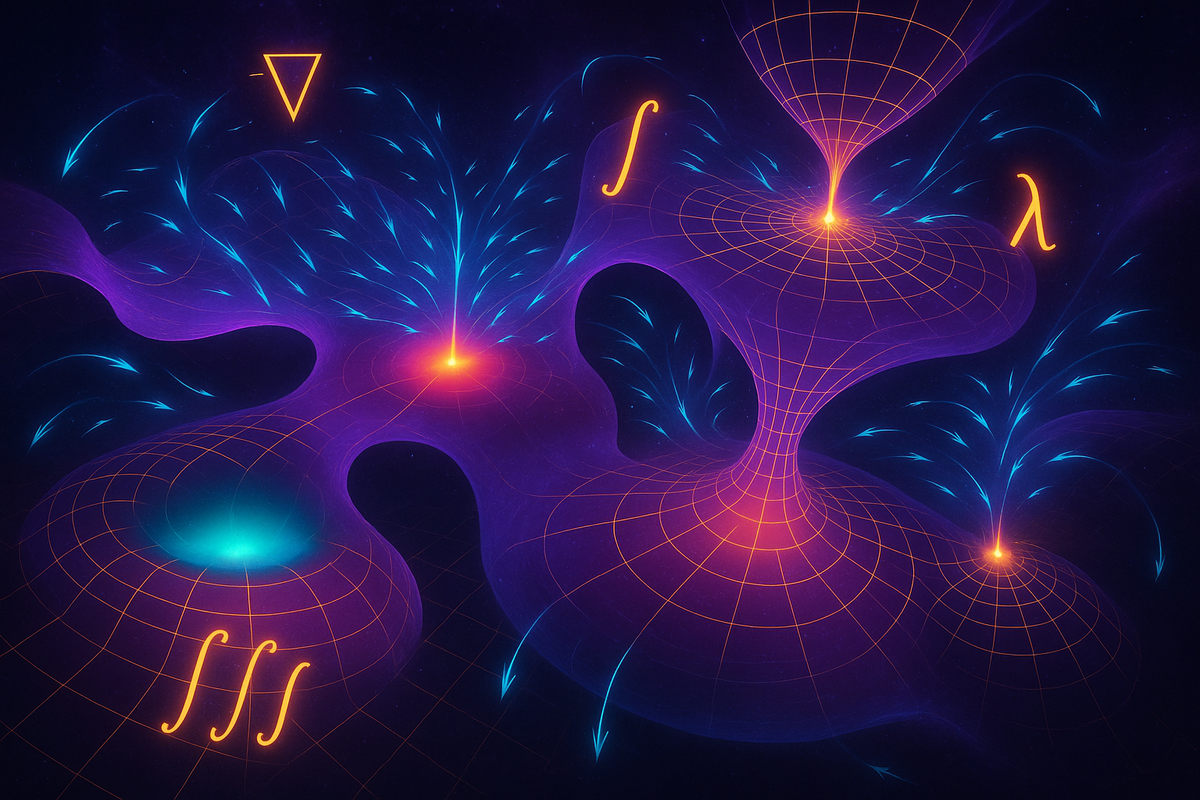
Multivariable calculus is not a random collection of techniques. It's a coherent framework for analyzing functions when variables live in higher-dimensional spaces.
This final article pulls the threads together: how differentiation, integration, and optimization interconnect; how geometry and algebra collaborate; how the tools you've learned form a unified toolkit for understanding systems where everything depends on everything else.
Let's synthesize.
The Core Structure: Three Pillars
Multivariable calculus rests on three pillars:
1. Differentiation: Understanding local change
- Partial derivatives isolate change in one direction
- The gradient packages all partial derivatives into a vector pointing uphill
- Directional derivatives measure change along any path
- The chain rule tracks how change propagates through compositions
2. Integration: Accumulating quantities over regions and volumes
- Double integrals sum over 2D regions (area, mass, probability)
- Triple integrals sum over 3D volumes (volume, mass, moments)
- Jacobians handle coordinate transformations (polar, cylindrical, spherical)
3. Optimization: Finding maxima and minima
- Critical points occur where ∇f = 0
- The second derivative test uses the Hessian to classify them
- Lagrange multipliers handle constraints: ∇f = λ ∇g
These aren't separate topics—they're facets of the same underlying mathematics. The gradient connects differentiation to optimization. The Jacobian connects differentiation to integration. Constraints connect optimization to geometry.
The Gradient: The Universal Object
If there's one concept that unifies multivariable calculus, it's the gradient.
In differentiation:
- The gradient ∇f is the vector of partial derivatives
- It points in the direction of steepest ascent
- It's perpendicular to level curves/surfaces
- Directional derivatives are ∇f · u (projection of the gradient)
In optimization:
- Critical points occur where ∇f = 0
- Gradient descent follows -∇f to find minima
- Lagrange multipliers enforce ∇f = λ ∇g at constrained extrema
In geometry:
- The gradient is the normal vector to level surfaces
- It defines tangent planes: the plane perpendicular to ∇f at a point
- It appears in the chain rule: derivatives compose via dot products with gradients
In physics:
- Electric field E = -∇V (negative gradient of potential)
- Force F = -∇U (negative gradient of potential energy)
- Temperature gradient ∇T drives heat flow
The gradient is the multivariable analogue of the derivative—but it's more than just a computational tool. It's a geometric object that encodes directional information, optimization dynamics, and physical forces.
From Curves to Surfaces to Volumes
Single-variable calculus studies curves: y = f(x).
Multivariable calculus studies surfaces and higher-dimensional manifolds: z = f(x, y) or w = f(x, y, z).
This dimensional jump creates geometric richness:
Curves have slopes. Surfaces have slopes in every direction, encoded in the gradient.
Curves bound regions. Surfaces bound volumes.
Integrals over curves compute arc length or work. Integrals over surfaces compute area or flux. Integrals over volumes compute mass, energy, or total quantities.
The conceptual move from one dimension to many is not just "more algebra." It's a shift from linear thinking to spatial thinking, from single rates of change to fields of vectors, from areas to volumes to hypervolumes.
The Chain Rule: Composition and Dependencies
The multivariable chain rule is how calculus handles networks of dependencies.
In single-variable calculus, composition is linear: f(g(x)) chains two functions.
In multivariable calculus, composition is graph-like: a variable depends on other variables, which depend on still others, forming a dependency tree.
The chain rule says: to find how a function changes with respect to a variable, sum over all paths through the dependency graph, multiplying derivatives along each path.
This is the engine of:
- Backpropagation in neural networks: compute gradients by applying the chain rule backward through layers
- Thermodynamic relations: relate changes in different state variables via chain rule identities
- Sensitivity analysis: determine how output changes when inputs vary, accounting for indirect effects
The Jacobian matrix generalizes the chain rule to vector-valued functions: when you compose transformations, you multiply their Jacobians.
This connects differentiation to linear algebra: locally, every differentiable function looks like a linear transformation (its Jacobian), and compositions multiply.
Integration as Organized Summation
Integration is summation made rigorous: partition a region into infinitesimal pieces, sum the function over those pieces, take the limit as the pieces shrink.
In 1D: ∫_a^b f(x) dx sums f along an interval.
In 2D: ∬_R f(x, y) dA sums f over a region.
In 3D: ∭_V f(x, y, z) dV sums f over a volume.
The notation changes (dx → dA → dV), but the idea is constant: accumulate infinitesimal contributions.
Fubini's theorem says you can compute multidimensional integrals as nested one-dimensional integrals, choosing any order. This reduces the complexity: instead of a fundamentally 2D or 3D operation, you do sequential 1D integrations.
The Jacobian appears when you change coordinates. It's the scaling factor that accounts for how volume elements stretch or compress under coordinate transformations.
Why is this powerful? Because problems have natural coordinates:
- Circles and spheres: polar/spherical coordinates
- Cylinders: cylindrical coordinates
- General symmetries: custom coordinates that align with the symmetry
Choosing coordinates wisely transforms intractable integrals into trivial ones.
Optimization: Following Gradients
Optimization in multivariable calculus means finding where functions achieve extreme values.
Unconstrained optimization:
- Find critical points: ∇f = 0
- Classify them using the Hessian (matrix of second partial derivatives)
- If the Hessian is positive definite at a critical point, it's a local minimum
- If negative definite, it's a local maximum
- If indefinite (mixed signs), it's a saddle point
Constrained optimization:
- Use Lagrange multipliers: at constrained extrema, ∇f = λ ∇g
- The constraint g = c forces you onto a submanifold; the gradient must be perpendicular to it
- The multiplier λ measures sensitivity: how much the optimal value changes if you relax the constraint
This framework handles:
- Economic utility maximization: maximize utility subject to budget constraint
- Physics equilibria: minimize energy subject to physical constraints
- Machine learning: minimize loss subject to regularization or structural constraints
- Engineering design: optimize performance subject to material, cost, or safety limits
Optimization is where calculus becomes decision theory: given constraints and objectives, what's the best choice?
Geometry and Algebra in Dialogue
Multivariable calculus is a conversation between geometry and algebra.
Geometric objects:
- Surfaces, level curves, tangent planes
- Gradient fields, normal vectors, curvature
- Regions of integration, coordinate patches
Algebraic tools:
- Partial derivatives, matrices, determinants
- Systems of equations, linear approximations
- Dot products, cross products, eigenvalues
The geometry motivates the algebra: you want to compute a tangent plane (geometry), so you use partial derivatives to find its equation (algebra).
The algebra reveals the geometry: you compute a Jacobian determinant (algebra), and it tells you how area scales (geometry).
This interplay is what makes multivariable calculus powerful. You're not just manipulating symbols—you're describing the shape and behavior of functions in space.
The Big Theorems: Unifying Principles
Several major theorems unify different parts of multivariable calculus:
Clairaut's theorem: Mixed partial derivatives are equal (∂²f/∂x∂y = ∂²f/∂y∂x) if they're continuous. This says that the order of differentiation doesn't matter, imposing a symmetry constraint on how functions can curve.
Fubini's theorem: Double/triple integrals can be computed as iterated integrals in any order. This says integration over regions reduces to sequential integration along axes.
Fundamental theorem for line integrals: ∫_C ∇f · dr = f(b) - f(a), where C is a curve from a to b. This generalizes the fundamental theorem of calculus to multivariable settings: the integral of a gradient depends only on endpoints.
Green's theorem, Stokes' theorem, divergence theorem: These are higher-dimensional analogues of the fundamental theorem, relating integrals over regions to integrals over their boundaries. They're foundational in vector calculus (beyond the scope of this series, but the natural next step).
These theorems aren't isolated facts—they're structural principles that reveal deep connections between differentiation, integration, and geometry.
Where Multivariable Calculus Leads
Mastering multivariable calculus opens doors to:
Vector calculus: Divergence, curl, flux, line integrals, surface integrals—the mathematics of fields and flows. Essential for electromagnetism, fluid dynamics, and classical field theory.
Differential geometry: Curvature, geodesics, manifolds—the geometry of curved spaces. Essential for general relativity and modern geometry.
Optimization theory: Convex optimization, duality, numerical methods—finding best solutions in high-dimensional spaces. Essential for machine learning, operations research, economics.
Partial differential equations: Equations involving partial derivatives with respect to space and time. Essential for physics, engineering, and modeling continuous systems (heat, waves, diffusion).
Real analysis in ℝⁿ: Rigorous foundations of limits, continuity, and convergence in higher dimensions. Essential for theoretical mathematics.
Multivariable calculus is the gateway to all of these. It's where you transition from analyzing functions on a line to analyzing functions in space—and from there, to analyzing functions on curved spaces, functions with values in vector spaces, operators on infinite-dimensional spaces.
The techniques generalize, but the core ideas remain: differentiation captures local behavior, integration accumulates contributions, optimization finds extremes.
The Mental Shifts Multivariable Calculus Requires
Learning multivariable calculus isn't just acquiring techniques—it's developing new mental habits:
1. Spatial visualization: You must imagine surfaces curving in 3D, level curves in 2D, vector fields pointing through space. This requires geometric intuition that single-variable calculus doesn't demand.
2. Managing complexity: With more variables, there are more partial derivatives, more integration orders, more coordinate systems. You learn to organize complexity systematically (tree diagrams for the chain rule, choosing integration order strategically).
3. Thinking in systems: Variables don't vary in isolation—they're coupled. Changing x affects how f responds to changes in y. This is systems thinking: understanding feedback, dependencies, and emergent behavior.
4. Exploiting symmetry: Recognizing when a problem has circular, spherical, or other symmetry lets you choose coordinates that make the problem tractable. This is strategic thinking: matching your mathematical tools to the problem's structure.
5. Connecting geometry and algebra: You move fluidly between visual intuition (the gradient points uphill) and symbolic computation (∇f = (∂f/∂x, ∂f/∂y)). This dual fluency is the hallmark of mathematical maturity.
These are transferable skills. You'll use spatial visualization in data science (imagining high-dimensional data). You'll use systems thinking in economics, biology, engineering. You'll use symmetry-exploitation in physics and algorithm design.
Multivariable calculus trains you to think multidimensionally.
The Toolkit: What You Now Possess
After this series, you have a complete toolkit for multivariable calculus:
Differentiation tools:
- Compute partial derivatives to isolate directional change
- Construct gradients to find steepest ascent
- Calculate directional derivatives for change along arbitrary paths
- Apply the chain rule to track change through compositions
Integration tools:
- Set up double integrals over regions (Type I/II)
- Set up triple integrals over volumes (various orders)
- Transform coordinates using Jacobians (polar, cylindrical, spherical, custom)
- Choose integration order strategically based on region geometry
Optimization tools:
- Find critical points by solving ∇f = 0
- Classify them using the Hessian matrix
- Handle constraints using Lagrange multipliers
- Interpret multipliers as sensitivity/shadow prices
Geometric tools:
- Visualize level curves and surfaces
- Compute tangent planes and normal vectors
- Recognize how gradients relate to geometry
- Exploit symmetry to simplify problems
With these tools, you can:
- Compute volumes of irregular solids
- Find centers of mass of variable-density objects
- Optimize functions subject to constraints
- Model physical systems (fields, flows, energies)
- Analyze economic models (utility, production, equilibrium)
- Understand machine learning algorithms (gradient descent, backpropagation)
You've moved from "calculus as slope and area" to "calculus as the language of continuous systems."
What Made This Journey Possible
You learned multivariable calculus by building concepts systematically:
Start with single-variable intuition, then extend it:
- Derivative → partial derivative → gradient
- Integral over interval → integral over region → integral over volume
- Critical point → gradient equals zero → Lagrange condition for constraints
Use geometry to guide algebra:
- The gradient points uphill (geometry) because it packages all partial derivatives (algebra)
- The Jacobian scales volume elements (geometry) because it's a determinant of partial derivatives (algebra)
Recognize patterns:
- Partial derivatives are directional derivatives along axes
- The gradient is the direction of maximum directional derivative
- Lagrange multipliers enforce gradient alignment at constrained extrema
Practice strategic thinking:
- Choose coordinates that match the problem's symmetry
- Choose integration order that simplifies limits
- Use tree diagrams to organize chain rule calculations
This is mathematical thinking: not just memorizing formulas, but understanding structure, recognizing patterns, choosing strategies.
The Deep Idea: Locality and Linearity
Here's the philosophical core of multivariable calculus:
Differentiable functions are locally linear.
At any point, a smooth function f(x) can be approximated by a linear function:
f(x + h) ≈ f(x) + ∇f(x) · h
The gradient ∇f is the linear approximation to the function near x.
This is why derivatives are so powerful: they reduce curved, nonlinear behavior to flat, linear behavior in a small neighborhood.
And linear things are tractable: you can solve linear systems, multiply matrices, project vectors.
Multivariable calculus is the art of analyzing complicated functions by:
- Approximating them locally with their gradients (linear maps)
- Integrating (summing) these local approximations to recover global structure
- Finding where local behavior changes (critical points, extrema)
This pattern—local linearization, global integration, critical point analysis—extends far beyond multivariable calculus. It's the pattern of differential geometry, functional analysis, and much of modern mathematics.
The Payoff: Modeling the World
Multivariable calculus isn't abstract for its own sake. It's the language in which continuous systems are modeled:
Physics: Fields (electric, magnetic, gravitational) are vector-valued functions of position. Their behavior is described by partial differential equations derived from gradients, divergences, and curls.
Engineering: Stress, strain, heat, fluid flow—all vary continuously in space and time. Analyzing them requires multivariable calculus.
Economics: Utility, production, market equilibrium—these depend on multiple variables simultaneously. Optimization under constraints is formalized via Lagrange multipliers.
Biology: Population dynamics, enzyme kinetics, neural activity—systems with many interacting variables. Phase space analysis uses multivariable calculus.
Machine learning: Training neural networks is optimization in million-dimensional spaces. Gradients computed via the chain rule (backpropagation) guide the search for optimal parameters.
Data science: High-dimensional data lives in spaces where visualization is impossible, but calculus still works. Principal component analysis, clustering, regression—all use multivariable calculus.
The world operates in multiple dimensions. Multivariable calculus is how you mathematize that reality.
The Path Forward
You've completed multivariable calculus. What's next?
If you're drawn to pure mathematics:
- Real analysis in ℝⁿ (rigorous foundations)
- Differential geometry (calculus on curved spaces)
- Topology (properties preserved under continuous deformations)
If you're drawn to applied mathematics:
- Partial differential equations (heat equation, wave equation, Schrödinger equation)
- Numerical methods (finite differences, finite elements, optimization algorithms)
- Vector calculus and field theory (electromagnetism, fluid dynamics)
If you're drawn to data and computation:
- Optimization theory (convex optimization, gradient methods)
- Statistical learning theory (maximum likelihood, Bayesian inference)
- Computational geometry (meshing, ray tracing, simulation)
In every direction, multivariable calculus is the foundation. You've built the base. Now you can specialize, going deeper into theory or broader into applications.
Final Synthesis: The Unity of Calculus
Calculus—whether single-variable or multivariable—is fundamentally about three things:
1. Local vs. global: Derivatives give local information (slope at a point). Integrals recover global information (total area/volume). The fundamental theorem connects them.
2. Linear approximation: Smooth functions look linear up close. Derivatives are the coefficients of that linear approximation.
3. Optimization and equilibrium: Extrema occur where derivatives vanish. This applies to physics (equilibrium minimizes energy), economics (optimization maximizes utility), and learning (training minimizes loss).
In single-variable calculus, this plays out on curves.
In multivariable calculus, this plays out on surfaces, in volumes, across fields, through networks of dependencies.
The mathematics scales. The principles don't change—they deepen.
You're no longer just computing areas under curves. You're analyzing systems where multiple quantities vary simultaneously, where change propagates through interconnected variables, where optimization requires balancing competing constraints.
That's the power of multivariable calculus: it's not calculus with more variables. It's calculus as it actually operates in the world, where complexity is the norm and one-dimensional thinking isn't enough.
You've learned to think in multiple dimensions. You've internalized the gradient as a vector pointing uphill, integration as accumulation over regions, optimization as navigating constrained landscapes.
This is mathematical maturity: the ability to take powerful ideas—differentiation, integration, optimization—and wield them in spaces where intuition must be trained, visualization must be abstract, and technique must be systematic.
Welcome to multivariable calculus as a unified framework for understanding how the world changes, accumulates, and optimizes in higher dimensions.
You're ready.
Part 10 of the Multivariable Calculus series.
Previous: Lagrange Multipliers: Optimization Under Constraints
Comments ()