Mystical Experience: The Neuroscience of Unity
The feeling that boundaries dissolve and everything is one has a measurable neural signature. Psilocybin, meditation, and spontaneous mystical states all suppress the default mode network similarly. The oldest human experience is getting its first mechanistic explanation.
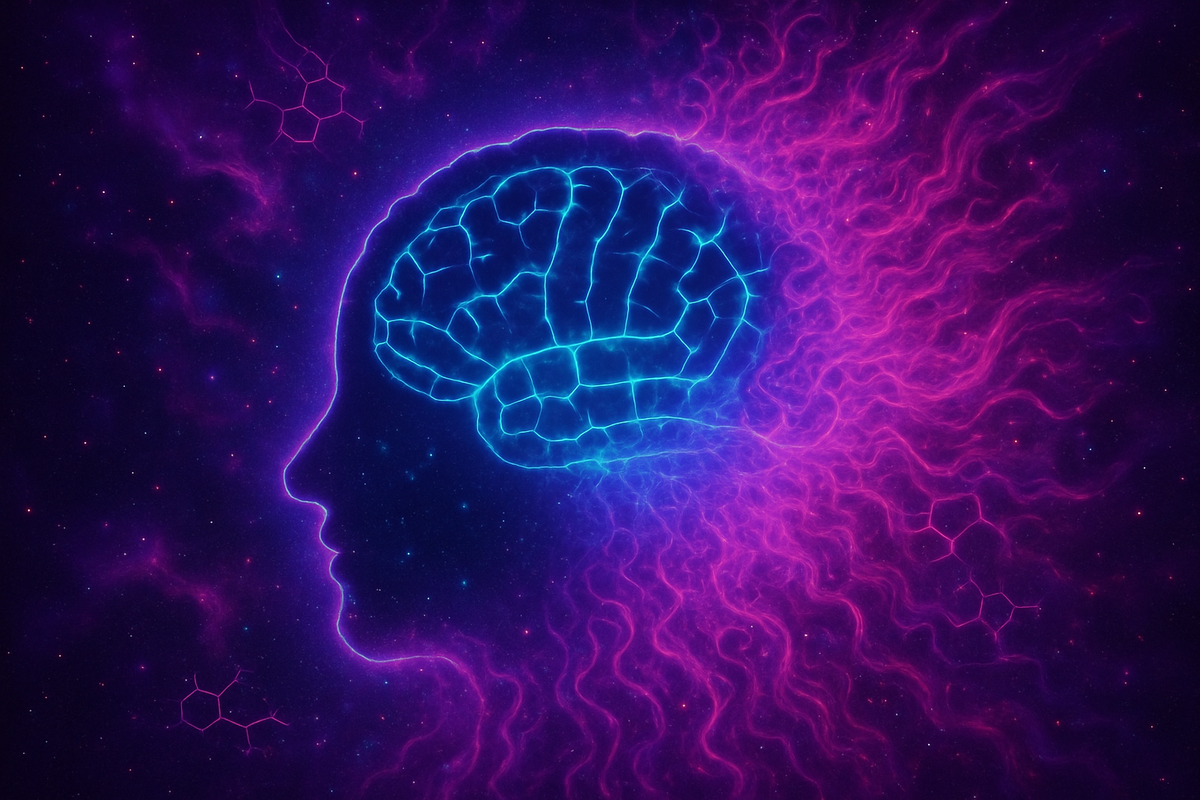
Mystical Experience: The Neuroscience of Unity
Series: Anomalous Cognition | Part: 4 of 9 Primary Tag: FRONTIER SCIENCE Keywords: mystical experience, psilocybin, meditation, ego dissolution, neuroscience, consciousness
Feeling one with everything. The dissolution of self. Infinite love. Absolute certainty of a deeper reality.
Mystical experiences have been reported across cultures, religions, and millennia. They've shaped religions, transformed lives, and occasionally produced great art and philosophy.
Now we can study them in the laboratory.
Psilocybin, meditation, prayer, and even electrical brain stimulation can induce mystical states. Brain imaging reveals their neural correlates. We're mapping the neuroscience of transcendence.
Does this explain mystical experience away? Or does it deepen the mystery?
The Phenomenology
William James, in his 1902 Varieties of Religious Experience, identified four marks of mystical experience:
Ineffability: The experience can't be adequately conveyed in words. It must be felt directly.
Noetic quality: Despite being ineffable, the experience feels like knowledge—insight into the nature of reality, not just a feeling.
Transiency: The experience doesn't last long—minutes to hours—though its effects may persist.
Passivity: Despite any preparation (meditation, prayer, drugs), the experience feels given, not achieved. Something happens TO you.
Modern researchers add:
Unity: A sense of merging with the universe, dissolution of the boundary between self and other.
Sacredness: A feeling of encountering something holy, precious, infinitely meaningful.
Positive mood: Profound peace, joy, love—often described as the most positive experience of one's life.
Transcendence of time and space: Ordinary coordinates seem irrelevant or illusory.
These features appear whether the experience arises from meditation, psychedelics, spontaneous episodes, or near-death.
Psilocybin Research
The modern neuroscience of mystical experience owes much to psilocybin research, pioneered at Johns Hopkins University by Roland Griffiths.
In controlled studies, volunteers receive psilocybin (the active compound in magic mushrooms) in a supportive setting with trained guides. The experiences are measured using standardized scales.
Key findings:
Mystical experiences are reliably produced. About 60-80% of participants have experiences meeting criteria for "complete mystical experience" on standard measures.
They're rated as among the most meaningful experiences of participants' lives. Months and years later, participants consistently rank them with birth of children, death of parents—the big moments.
They produce lasting positive changes. Reduced anxiety and depression, increased well-being, personality shifts toward openness—measured at 6 months and beyond.
They're dose-dependent. Higher doses are more likely to produce full mystical experiences.
Set and setting matter. The same drug produces different experiences depending on mindset and environment.
The brain changes during psilocybin experiences are distinctive:
Reduced activity in the default mode network (DMN): The DMN is associated with self-referential thinking, the narrative self. Psilocybin quiets it.
Increased connectivity between usually separate brain regions: Networks that don't normally talk to each other suddenly communicate.
Reduced filtering: The brain normally filters perception to be manageable. Psilocybin loosens this filtering.
Meditation Research
Long-term meditators can achieve states similar to psilocybin experiences without drugs.
Brain imaging of experienced meditators shows:
Changes in the DMN: Like psilocybin, deep meditation reduces default mode activity. The narrative self quiets.
Altered gamma waves: Some meditation practices increase high-frequency gamma oscillations associated with insight and perceptual integration.
Structural changes: Long-term practice physically changes the brain—increased gray matter in attention and emotion regulation areas.
State-trait shifts: Meditation produces both temporary states (during practice) and lasting traits (baseline shifts in cognition and emotion).
The neuroscience of meditation and psychedelics converge: both reduce self-referential processing and increase perceptual openness. The unity experience might be what consciousness feels like when the brain's usual self-model loosens.
The God Helmet
Neuroscientist Michael Persinger developed the "God Helmet"—a device that applies weak magnetic fields to the temporal lobes—and claimed it could induce sensed presence, religious feelings, and mystical experiences.
His findings were controversial:
Some subjects reported mystical experiences. Sensed presences, feelings of unity, religious feelings.
But replication was mixed. Other researchers, using similar protocols, got inconsistent results.
Expectation effects were strong. Subjects who expected spiritual experiences were more likely to have them, regardless of whether the magnetic field was active.
The God Helmet probably doesn't reliably induce mystical experiences. But it highlights that the temporal lobe is involved—the same region implicated in epileptic religious experiences and near-death experiences.
The Neuroscience of Ego Dissolution
The most dramatic aspect of mystical experience is ego dissolution—the sense that the self disappears, merges with everything, loses its boundaries.
This correlates with:
Reduced default mode network activity: The DMN maintains the sense of a persistent self across time. Quiet the DMN, and the self becomes less solid.
Disrupted connectivity between the medial prefrontal cortex and posterior cingulate cortex: These regions interact to create the sense of "me." Disrupting their connection disrupts the self.
Increased entropy: Under psychedelics, brain activity becomes more random, less predictable. The usual constraints loosen.
Ego dissolution isn't brain death or dysfunction. It's a specific alteration in how the brain constructs the self. The self is a model—a useful fiction the brain maintains. Under certain conditions, that model becomes transparent, reveals itself as a construction, or temporarily dissolves.
Does Neuroscience Explain Mystical Experience Away?
Here's the key philosophical question: if we can explain mystical experience in terms of brain states, have we debunked it?
The debunking argument: Mystical experiences are just what brains do under certain conditions. They don't reveal anything about external reality. The "unity with everything" is a neural artifact, not a perception of truth.
The non-debunking argument: All experiences are brain states. Seeing red, hearing music, understanding mathematics—all have neural correlates. We don't say color or mathematics are debunked because they have brain bases. Why apply different standards to mystical experience?
The middle position: Neuroscience explains HOW mystical experiences happen, not WHETHER they reveal truth. The mechanism doesn't determine the meaning.
My view: Mystical experiences are real experiences—vivid, meaningful, life-changing. They happen when the brain operates in unusual ways. Whether they reveal deep truths about consciousness or reality remains an open question that neuroscience alone can't answer.
The Therapeutic Potential
Whatever their metaphysical status, mystical experiences have therapeutic value:
Depression and anxiety: Psilocybin-assisted therapy is showing remarkable results for treatment-resistant depression, end-of-life anxiety, and other conditions.
Addiction: Mystical experiences during psilocybin therapy predict successful smoking cessation and alcohol reduction.
Existential distress: Cancer patients with psilocybin-induced mystical experiences show lasting reductions in death anxiety.
The experiences seem to produce a "reset"—a fundamental reorientation of perspective that alleviates rigid, maladaptive patterns.
This has implications for mental health treatment. We might be able to reliably induce transformative experiences that produce lasting benefit.
What Mystical Experience Suggests
Mystical experience reveals something about the mind, whether or not it reveals something about ultimate reality:
The self is constructed. It can be deconstructed, at least temporarily. What we take as given—our identity, our separateness—is a process that can be altered.
Consciousness has more modes than normal waking awareness. There are states of being we rarely access but that are available to human brains.
The brain's filtering can be loosened. Usually we perceive a tiny fraction of available information. That filtering can be reduced.
Peak experiences may be valuable in themselves. Even if mystical experiences are "just" brain states, they might be intrinsically valuable brain states worth cultivating.
The mystics were onto something. The neuroscientists are onto something. The full picture might require both.
Further Reading
- Griffiths, R.R. et al. (2006). "Psilocybin can occasion mystical-type experiences having substantial and sustained personal meaning." Psychopharmacology. - James, W. (1902). The Varieties of Religious Experience. Longmans, Green, and Co. - Carhart-Harris, R.L. et al. (2012). "Neural correlates of the psychedelic state as determined by fMRI studies with psilocybin." PNAS. - Newberg, A. & D'Aquili, E. (2001). Why God Won't Go Away. Ballantine.
This is Part 4 of the Anomalous Cognition series. Next: "Epiphany and Insight: When Solutions Appear."
Comments ()