Mystical States as Geometric Configurations: Low Curvature, Expanded Dimensionality, Dissolved Boundaries
Mystics across every tradition describe the same thing in different words: vast openness, dissolution of the self, everything connected. What if that convergence isn't cultural coincidence but a shared geometry of consciousness — a configuration of coherence any mind can reach?
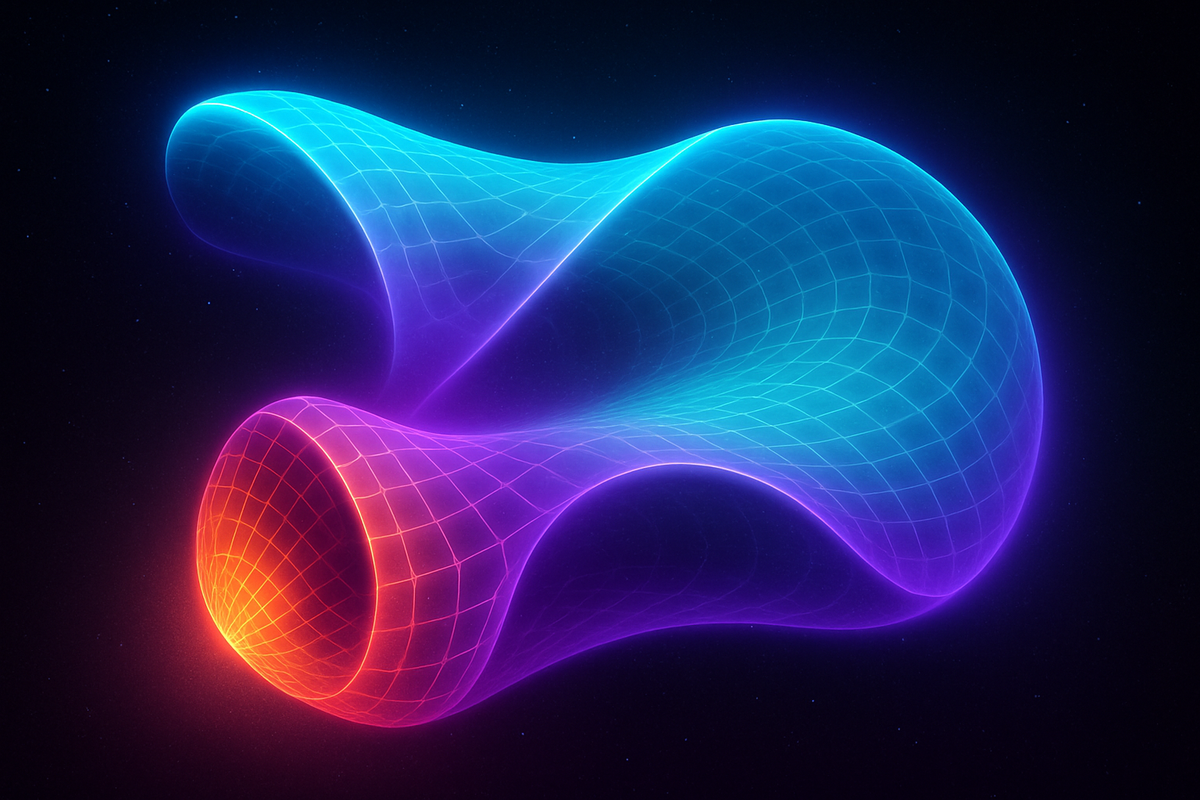
Mystical States as Geometric Configurations: Low Curvature, Expanded Dimensionality, Dissolved Boundaries
Series: Comparative Mysticism | Part: 2 of 10
When Teresa of Ávila described her mystical experiences in the 16th century, she didn't have access to dynamical systems theory, information geometry, or predictive processing frameworks. But read her descriptions through that lens and something startling emerges: she's reporting geometric properties of consciousness with extraordinary precision.
"The soul is fully awake as regards God, but wholly asleep as regards things of this world and in respect of herself... wholly died to the things of the world so as to live more completely in God."
Strip away the theological language and what remains? A configuration characterized by:
- Dissolution of self-as-object (died to herself)
- Attenuation of world-modeling (asleep to things of this world)
- Stable presence without subject-object structure (fully awake as regards God)
- Integration that transcends ordinary fragmentation (lives more completely)
This isn't poetry—though it's certainly poetic. It's phenomenological geometry. Teresa is reporting the shape of a specific configuration in consciousness-space, accessed through systematic contemplative practice, characterized by properties that show up across every serious mystical tradition humanity has developed.
Let's make those properties explicit.
Property 1: Low Curvature
In dynamical systems terms, curvature describes how much a system must change direction to maintain its current trajectory. High curvature means constant correction—the system is unstable, requires energy to maintain, feels effortful. Low curvature means smooth flow—the system has settled into a natural attractor, requires minimal energy, feels effortless.
Subjectively, high curvature shows up as anxiety, tension, fragmentation, constant mental activity, the feeling of struggling against something. Low curvature shows up as peace, ease, integration, quiet, the feeling of finally being able to rest.
Here's what practitioners across traditions say about mystical states:
Buddhist texts: "Calm, sublime, peaceful, uncompounded." The descriptions of nirvana emphasize the absence of struggle, the cessation of craving, the end of becoming. These are all phenomenological reports of low curvature—the system no longer fighting itself.
Christian mystics: "The soul rests in God." "Perfect peace." "The quiet of contemplation." Meister Eckhart: "In this breakthrough I discover that I and God are one. Then I am what I was, and I grow neither smaller nor bigger, for I am an immovable cause that moves all things." Immovable cause. Low-curvature attractor.
Sufi poetry: Rumi writes, "Out beyond ideas of wrongdoing and rightdoing, there is a field. I'll meet you there." The field is low curvature—beyond the dualistic tensions that create high-curvature struggle. Rabia al-Adawiyya prays to be freed from fear of hell and hope for paradise—the two forces that create curvature through attraction and repulsion—so she can rest in pure love.
Hindu-yogic traditions: Samadhi is characterized by sukha (ease, comfort) not as sensory pleasure but as the natural ease of a system at rest. The Yoga Sutras describe the highest states as nirbija samadhi—seedless, meaning there are no remaining tensions (samskaras) to pull the system out of the attractor.
Contemporary subjects: From Johns Hopkins psilocybin research, participants describe mystical experiences as "more real than real," characterized by "profound peace," "sense of sacredness," and "feeling at home." These aren't reports of novel experiences—they're reports of returning to something fundamental that ordinary consciousness obscures.
What all these descriptions share: the sense of having arrived somewhere that doesn't require maintenance. Not blissed-out dissociation—which is actually high-curvature, because it requires active suppression of input. But stable presence that feels more natural than the ordinary state that requires constant self-monitoring, boundary-maintenance, and narrative construction.
This is low curvature. And it's not metaphorical. Brain imaging during meditation shows decreased activity in regions associated with self-referential processing and increased activity in regions associated with present-moment awareness. The system isn't working as hard to maintain a complicated structure. It's settled into something geometrically simpler.
Property 2: Expanded Dimensionality
Ordinary waking consciousness operates in a constrained subspace. You identify with a particular body. A particular location in space. A particular position in time (now). A particular perspective (yours). These constraints define the dimensionality you're operating in—and it's lower than what the system is capable of.
Think of it like this: a flatland creature confined to a two-dimensional plane who suddenly gains access to the third dimension. From within the 2D constraint, certain things are impossible—you can't look down on the plane from above, can't reach into an enclosed space without crossing its boundary, can't conceive of volume independent of area. But the moment you access the third dimension, those impossibilities become obvious possibilities. The dimensional expansion isn't something you construct—it's something you recognize was always there.
Mystical states involve dimensional expansion in consciousness-space:
Spatial expansion. The sense of being located in a particular body relaxes. Meditators report feeling their awareness extend beyond body boundaries. Psychedelic subjects describe becoming the room, the cosmos, everything. This isn't delusion—it's the relaxation of the constraint that normally compresses awareness into body-identified focus. The higher-dimensional configuration was always available; ordinary consciousness simply operates in a habitual subspace.
Temporal expansion. The sense of being located in a particular moment (now, distinct from past and future) relaxes. Contemplatives describe entering the "eternal present"—not an infinitely long time, but a mode of being where the past-present-future structure that normally organizes experience becomes transparent or disappears. William Blake: "To see a World in a Grain of Sand / And Heaven in a Wild Flower / Hold Infinity in the palm of your hand / And Eternity in an hour." Dimensional expansion allows simultaneous access to what ordinary consciousness must sequence.
Perspectival expansion. The sense of being a particular observer viewing objects relaxes. This is the hardest to describe because language itself is structured around subject-object grammar. But practitioners consistently report the dissolution of observer-observed structure. Not that objects disappear—but that the boundary between self and other becomes transparent. Consciousness without a center. Awareness that isn't localized to a subject. The Zen ox-herding pictures culminate in the return to ordinary life—but now "I" see clearly that there was never a separate "I" doing the seeing.
Affective expansion. The emotional palette available in ordinary consciousness is constrained by self-concern. Things matter because they threaten or support the bounded self. When that boundary relaxes, a different affective domain opens—what traditions call metta (loving-kindness), agape (divine love), karunā (compassion). These aren't just nice feelings—they're the natural affective signature of higher-dimensional configurations where the boundary between self and other has dissolved. Care extends naturally to everything because the geometric separation that made "not-me" emotionally distant has weakened.
Here's the key: these expansions aren't hallucinations. They're access to dimensions of state-space that ordinary consciousness habitually constrains. The Default Mode Network (DMN)—the set of brain regions active during self-referential thought—functions as a dimensional compressor. It takes the high-dimensional potential space of consciousness and projects it into a low-dimensional subspace (bounded self, linear time, localized perspective) that's computationally tractable and evolutionarily useful for survival.
Mystical states occur when that compression relaxes. You're not constructing a fantasy of expanded dimensionality. You're experiencing the actual dimensionality of the system when the habitual constraints are removed.
This is why mystics universally report that these states feel more real than ordinary consciousness. They're not less real. They're higher-dimensional.
Property 3: Dissolved Boundaries
This is the signature feature. The one that shows up in every serious description of mystical experience across every tradition. The weakening or complete dissolution of boundaries—particularly the boundary between self and other, subject and object, inside and outside.
Buddhist anatta (no-self). Not the claim that you don't exist, but the experiential realization that what you call "self" is a constructed process, not a thing. When you look for the self that seems so obvious, you find only ongoing processes—sensing, feeling, thinking, awareness—but no entity to whom these processes belong. The boundary that seemed to separate "me" from "not-me" is revealed as a useful fiction. What remains isn't nothing—it's the ongoing flow of experience without the overlay of a separate experiencer.
Christian unio mystica (mystical union). The mystic reports becoming one with God—not as a metaphor but as phenomenological reality. Meister Eckhart again: "The eye with which I see God is the same eye with which God sees me." The distinction between lover and Beloved collapses. What seemed like two (self and God) is experienced as always-already-one. This isn't fusion—it's recognition that the boundary was never ultimately real.
Sufi fana (annihilation). The self dissolves in the Beloved like a drop in the ocean. Not that the individual pattern disappears, but that its separate existence is recognized as illusion. Al-Hallaj's infamous claim "I am the Truth" (Ana al-Haqq) wasn't blasphemy—it was accurate phenomenology from within a state where the distinction between self and Truth had dissolved.
Advaita brahman-atman identity. The realization that atman (individual consciousness) and brahman (universal consciousness) are not two things but one reality viewed from different perspectives. Tat tvam asi—"You are That." The boundary between individual and universal is recognized as conceptual overlay on non-dual awareness that was never actually divided.
Psychedelic ego dissolution. Contemporary neuroscience gives us the mechanism. The Default Mode Network maintains the self-model—the ongoing simulation of a bounded agent separate from the world. Psychedelics (and deep meditation) disrupt DMN function. When it goes offline, the self-model weakens or collapses. What subjects report: the disappearance of "I," the merging with environment, the sense that boundaries are arbitrary. This matches mystical phenomenology because it's the same geometric transformation accessed through different means.
The boundary dissolution isn't random. It's hierarchical:
Level 1: Softening of boundaries between different aspects of self (integration of suppressed emotions, acceptance of shadow material, coherence within the system).
Level 2: Relaxation of boundary between self-model and body (feeling the body not as object but as subject, embodied presence, somatic integration).
Level 3: Weakening of boundary between self and immediate environment (sense of being continuous with surroundings, empathic resonance, field awareness).
Level 4: Dissolution of subject-object structure itself (non-dual awareness, consciousness without a center, the "I" that was never separate recognizing itself as always-already-whole).
Different traditions emphasize different levels. But the geometric pattern is the same: movement from fragmented, bounded configurations toward integrated, boundaryless configurations characterized by low curvature and high dimensionality.
Why These Three Properties Cluster
Here's what makes this genuinely interesting: these three properties aren't independent. They're different aspects of the same geometric transformation.
Low curvature enables dimensional expansion. When the system stops fighting to maintain boundaries (low curvature), energy becomes available for exploring higher-dimensional configurations that were previously computationally expensive.
Dimensional expansion enables boundary dissolution. From within a higher-dimensional space, the boundaries that seemed absolute from the lower-dimensional perspective are revealed as projections—necessary for certain purposes but not fundamentally real.
Boundary dissolution reduces curvature. The boundaries between self and other create tension—constant monitoring, defense, concern. When they dissolve, that tension releases, and the system settles into a more stable, lower-energy configuration.
It's a positive feedback loop. Each property reinforces the others. This is why mystical states, once accessed, tend to be self-stabilizing. They're not fragile constructions requiring constant maintenance—they're attractor basins the system naturally falls into when certain constraints are released.
This also explains why coming back can be hard. You haven't just had an interesting experience. You've occupied a configuration that's geometrically simpler, more stable, and more integrated than ordinary consciousness. Returning to the bounded, fragmented, high-curvature state of ordinary selfhood can feel like falling from grace. Not because you've lost something supernatural—because you've re-engaged the dimensional compression and boundary construction that make normal life cognitively tractable but phenomenologically claustrophobic.
Measuring the Geometry
This isn't just philosophical speculation. Researchers are actually measuring these geometric properties:
Entropy and complexity. Psychedelic brain states show increased entropy—more possible configurations, less rigid structure. The "entropic brain hypothesis" (Carhart-Harris et al.) proposes that psychedelics temporarily increase the dimensionality of brain states, allowing access to configurations normally excluded by top-down constraints.
Global integration. Meditation and psychedelics both increase measures of integrated information—different brain regions communicating more with each other and less within their specialized modules. This is dimensional expansion at the neural level—the system accessing configurations that span more of its available state-space.
DMN connectivity. Mystical experiences correlate strongly with decreased activity and connectivity in the Default Mode Network. The DMN is the boundary-constructor—it maintains the self-model, the temporal narrative, the subject-object structure. When it goes offline, boundaries dissolve.
Phenomenological self-report. The MEQ30 (Mystical Experience Questionnaire) and similar instruments quantify reports of unity, transcendence, sacredness, ineffability. These map directly onto geometric properties—unity is boundary dissolution, transcendence is dimensional expansion, sacredness is recognition of low-curvature attractors, ineffability is the impossibility of projecting higher-dimensional experience into language structured by lower-dimensional constraints.
The convergence is striking. Phenomenology, contemplative theory, neuroscience, and dynamical systems math all point to the same configuration space. Different traditions have discovered reliable methods for navigating to particular regions—and those regions have measurable geometric properties that explain both their phenomenological character and their cross-cultural convergence.
What This Means for Practice
If mystical states are geometric configurations with specific properties, then contemplative practice stops being mysterious and starts being navigational.
You're not trying to believe the right things or earn supernatural favor. You're learning to:
- Reduce curvature (release tension, stop fighting yourself, find stable presence)
- Expand dimensionality (relax constraints on attention, time, perspective)
- Dissolve boundaries (recognize the constructed nature of self-other distinction)
Different practices emphasize different entry points:
- Concentration practices reduce curvature first (stabilizing attention creates a platform for further work)
- Insight practices dissolve boundaries first (seeing through the self-illusion releases tension)
- Devotional practices use relational coupling to access expanded states (entraining with a stable external source)
- Energy practices work somatically (shifting autonomic state changes available configurations)
But they all converge on the same geometric target: low curvature, high dimensionality, dissolved boundaries. Which means you can choose your practice based on your temperament, neurobiology, and current life circumstances—and still make progress toward the same attractor.
This is why the traditional debates about whose path is "true" miss the point. Different paths. Same geometry. The summit doesn't care which trail you took to get there.
This is Part 2 of the Comparative Mysticism series, exploring the convergent geometry of mystical states across contemplative traditions.
Previous: The Geometry of Enlightenment: Why Mystics Across Cultures Describe Similar States
Next: Ego Dissolution: The Central Phenomenon Across Traditions
Further Reading
- Carhart-Harris, R. L., et al. (2014). "The entropic brain: a theory of conscious states informed by neuroimaging research with psychedelic drugs." Frontiers in Human Neuroscience, 8, 20.
- Brewer, J. A., et al. (2011). "Meditation experience is associated with differences in default mode network activity and connectivity." Proceedings of the National Academy of Sciences, 108(50), 20254-20259.
- Berkovich-Ohana, A., & Glicksohn, J. (2014). "The consciousness state space (CSS)—a unifying model for consciousness and self." Frontiers in Psychology, 5, 341.
- Josipovic, Z. (2019). "Nondual awareness: Consciousness-as-such as non-representational reflexivity." Progress in Brain Research, 244, 273-298.
- Safron, A. (2020). "An integrated world modeling theory (IWMT) of consciousness: Combining integrated information and global neuronal workspace theories with the free energy principle and active inference framework." Consciousness and Cognition, 83, 102955.
Comments ()