Myth and Meaning Crisis: Why the Compression Algorithms Stopped Working
Self-help culture, conspiracy theories, wellness obsession, political tribalism — these aren't separate pathologies. They're different people trying to rebuild meaning infrastructure after the old myths stopped compressing. The hunger is ancient; the solutions are improvised.
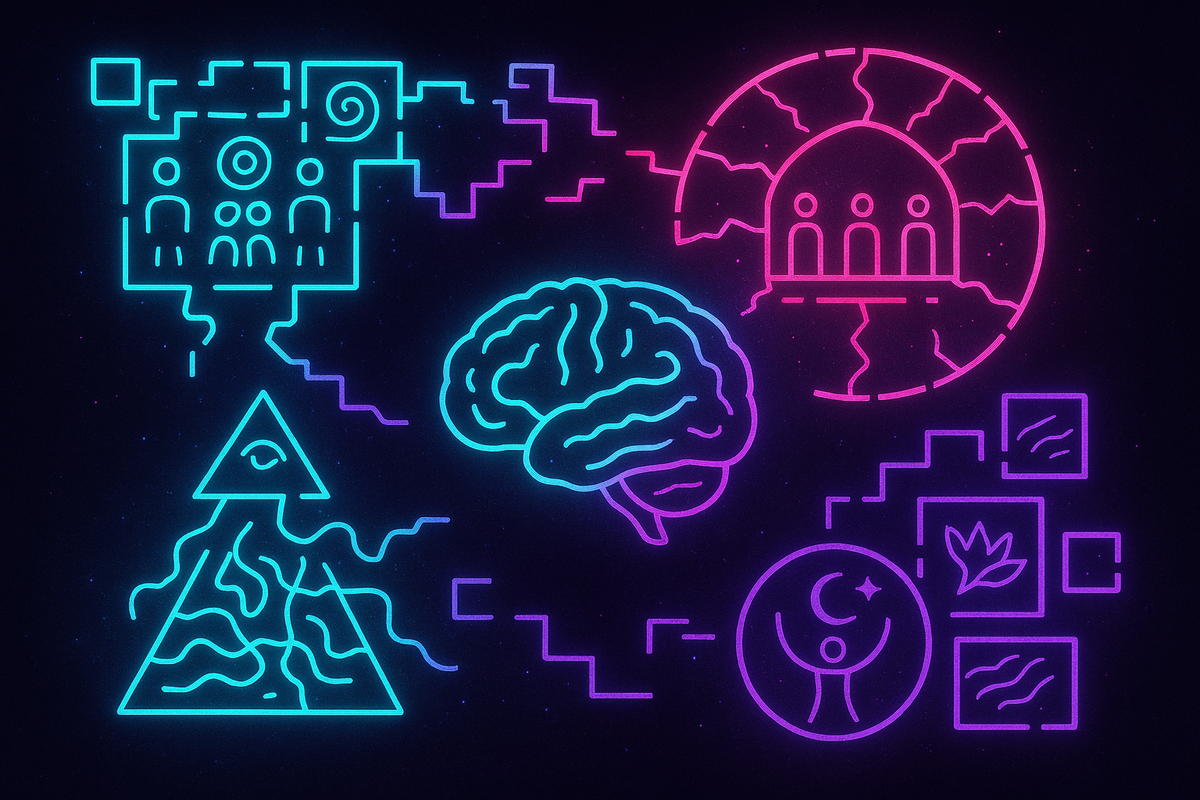
Myth and Meaning Crisis: Why the Compression Algorithms Stopped Working
Here's a pattern you've probably noticed: people are desperate for meaning.
Self-help books promising purpose top bestseller lists. Meditation retreats are booked months in advance. Jordan Peterson's lectures on ancient wisdom get millions of views. Young men join extremist movements offering identity and narrative. Wellness culture sells crystals and astrology as meaning-technologies. Conspiracy theories provide satisfying explanatory frameworks for a world that feels incoherent.
Philosopher John Vervaeke calls this the meaning crisis—widespread inability to answer questions about purpose, identity, and navigation that every previous culture had robust answers for. The crisis isn't that people don't believe in God (though that's part of it). It's that the systems that used to reliably generate meaning have broken down, and we haven't built adequate replacements.
This series has argued that myths are compression algorithms for coherence instructions. So here's the question: if myths are such powerful technology, why did they stop working? And what happens when cultures lose their myths without finding substitutes?
What Myths Did (That Nothing Else Does)
Before diagnosing the crisis, let's be clear about what we lost.
Traditional mythological systems provided:
Identity scaffolding → Who am I? The myths gave you archetypal roles to inhabit, developmental stages to traverse, and narratives to locate yourself within. Not rigid boxes but coherence templates you could customize while maintaining structure.
Transition navigation → How do I get from here to there? Myths encoded specific instructions for major life passages: birth, coming of age, marriage, parenthood, elderhood, death. Each had mythic templates showing the path.
Collective coordination → How do we stay aligned? Shared myths created common prediction models. When everyone knows the same stories, you can coordinate without explicit communication because you're running compatible software.
Existential orientation → What's the point? Myths situated individual lives within cosmic context—cycles of creation and destruction, battles between order and chaos, the journey from ignorance to wisdom. Your suffering had meaning within the larger pattern.
Moral instruction → What should I do? Not abstract ethics but embodied wisdom: the fool gets punished, the trickster teaches through violation, the hero serves the collective, the shadow must be integrated. Narrative makes ethics memorable and applicable.
Relational continuity → Am I alone? Myths connected you to ancestors (who walked these paths before), descendants (who will walk them after), and the more-than-human world (spirits, gods, nature itself). You lived in a relationally populated cosmos.
Notice: these functions aren't "nice to have." They're necessary for coherent selfhood. Without them, you face existential questions your nervous system can't ignore but has no stable answers for.
How Modernity Broke the Compression Algorithm
The Enlightenment project promised to replace mythic wisdom with rational principle. Science would explain the world. Liberal democracy would organize society. Individual freedom would replace traditional constraint. Progress would solve what tradition couldn't.
And in many domains, this worked brilliantly. Scientific medicine beats shamanic healing for bacterial infections. Democratic governance beats hereditary monarchy for most people. Individual freedom enables flourishing impossible under rigid caste systems.
But mechanism isn't meaning. Knowing how photosynthesis works doesn't tell you how to live when your child dies. Understanding evolutionary psychology doesn't give you identity when your traditional roles collapse. Rational ethics doesn't provide embodied capacity for action under conditions that make principles nearly impossible.
Modernity broke mythic compression through several mechanisms:
1. Literalism Destroyed Symbolic Depth
The Enlightenment demanded: are myths literally true? Did the Red Sea actually part? Was there really a garden with a talking snake?
When myths said "no" to literal truth tests, modernity concluded they were false and discarded them. But myths were never making literal claims. They were encoding navigational wisdom in symbolic form.
It's like asking "is the quadratic formula literally true?" It's the wrong category. The formula is useful. Myths are useful. Demanding literal truth breaks the compression by forcing symbolic language into wrong evaluative frame.
2. Individualism Severed Collective Rituals
Traditional myths weren't just stories you read. They were enacted in collective ritual—festivals, ceremonies, initiations, seasonal celebrations. The ritual embedded the myth in your nervous system through direct experience and social entrainment.
Modernity emphasized individual belief over collective practice. You could "believe in" Christianity while never participating in liturgy, never taking communion, never embodying the passion narrative through ritual reenactment. This is like trying to learn swimming by reading about it—the knowledge stays abstract, never becomes embodied capacity.
When ritual collapses, myths become information without installation. You know the story but haven't run the algorithm.
3. Plurality Fragmented Consensus
In traditional societies, mythic consensus was enforced. Everyone knew the same stories. Deviation was punished. This is oppressive, yes. But it created aligned prediction models across the population.
Modernity celebrates pluralism: all myths are equally valid, choose your own narrative, personal truth matters most. This is liberating. But it destroys the coordination function of myth. When everyone runs different software, you can't synchronize.
The result is meaning atomization: you construct personal meaning in isolation rather than inheriting collective meaning through transmission. This is exhausting and unstable. Most people aren't equipped to build coherent world-models from scratch.
4. Acceleration Exceeded Adaptation Speed
Myths evolve slowly through cultural transmission. They're optimized for relatively stable conditions where the challenges your grandparents faced are similar to yours.
Modernity produces change so fast that ancestral wisdom becomes obsolete. The job your grandfather did doesn't exist. The marriage model your grandmother followed doesn't work. The religious certainty your great-grandparents had feels impossible.
When conditions change faster than myths can adapt, the compression algorithms don't match current reality. They provide answers to questions nobody's asking while failing to address the questions everybody faces.
5. Commodification Stripped Sacred Context
Late capitalism treats everything as commodity—including meaning itself. You can buy mythology: oracle cards, weekend workshops promising transformation, self-help books packaging ancient wisdom, apps gamifying spiritual practice.
But commodified myth is decontextualized myth. When you extract the hero's journey from its ritual container, lineage transmission, and community context, you get the narrative structure without the coherence technology. It's like selling someone a hammer without teaching them carpentry—they have the tool but not the practice.
The Symptoms of Mythic Starvation
What happens when brains evolved to run on myths don't have them?
Substitute mythologies fill the vacuum. Political movements become pseudo-religions providing identity, narrative, collective ritual, moral clarity. Not because politics is naturally religious, but because humans need mythic structure and will find it wherever they can.
Conspiracy theories proliferate. They're poorly structured myths—providing agency (shadowy elites), narrative (the great plan), identity (awakened truth-seekers), moral clarity (us vs. them). They satisfy mythic hunger while violating Proppian structure and archetypal logic, which is why they're unstable and require constant escalation.
Therapeutic culture pathologizes normal coherence challenges. Coming of age is now "identity crisis." Grief is "complicated bereavement." Shadow integration is "trauma processing." Medicalization provides institutional support but strips the mythic frame that makes suffering meaningful.
Wellness culture commodifies ritual. Yoga without Hindu context. Meditation without Buddhist framework. Breathwork without shamanic lineage. These can be effective practices, but they're orphaned technologies—separated from the mythological contexts that explained why they work and what they're for.
Meaning becomes performance. Without stable mythos, you construct public persona and curate experience to signal coherence you don't actually feel. Instagram wellness is substitute mythology—the appearance of mythic integration without the actual navigation.
Nihilism and depression spike. When meaning-generation systems fail and substitutes don't satisfy, many people conclude there is no meaning. This isn't philosophical sophistication—it's system failure. Brains running meaning-generation algorithms with no viable inputs produce depression as error state.
Can Myths Work in Modernity?
The meaning crisis diagnosis raises an urgent question: can mythic technology function under modern conditions, or are we permanently post-mythic?
The problem isn't that myths are obsolete. Your nervous system still needs identity templates, transition navigation, collective coordination, existential orientation. These are human universals, not pre-modern artifacts.
The problem is transmission breakdown. The systems that used to install myths (ritual, consensus, slow cultural evolution, lineage transmission) don't function at scale in pluralistic, accelerating, individualized modernity.
This creates a design challenge: how do you preserve mythic function while adapting to modern constraints?
Several strategies are emerging:
Conscious Myth Work
Instead of unconsciously inheriting myths through cultural immersion, you can consciously choose and work with mythic templates that serve your coherence.
This isn't cultural appropriation or New Age pick-and-mix. It's recognizing myths as tools and selecting the right tool for your situation. Facing major transition? Work with hero's journey template. Navigating chaos? Study trickster patterns. Integrating shadow? Use myths that encode that geometry.
The difference from traditional transmission is conscious selection and application rather than unconscious absorption. This works but requires more effort—you're doing explicitly what your ancestors did implicitly.
Small-Scale Re-Ritualization
Even if society-wide ritual consensus is gone, you can create small-group ritual containers that install mythic templates through enacted practice.
This is what's happening in men's groups doing rite-of-passage work, women's circles doing seasonal celebration, martial arts dojos transmitting warrior ethos, intentional communities building shared ritual calendars.
These work because they restore the missing piece: embodied collective practice. The myth isn't just story you believe—it's pattern you enact with others, which installs it neurologically.
Narrative Reconstruction
You can use mythic templates to reframe your own life as meaningful journey rather than random events. This isn't delusion—it's applying the hero's journey structure to interpret your experiences.
"I'm not failing—I'm in trials phase."
"This isn't random suffering—it's ordeal that will yield transformation."
"I'm not lost—I'm navigating threshold between old and new coherence."
This self-narrative work leverages mythic compression to generate meaning from circumstances that would otherwise feel incoherent.
Cultural Hybridization
Modernity prevents single mythic consensus. But you can build local consensus within subcultures. Fandom communities do this constantly—creating shared mythology through participatory culture.
Marvel fans share mythic framework (hero narratives, archetypal characters, cosmic stakes). Star Wars fans have generational saga. Sports fans have seasonal ritual and tribal identity. These are functional mythologies for those communities, even if society-wide agreement is impossible.
Evolutionary Updating
Some traditional myths need revision to match current conditions. You can preserve the compression algorithm while updating the symbols.
The hero's journey works. But maybe your culture needs heroine's journey emphasizing different strengths. The trickster pattern works. But maybe you need digital-age tricksters rather than just Coyote and Loki. Rites of passage work. But maybe yours centers environmental responsibility rather than hunting prowess.
This is what cultures always did—myths evolved continuously. The difference is doing it consciously rather than through unconscious drift.
The Irreplaceable Core
What's clear from failed experiments: you can't replace myth with non-mythic alternatives.
Philosophy gives you abstract truth, not embodied wisdom. Science gives you mechanism, not meaning. Therapy gives you individual healing, not collective coordination. Politics gives you power arrangements, not existential orientation.
Each of these is valuable. None provides what myth provides: compressed coherence instructions installed through narrative, ritual, and social transmission.
The meaning crisis persists because we keep trying to solve a mythic problem with non-mythic tools. It's category error. You can't treat mythic starvation with more information, more therapy, more rational ethics. You need myth—or functional equivalent that preserves its core properties.
The Path Forward
The meaning crisis won't resolve through nostalgia (trying to restore pre-modern mythic consensus) or through denial (pretending we don't need myths).
It resolves through conscious cultural evolution: recognizing what myths do, understanding how they work, and building modern transmission systems that preserve mythic function while adapting to current conditions.
This means:
Mythic literacy → Understanding myths as coherence technology, not literal truth or primitive superstition
Ritual reconstruction → Creating embodied collective practices that install myths neurologically
Narrative sovereignty → Choosing mythic templates consciously rather than inheriting them unconsciously
Community containers → Building small-scale contexts where mythic transmission functions
Evolutionary adaptation → Updating myths to match current conditions while preserving core algorithms
The good news: humans are mythic animals. We will create meaning-generation systems because we must. The question is whether we build functional ones or continue substituting with politics, consumerism, and performative wellness.
The compression algorithms didn't stop working. We stopped transmitting them. And we can start again.
Further Reading
- Vervaeke, John, et al. Zombies in Western Culture: A Twenty-First Century Crisis. Open Book Publishers, 2021.
- Taylor, Charles. A Secular Age. Harvard University Press, 2007.
- Lent, Jeremy. The Patterning Instinct: A Cultural History of Humanity's Search for Meaning. Prometheus Books, 2017.
- Berman, Morris. The Reenchantment of the World. Cornell University Press, 1981.
- Smith, James K.A. You Are What You Love: The Spiritual Power of Habit. Brazos Press, 2016.
This is Part 8 of the Cognitive Mythology series, exploring how myths function as compression algorithms for coherence instructions.
Previous: Computational Mythology: Network Analysis and Distant Reading of Mythic Corpora
Comments ()