Myths Are Not Primitive Science: What Stories Actually Do for Brains
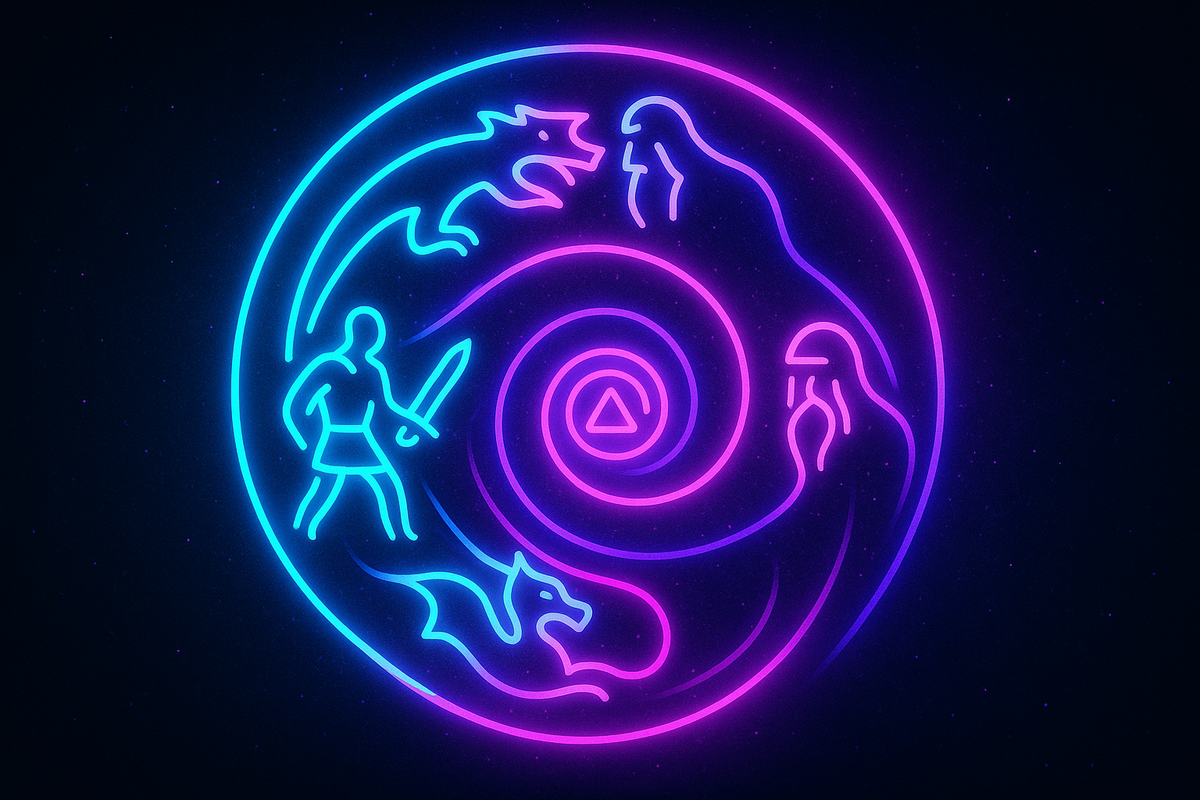
The mistake is treating myths as failed explanations. They were never trying to explain lightning. They were building shared frameworks for action — encoding what your community knows about danger, obligation, and meaning into a format the brain can store and retrieve.
Myths Are Not Primitive Science: What Stories Actually Do for Brains
When anthropologists first encountered indigenous creation myths in the 19th century, they made a mistake that would contaminate scholarship for generations. They assumed myths were failed attempts at scientific explanation—primitive efforts to answer questions like "where did the sun come from?" or "why do seasons change?" The implicit narrative: rational modernity had replaced superstitious mythology, and we were better for it.
This wasn't just wrong. It was spectacularly, comprehensively wrong in ways that reveal something crucial about what myths actually do—and why we still need them.
Myths aren't proto-science. They're compression algorithms for coherence instructions. They package navigational wisdom about how to maintain integrity across state transitions in memorable, transmissible form. And the reason they persist across every human culture isn't because people are gullible. It's because they solve a problem that science doesn't even address: how to stay coherent when conditions change.
This is the first article in a series exploring cognitive mythology—what happens when you analyze myths not as primitive cosmology but as evolved information technology, optimized over millennia to do something brains desperately need.
The Explanatory Theory Mistake
The "myths as primitive science" interpretation seemed obvious to 19th-century scholars. When you read that the Norse believed thunder came from Thor's hammer or that the Greeks thought Helios drove the sun across the sky in a chariot, it looks like naive causal explanation. Ancient people observed phenomena they couldn't explain scientifically, so they made up stories featuring anthropomorphic agents. QED.
Except this interpretation fails on multiple fronts.
First, indigenous peoples themselves don't treat myths as explanatory hypotheses. When anthropologist Claude Lévi-Strauss actually asked indigenous informants whether they believed their creation myths literally happened, he got responses like: "The myths are not true in the way you mean true. They are anciently true." This isn't evasion—it's a category distinction we lack vocabulary for.
Second, myths are terrible at the one thing scientific explanations excel at: specificity and prediction. If the Norse really wanted to explain thunder, "Thor hit his hammer" doesn't tell you when storms arrive, how long they last, or where lightning strikes. For that, Norse sailors developed remarkably accurate weather prediction through observation—entirely separate from mythology. Myths and practical knowledge coexisted without conflict because they addressed different problems.
Third—and this is where it gets interesting—myths exhibit design features that make no sense for explanatory purposes but are perfectly optimized for memory transmission. They're filled with what cognitive scientist Pascal Boyer calls "minimally counterintuitive" concepts: mostly normal entities with one or two violations of intuitive ontology. A talking snake. An immortal human. A god who dies. These aren't random weird details—they're precisely the kinds of concepts that hijack attention and survive cultural transmission.
If myths were about explaining nature, they'd be detailed, mechanistic, and boring. Instead they're dramatic, emotionally resonant, and sticky. That's not a bug in failed science. It's a feature of successful cultural technology.
What Myths Actually Compress
So if myths aren't explaining thunder and seasons, what are they doing?
Look at the structure of mythic narrative across cultures and you see remarkable convergence. Not in surface content—Norse myths look nothing like Yoruba myths look nothing like Polynesian myths. But in deep narrative architecture, the same patterns recur:
Order → Chaos → Struggle → New Order
This isn't explaining cosmology. It's encoding the fundamental pattern of coherence dynamics that every human experiences: stable states get disrupted, you navigate high-curvature conditions, you (maybe) establish new integration.
The Babylonian Enuma Elish describes primordial chaos (Tiamat) being defeated by ordered forces (Marduk) to create the world. The Judeo-Christian Genesis describes formless void being organized into structured creation. Hindu cosmology describes cycles of creation and dissolution. These aren't competing meteorological theories. They're different cultural encodings of the same geometric truth: coherent systems emerge from and return to high-entropy states.
In AToM terms, myths are teaching M = C/T at the experiential level. They're showing you what it looks like when coherence collapses (chaos dragons, world-ending floods, cosmic dissolution) and what it takes to restore it (heroes, divine intervention, sacrifice, transformation).
But here's the crucial move: myths don't just describe these patterns abstractly. They encode them in narrative form that your brain can run as simulation. When you internalize the hero's journey, you're not learning facts about ancient warriors. You're installing a template for navigating high-curvature state transitions in your own life.
Story as Coherence Instruction Set
Why does narrative work better than abstract principle for this purpose?
Because your brain is a prediction machine, and predictions run on patterns extracted from experience. When you hear "be courageous in the face of danger," that's an abstraction your prefrontal cortex can intellectually endorse while your limbic system ignores it completely. But when you internalize the story of Odysseus maintaining his identity through a decade of trials, or Arjuna facing impossible duty on the battlefield, or the Buddha sitting under the Bodhi tree through Mara's temptations, you're acquiring procedural knowledge about coherence maintenance.
Myths are procedural memory disguised as declarative story. They teach you how to do something—maintain coherence across transitions—by giving you a pattern to entrain with.
This is why myths are:
Emotionally intense → Emotional arousal enhances memory consolidation. The brain tags affectively charged information as important for prediction.
Socially embedded → Shared narratives create common prediction models across group members, enabling coordination through synchronized expectations.
Ritually repeated → Periodic re-exposure strengthens the neural traces, keeping the coherence templates accessible for pattern-matching.
Symbolically condensed → Archetypes (hero, trickster, wise old man, great mother) are high-compression representations of recurring coherence challenges and solutions. Your brain can pattern-match current situations to these templates faster than it can reason through novel problems from first principles.
When developmental psychologist Jean Piaget studied children's moral development, he found they went through predictable stages—from concrete rule-following to abstract principle application. But across cultures, the endpoint wasn't pure rational ethics. It was narrative wisdom: the ability to recognize which story you're in and what that story teaches about action.
Adults don't navigate complex moral situations by deriving principles from axioms. They pattern-match to narratives: "This is a David vs. Goliath situation." "I'm being tempted like Faust." "This is a tragedy in the making." These aren't metaphors. They're active predictions about how situations unfold and what actions preserve coherence.
Why Modernity Lost Its Myths (And Why That's a Problem)
The Enlightenment project tried to replace narrative wisdom with rational principle. Myth gave way to science, ritual to reason, tradition to progress. And this worked brilliantly—for certain domains.
Science is unmatched for explaining mechanisms: how photosynthesis works, why diseases spread, what causes earthquakes. Rational ethics is powerful for consistency: ensuring rules apply equally, detecting logical contradictions, formalizing justice.
But mechanism isn't meaning, and consistency isn't coherence.
Science tells you how things work. It doesn't tell you how to live when your child dies, or what to do when your cultural certainties collapse, or how to maintain integrity when every choice violates something essential. Rational ethics gives you principles. It doesn't give you the embodied capacity to enact those principles under conditions that make them nearly impossible.
Myths did both. They provided:
Identity scaffolding → Who am I? The myths gave you archetypal roles to inhabit: warrior, caregiver, seeker, guardian. Not as rigid boxes but as coherence templates.
Transition navigation → How do I get from here to there? The myths encoded patterns for major life transitions: coming of age, leaving home, facing mortality, integrating shadow.
Collective coordination → How do we stay aligned? Shared myths created common frameworks for interpreting events and coordinating responses.
Existential orientation → What's the point? The myths situated individual lives within larger patterns of meaning that survived individual death.
When we abandoned myth as "primitive," we didn't replace these functions. We just stopped having stable, culturally-transmitted solutions to them. The result is what philosopher John Vervaeke calls "the meaning crisis"—widespread inability to answer questions about purpose, identity, and navigation that every previous culture had robust (if varied) mythic answers for.
You can see this in the frantic contemporary search for meaning: self-help books promising transformation, wellness culture offering ritual, political movements providing identity, conspiracy theories supplying narrative coherence. These aren't signs of irrationality. They're symptoms of mythic starvation—brains desperately seeking the coherence instructions that myths used to provide.
The Geometric Structure Beneath Every Myth
Here's where cognitive mythology gets interesting for AToM's framework.
If you analyze myths through the lens of coherence geometry, you see that beneath their surface diversity, they're encoding the same state-space structure:
Stable attractor (the ordinary world, the kingdom at peace)
↓
Perturbation (the call to adventure, the invasion, the curse)
↓
High-curvature navigation (trials, temptations, transformations)
↓
Critical choice point (the ordeal, the sacrifice, the integration)
↓
New stable attractor (return with the elixir, the kingdom restored, the self transformed)
This isn't metaphor. It's geometric description of how systems maintain coherence across state transitions. The myths are teaching you the shape of coherence dynamics through narrative rather than equations.
Joseph Campbell's "monomyth"—the hero's journey—gets criticized for overgeneralizing diverse cultural traditions. And yes, surface details vary enormously. But Campbell was tracking something real: the deep attractor structure that myths converge on because it maps to actual coherence dynamics.
When you depart from ordinary world (low-curvature attractor), you enter threshold/initiation (high-curvature region where predictions fail and transformation becomes possible), you face the ordeal (the point of maximum uncertainty where old self-model must dissolve), and you return transformed (integrated into new attractor), you're not following arbitrary narrative convention. You're traversing the geometry that any system navigating major state transitions must traverse.
The myths don't tell you about this geometry abstractly. They let you experience it viscerally through identification with the protagonist. Your mirror neurons fire. Your prediction machinery runs simulations. Your emotional system codes valence gradients. By the time you finish the story, you've rehearsed the coherence transition without having to risk actual disintegration.
This is what initiation rituals do: they dramatize the mythic pattern so participants experience the state transition in controlled conditions. You symbolically die (ego dissolution in high-curvature region) and are reborn (integrated into new identity attractor). The myth provides the template. The ritual enacts it. The participant emerges transformed—not because magic happened, but because their nervous system just ran a full coherence-transformation cycle.
Recognizing Myth in Modern Dress
Once you see myths as coherence compression algorithms rather than primitive explanations, you start recognizing them everywhere—including places that claim to have transcended mythology.
Superhero narratives → Same archetypal structure as classical myth. Not because comic writers are consciously copying Homer, but because they're responding to the same human need for coherence templates. Spider-Man learns "with great power comes great responsibility"—a principle transmitted through narrative because abstract ethics don't stick.
Sports stories → The underdog victory, the comeback from defeat, the veteran's last championship—these are mythic patterns. They compress coherence lessons: "persistence through adversity," "unity under pressure," "glory in sacrifice." Fans don't just watch games; they participate in mythic enactment.
National founding myths → Every country has them. George Washington and the cherry tree. The Mayflower Compact. The Long March. These aren't accurate history—they're coherence instructions for national identity. "This is who we are. This is what we value. This is what we do when tested."
Self-help mythology → From The Secret to 12 Rules for Life, popular psychology books function as modern myth. They provide archetypal narratives (the victim who becomes victor, the order that emerges from chaos) and transmit them with emotional intensity, repetition, and symbolic condensation. Their truth isn't empirical—it's navigational.
Corporate mythology → "Startup in a garage becomes world-changing company." This narrative shapes how entrepreneurs see themselves and what risks they're willing to take. It's not about historical accuracy—Apple's actual founding was more complex and less mythic—it's about providing a coherence template for navigating the chaos of venture creation.
The human brain hasn't changed in 50,000 years. We still need coherence instructions packaged in memorable, transmissible narrative form. We've just stopped calling them myths and started calling them stories, journeys, frameworks, and narratives. Same function. Different branding.
What This Series Will Explore
The articles that follow will unpack the cognitive machinery that makes myths work:
Why certain concepts stick while others fade (minimally counterintuitive ideas that exploit attention mechanisms)
Why we see agency everywhere (hyperactive agency detection and its role in populating myths with gods and spirits)
What archetypes actually encode (high-compression solutions to recurring coherence challenges)
Why the hero's journey is universal (geometric reading of the monomyth as coherence-transition template)
How narratives function as state machines (Propp's morphology and the algorithmic structure of stories)
What computational analysis reveals (network analysis and distant reading of mythic corpora)
Why myths are failing in modernity (the meaning crisis and broken compression algorithms)
How to work with myth consciously (recovering mythic function without regressing to literalism)
And finally, we'll integrate these findings to show how myths function as coherence technology—evolved information structures that package navigational wisdom in forms optimized for human neural architecture.
Myths aren't primitive science. They're sophisticated cultural technology for coherence transmission. Understanding how they work doesn't demystify them into irrelevance. It reveals why we need them—and why we're struggling without them.
The question isn't whether you live by myths. You do. The question is whether you're conscious of which myths are running your predictions—and whether they're serving your coherence or undermining it.
Further Reading
- Boyer, Pascal. Religion Explained: The Evolutionary Origins of Religious Thought. Basic Books, 2001.
- Campbell, Joseph. The Hero with a Thousand Faces. Princeton University Press, 1949.
- Lévi-Strauss, Claude. Structural Anthropology. Basic Books, 1963.
- Vervaeke, John, et al. Zombies in Western Culture: A Twenty-First Century Crisis. Open Book Publishers, 2021.
- Donald, Merlin. Origins of the Modern Mind: Three Stages in the Evolution of Culture and Cognition. Harvard University Press, 1991.
This is Part 1 of the Cognitive Mythology series, exploring how myths function as compression algorithms for coherence instructions.
Next: Why Myths Stick: The Cognitive Science of Minimally Counterintuitive Concepts
Comments ()