NAD+ and Sirtuins: David Sinclair's Protocol
Harvard's David Sinclair takes NMN every morning based on his theory that aging is a loss of epigenetic information, not irreversible damage. NAD+ and sirtuin proteins are central to his framework — and to a fierce scientific debate.
NAD+ and Sirtuins: David Sinclair's Protocol
David Sinclair is either the most important longevity researcher of our time or a very effective salesman of supplements. Possibly both. The Harvard geneticist has built his career around a simple claim: aging is not an inevitable decay but an information problem that can be addressed. The central mechanism, in his telling, involves a molecule called NAD+ and the enzymes that depend on it—the sirtuins. His book Lifespan became a bestseller. His supplement recommendations moved markets. His public profile made him the face of longevity research for millions of people who'd never read a scientific paper. But what does the actual science say? And can you really slow aging by taking some pills?
Enter the Sirtuins
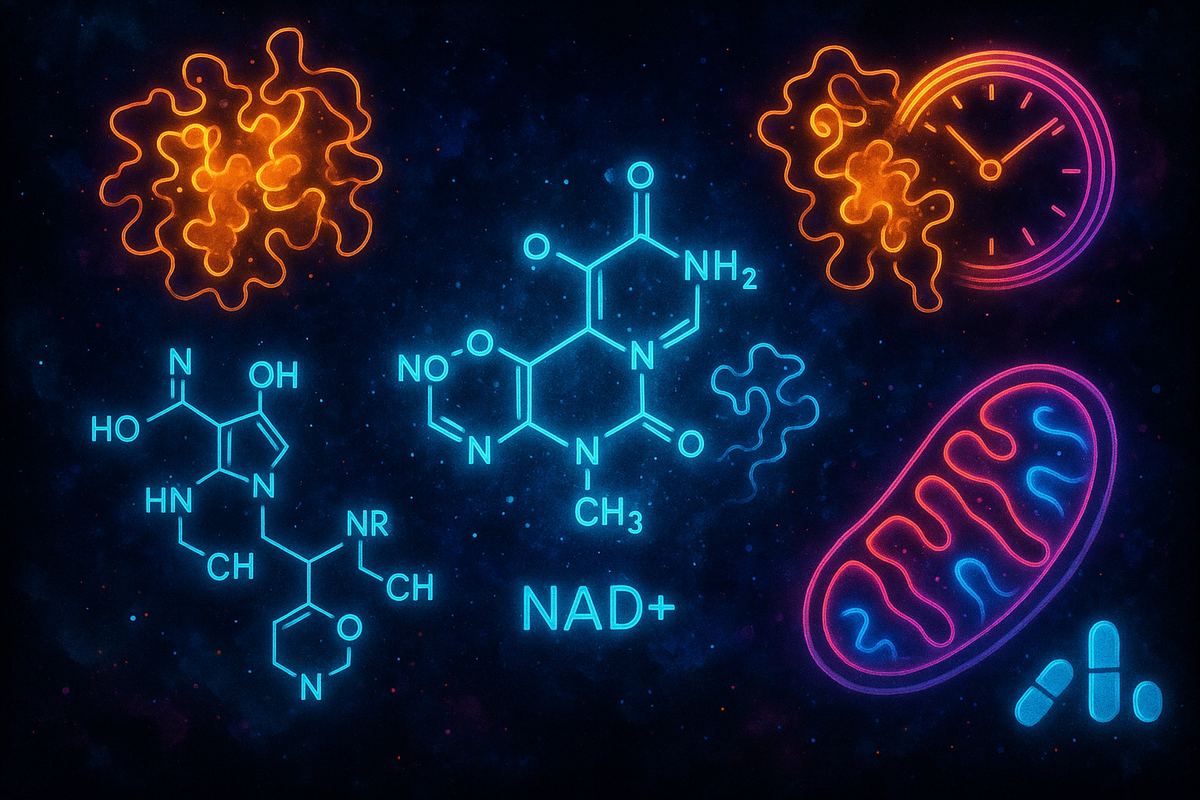
NAD+ isn't just an energy molecule. It's also required by a family of enzymes called sirtuins (SIRT1-7 in mammals). Sirtuins do several things:
- Regulate gene expression by removing acetyl groups from histones (the proteins that DNA wraps around)
- Repair DNA damage
- Modulate inflammatory pathways
- Influence mitochondrial function
In Sinclair's framing, sirtuins are "survival genes"—they evolved to help organisms survive periods of stress (caloric restriction, cold, physical stress). When conditions are tough, sirtuins shift the cell toward repair and maintenance rather than growth and reproduction. Caloric restriction—the most robust intervention known to extend lifespan in laboratory animals—activates sirtuins. This is partly because caloric restriction increases the NAD+/NADH ratio, making more NAD+ available for sirtuin activity. Sinclair's pitch: if caloric restriction works by activating sirtuins, and sirtuins need NAD+, maybe we can get the benefits of caloric restriction without the restriction—by boosting NAD+ directly.
The Precursors
You can't just swallow NAD+. It's a large molecule that doesn't survive digestion and can't easily enter cells. So the focus has been on precursors—smaller molecules that the body can convert into NAD+. Nicotinamide riboside (NR) and nicotinamide mononucleotide (NMN) are the two main contenders. Both are forms of vitamin B3 that feed into NAD+ synthesis pathways. Both are marketed as supplements. Both have research backing (of varying quality). NR has been around longer in the supplement market. It's the active ingredient in products like Tru Niagen. NMN is Sinclair's preference. He's been vocal about taking it himself (along with resveratrol, metformin, and other compounds). Animal studies show that both NR and NMN can raise NAD+ levels in tissues. Mouse studies show improvements in various aging markers: better mitochondrial function, improved insulin sensitivity, enhanced endurance, protection against age-related decline in organs. The human data is thinner. Clinical trials show that NR and NMN are safe and can raise blood NAD+ levels. Effects on clinical outcomes—longevity, disease prevention, functional improvements—are much less clear. We don't have evidence that NAD+ precursors extend human lifespan. We have evidence they raise a biomarker that might relate to aging. That's not nothing, but it's not proof of efficacy either.
Sinclair's Protocol
Sinclair has been publicly transparent about his own supplement regimen. As of recent interviews, it includes:
- NMN: 1 gram per day
- Resveratrol: 1 gram per day (with yogurt for better absorption)
- Metformin: 1 gram per day (a diabetes drug with possible longevity effects)
- Vitamin D: daily
- Vitamin K2: daily
- Aspirin: low-dose
- Various others that have varied over time
He combines this with:
- Eating mostly plant-based, often skipping breakfast or lunch
- Regular exercise
- Avoiding excessive sun exposure
- Keeping the house cool at night
This is an n=1 experiment. Sinclair is his own guinea pig. He's also a 50-something who looks younger than his age—which proves nothing statistically but is very good marketing. The protocol is expensive if you're taking pharmaceutical-grade NMN and resveratrol. It's also based on extrapolations from animal studies and mechanistic reasoning, not from human clinical trials showing lifespan extension.
The Criticisms
Sinclair has critics, and their objections are worth taking seriously. The animal-to-human gap. Many interventions that extend lifespan in mice don't work in humans. Mice live 2-3 years; humans live 80+. The biology of aging may not translate. Most mouse longevity studies are done in specific inbred strains under controlled conditions—not exactly translatable to genetically diverse humans living varied lives. Biomarker ≠ outcome. Raising NAD+ levels is not the same as extending lifespan. We're treating a surrogate endpoint as if it were the goal. Many drugs that raised "good" biomarkers have failed to improve clinical outcomes. The hype-to-evidence ratio. Sinclair is a skilled communicator with a large platform. Some scientists worry that his public enthusiasm outpaces the data. The supplements he discusses aren't FDA-approved for anti-aging, and the clinical evidence for their longevity benefits is weak. Financial conflicts. Sinclair has financial ties to companies in the longevity supplement space. He's disclosed them, but the incentive structure raises questions. When someone profits from sales of a product, their public statements about that product deserve extra scrutiny. Mechanistic complexity. The NAD+-sirtuin-aging axis is real, but it's embedded in a web of interconnected pathways. Boosting one molecule may have unintended effects elsewhere. Cancer cells, for instance, also like NAD+—they need it to grow. The long-term consequences of chronically elevated NAD+ are unknown.
What the Studies Actually Show
Let's be precise about the evidence. In mice and other animals:
- NR and NMN raise NAD+ levels in tissues
- This is associated with improved mitochondrial function
- Some studies show improved endurance, insulin sensitivity, and protection against high-fat diet damage
- Some studies show extended healthspan (time healthy) though effects on lifespan are less consistent
In humans:
- NR and NMN raise blood NAD+ levels
- They appear safe at doses tested
- Some studies show modest improvements in metabolic markers
- No studies have shown lifespan extension (which would take decades to test)
- No studies have shown robust clinical improvements in disease outcomes
The gap between animal promise and human proof is large. That doesn't mean the supplements don't work. It means we don't know if they work. Different things.
Reasonable Conclusions
If you're considering NAD+ precursors, here's an honest assessment: Plausible mechanism: The NAD+-sirtuin connection is real biology. The hypothesis that declining NAD+ contributes to aging is reasonable, even if not proven. Animal evidence: Suggestive but not conclusive. Many interventions that help mice don't help humans. Human evidence: We know supplements can raise NAD+ levels. We don't know if that translates to healthspan or lifespan benefits. Safety: NR and NMN appear safe at commonly used doses. Long-term safety data is limited. Cost-benefit: If you have disposable income and want to bet on plausible longevity interventions, NAD+ precursors are among the more reasonable options. If you're looking for proven therapies, this isn't one. The boring stuff still matters more: Sleep, exercise, nutrition, stress management, not smoking, moderate alcohol—these have much stronger evidence bases than any supplement. Don't skip the basics hoping pills will compensate.
The Bigger Picture
Sinclair's greatest contribution may not be NAD+ specifically but the framing of aging as tractable. For most of history, aging was accepted as inevitable. Sinclair and others in the longevity field argue that aging is a biological process, and biological processes can be understood and potentially modified. "Aging is a disease, and it can be treated." This is Sinclair's mantra. Whether or not his specific interventions pan out, the conceptual shift matters. If aging is a process rather than a fate, then researching interventions is legitimate science, not quackery. The NAD+ story is one chapter in a larger book. Senolytics, cellular reprogramming, caloric restriction mimetics—multiple approaches are being explored. Some will fail. Some may work. The field is moving. In twenty years, we'll know whether NAD+ supplementation was an early insight or a dead end. For now, it's an educated bet—plausible, not proven, and subject to revision as data accumulates.
Further Reading
- Sinclair, D. A. & LaPlante, M. D. (2019). Lifespan: Why We Age—and Why We Don't Have To. Atria Books.
- Rajman, L., Chwalek, K., & Sinclair, D. A. (2018). "Therapeutic Potential of NAD-Boosting Molecules." Cell Metabolism.
- Shade, C. (2020). "The Science Behind NMN–A Stable, Reliable NAD+ Activator." Integrative Medicine.
This is Part 4 of the Longevity series. Next: "Yamanaka Factors: Reversing Cellular Age."


Comments ()