The Near-Death Experience: Neuroscience of Dying
Near-death experiences feel more real than ordinary life to those who have them. The neuroscience of a dying brain — surging gamma waves, oxygen starvation, REM intrusion — suggests why, without fully explaining the experience away.
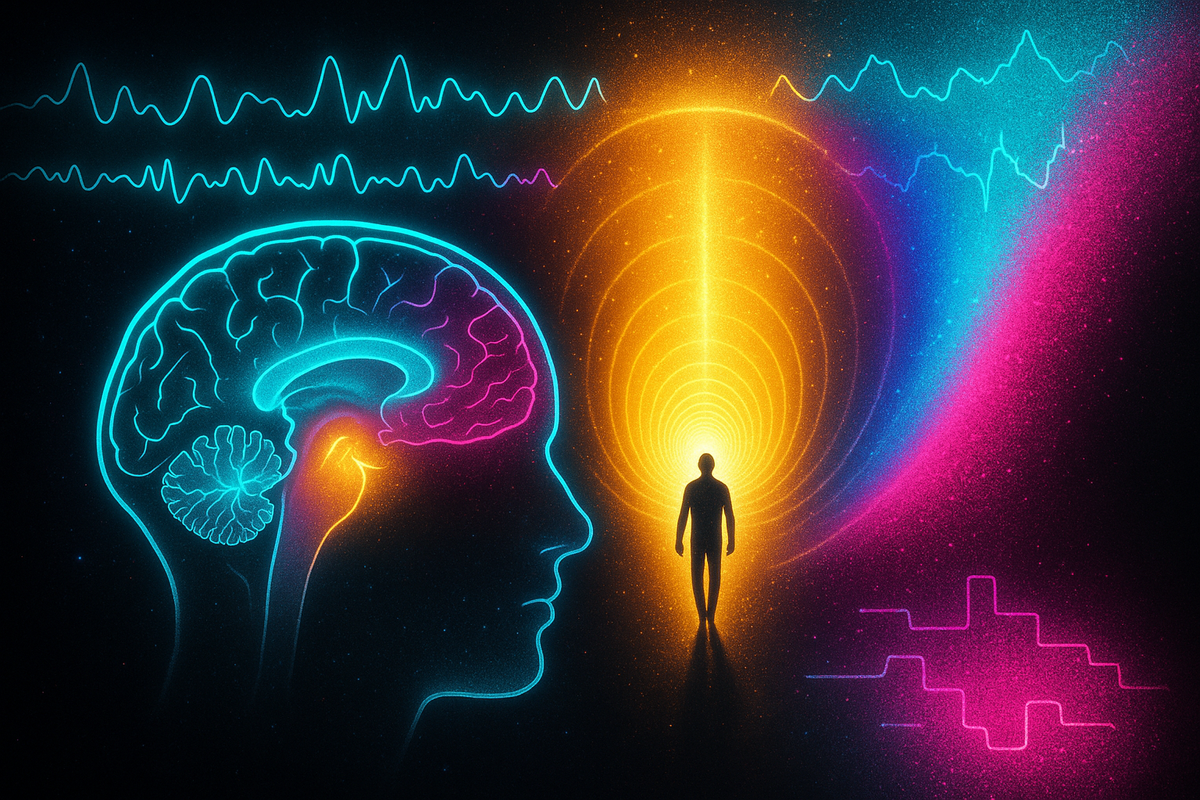
Near-Death Experience: The Neuroscience of Dying
Series: Anomalous Cognition | Part: 3 of 9 Primary Tag: FRONTIER SCIENCE Keywords: near-death experience, NDE, neuroscience, consciousness, dying brain, out-of-body experience
A tunnel of light. Deceased relatives. A life review. A sense of profound peace. The feeling of leaving the body.
Millions of people have reported these experiences after coming close to death. The reports are remarkably consistent across cultures, ages, and circumstances.
What's happening? Is consciousness separating from the body? Is there an afterlife glimpse? Or is this what dying brains do?
Neuroscience has a lot to say about near-death experiences—more than many people realize. The mystery isn't fully solved, but it's considerably reduced.
The Phenomenology
Near-death experiences (NDEs) share common features:
The tunnel and light: Many experiencers report moving through a dark tunnel toward a bright light. The light is described as warm, welcoming, infinitely loving.
Out-of-body experience: A sense of floating above one's body, often watching resuscitation attempts. Some claim to see events they shouldn't have been able to perceive.
Life review: A rapid, panoramic review of one's entire life, sometimes described as seeing everything at once. Often accompanied by understanding how one's actions affected others.
Deceased relatives: Encounters with dead friends, family members, or religious figures. These beings often communicate that it's "not yet time."
Ineffability: Experiencers typically say the experience cannot be adequately described in words. It transcends ordinary experience.
Transformative effects: Many experiencers report lasting changes—reduced fear of death, increased spirituality, changed values, sometimes personality shifts.
The consistency of these reports, even across cultures, is striking. But consistency doesn't prove a supernatural explanation. It might mean dying brains reliably produce similar experiences.
The Neuroscience of Oxygen Deprivation
When brains don't get enough oxygen, specific things happen:
Cortical disinhibition: As oxygen drops, the brain's inhibitory circuits fail before excitatory ones. This produces a wave of hyperactivity—neurons firing chaotically—before final shutdown.
Visual cortex effects: The tunnel-and-light phenomenon can be produced by abnormal activity in the visual cortex. Similar effects occur with migraine auras, epilepsy, and psychedelic drugs. The peripheral visual field fails first, creating a tunnel effect as the central field remains.
Temporal lobe involvement: The temporal lobe mediates emotion, memory, and self-representation. Stimulating it (electrically or through seizures) can produce feelings of presence, religious experiences, and out-of-body sensations. Dying brains have abnormal temporal lobe activity.
Endogenous opioids: The brain releases endorphins under extreme stress, potentially explaining the peace and euphoria of NDEs.
REM intrusion: Some researchers suggest NDEs involve intrusion of REM sleep mechanisms—the same circuits that produce dreams—into waking consciousness during crisis states.
None of this is a complete explanation. But it shows that known neuroscience can account for many NDE features without invoking the supernatural.
The Cardiac Arrest Studies
The AWARE study (AWAreness during REsuscitation) was designed to test whether NDEs involve genuine out-of-body perception.
The method: place hidden targets (images only visible from above) in hospital rooms where cardiac arrests occur. If patients really leave their bodies, they might see and report these targets.
Results from AWARE I and II: hundreds of cardiac arrests, some with NDEs, but almost no verified perception of hidden targets. One patient gave a detailed account of his resuscitation but didn't see the hidden target in his room.
The studies didn't definitively refute out-of-body perception, but they didn't support it either. The most parsimonious explanation: NDE content comes from expectations, prior knowledge, and the dying brain's reconstructions—not actual perception of physical events.
The Timing Problem
A key claim: some NDEs occur when the brain is "flatlined"—showing no EEG activity during cardiac arrest. If true, this would challenge materialist neuroscience. No brain activity, yet complex experiences.
But there's a timing problem:
EEG limitations: Surface EEG measures cortical activity poorly. Deep brain structures can be active without surface EEG showing it. "Flat" EEG doesn't necessarily mean no brain activity.
Memory formation: Experiences during cardiac arrest might be reconstructed from fragments during the recovery period, not formed during the arrest itself. The feeling of "this happened while I was dead" could be a timing illusion.
Brief consciousness: Consciousness might flicker in and out during resuscitation. The NDE could happen during these brief periods of brain function, not during the deepest arrest.
We can't currently prove when NDEs happen relative to brain activity. The claim that they occur during true flatline is an assumption, not a demonstrated fact.
Cross-Cultural Variations
NDEs are remarkably consistent, but not identical across cultures:
Western NDEs: Often feature tunnels, light, deceased relatives, religious figures (Jesus, angels).
Indian NDEs: Sometimes feature yamudoots (messengers of death) and bureaucratic mistakes (being told they have the "wrong person").
Melanesian NDEs: May feature different landscape features and cultural figures.
The core elements (light, peace, boundary, return) seem universal. The specific content is culturally shaped. This is exactly what you'd expect if NDEs are brain-generated experiences filtered through cultural expectations—not glimpses of an objective afterlife.
The Transformative Effects
The lasting changes from NDEs are real and well-documented:
- Reduced fear of death - Increased compassion and concern for others - Decreased materialism - Enhanced sense of meaning - Sometimes difficult reintegration into normal life
These changes don't prove NDEs are veridical (accurately perceiving reality). Powerful experiences transform people whether or not they're objectively real. Psychedelic experiences produce similar transformations without anyone claiming the user visited another dimension.
The transformation suggests NDEs are deeply meaningful experiences. It doesn't tell us whether they involve consciousness leaving the body.
The Philosophical Question
Here's what we can say with confidence:
NDEs happen. Millions of people have had them. The experiences are vivid, memorable, and often life-changing.
They have neural correlates. Oxygen deprivation, temporal lobe activity, REM intrusion, and other mechanisms can explain many features.
They're culturally shaped. The specific content varies by culture, suggesting brain-generated imagery rather than objective perception.
Out-of-body perception isn't verified. Controlled studies haven't confirmed that experiencers perceive events they couldn't have known about.
What we can't say:
Whether consciousness is purely neural. NDEs raise but don't answer the hard problem of consciousness. If subjective experience is what it feels like to be a brain, then NDEs are what it feels like to be a dying brain. If consciousness is something more, NDEs might be something more too.
What subjective experience is "really" like during dying. We have reports from people who recovered. What happens to those who don't recover—we can never know.
The Honest Position
NDEs are probably generated by dying brains.
The evidence points this way: the neural mechanisms, the cultural variations, the failure to verify out-of-body perception, the precedents from similar experiences induced by other causes.
But "probably" acknowledges uncertainty. We don't fully understand consciousness. We can't definitively prove NDEs are "just" brain activity. The hard problem of how subjective experience arises from matter remains unsolved.
What I'm confident about: - NDEs have naturalistic explanations for their specific features - They don't provide strong evidence for an afterlife - The experiences themselves are real and often transformative - They're worth studying as unusual brain states
What I'm uncertain about: - The ultimate nature of consciousness - Whether there's something it's like to die that we can never access - Whether materialism fully explains mind
The NDE isn't a proof of afterlife. It's a fascinating window into what brains do at their limits.
Further Reading
- Blanke, O. & Dieguez, S. (2009). "Leaving body and life behind: Out-of-body and near-death experience." The Neurology of Consciousness. - Parnia, S. et al. (2014). "AWARE—AWAreness during REsuscitation—A prospective study." Resuscitation. - van Lommel, P. et al. (2001). "Near-death experience in survivors of cardiac arrest." The Lancet. - Mobbs, D. & Watt, C. (2011). "There is nothing paranormal about near-death experiences." Trends in Cognitive Sciences.
This is Part 3 of the Anomalous Cognition series. Next: "Mystical Experience: The Neuroscience of Unity."
Comments ()