Network Topology: Small Worlds
Random networks and perfect lattices are both easy to analyze but rare in nature. Real social, biological, and technological networks cluster locally but stay globally connected — a structure with profound consequences for how quickly anything spreads through them.
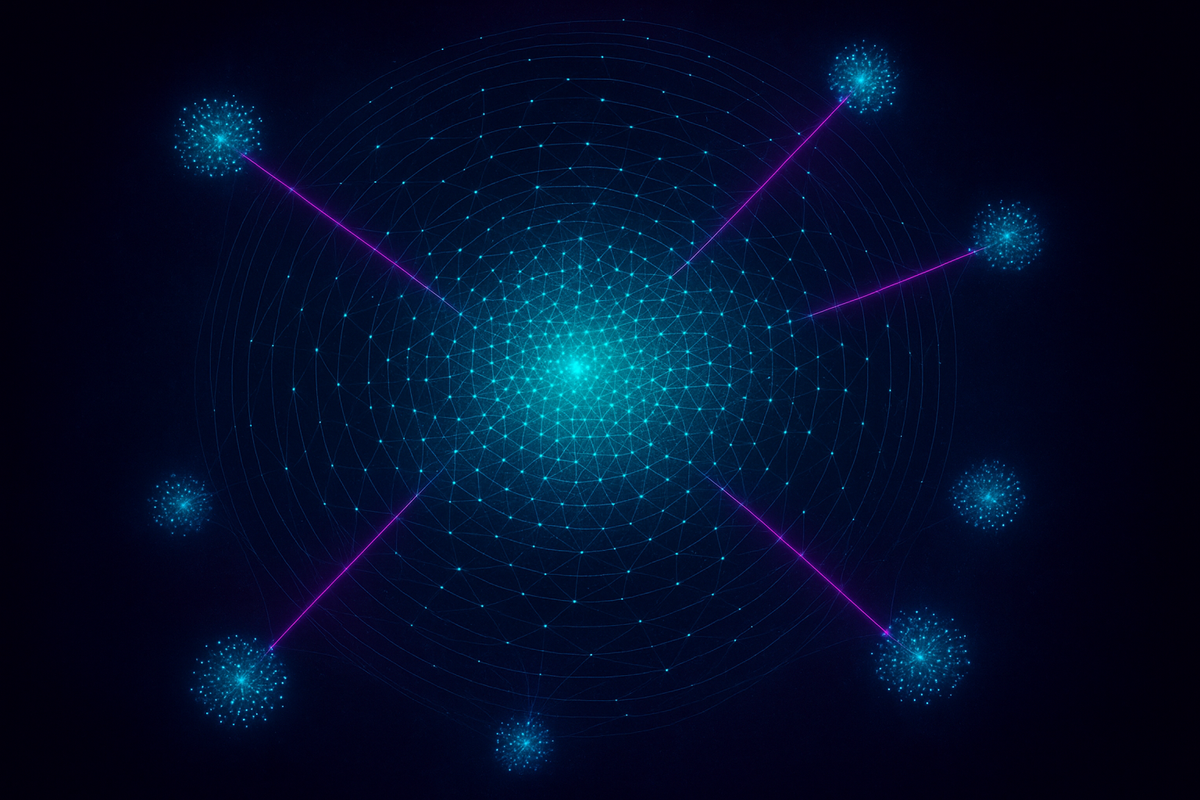
Network Topology: Small Worlds
In 1967, social psychologist Stanley Milgram ran an experiment that would become one of the most famous in history.
He gave letters to random people in Nebraska and Kansas, addressed to a stockbroker in Boston. The catch: participants couldn't mail the letters directly. They had to send them to someone they knew personally—someone who might be one step closer to the target. That person would do the same, and so on, until the letter reached the stockbroker.
The average number of steps? Six.
"Six degrees of separation" entered popular culture as a quasi-mystical fact about human connection. But the more important finding was hidden in the result: a network can be both highly clustered (your friends know each other) and globally connected (you can reach anyone in six hops).
This was supposed to be impossible. The mathematics of networks said you could have one or the other, not both. Milgram's experiment suggested the mathematics was wrong—or incomplete.
Three decades later, mathematicians Duncan Watts and Steven Strogatz figured out how. They called it a "small-world network." And it turned out to describe almost everything.
The Clustering Problem
Before Watts and Strogatz, network theory had two extreme models.
Regular networks: Think of a grid or a ring where each node connects only to its immediate neighbors. These networks are highly clustered—your contacts know each other because they're also your neighbors' neighbors. But they're poorly connected globally. To get a message across a regular network, you have to traverse many steps, hopping from neighbor to neighbor.
Random networks: Think of connections assigned by lottery. Each node is equally likely to connect to any other node. These networks are poorly clustered—your contacts probably don't know each other, because connections are random. But they're well-connected globally. Random long-range connections create shortcuts that dramatically reduce the average path length.
The problem: real social networks don't look like either. They have high clustering (your friends know each other) and short path lengths (you can reach anyone in a few hops). The existing models couldn't produce both properties simultaneously.
Watts and Strogatz's insight was elegant: start with a regular network, then rewire a small fraction of edges randomly. The random long-range connections create shortcuts without destroying local clustering. You get a network that's mostly local—clusters of connected neighbors—with occasional long bridges to distant clusters.
This is a small-world network. And its properties are remarkable.
The Watts-Strogatz Model
Here's the construction:
Start with a ring of nodes, each connected to its nearest neighbors. This is highly clustered (your neighbors' neighbors are also your neighbors) but has long path lengths (to reach the opposite side of the ring, you have to traverse half the circumference).
Now rewire: with some probability p, replace each local connection with a random long-range connection.
At p=0 (no rewiring), you have the regular clustered ring. Path lengths are high; clustering is high.
At p=1 (complete rewiring), you have a random network. Path lengths are low; clustering is low.
But at intermediate values—even small ones, like p=0.01—something magical happens. Path lengths drop dramatically while clustering stays almost intact.
A tiny number of random long-range connections—"shortcuts"—collapse the diameter of the network. You can now reach distant nodes in a few hops by hitting a shortcut. But most of your connections are still local, so your friends still know each other.
This is the small-world regime: high clustering, short paths. And it turns out this is where real networks live.
Why Small Worlds Matter for Contagion
The topology of a network determines what can spread through it and how fast.
In a regular lattice (no shortcuts), contagions spread slowly and steadily outward from the origin. Think of ripples in a pond. Distant parts of the network don't get infected until the wavefront reaches them. This makes the network resilient to rapid spread but also slow to adapt or coordinate.
In a random network (all shortcuts), contagions spread explosively. Any infection quickly hops to every part of the network. This makes the network fast but fragile—a single infection can become global almost instantly.
In a small-world network, you get a hybrid dynamic. Contagions spread locally through clusters, then jump to distant clusters through shortcuts. The outbreak pattern is punctuated: slow local spread, sudden long-range jump, slow local spread in the new location, another jump.
This has profound implications:
Simple contagions (which spread on single exposure) spread faster in small-world networks than in regular networks, because the shortcuts accelerate transmission.
Complex contagions (which require reinforcement) spread slower in small-world networks than in regular networks, because the shortcuts disrupt the clustering needed for reinforcement. A single long-range tie delivers only one exposure—not enough to trigger adoption.
The same network topology can accelerate some contagions and impede others, depending on the threshold dynamics of what's spreading.
Scale-Free Networks: The Fat Tail Problem
Small-world networks have another cousin: scale-free networks.
In a Watts-Strogatz small-world network, nodes have roughly similar numbers of connections. But real social networks show something different: a power-law distribution of connections. A few "hubs" have enormously many connections; most nodes have few.
Albert-László Barabási and Réka Albert characterized this pattern and named it "scale-free" because the degree distribution has no characteristic scale—the pattern repeats across orders of magnitude.
Scale-free networks emerge from a simple process: preferential attachment. When a new node joins the network, it's more likely to connect to nodes that already have many connections. The rich get richer. Early nodes and lucky nodes accumulate connections, becoming hubs. Late nodes stay peripheral.
This creates a network that's robust to random failure but vulnerable to targeted attack. Remove random nodes, and the network mostly stays connected—peripheral nodes don't matter much. But remove the hubs, and the network shatters.
For contagion, scale-free topology matters enormously:
Hubs are super-spreaders. If a hub gets infected, they can transmit to dozens or hundreds of contacts. Early infection of hubs accelerates epidemic spread.
Hubs are targets for vaccination. Immunizing hubs provides disproportionate protection to the network. You don't need to vaccinate everyone—just the hubs.
Hubs create inequality in exposure. Peripheral nodes may never encounter a contagion if it doesn't reach their local cluster. But hubs encounter everything that circulates in the network.
The Clustering Coefficient
One key metric for network topology is the clustering coefficient: what fraction of your friends are friends with each other?
In a regular lattice, clustering is high—almost all of your friends know each other, because they're all in your immediate neighborhood.
In a random network, clustering is low—your friends are randomly selected from the whole population, so they're unlikely to know each other.
In a small-world network, clustering remains high despite the presence of long-range shortcuts, because most connections are still local.
The clustering coefficient matters for contagion in subtle ways:
High clustering facilitates complex contagions. When your friends know each other, they can provide the redundant exposure needed to trigger adoption. You see multiple people in your cluster adopting, which pushes you over your threshold.
High clustering contains simple contagions. When your friends know each other, a simple contagion that enters your cluster quickly saturates it—but has fewer paths to escape to other clusters. The local density that aids complex contagions traps simple contagions.
Bridging ties escape clusters. The people who connect different clusters—weak ties, in Granovetter's terminology—are low-clustering connections. They don't know your other friends. But they're the paths by which contagions cross cluster boundaries.
The interplay between clustering and bridging determines the global dynamics of any spreading process.
Real Networks
When researchers map real social networks, they consistently find small-world properties:
Scientific collaboration networks (who co-authored papers with whom) show high clustering (co-authors tend to share other co-authors) and short path lengths (most scientists are a few links apart).
Actor collaboration networks (who appeared in films with whom) show the same pattern. Kevin Bacon is famously connected to almost everyone in six steps or fewer—but so is almost everyone else.
Online social networks are small worlds. Facebook reported in 2016 that the average path length between users was 3.57 steps. Twitter, LinkedIn, Instagram—all show high clustering with short global paths.
Neural networks in biological brains exhibit small-world topology. Local clusters of densely connected neurons are linked by long-range axonal projections. This architecture may optimize information integration across brain regions.
Power grids and airline networks and protein interaction networks and food webs—all show small-world structure. The pattern appears to be near-universal in complex systems.
Why? Because small-world topology is efficient. It provides local redundancy (clustering) for robustness while maintaining global connectivity (short paths) for coordination. Evolution and self-organization both seem to converge on this architecture.
The ubiquity raises a question: if small-world structure is the default for complex systems, is it meaningful to call it a finding? Yes—because the alternative architectures are mathematically possible. Perfectly regular networks exist. Perfectly random networks exist. The finding is that natural systems avoid both extremes and cluster in the small-world regime, suggesting that selection pressures—whether biological, economic, or social—favor this particular balance of local and global connectivity.
The Searchability Problem
Milgram's experiment had a puzzle beyond the six-degree finding: how did people find the short paths?
Participants didn't have a map of the network. They couldn't see who was connected to whom. They just had local information—who they personally knew. Yet they still managed to route letters to distant targets in remarkably few hops.
Jon Kleinberg, a computer scientist at Cornell, formalized this problem. He showed that finding short paths in a network is a different problem than having short paths exist. A random graph might have short paths that are effectively unfindable because there's no local information that tells you which connection leads closer to the target.
Kleinberg proved that only certain network structures are searchable—meaning local information suffices to find global shortcuts. The key condition involves the relationship between social distance and connection probability. When people are more likely to know others who are "close" to them in some social space (geographic, professional, interest-based), the network becomes navigable.
This matters for contagion because it means information doesn't just spread through networks—it can be deliberately routed. If the network is searchable, people can direct information toward specific targets, not just broadcast randomly. Rumors can find their way to the person they're about. Influence campaigns can be targeted even without centralized mapping.
Network Interventions
Understanding topology suggests interventions:
To accelerate spread: Add shortcuts. Create connections that bridge distant clusters. Recruit hubs as early adopters. For simple contagions, more bridges = faster spread.
To slow spread: Remove shortcuts. Quarantine hubs. Strengthen cluster boundaries. This is the logic of social distancing during epidemics—reduce the long-range connections that let contagions jump between communities.
To enable complex contagions: Increase clustering. Create dense local networks where people can observe multiple adopters. For behavior change, don't maximize reach—maximize density.
To prevent cascade lock-in: Increase diversity of initial conditions. Ensure that different clusters get different early signals. Distribute hubs across perspectives.
To identify influential nodes: Map the network and find the hubs, the bridges, the high-betweenness nodes. These are the leverage points for both spreading and blocking.
Network topology isn't destiny—but it's terrain. Knowing the terrain changes what's possible.
The Hidden Structure
The deepest insight from small-world research is that network structure is usually invisible but always present.
You don't see your network. You see individual relationships. But those relationships form a topology with mathematical properties—clustering coefficients, path lengths, degree distributions—that determine what can spread and how.
This hidden structure shapes outcomes that seem individual:
Your obesity is predicted by your network position, not just your diet. Your happiness is predicted by your network position, not just your choices. Your beliefs are predicted by your network position, not just your reasoning.
The network is a variable that acts on you, but you can't perceive it directly. You experience it as "influence" or "culture" or "the zeitgeist"—vague abstractions for a concrete mathematical structure.
The topology is the message. What reaches you, what sticks, what spreads—all of this is encoded in the shape of your connections, the density of your clusters, the length of your bridges.
The Takeaway
Network topology is the physics of social contagion.
Small-world networks—highly clustered locally, globally connected through shortcuts—appear nearly everywhere because they balance local robustness with global efficiency. But this same architecture creates characteristic dynamics for spreading: local saturation, then long-range jumps, then more local saturation.
Different contagions interact differently with topology. Simple contagions love shortcuts. Complex contagions need clusters. Scale-free hubs can accelerate or halt spread depending on whether they're infected or vaccinated.
The shape of your network determines what can reach you. That shape is mathematically characterizable. And once you see it, you can't unsee it—the hidden structure underneath everything you think of as "social."
Further Reading
- Watts, D. J., & Strogatz, S. H. (1998). "Collective dynamics of 'small-world' networks." Nature. - Barabási, A. L., & Albert, R. (1999). "Emergence of scaling in random networks." Science. - Milgram, S. (1967). "The small world problem." Psychology Today.
This is Part 6 of the Network Contagion series. Next: "[R0 for Ideas](/r0-ideas-viral-beliefs/)"

Comments ()