Synthesis: The Cyborg Future
Brain-computer interfaces began restoring movement to paralyzed patients. That's already remarkable. But the technology doesn't stop at remediation — it points toward memory prosthetics, attention enhancement, and a future where the boundary between mind and tool is genuinely unclear.
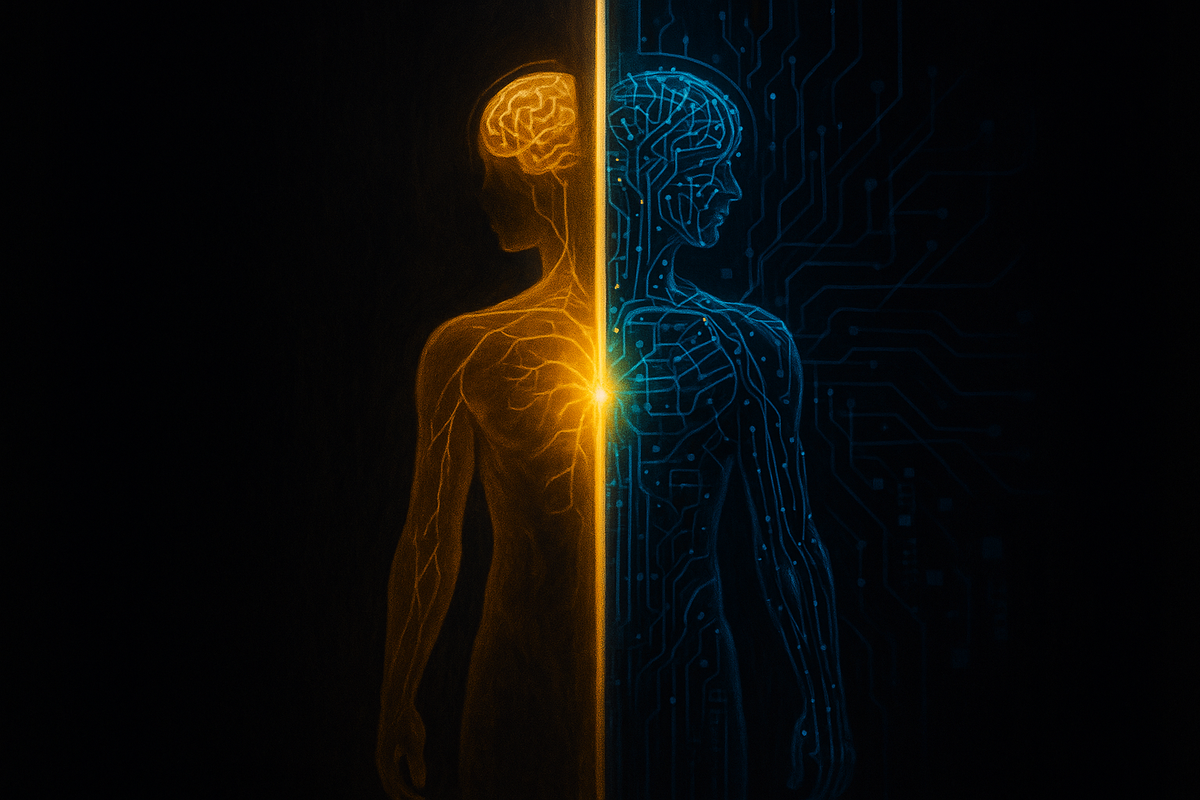
Synthesis: The Cyborg Future
Let's pull it all together. Over the past seven articles, we've tracked neural interfaces from the bleeding edge to the mundane. From Neuralink's first patient playing chess with his mind to the million-plus cochlear implant recipients who barely think about the computers in their heads. From the technical details of electrode arrays to the philosophical puzzles of mind uploading. From motor prosthetics giving paralyzed people reach to sensory feedback giving them touch. Now: what does it all mean? Where is this going? And what becomes of humans when the brain is an interface?
The Gradient of Proof
The field exists on a gradient: cochlear implants (1M+ recipients, routine) → deep brain stimulation (200K+ patients, FDA-approved) → motor BCIs (dozens of research participants, works reliably) → sensory BCIs (fewer patients, proof of concept) → mind uploading (speculative). Everything is advancing along this spectrum simultaneously. The technologies that work (cochlear implants, DBS) target well-understood systems with clear objectives. We didn't need to understand consciousness. We needed to understand specific input-output relationships.
The Convergence
Here's what's happening: multiple technologies are converging toward the same goal. Electrode technology is improving. Neuralink has 1,024 electrodes on flexible threads. Competitors are developing their own high-density arrays. Non-invasive approaches (like Synchron's stentrode) are finding ways to get signal without surgery. Each advance means more neurons sampled, more information decoded. Machine learning is transforming decoding. Neural networks can extract information from noisy brain signals that linear decoders couldn't touch. The algorithms are getting smarter, the training is getting faster, the performance is improving on every metric. Computing power continues to increase. Whether you need to run a brain emulation or just decode motor signals in real-time, more compute helps. And computing power remains on something like an exponential curve. Surgical techniques are becoming more refined. Robotic surgery, minimally invasive approaches, better imaging—all reduce risk and improve outcomes. Regulatory pathways are being established. FDA has approved trials for multiple BCI companies. The path from experiment to treatment is becoming clearer, if still long. These aren't isolated developments. They reinforce each other. Better electrodes give better data. Better algorithms extract more from that data. Better computers run those algorithms faster. Better surgery reduces risk, expanding who can participate. Better regulation makes the technology accessible. We're not waiting for one breakthrough. We're watching many incremental advances compound.
The Near-Term Future (2025-2035)
Motor BCIs will become clinical treatments for paralysis—covered by insurance, performed at major hospitals. Speech decoding will mature into practical communication for ALS and locked-in patients. Bidirectional interfaces will become standard for prosthetics. The market will sort out which companies and approaches win. These aren't wild predictions. They're extrapolations from current trajectories. The surprises will be in the details.
The Medium-Term Future (2035-2050)
Here things get more speculative. Neural interfaces may expand beyond medical applications. If devices are safe, effective, and cheap enough, some people will want them for enhancement rather than restoration. Faster typing. Direct memory access. Augmented reality that lives in your visual cortex rather than on glasses. The boundary between biological and digital cognition will blur. If part of your thinking happens in silicon, if part of your memory is stored externally, if your perception is augmented by computational processing—where does "you" end and "tool" begin? Brain-to-brain communication might become possible. Not telepathy—but perhaps something like shared attention, or emotional resonance, or collaborative cognition. Early experiments in this direction are already happening. The politics of neural interfaces will intensify. Access, privacy, security, identity—all the issues we can see coming will become urgent. Who can afford BCIs? Who controls the data they generate? What happens when neural interfaces can be hacked? New applications we haven't imagined will emerge. The history of technology suggests that the most important uses are often not anticipated. The internet wasn't built for social media. Smartphones weren't built for Uber. BCIs will likely find applications we can't currently envision.
The Long-Term Future (2050+)
Here we're essentially speculating. Mind uploading remains uncertain. The technical requirements are enormous, the philosophical issues unresolved. It might be possible. It might not. We won't know for decades. Human enhancement may become normal. If neural interfaces can genuinely improve cognition, memory, perception, or communication, pressure to adopt them will be intense. What starts as optional may become expected, then required. The definition of "human" may shift. Cyborg is currently a science fiction term. It might become a demographic category. Humans with extensive neural augmentation might be as different from us as we are from our pre-literate ancestors. Artificial intelligence and human intelligence may merge. Not "AI takes over"—but symbiosis. Hybrid cognitive systems that combine biological creativity with computational power. The distinction between human and AI might become meaningless. These are not predictions. They're possibilities. The long-term future is genuinely unknown.
The Governance Challenge
Let's talk about what we need to figure out. Who owns neural data? If a device reads your brain activity, who controls that data? You? The company that made the device? The healthcare system? Can it be sold? Can it be subpoenaed? What are the security requirements? A hacked BCI is not like a hacked phone. If someone can write to your brain, they can potentially control your movements, alter your perceptions, insert false memories. The security standards need to be very high. How do we handle consent? BCIs are currently implanted in adults who can consent. What about children? What about people with cognitive impairments? What about situations where refusal carries significant costs? How do we ensure access? Neural interfaces are expensive. If they genuinely enhance capability, they'll increase inequality unless we find ways to distribute them broadly. This is the same problem as with all advanced medicine, but amplified. What do we do about dual use? The same technologies that restore function can potentially be used for surveillance, control, or weaponization. How do we support beneficial applications while limiting harmful ones? These aren't problems to solve later. We need to be developing governance frameworks now, while the technology is still emerging. Waiting until BCIs are widespread to figure out the rules is a recipe for disaster.
What It Means to Be Human
Here's the deepest question. For most of human history, the mind has been contained in the skull. Bounded. Private. Inaccessible to external probing or modification (beyond crude measures like drugs and brain damage). Neural interfaces breach that boundary. They create channels between the biological mind and external systems. Channels that will only get wider and faster and more capable. What happens to human identity when the brain is readable from outside? When it's writable? When cognitive processes can be distributed across biological and digital substrates? Some people find this terrifying—a loss of privacy, autonomy, perhaps humanity itself. The fear of becoming less than human, or of becoming something that's no longer human. Others find it exhilarating—an expansion of human capability, a solution to mortality, an evolutionary leap. The hope of becoming more than human, of transcending our biological limitations. Both reactions contain truth. The future of neural interfaces involves real losses and real gains. Real risks and real opportunities. The question isn't which reaction is correct. The question is how we navigate the transition. We are the first humans who will have to answer these questions not as philosophy but as policy.
The Patients Lead the Way
In the midst of all this speculation, let's not lose sight of what's actually happening. Noland Arbaugh, paralyzed, is playing video games with his mind. Nathan Copeland is feeling touch through a robotic hand. Philip O'Keefe is texting his wife using signals from his brain. Dennis DeGray is typing faster with his thoughts than most people type with their fingers. Millions of cochlear implant recipients are hearing their children speak. Hundreds of thousands of deep brain stimulation patients are walking without tremor. These are real people living real lives made better by neural interfaces. Not hypotheticals. Not projections. Actual humans, right now, benefiting from technologies that didn't exist when they were born. This is what matters. Not the science fiction. Not the philosophical puzzles. The actual lives being changed. The cyborg future isn't a prediction. It's already here—just not evenly distributed. Every advance in neural interfaces starts with patients willing to try something new. Willing to have surgery, to train for months, to live with imperfect technology. They're the ones pushing the boundary forward. They're the ones turning speculation into reality. The synthesis isn't a conclusion. It's a beginning. The brain is becoming an interface. What that means—for medicine, for identity, for society, for humanity—we're only starting to discover. But we're discovering it now. With every electrode implanted, every signal decoded, every patient who reaches out with thoughts and touches the world. The line between brain and machine is blurring. The question is no longer whether. It's how—and who decides. That's on all of us.
The Transformation of Medicine
Neural interfaces represent something larger than any single technology: the transformation of medicine from treating symptoms to engineering function. For most of medical history, we've worked with the body as given. When something breaks, we try to fix it. When something can't be fixed, we manage the consequences. Medicine has been fundamentally conservative—helping the body do what it was already trying to do. Neural interfaces are different. They're not fixing the damaged spinal cord—they're bypassing it. They're not repairing the cochlea—they're replacing it. They're engineering new pathways that didn't exist before. This is proactive medicine. Design-based medicine. And it's going to change everything about how we think about disability, ability, and the boundaries between them. Today's distinction between "medical device" and "enhancement technology" may dissolve. A device that restores hearing to the deaf might also give enhanced hearing to the hearing. A device that restores movement to the paralyzed might also give enhanced movement to the able-bodied. The same technology, applied to different starting conditions. Medicine is becoming engineering. The body is becoming a platform.
The Economic Transformation
The economics of neural interfaces will reshape healthcare (BCI companies as important as pharma), computing (keyboards as obsolete as punch cards), and labor (disability ceasing to be a barrier to many jobs). The policy frameworks built for a world without neural interfaces will need to adapt.
The Personal Choice
Eventually, you might face this question: do you want a neural interface? Not in some science fiction future. Possibly in your lifetime. Possibly within the next decade or two, if the technology advances as the trajectories suggest. The choice will depend on your circumstances. A person with paralysis faces different cost-benefit calculations than a healthy person considering enhancement. Someone with progressive hearing loss has different considerations than someone with perfect hearing. But the choice will become increasingly real. What would you trade for direct brain-computer communication? For enhanced memory? For accelerated learning? For augmented perception? What risks would you accept? Surgery. Infection. Device failure. Hacking. Unknown long-term effects. Obsolescence as the technology advances. What changes to identity would you welcome? Would you still be you with a computer in your head? Would you be more you, or less? These aren't hypotheticals anymore. They're questions that real people are answering right now, in research labs and operating rooms around the world. The answers they're giving are shaping the technology that the rest of us will eventually confront. The cyborg question isn't abstract. It's personal. And it's coming for you.
The Beginning
I've called this article a synthesis, but it's really a beginning. We're at the start of something. The science of neural interfaces is young—decades old at most, compared to centuries for most medical fields. The technology is primitive by future standards. The understanding of consciousness that would be needed for mind uploading remains elusive. But the trajectory is visible. Jan Scheuermann eating chocolate with a thought-controlled robot arm. Nathan Copeland feeling touch through a machine. Noland Arbaugh playing chess with his mind. These are not endpoints. They're proof of concept. They're the first tentative steps on a path that leads somewhere we can barely imagine. The brain is an electrical organ. We're learning to speak its language. Every electrode implanted, every algorithm refined, every patient trained, every trial completed—each is another word in a vocabulary we're building together. Where that vocabulary leads—what stories we'll tell, what capabilities we'll gain, what challenges we'll face—that's not determined yet. It's being determined now, by researchers and engineers, by patients and policy makers, by all of us thinking about what these technologies should become. This is the moment. This is the transition. This is when brain-computer interfaces stop being science fiction and start being science. The future is not written. But it's being drafted, right now, in labs and hospitals and boardrooms around the world. Pay attention. Think carefully. Participate if you can. The brain is becoming an interface. What we make of that is up to us.


Comments ()