Neural Networks as Functors: Category Theory Meets Deep Learning
Category theory treats structure-preserving maps between mathematical objects as first-class citizens. Neural networks, it turns out, are functors — and this isn't just a metaphor. Applied category theory gives deep learning a mathematical grammar for why certain architectures work.
Neural Networks as Functors: Category Theory Meets Deep Learning
Series: Applied Category Theory | Part: 5 of 10
In 2014, a paper by Brendan Fong, David Spivak, and Rémy Tuyéras quietly appeared on arXiv with an audacious claim: neural networks aren't just computational graphs. They're functors—structure-preserving maps between categories. Most of the deep learning community ignored it. The mathematics seemed abstract, disconnected from the messy reality of training ImageNet classifiers or tuning learning rates. But the claim wasn't metaphorical. It was precise. And once you see it, you can't unsee it: deep learning is composition all the way down.
This matters because the compositional view doesn't just describe what neural networks are—it explains why they work, why they fail, and what new architectures become possible when you take the mathematics seriously. Category theory reveals that a neural network is a functor from the category of vector spaces to itself, transforming inputs through layers while preserving the compositional structure that makes learning possible. This isn't philosophy. It's the working hypothesis of researchers building the next generation of AI systems, from AlphaFold's protein structure prediction to diffusion models generating photorealistic images.
What Makes a Neural Network a Functor?
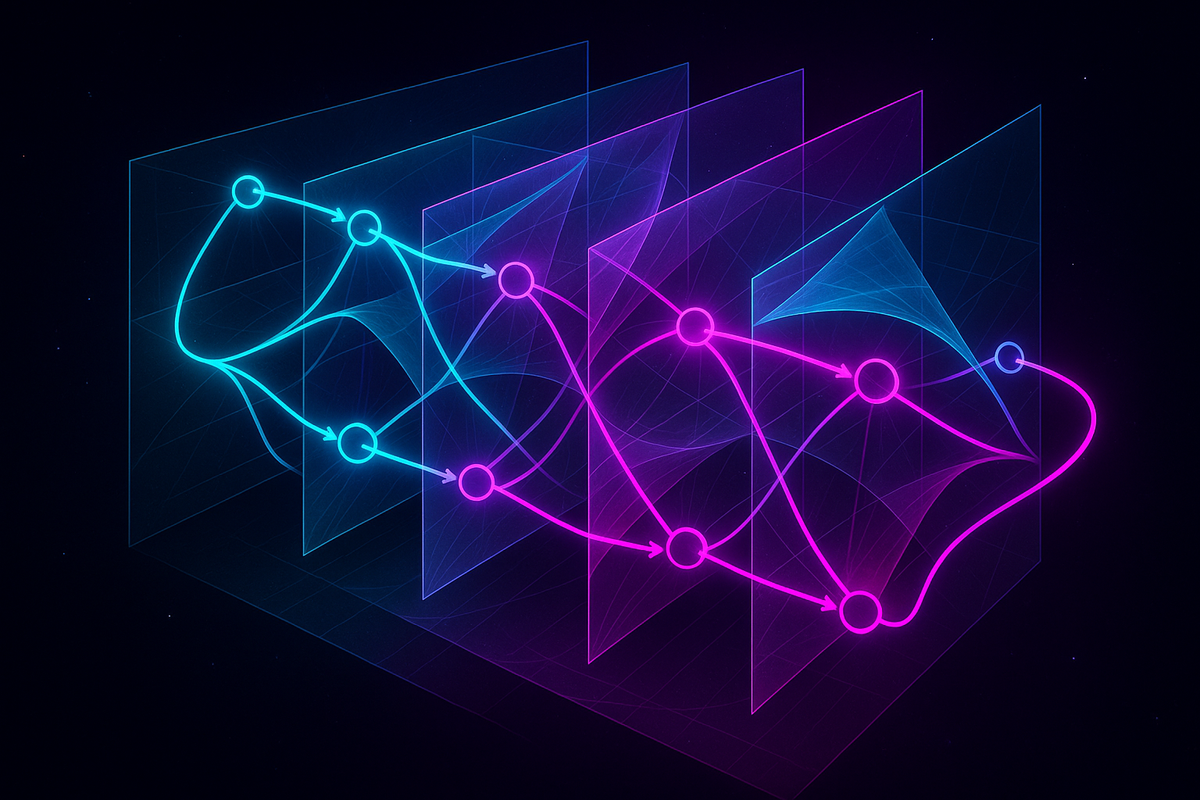
Start with the basics. A functor is a map between categories that preserves structure—it sends objects to objects, morphisms to morphisms, and respects composition and identity. A neural network, in its simplest form, is a sequence of layers, each performing a transformation on vector spaces.
Consider a feedforward network with three layers:
Input → Layer 1 → Layer 2 → Output
Each layer is a function that maps vectors to vectors: f₁: ℝⁿ → ℝᵐ, f₂: ℝᵐ → ℝᵏ, f₃: ℝᵏ → ℝᵖ. The full network is their composition: f₃ ∘ f₂ ∘ f₁. This looks like ordinary function composition. But category theory sees deeper structure.
The category of vector spaces (call it Vect) has:
- Objects: Vector spaces like ℝⁿ, ℝᵐ, ℝᵏ
- Morphisms: Linear transformations between them
- Composition: If f: V → W and g: W → X, then g ∘ f: V → X
A neural network defines a functor F: Vect → Vect that:
- Maps each vector space to another vector space (dimensionality transformations)
- Maps each linear transformation (weight matrix) to composed transformations
- Preserves composition: F(g ∘ f) = F(g) ∘ F(f)
- Preserves identity: F(id) = id
The activation functions (ReLU, sigmoid, tanh) are where things get interesting. They're nonlinear, which means they're not morphisms in Vect. But category theory handles this elegantly: the network becomes a functor in a richer category where morphisms include both linear maps and pointwise nonlinear operations. The compositional structure remains—activation functions compose just like linear transformations do.
This is more than formalism. Recognizing neural networks as functors means recognizing that architecture is compositional structure. Every design choice—skip connections, attention mechanisms, batch normalization—is a statement about how morphisms compose. And category theory gives us tools to reason about composition systematically.
Layers, Composition, and Why Depth Matters
The universal approximation theorem tells us that a single hidden layer can approximate any continuous function. So why do we build networks with hundreds or thousands of layers? The categorical answer is compositional economy.
A single-layer network requires exponentially many parameters to represent complex functions. A deep network achieves the same expressive power by composing many simple transformations. Category theory formalizes this intuition: deep composition allows you to factor complex morphisms into simpler ones.
Think of it geometrically. Each layer performs a coordinate transformation on the input space. A ReLU activation folds the space along hyperplanes. A linear transformation rotates, scales, shears. Stacking layers means composing these geometric operations, building up intricate manifolds from simple pieces.
ResNets make the compositional structure explicit. A residual block computes F(x) = f(x) + x, where f is a sequence of convolutions and activations. The skip connection +x is the identity morphism. This is categorical purity: the network learns the difference between identity and the target transformation, making composition easier to optimize.
Attention mechanisms, introduced in the Transformer architecture, are functorial operations over sequences. Self-attention computes Attention(Q, K, V) = softmax(QKᵀ/√d)V, where Q, K, V are linear projections of the input. Categorically, this is a functor from the category of sequences (with morphisms as sequence-to-sequence maps) to itself, preserving the compositional structure that allows the model to route information dynamically.
Category theory explains why these architectures work: they respect compositional structure, making gradient flow tractable and learning efficient. Architectures that violate composition (say, by introducing operations that don't commute) tend to fail catastrophically.
Backpropagation as Contravariance
Training a neural network means adjusting parameters to minimize a loss function. Backpropagation is the algorithm that computes gradients efficiently. Category theory reveals that backpropagation is contravariant functoriality—the backward pass is a functor in the opposite direction.
Forward pass: F: Vect → Vect maps input x to output y = F(x)
Backward pass: F: Vectᵒᵖ → Vectᵒᵖ* maps output gradient ∂L/∂y to input gradient ∂L/∂x
The key property: if forward composition is g ∘ f, then backward composition is f ∘ g**—the order reverses. This is contravariance. The chain rule of calculus is just the functorial property of the backward pass.
Why does this matter? Because it reveals that backpropagation isn't a clever engineering trick—it's a mathematical necessity given the compositional structure of neural networks. Any functor from a category to itself induces a dual functor in the opposite category. Gradients flow backwards because composition has a direction, and optimization must respect that direction.
This also explains why certain architectures are hard to train. If a layer's Jacobian (the derivative of its output with respect to its input) is poorly conditioned—say, with eigenvalues far from 1—then gradients explode or vanish. Category theory frames this as a failure of functorial continuity: the backward functor becomes discontinuous, breaking the compositional flow that makes learning possible.
Batch normalization, gradient clipping, and careful initialization schemes are all interventions to preserve functorial continuity. They ensure that the backward pass remains a well-behaved contravariant functor, allowing gradients to propagate cleanly through hundreds of layers.
Natural Transformations and Transfer Learning
Natural transformations are maps between functors that respect the categorical structure. In neural networks, transfer learning is a natural transformation.
Suppose you train a network F₁ on ImageNet to classify objects. Then you adapt it to classify medical images by replacing the final layer, creating a new network F₂. The shared layers (feature extractors) define a natural transformation η: F₁ → F₂ that preserves the learned representations while adapting the output.
Formally, a natural transformation satisfies: η_B ∘ F₁(f) = F₂(f) ∘ η_A for every morphism f: A → B. In neural network terms: the transformation commutes with the compositional structure of the network. Transfer learning works when the source and target tasks share compositional features—when the functors are "naturally related."
This explains why transfer learning fails for sufficiently different domains. If the source task learns to compose features in a way incompatible with the target task, no natural transformation exists. The functors are categorically incompatible, and retraining from scratch becomes necessary.
Meta-learning (learning to learn) pushes this further. A meta-learner is a functor between functor categories—it maps one neural network functor to another, optimizing for adaptability across tasks. MAML (Model-Agnostic Meta-Learning) does exactly this: it finds network parameters that, when fine-tuned with a few gradient steps, quickly adapt to new tasks. Categorically, MAML searches for a functor F such that natural transformations to nearby functors are "short"—requiring minimal adjustment.
Compositional Architectures: Beyond Feedforward
Recognizing neural networks as functors opens design space that feedforward architectures don't explore. Graph neural networks (GNNs) are functors on the category of graphs. Recursive neural networks are functors on the category of trees. Equivariant networks are functors that commute with group actions, preserving symmetries like rotation or translation.
Consider a GNN operating on molecular graphs. The network must respect the compositional structure of molecules: atoms compose into bonds, bonds compose into functional groups, groups compose into molecules. A GNN is a functor from Graph to Vect that preserves this structure, ensuring that the learned representation of a molecule respects its compositional hierarchy.
E(3)-equivariant networks, used in AlphaFold 2 and other protein structure predictors, are functors that commute with 3D rotations and translations. If you rotate the input, the output rotates accordingly. This isn't a constraint—it's a compositional guarantee that makes learning vastly more efficient. The functor respects the geometric structure of physical space, reducing the hypothesis space the network must search.
Diffusion models, which generate images by iteratively denoising random noise, are functors in a temporal category where morphisms are timestep transitions. The denoising process composes across timesteps, and the learned network is a functor that preserves this temporal composition. Category theory explains why diffusion models outperform GANs for many tasks: they respect the compositional structure of iterative refinement, while GANs treat generation as a single monolithic transformation.
Coherence, Prediction, and the Free Energy Connection
This is where category theory meets the Free Energy Principle. Neural networks minimize loss functions—prediction error, cross-entropy, mean squared error. In AToM terms, they minimize incoherence: the mismatch between predicted and observed structure.
A trained network has learned a generative model of its training data. It predicts what comes next, what features co-occur, what transformations preserve category membership. This is active inference at the level of parameters: the network adjusts its weights to minimize surprise, building an internal model that maximizes coherence with observed data.
Categorically, training is a search for a functor F that maximizes commutativity with the data-generating process. If the true data distribution is a functor D: Input → Output, then learning succeeds when F ≈ D—when the learned functor approximates the true one.
Overfitting is a coherence collapse. The network learns a functor that fits the training data perfectly but fails to generalize—it maximizes coherence with noise rather than signal. Regularization techniques (dropout, weight decay, data augmentation) are coherence constraints: they prevent the functor from becoming too specific, ensuring it captures the compositional structure of the underlying distribution rather than memorizing particulars.
This connects to M = C/T, the AToM coherence equation. A neural network's meaning (its learned representation) equals its coherence (how well it predicts data) over tension (the complexity of the loss landscape). Networks trained on simple, coherent data learn meaningful representations quickly. Networks trained on noisy, high-tension data require more parameters, more layers, more composition to extract coherence.
Why This View Changes How We Build AI
Seeing neural networks as functors isn't academic aesthetics. It's a design principle that makes new architectures thinkable.
Compositional generalization is the holy grail of AI: the ability to combine learned primitives in novel ways. Humans do this effortlessly—learning "jump" and "backwards" lets you understand "jump backwards" without explicit training. Most neural networks fail at this. They memorize patterns rather than composing primitives.
Category theory explains why: standard architectures don't enforce functorial composition at the semantic level. They compose at the layer level (stacking transformations) but not at the concept level (combining learned meanings). Networks that explicitly represent composition as categorical structure—using operads, monoidal categories, or other compositional frameworks—achieve better generalization.
Researchers at DeepMind, MIT, and Oxford are building categorically-structured neural networks that represent programs, languages, and reasoning as functors. These networks learn to compose operations explicitly, treating composition as a first-class primitive rather than an emergent property. Early results show dramatic improvements in few-shot learning, program synthesis, and mathematical reasoning.
The future of AI may be less "bigger models, more data" and more "compositional structure, categorical discipline." Understanding neural networks as functors reveals that architecture is theory, and theory shapes what becomes learnable.
Where Category Theory Takes Deep Learning Next
Current neural networks are opaque. We train them, evaluate them, deploy them, but we rarely understand why they work. Mechanistic interpretability—reverse-engineering trained networks to understand their internal representations—is a booming field. Category theory offers a language for this.
If a network is a functor, then its internal layers are intermediate objects in a compositional sequence. Interpretability means identifying what those objects are, what morphisms connect them, and what compositional structure emerges. Researchers are using tools from sheaf theory, topos theory, and higher category theory to map the internal geometry of neural networks.
One striking finding: networks trained on similar tasks often converge to categorically equivalent representations, even when initialized differently. The functors differ in details but share compositional structure. This suggests that certain compositional forms are optimal for given tasks—that there's a "natural" categorical structure the network discovers through training.
This opens the door to architecture search by category. Instead of trying random architectures, we could search the space of functors with desired compositional properties. Want a network that generalizes compositionally? Search for functors that preserve certain categorical structures. Want a network robust to adversarial perturbations? Search for functors with continuity guarantees in the categorical sense.
The Compositional Revolution
Deep learning's success was supposed to be a victory for empiricism over theory—just scale up data and compute, and intelligence emerges. But the best architectures (ResNets, Transformers, diffusion models) succeed because they respect compositional structure. They're not random neural soups. They're carefully designed functors, preserving the categorical properties that make learning tractable.
Category theory doesn't replace empirical experimentation. It guides it, revealing what architectures are worth trying and why some succeed where others fail. The networks that transformed AI in the past decade—AlexNet, AlphaGo, GPT, Stable Diffusion—all exhibit functorial structure. The next generation will make that structure explicit, building AI systems that compose primitives the way category theory composes morphisms.
This is composition all the way down. Not as metaphor. As mathematics. As engineering principle. As the deep structure that makes meaning computable.
This is Part 5 of the Applied Category Theory series, exploring how categorical structures illuminate the mathematics of composition across science and cognition.
Previous: Natural Transformations: When Translations Talk to Each Other
Next: String Diagrams: Drawing Your Way to Mathematical Insight
Further Reading
- Fong, B., Spivak, D. I., & Tuyéras, R. (2019). Backprop as Functor: A Compositional Perspective on Supervised Learning. arXiv:1711.10455.
- Shiebler, D., Gavranović, B., & Wilson, P. (2021). Category Theory in Machine Learning. arXiv:2106.07032.
- Cruttwell, G. S. H., et al. (2022). A Categorical Foundation for Bayesian Probability. Applied Categorical Structures, 30(4), 819–863.
- Olah, C., & Carter, S. (2016). Attention and Augmented Recurrent Neural Networks. Distill.
- Bronstein, M. M., et al. (2021). Geometric Deep Learning: Grids, Groups, Graphs, Geodesics, and Gauges. arXiv:2104.13478.
- Pearl, J. (2018). Theoretical Impediments to Machine Learning With Seven Sparks from the Causal Revolution. arXiv:1801.04016.
Comments ()