Neuromorphic Chips: Silicon Learns from Neurons
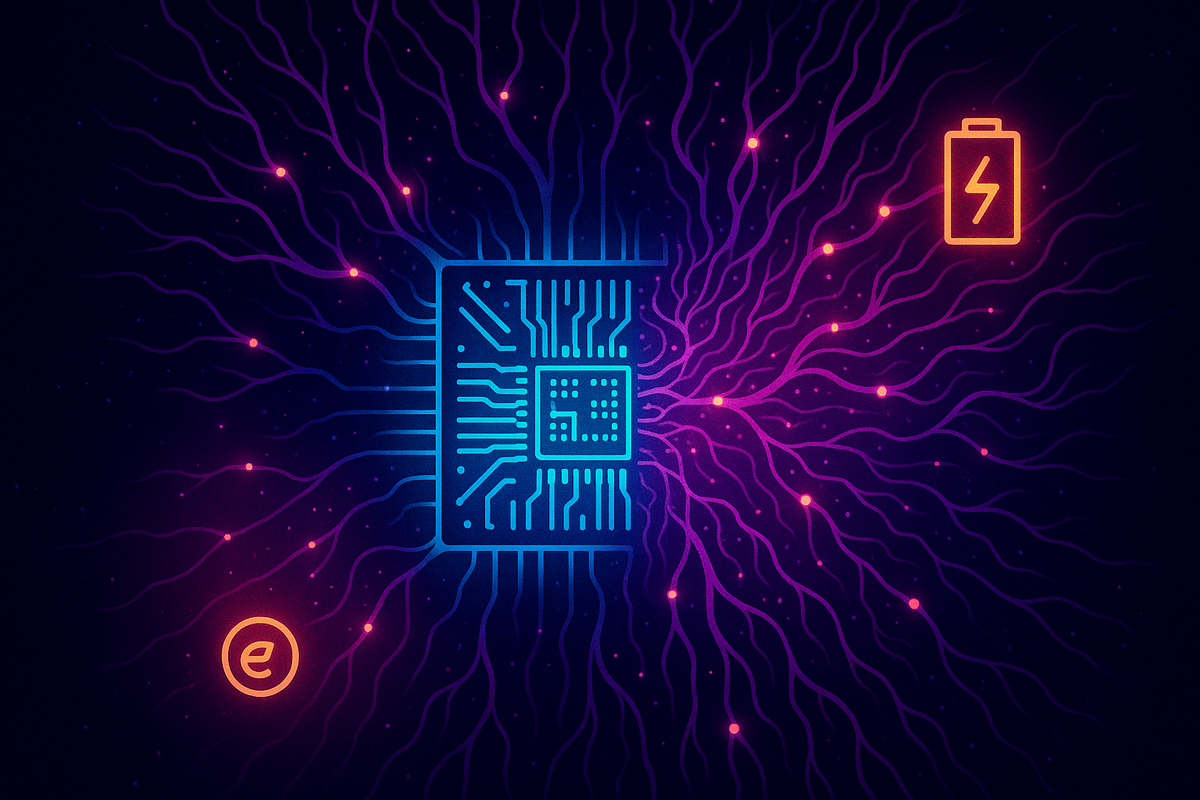
Your brain runs on 20 watts. A GPU training a language model runs on tens of thousands. Neuromorphic chips attack that gap by mimicking the brain's event-driven architecture — processing only what changes, only when it changes, using spikes instead of clock cycles.
Neuromorphic Chips: Silicon Learns from Neurons
If you can't grow a brain in a dish—or don't want to deal with the complications of keeping tissue alive—there's another option: build silicon that acts like a brain.
This is the neuromorphic computing approach. Instead of cramming biological neurons into a computational framework designed for von Neumann architecture, you redesign the silicon to work the way neurons work. Spikes instead of continuous signals. Event-driven processing instead of clock cycles. Local memory instead of separate storage.
The result: chips that are 100 to 1,000 times more energy-efficient than conventional GPUs for certain tasks. Not biology's million-fold advantage, but enough to matter enormously.
Neuromorphic computing is the compromise position between silicon's manufacturability and biology's efficiency. And it's already shipping.
What Makes a Chip Neuromorphic
The term "neuromorphic" was coined by Carver Mead at Caltech in the late 1980s. Mead observed that analog electronic circuits could naturally implement the kinds of computations neurons perform—integration, thresholding, adaptation—and that this might be more efficient than digital simulation of neural processes.
The core insight: neurons aren't digital. They don't represent information as discrete symbols that get manipulated according to rules. They represent information as patterns of activity across populations, communicated through discrete spikes in continuous time.
Conventional computing forces neural computation into a digital framework. You represent neuron activations as floating-point numbers, process them through matrix multiplications, and pretend spikes are continuous values. This works—deep learning proves it works—but it's inefficient. You're simulating something analog using digital machinery, paying the overhead of that translation.
Neuromorphic chips eliminate the translation. They implement spiking neural networks directly in hardware, with each artificial neuron represented by a circuit that accumulates input, fires when a threshold is reached, and sends spikes to connected neurons.
Key features that distinguish neuromorphic from conventional chips:
Spikes, not values. Information travels as discrete events (spikes), not continuous signals. This is inherently sparse—neurons that aren't firing aren't transmitting, and silence costs nothing.
Event-driven, not clock-driven. Computation happens when spikes arrive, not at regular intervals. If no inputs arrive, nothing happens and no energy is spent.
Local memory. Each neuron has its own parameters stored locally. There's no memory bus bottleneck because computation happens where the data lives.
Analog computation. Many neuromorphic designs use analog circuits to perform the integration and thresholding that neurons do. This is more energy-efficient than digital arithmetic for these specific operations.
Massive parallelism. Neuromorphic chips can have millions of simple neuron units operating simultaneously, each responding to its own inputs independently.
Intel Loihi: The Research Flagship
Intel's Loihi chip, first released in 2017 and now in its second generation (Loihi 2), is the most sophisticated neuromorphic processor from a major semiconductor company.
Loihi 2 contains about one million neuron units and 120 million synapses on a single chip. Each neuron can be independently programmed with its own parameters—threshold, decay rate, spike shape. The chip supports on-chip learning, meaning the synaptic weights can adapt based on activity without external intervention.
The efficiency numbers are impressive. For certain pattern recognition tasks, Loihi achieves 50-1000x better energy efficiency than conventional CPUs and 10-100x better than GPUs. Intel has demonstrated real-time gesture recognition, olfactory sensing (electronic nose), and adaptive robotics—all at milliwatt power levels.
Loihi isn't designed to replace GPUs for training large language models. It's designed for a different class of problems: real-time inference on streaming data, especially in power-constrained environments. Think edge devices, sensors, autonomous systems—applications where you can't afford to burn watts but need to process information continuously.
Intel provides Loihi to research partners through its Intel Neuromorphic Research Community. It's not a commercial product you can buy; it's a research platform exploring what neuromorphic computing can do. But it proves the concept works at scale.
IBM TrueNorth: The Pioneer
Before Loihi, there was IBM's TrueNorth, developed in 2014 under DARPA's SyNAPSE program. TrueNorth demonstrated that neuromorphic computing could work at scale: one million neurons, 256 million synapses, on a chip that consumed only 70 milliwatts—roughly the power of a hearing aid battery.
TrueNorth achieved its efficiency through extreme constraints. It used digital circuits (not analog), but with a very simple neuron model—integrate-and-fire with no learning on chip. This made it less flexible than Loihi but demonstrated the efficiency gains possible from event-driven architecture alone.
IBM benchmarked TrueNorth on image classification tasks, showing it could achieve accuracy comparable to conventional deep learning at a fraction of the power. For continuous video processing—the kind of task that would melt a GPU—TrueNorth ran cool and efficient.
The TrueNorth project also revealed challenges. The simple neuron model made it hard to map complex neural network architectures onto the chip. Training had to happen off-chip on conventional hardware, then the trained weights were loaded onto TrueNorth for inference. This limited flexibility and made the development workflow awkward.
Lessons from TrueNorth informed later designs, including Loihi's more flexible neuron models and on-chip learning capabilities.
BrainChip Akida: Commercial Reality
While Intel and IBM pursue research, BrainChip has bet on commercialization. Their Akida chip is designed for edge AI applications—the kinds of devices that need to process sensory data locally without cloud connectivity.
Akida targets specific applications: smart cameras, voice processing, gesture recognition, predictive maintenance. These are tasks where conventional AI is too power-hungry, where you can't stream data to the cloud, and where real-time response matters.
The business case is compelling. A smart doorbell that runs AI vision locally uses less battery, preserves privacy (video never leaves the device), and works without internet. A sensor that monitors industrial equipment can predict failures in real-time without expensive cloud infrastructure. These niches are large enough to build a business on.
BrainChip went public in 2021 and has announced partnerships with major semiconductor companies. It's still early—neuromorphic computing isn't yet mainstream—but Akida represents the transition from lab research to market product.
Other companies are entering the space: SynSense (previously aiCTX), GrAI Matter Labs, and various startups. The neuromorphic market is small but growing, driven by the same energy constraints that make AI training so expensive.
The Spiking Neural Network Challenge
There's a catch: neuromorphic chips run spiking neural networks (SNNs), and SNNs are harder to train than conventional deep learning models.
Standard deep learning uses backpropagation—computing gradients of a loss function with respect to network weights, then adjusting weights to reduce loss. This works because the activation functions are differentiable: small changes in weights produce small, predictable changes in output.
Spikes aren't differentiable. A neuron either fires or it doesn't. There's no gradient to propagate through a binary event. This makes standard backpropagation inapplicable.
Researchers have developed workarounds. Surrogate gradients replace the sharp spike with a smooth approximation during training, then use actual spikes during inference. ANN-to-SNN conversion trains a conventional neural network, then converts it to a spiking equivalent. Spike-timing-dependent plasticity (STDP) uses local learning rules that don't require global gradients.
None of these approaches is as mature as standard deep learning. Training SNNs remains harder, less reliable, and less well-understood. The neuromorphic field is still developing its fundamental algorithms.
This creates a chicken-and-egg problem. Without good SNN training methods, neuromorphic hardware can't match conventional AI on capability. Without neuromorphic hardware adoption, there's less incentive to develop SNN training methods. Breaking this cycle requires either a breakthrough in SNN training or applications where current SNN capabilities are sufficient.
What Neuromorphic Does Best
Despite training challenges, neuromorphic excels in specific domains:
Temporal pattern recognition. SNNs naturally process time-varying signals. The timing of spikes carries information, not just their rate. This makes them well-suited for audio processing, gesture recognition, and other sequential data.
Always-on sensing. Event-driven processing means a quiet input costs nothing. A neuromorphic camera watching a static scene uses almost no power; it activates only when something changes. This is ideal for surveillance, monitoring, and other always-on applications.
Ultra-low-power inference. When you need AI capabilities on microwatts—in wearables, implants, or remote sensors—neuromorphic is often the only option. Conventional AI requires too much power even in its most optimized forms.
Sparse data. Real-world sensory data is often sparse: most pixels don't change, most frequencies are silent, most sensors report nothing interesting most of the time. Neuromorphic architectures naturally exploit this sparsity; conventional architectures process the boring parts anyway.
Online learning. Some neuromorphic chips support learning during operation, without external retraining. This enables adaptation to changing conditions—a robot that adjusts to new environments, a sensor that learns normal patterns and detects anomalies.
For problems that fit these profiles, neuromorphic isn't just more efficient—it enables applications that conventional AI can't address at all.
The Efficiency Gap
How much more efficient is neuromorphic, really?
The numbers vary enormously depending on the task, the comparison baseline, and how you measure. Here are some representative benchmarks:
Image classification: Loihi achieves comparable accuracy to conventional CNNs at 50-100x lower energy per inference. Akida claims similar efficiency for edge vision tasks.
Keyword spotting: Neuromorphic chips excel at continuous audio monitoring, achieving 10-50x efficiency gains over conventional approaches because they can ignore silence.
Gesture recognition: Real-time processing of event camera data shows 100-1000x efficiency advantages, because event cameras and neuromorphic processors are both sparse and event-driven.
These are impressive numbers, but context matters. Neuromorphic chips aren't competing with data center GPUs on large language models. They're competing with edge processors on narrow tasks. The efficiency gains are real within their niche but don't translate to all AI applications.
The question is how large the niche becomes. If edge AI grows—autonomous vehicles, AR glasses, IoT sensors, smart everything—neuromorphic could transition from niche to mainstream. If AI remains concentrated in cloud data centers, neuromorphic stays a specialty technology.
Learning From Biology, Implemented in Silicon
Neuromorphic computing represents a middle path in the quest for efficient intelligence.
Pure biology—organoid computing—offers maximum efficiency but minimum manufacturability. Growing neurons is slow, keeping them alive is hard, and interfacing with them is crude.
Pure conventional computing—GPUs and TPUs—offers maximum capability and manufacturability but minimum efficiency. We can build huge chips and train huge models, but the energy cost is enormous and growing.
Neuromorphic computing splits the difference. It can't match biology's efficiency, but it improves on conventional silicon by 100x or more for appropriate tasks. It can't match conventional AI's capability on every task, but it enables applications conventional AI can't reach.
The lesson from biology isn't "become biological." It's "become efficient in the ways biology is efficient." Sparsity. Event-driven processing. Local memory. Analog-tolerant computation. These principles work in wetware and in silicon.
As the energy constraint on AI tightens, expect neuromorphic approaches to gain ground. They're not a silver bullet, but they're part of the solution.
The trajectory is clear: start with narrow applications where efficiency advantages are decisive, prove the technology works at scale, develop better training methods as adoption grows, gradually expand the range of applications. This is the standard technology adoption curve, applied to brain-inspired hardware.
Within a decade, neuromorphic chips may be as common in edge devices as GPUs are in gaming PCs. Not because they're better at everything—they're not—but because they're better at the things that matter most when power is constrained and real-time processing is required.
The brain's design principles, evolved over millions of years, are being transcribed into silicon. The translation isn't perfect. But it doesn't need to be perfect. It just needs to be efficient enough to matter.
Further Reading
- Davies, M., et al. (2018). "Loihi: A Neuromorphic Manycore Processor with On-Chip Learning." IEEE Micro. - Merolla, P. A., et al. (2014). "A million spiking-neuron integrated circuit with a scalable communication network and interface." Science. - Schuman, C. D., et al. (2022). "Opportunities for neuromorphic computing algorithms and applications." Nature Computational Science.
This is Part 5 of the Intelligence of Energy series. Next: "[Nuclear for AI: Why Data Centers Want Reactors](/nuclear-ai-data-centers/)."


Comments ()