Synthesis: What Neuroscience Actually Tells Us About Being Human
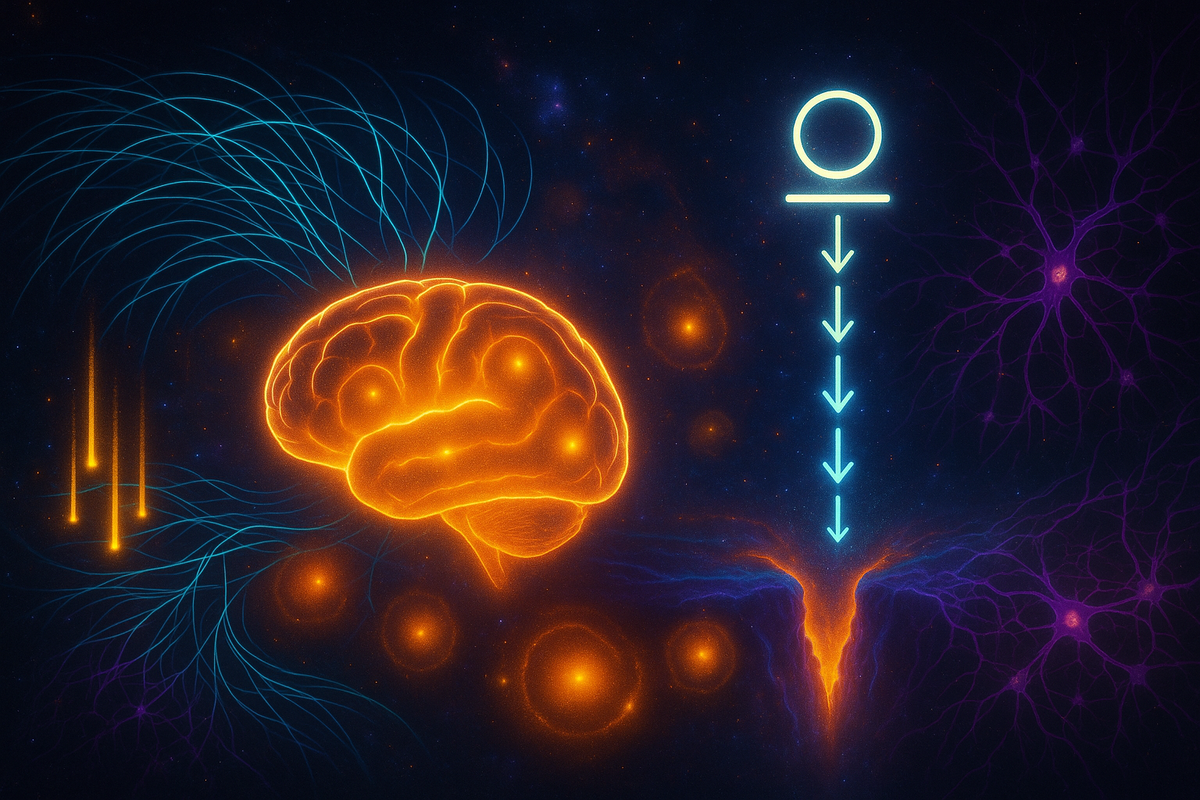
Neuroscience maps the machinery. But knowing which neurons fire during grief doesn't explain grief. The discipline has made extraordinary progress on mechanism — and very little on what those mechanisms mean for consciousness, identity, or moral status. That gap is the real frontier.
Synthesis: What Neuroscience Actually Tells Us About Being Human
After seven articles exploring the frontiers of brain science—connectomics, optogenetics, glial cells, neuroinflammation, the default mode network, and predictive processing—it's time to step back and ask the harder question: What does any of this mean for understanding what we are? Because here's the thing about neuroscience: it's spectacularly good at revealing mechanisms and frustratingly silent on meaning. We can now map neural connections at unprecedented resolution, control specific neurons with light, watch the brain predict its own experience in real time. And yet. The mystery remains. The explanatory gap between neurons firing and someone experiencing something—the gap between mechanism and meaning—hasn't closed. If anything, the more we learn about the brain, the stranger the question becomes. This synthesis isn't going to resolve that mystery. It's going to sit with it honestly, and extract what we can actually say about being human from what neuroscience has revealed.
The Persistent Mystery
And yet. None of this explains consciousness. We know more about the brain than any previous generation. We can describe neural correlates of consciousness—the activity patterns associated with conscious experience. We can identify what's different when someone is anesthetized versus awake, asleep versus dreaming, attending versus not. But we can't explain why any of this is accompanied by experience. Why does neural activity feel like something? Why is there a "what it's like" to be you? This is the hard problem of consciousness, and neuroscience hasn't solved it. Some argue it can't—that the explanatory gap between mechanism and experience is unbridgeable by physical science. Others argue we just need better theories, more data, and that the mystery will dissolve as it did for other "vital forces." The honest answer is: we don't know. Neuroscience tells us a lot about the correlates and conditions of consciousness. It tells us very little about consciousness itself. This isn't a failure of neuroscience. It's a recognition of what the hard problem actually is. The question isn't "what brain activity correlates with experience?" It's "why does any brain activity correlate with experience at all?"
What Neuroscience Can Tell Us About Being Human
Accepting the limits, let's be clear about what neuroscience can say. You are more embodied than you think. The old picture—a rational mind riding around in a body, like a ghost in a machine—is wrong. Your body shapes your cognition at every level. Your gut bacteria affect your mood. Your posture affects your emotional state. Your immune system affects your memory. You're not a mind with a body. You're a bodymind, a single integrated system. You are more predictive than you think. Most of what you perceive is generated, not received. Your brain is constantly filling in gaps, suppressing prediction-irrelevant information, constructing a stable world from fragmentary and delayed signals. What you take to be direct perception is actually inference. This explains a lot: why eyewitness testimony is unreliable, why placebos work, why expectations shape experience, why beliefs are so hard to change. Your brain prefers its own predictions to incoming data. Changing your mind means overcoming the weight of your own generative model. You are less unified than you think. There's no single "you" sitting in a control room. There are multiple, partially overlapping systems that compete and cooperate: the DMN with its self-narratives, the salience network detecting what matters, the executive network focusing attention, the emotional systems biasing decisions. The sense of a unified self is itself a construction—a narrative the brain tells to organize its outputs. "You" are a process, not a thing. An ongoing computation, not a fixed entity. You are more social than you think. Huge portions of the brain are devoted to understanding other people—their intentions, their emotions, their perspectives. The DMN, active during rest, is also active during social cognition. We're wired for connection, not because it's nice but because our survival depended on it. Loneliness isn't just sad; it's physiologically damaging, associated with inflammation, cognitive decline, and mortality. Connection isn't a luxury. It's a biological need as real as food or sleep. You are more malleable than you think. Neuroplasticity is real. The brain changes with experience, at every age. Learning reshapes circuits. Therapy reshapes patterns. Meditation reshapes default modes. You're not locked into who you are. But plasticity has limits. The brain isn't infinitely flexible. Some windows close. Some patterns are hard to budge. The therapeutic promise of neuroplasticity often outruns the scientific reality. Still, the basic fact stands: the brain is not fixed. Change is possible.
The Coherence Frame
How does this connect to the AToM framework that runs through Ideasthesia? The brain is fundamentally a coherence-maintaining system. Its core function is to minimize prediction error—to keep its model of the world aligned with incoming signals. When the model is coherent with reality, the system is stable. When prediction error spikes, the system acts—either updating the model or acting on the world—to restore coherence. This is what "making sense" literally means: reducing prediction error, achieving coherence between expectations and experience. Mental health, in this frame, is coherence. Stable predictions, manageable surprise, a model that flexibly updates when needed. Mental illness is coherence breakdown—predictions that don't match reality, chronic prediction error, a system stuck in maladaptive patterns. The default mode network generates the narrative coherence that makes you feel like a continuous self over time. When it's dysregulated—as in depression, where rumination spirals, or in psychedelics, where it's suppressed—the sense of self changes dramatically. The brain's job is coherence. Neuroscience is the study of how biological matter achieves coherence—and what happens when it doesn't.
What This Means for You
Here's the practical takeaway: Respect your embodiment. Your cognition depends on your physiology. Sleep, nutrition, movement, inflammation—these aren't separate from your mental life. They're the substrate of it. Taking care of your body is taking care of your mind. Question your perceptions. You're not seeing reality directly. You're seeing your brain's best guess about reality. This is humbling. It suggests epistemic humility, openness to being wrong, recognition that others may be constructing different realities from the same inputs. Work with your predictions. If perception is prediction, then changing your predictions changes your perception. This is the insight underlying cognitive therapy, meditation practices, and much of psychological intervention. You can't will yourself to see differently. But you can practice, can expose yourself to prediction-error, can gradually update your priors. Nurture your connections. Your brain needs other brains. Social isolation isn't just unpleasant; it's neurobiologically harmful. Connection is as basic as food. Build it into your life. Embrace uncertainty. The brain prefers certainty—it wants its predictions confirmed. But growth requires prediction error. Learning means being wrong. Avoiding all surprise means avoiding all change. A well-functioning brain is one that can tolerate uncertainty, update gracefully, and remain coherent while revising.
The Next Decade: Where Brain Science Is Heading
The tools that made this series possible—optogenetics, connectomics, high-resolution imaging, computational modeling—are still improving rapidly. What comes next? Whole-brain connectomes. We've mapped the fruit fly's brain. The mouse is next. A human connectome—all 86 billion neurons, all 100 trillion synapses—remains distant but no longer unimaginable. When we get there, we'll have the full wiring diagram of the most complex object in the known universe. Precision psychiatry. The default mode network, neuroinflammation, predictive processing—these frameworks are already changing how we think about mental illness. The next step is treatment: interventions targeted at specific neural circuits, not just brain-wide chemical modulation. Psychedelics research is one front. Transcranial stimulation is another. The goal is moving from "this drug might help" to "this circuit is dysregulated, here's how we fix it." Brain-machine interfaces. Neuralink and its competitors are just the beginning. Reading from the brain is getting better. Writing to the brain is the frontier. The line between brain and computer is already blurring (as we explore in the Neural Interfaces series). Within a decade, we may have bidirectional interfaces that restore not just movement but sensation, memory, even mood. The limits of mechanism. And yet. The hard problem won't dissolve just because our measurements improve. As brain science advances, the explanatory gap between mechanism and experience may become more glaring, not less. We'll know more about what brains do while remaining uncertain about why any of it is accompanied by consciousness. That's okay. Some mysteries don't resolve—they deepen. The honest position is to keep asking the question while acknowledging we might not have the conceptual tools to answer it yet. The coming decade will bring better maps, better interventions, better understanding of mechanism. Whether it brings better understanding of mind remains to be seen.
The Honest Conclusion
Neuroscience has given us an extraordinary map of the brain. We know more about neural circuits, chemical signals, developmental processes, and pathological breakdowns than ever before. But the map is not the territory. And the territory—consciousness, meaning, the felt sense of being someone—remains mysterious. This isn't cause for despair. It's cause for intellectual honesty. We can hold two truths simultaneously: that neuroscience is revealing deep things about how brains work, and that the deepest question—why there's something it's like to have a brain—remains open. The series has tried to walk that line. To convey the genuine excitement of discoveries at the frontier of brain science. And to remain honest about what we still don't understand. Being human is still strange. But now we know more about how strange it is.
Further Reading
- Seth, A. (2021). Being You: A New Science of Consciousness. Penguin.
- Barrett, L. F. (2017). How Emotions Are Made: The Secret Life of the Brain. Houghton Mifflin.
- Clark, A. (2015). Surfing Uncertainty: Prediction, Action, and the Embodied Mind. Oxford University Press.
This is Part 8 of the New Neuroscience series, concluding our exploration of what modern brain science reveals about being human.


Comments ()