Nuclear for AI: Why Data Centers Want Reactors
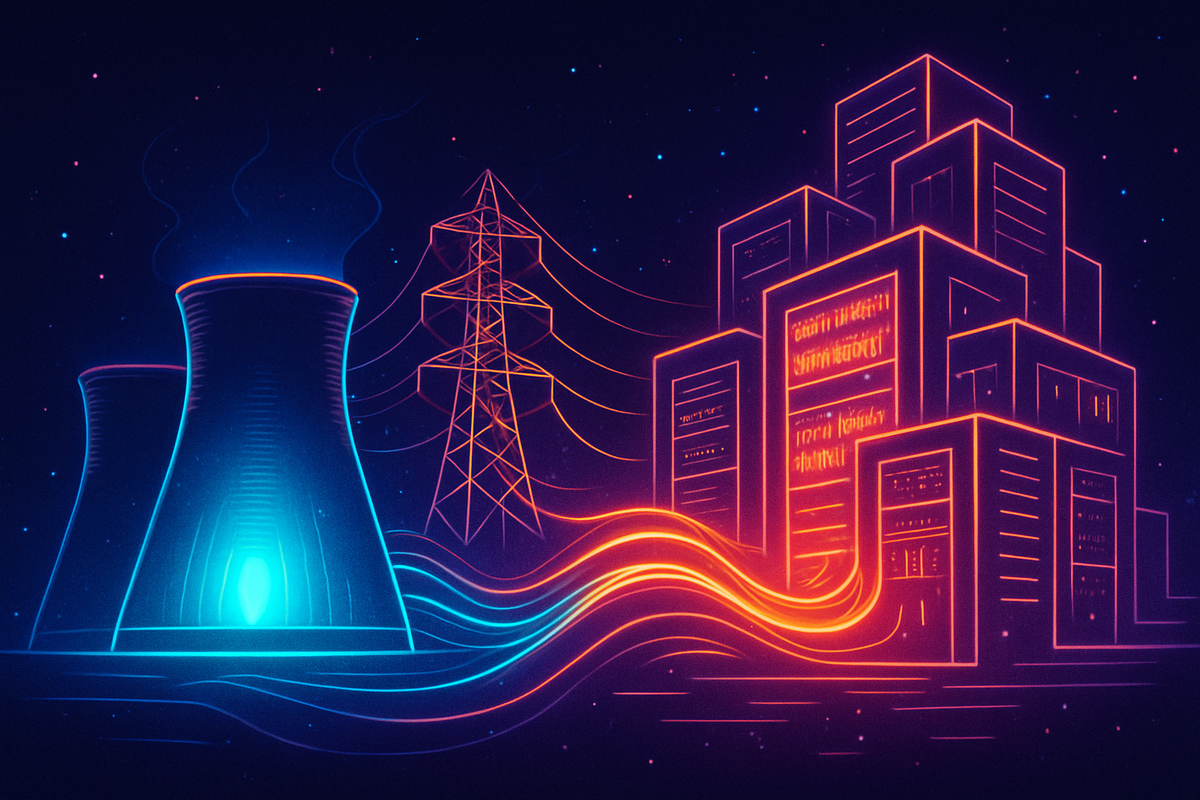
AI's hunger for electricity is so intense that the biggest tech companies are turning to nuclear reactors. Here's why a technology once written off is suddenly the hottest deal in Silicon Valley.
Nuclear for AI: Why Data Centers Want Reactors
In September 2024, Microsoft announced it was restarting the Three Mile Island nuclear plant. Yes, that Three Mile Island—the site of America's worst commercial nuclear accident in 1979. The company signed a twenty-year power purchase agreement with Constellation Energy, the plant's owner.
A month later, Amazon announced it was acquiring a data center campus powered by a nuclear plant from Talen Energy. Google announced investments in small modular reactor development. Meta began exploring nuclear procurement.
The AI industry is becoming the nuclear industry's most enthusiastic customer. This isn't greenwashing. It's desperation.
When the compute ceiling forces you to choose between building more data centers and finding more power, you start looking at every option. And nuclear, for all its baggage, has something nothing else can offer: reliable, carbon-free baseload power at scale.
The Math That Forces the Decision
Let's do the arithmetic that's driving these deals.
A large AI data center consumes 100-500 megawatts of power. The biggest facilities—the kind needed to train frontier models—might need a gigawatt. That's the output of a decent-sized power plant, dedicated to a single building full of GPUs.
Current projections suggest AI-related electricity demand in the United States could reach 8-10% of total generation by 2030, up from approximately 2-3% in 2024. Global figures are harder to estimate but trending similarly.
The grid wasn't built for this. Most electricity infrastructure was designed decades ago, assuming gradual demand growth and distributed loads. Suddenly adding gigawatt-scale facilities in specific locations strains everything: generation, transmission, and distribution.
Power utilities operate on decades-long planning cycles. A tech company that decides today to build a new data center needs power in two to three years. The utility timeline doesn't match the AI timeline.
This creates a gap. AI companies need power faster than utilities can provide it. The solutions: build your own power, contract for dedicated generation, or locate where power is abundant.
Nuclear fits the "dedicated generation" approach. A nuclear plant produces reliable, predictable power for decades. If you're going to sign twenty-year contracts for data center operations, you need twenty-year guaranteed power supply. Renewables with battery storage are getting there, but nuclear is already there.
Why Not Just Use Renewables?
The obvious question: if these companies care about carbon emissions (and they claim to), why not solar and wind? Those are now cheaper than nuclear on levelized cost of energy.
The answer is threefold: reliability, density, and timing.
Reliability. Data centers need power 24/7/365. AI training runs take weeks or months; interrupting them is extraordinarily expensive. Renewables are intermittent—the sun doesn't always shine, the wind doesn't always blow. Storage can bridge gaps, but battery storage at data center scale is still immature and expensive.
Nuclear provides baseload power: constant output regardless of weather or time of day. A data center connected to a nuclear plant knows it will have power at 3 AM on a cloudy, windless Tuesday in February. That certainty has value.
Density. Nuclear plants produce enormous power from small footprints. A gigawatt nuclear plant occupies maybe a square mile. Getting a gigawatt from solar requires roughly 5,000-10,000 acres of panels. Wind requires even more land area, though it can coexist with agriculture.
For a data center that needs a gigawatt in a specific location, nuclear's power density is crucial. You can't necessarily find thousands of acres of suitable land near where you want to locate, but you can potentially access an existing nuclear plant or site a small modular reactor nearby.
Timing. Here's the uncomfortable reality: building new renewable capacity at the scale AI requires takes time. Solar and wind farms need permitting, land acquisition, and grid interconnection. Battery storage needs to scale up dramatically. All of this is happening, but not fast enough for AI's demand growth.
Nuclear plants exist now. They're producing power now. Restarting an idled plant (like Three Mile Island) can add gigawatts of capacity within a year or two. New nuclear construction is slow—notoriously so—but existing plants offer immediate supply.
The tech industry's nuclear enthusiasm isn't anti-renewable. It's recognition that the renewable buildout isn't happening fast enough, and something has to fill the gap.
The Three Mile Island Deal
The Three Mile Island agreement deserves closer examination because it reveals the dynamics driving these deals.
Three Mile Island has two units. Unit 2 was the reactor that partially melted down in 1979 and never operated again. Unit 1, which operated safely for decades, was shut down in 2019 for economic reasons—it couldn't compete with cheap natural gas.
Constellation Energy plans to restart Unit 1 (now renamed the Crane Clean Energy Center) by 2028. Microsoft will purchase all of its output—approximately 835 megawatts—under a twenty-year agreement.
The economics work only because Microsoft is willing to pay a premium for guaranteed clean power. Without a dedicated offtaker, the plant couldn't compete with gas. With Microsoft's commitment, the investment makes sense.
This is a template for future deals. Idled or struggling nuclear plants become attractive when a large customer commits to long-term purchase. The AI industry has both the need and the financial capacity to be that customer.
There are approximately 20 nuclear units in the United States that have been retired since 2013, and several more that are at risk of early closure. Some of these could potentially be restarted with similar arrangements. It's not free power—restarting plants requires significant investment—but it's faster than building new capacity.
Small Modular Reactors: The Startup Bet
While restarting existing plants offers near-term supply, the longer-term bet is on small modular reactors (SMRs).
SMRs are nuclear reactors designed to be smaller than conventional plants (typically under 300 megawatts, sometimes much smaller), factory-manufactured, and potentially deployable at scale. The idea is to make nuclear power more like a product and less like a megaproject.
Several companies are developing SMRs:
NuScale has the most advanced regulatory position, with its design approved by the Nuclear Regulatory Commission. However, its first project—a utility-scale deployment for Utah municipal power—was cancelled in 2023 due to cost increases.
TerraPower, backed by Bill Gates, is developing a sodium-cooled reactor design. It's building a demonstration plant in Wyoming on the site of a retiring coal plant, with expected operation in the early 2030s.
X-energy is developing high-temperature gas-cooled reactors, with applications in both electricity and industrial heat. It has agreements to supply reactors to Dow Chemical and others.
Kairos Power uses molten salt coolant and aims for simplicity and passive safety. Google has signed an agreement to purchase power from future Kairos reactors.
Oklo is developing very small reactors (15-50 megawatts) designed for remote locations or dedicated industrial facilities. Sam Altman, CEO of OpenAI, was formerly chairman of Oklo and remains an investor.
The SMR promise is modular deployment: instead of one huge plant, many smaller units that can be added as demand grows. This could match AI's growth pattern—add reactors as you add data centers—rather than making massive upfront bets.
But SMRs are still mostly theoretical. No SMR has yet operated commercially in the United States. Construction costs and timelines remain uncertain. Regulatory approval for new designs is slow and expensive. The technology may deliver on its promise, but it hasn't yet.
The AI industry is betting on SMRs arriving in time. If they don't, the energy constraint only tightens.
Nuclear's Old Problems, AI's New Pressure
Nuclear power has baggage. The 1979 Three Mile Island accident and 1986 Chernobyl disaster created lasting public fear. The 2011 Fukushima disaster, while causing no direct deaths from radiation, reinforced concerns about nuclear safety.
Beyond safety, nuclear faces economic challenges. New plants consistently run over budget and behind schedule. The Vogtle expansion in Georgia—the only new nuclear construction in the United States in decades—cost roughly $35 billion, more than double the original estimate. It took over a decade from groundbreaking to operation.
These problems are real. They're why nuclear's share of global electricity has declined from a peak of about 17% in 1996 to about 9% today. They're why most countries stopped building new nuclear plants.
But AI's energy demand is changing the calculation. When your alternative is not building AI systems at all—or paying ruinous electricity bills that make your business uncompetitive—suddenly nuclear's problems look more manageable.
The AI industry isn't embracing nuclear because the problems disappeared. It's embracing nuclear because the alternatives are worse.
Cost overruns matter less when you have deep pockets and desperate need. Construction delays matter less when you're planning data centers for 2030 anyway. Public opposition matters less when your data center is in a remote location with few neighbors.
This doesn't make nuclear's problems go away. But it creates a customer willing to work around them.
The Global Picture
The nuclear-AI nexus isn't just American. It's global, and geography matters enormously.
France generates about 70% of its electricity from nuclear power—the highest percentage in the world. French data centers have access to abundant, reliable, low-carbon power. This is a significant competitive advantage as energy-constrained AI development favors locations with cheap, clean electricity.
China is building nuclear plants faster than any other country. If Chinese AI development isn't energy-constrained while Western AI is, that's a strategic advantage.
Middle Eastern countries with sovereign wealth funds—UAE, Saudi Arabia—are investing in both nuclear power and AI infrastructure. They're explicitly positioning to become AI hubs, leveraging energy abundance.
Canada has extensive nuclear capacity and is actively courting AI investment, emphasizing its clean power grid.
The countries that can offer abundant, reliable, clean electricity to AI companies will attract AI investment. Nuclear capacity is becoming a competitive asset in the global AI race.
What This Means
The nuclear-AI alliance is real and likely to grow. It reflects hard physics: AI needs power at scales that strain existing infrastructure, and nuclear is one of the few proven technologies that can deliver.
This doesn't mean nuclear is the answer to AI's energy challenge. It's part of the answer—perhaps a bridge to something better. Nuclear provides power now, buying time for efficiency improvements, renewable scaling, and potentially fusion to arrive.
The irony is thick. The industry building artificial intelligence—the technology of the future—is turning to nuclear fission—the technology of the mid-twentieth century—to keep the lights on. Sometimes the future runs on the past.
The compute ceiling is forcing choices that pure economics never would. Tech companies that would never have considered nuclear are now signing billion-dollar deals. Shuttered reactors are reopening. Mothballed nuclear projects are being reconsidered.
Energy shapes technology. Always has. The AI revolution, like every technological revolution before it, must answer the question: where does the power come from?
Right now, increasingly, the answer is: from splitting atoms.
There's something fitting about this. Nuclear fission was the last time humanity fundamentally expanded its energy options—unlocking energy from atomic nuclei rather than chemical bonds. Now, as AI strains our existing energy infrastructure, we're forced back to the most powerful energy source we have.
The marriage of nuclear and AI won't be simple. There will be regulatory battles, cost overruns, public opposition, and technical challenges. But the fundamental alignment is there: AI needs vast amounts of reliable, concentrated power, and nuclear provides it better than any alternative available today.
Whether this marriage is temporary—a bridge to fusion or radically improved renewables—or permanent remains to be seen. What's clear is that it's happening now, reshaping both industries in the process.
Further Reading
- Harvey, C. (2024). "AI Is Pushing Big Tech into Nuclear Power Deals." E&E News. - World Nuclear Association. (2024). "Small Nuclear Power Reactors." - Constellation Energy. (2024). "Crane Clean Energy Center Announcement." Press release.
This is Part 6 of the Intelligence of Energy series. Next: "[Tungsten and the Chip Supply Chain](/tungsten-chip-supply-chain/)."

Comments ()