Number Sets: Natural Integers Rational Real Complex
The sequence ℕ → ℤ → ℚ → ℝ → ℂ isn't arbitrary taxonomy — it's a history of mathematicians refusing to accept "no solution." Each new number set was invented to solve something the old one couldn't handle.
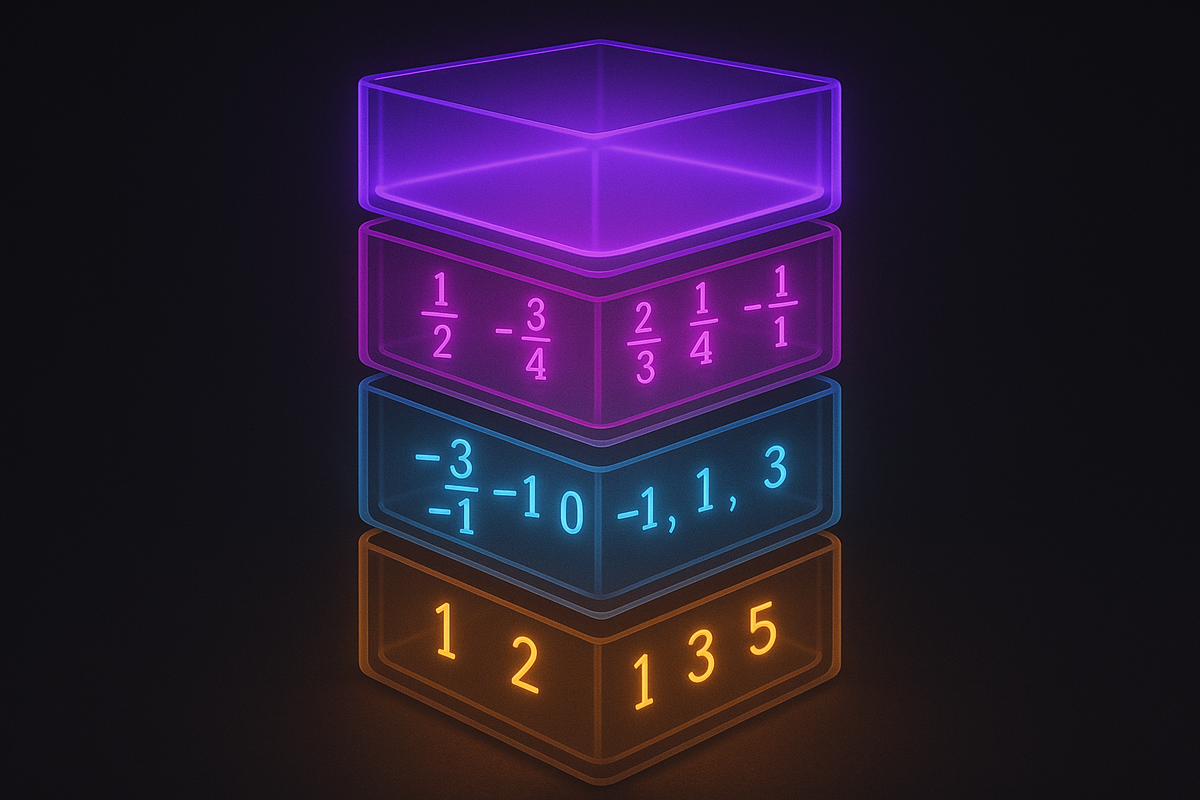
Every number system was invented to solve equations the previous one couldn't.
The naturals can't solve x + 3 = 0 (no negative numbers). So we invented integers. The integers can't solve 2x = 1 (no fractions). So we invented rationals. The rationals can't solve x² = 2 (no irrational roots). So we invented reals. The reals can't solve x² = -1 (no square root of negative). So we invented complex numbers.
Each number set extends the previous to close a gap.
That's the unlock. The number hierarchy — ℕ ⊆ ℤ ⊆ ℚ ⊆ ℝ ⊆ ℂ — isn't arbitrary. Each extension answers equations that were previously impossible. The sets form a nested sequence of increasingly powerful arithmetic systems.
ℕ: Natural Numbers
ℕ = {0, 1, 2, 3, 4, ...} (or {1, 2, 3, ...}, depending on convention)
The counting numbers. What you use to count discrete objects.
Operations closed in ℕ:
- Addition: 3 + 5 = 8 ✓
- Multiplication: 3 × 5 = 15 ✓
Operations not closed in ℕ:
- Subtraction: 3 - 5 = ? (no natural number works)
- Division: 5 ÷ 3 = ? (no natural number works)
To solve x + 5 = 3, we need something beyond naturals.
ℤ: Integers
ℤ = {..., -3, -2, -1, 0, 1, 2, 3, ...}
The natural numbers plus their negatives.
The "ℤ" comes from German Zahlen (numbers).
New capability: Subtraction always works. 3 - 5 = -2 ✓ x + 5 = 3 has solution x = -2 ✓
Still missing: Division. 5 ÷ 3 is not an integer.
ℚ: Rational Numbers
ℚ = {p/q : p ∈ ℤ, q ∈ ℤ, q ≠ 0}
Fractions. Ratios of integers.
The "ℚ" comes from quotient.
New capability: Division by nonzero integers always works. 5 ÷ 3 = 5/3 ✓ 2x = 1 has solution x = 1/2 ✓
Still missing: Roots of some equations. x² = 2 has no rational solution.
The Irrationality of √2
Proof that √2 is not rational:
Suppose √2 = p/q in lowest terms (gcd(p,q) = 1). Then 2 = p²/q², so p² = 2q². This means p² is even, so p is even. Write p = 2k. Then 4k² = 2q², so q² = 2k². This means q² is even, so q is even. But if both p and q are even, the fraction wasn't in lowest terms. Contradiction. ∎
The rationals have "gaps" — numbers like √2, ∛5, and many others.
ℝ: Real Numbers
ℝ = all points on the number line
The reals include rationals plus irrationals (√2, π, e, ...).
New capability: Limits of sequences have values. The sequence 1, 1.4, 1.41, 1.414, 1.4142, ... converges in ℝ to √2.
The reals are complete: every Cauchy sequence converges.
Still missing: Square roots of negatives. x² = -1 has no real solution.
ℂ: Complex Numbers
ℂ = {a + bi : a, b ∈ ℝ} where i² = -1
The reals plus imaginary numbers.
New capability: Every polynomial has roots. x² = -1 has solutions x = ±i ✓ x² + 1 = 0 factors as (x + i)(x - i) ✓
The complex numbers are algebraically closed: every polynomial equation has a solution in ℂ.
The Hierarchy
ℕ ⊆ ℤ ⊆ ℚ ⊆ ℝ ⊆ ℂ
Each set is a proper subset of the next:
- Every natural is an integer: 5 = 5/1
- Every integer is rational: -3 = -3/1
- Every rational is real: 2/3 ∈ ℝ
- Every real is complex: 7 = 7 + 0i
Density and Completeness
ℚ is dense in ℝ: Between any two reals, there's a rational. (And also an irrational!)
ℝ is complete: Limits exist. Sequences that "should" converge actually do.
ℚ is dense but not complete — sequences of rationals can converge to irrationals.
Cardinality Surprise
ℕ, ℤ, and ℚ all have the same cardinality: ℵ₀ (countable infinity). You can list them all (with clever ordering).
ℝ has larger cardinality: the continuum. Cantor proved you cannot list all real numbers.
Infinite sets come in different sizes. ℕ < ℝ in cardinality.
What Each Set Adds
| Set | New elements | New capability |
|---|---|---|
| ℕ | counting numbers | counting |
| ℤ | negatives | subtraction always works |
| ℚ | fractions | division always works (except by 0) |
| ℝ | irrationals | limits exist, completeness |
| ℂ | imaginaries | all polynomials have roots |
Why Stop at ℂ?
The complex numbers are algebraically closed — every polynomial factors completely.
There are extensions beyond ℂ (quaternions, octonions), but they sacrifice properties:
- Quaternions: lose commutativity (ab ≠ ba)
- Octonions: lose associativity ((ab)c ≠ a(bc))
For most purposes, ℂ is the natural stopping point.
Notation Conventions
- ℕ: sometimes includes 0, sometimes doesn't. Context matters.
- ℤ⁺: positive integers {1, 2, 3, ...}
- ℚ⁺, ℝ⁺: positive rationals, positive reals
- ℝ*: nonzero reals
Always check the author's definitions.
The Core Insight
The number sets form a tower of extensions, each built to solve problems the previous couldn't.
Naturals for counting. Integers for debt. Rationals for fair division. Reals for measurement. Complex for algebra.
Each extension preserves the old operations while adding new capabilities. The hierarchy isn't arbitrary — it's the necessary expansion of what "number" means when we demand more from arithmetic.
Part 9 of the Set Theory series.
Previous: Cartesian Products: Ordered Pairs and Beyond Next: Cardinality: Counting the Uncountable
Comments ()