Objects, Morphisms, and the Art of Not Caring What Things Are
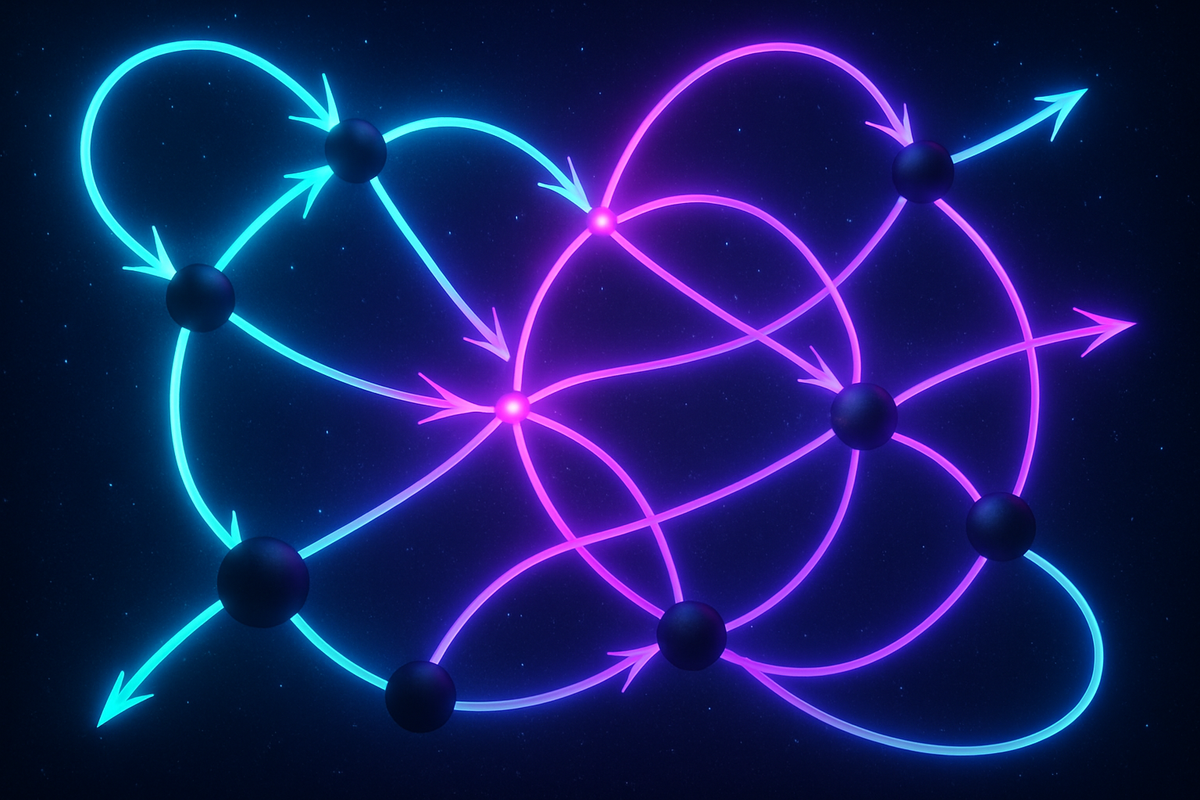
Category theory makes a provocative move: it refuses to look inside objects. All that matters is the morphisms — the arrows between them. This isn't laziness; it's a feature. Focusing on relationships rather than essence reveals the same structure underlying radically different domains.
Objects, Morphisms, and the Art of Not Caring What Things Are
Series: Applied Category Theory | Part: 2 of 10
In 1945, two mathematicians independently realized they'd been working on the same problem in completely different mathematical worlds. Samuel Eilenberg was studying algebraic topology. Saunders Mac Lane was working in algebra. They discovered something unsettling: the structure of their problems was identical, even though the things they were studying had nothing to do with each other.
This shouldn't have been possible. Topology deals with shapes and continuous deformations. Algebra deals with operations and equations. These were supposed to be separate continents in the mathematical landscape.
But Eilenberg and Mac Lane saw the same patterns of relationships repeating across both fields. So they did something radical: they stopped asking what mathematical objects are and started asking how they relate.
They called it category theory. And it changed everything.
The Ontological Surrender
Here's the move that makes category theory feel like philosophy disguised as mathematics.
Traditional mathematics: Define what things are, then study their properties.
Category theory: Forget what things are. Study only how they connect.
This is a surrender. A deliberate blindness. Category theory refuses to look inside objects. It only cares about the arrows between them.
An object in category theory is a black box. You don't know what's inside. You're not allowed to ask. All you get is the network of relationships—the morphisms—connecting one object to another.
This feels wrong at first. How can you understand something without knowing what it is?
But that's exactly the point. What something is doesn't matter. What matters is how it behaves in relation to everything else.
This is the core intuition Eilenberg and Mac Lane discovered: mathematical structures aren't defined by their internal nature. They're defined by their patterns of connection.
Objects: The Things We Don't Care About
In category theory, an object is just a dot. A placeholder. A node in a network.
It could be a number. A set. A topological space. A cognitive state. A social relationship. A programming function. Category theory genuinely doesn't care.
This is not laziness. It's precision.
By refusing to specify what objects are, category theory forces you to talk about what actually matters: the structure of how they relate.
Think about social relationships. You could spend years cataloging what makes a "good friend"—their personality traits, shared interests, values. But you'd miss the structural fact that friendship is transitive in certain contexts and not transitive in others.
If Alice trusts Bob, and Bob trusts Carol, does Alice trust Carol? Sometimes yes. Sometimes no. The answer depends on the structure of trust propagation, not the internal properties of Alice, Bob, or Carol.
Category theory says: forget the people. Study the arrows.
Morphisms: Where the Action Lives
A morphism is an arrow from one object to another. It represents a structure-preserving transformation.
Write it like this: f: A → B
This says: there's a morphism f that goes from object A to object B.
But here's the critical move: a morphism isn't just any connection. It's a structure-preserving connection.
If you're working with numbers, a morphism might be a function that preserves addition.
If you're working with topological spaces, a morphism might be a continuous map.
If you're working with cognitive states, a morphism might be a transition that preserves coherence.
The specifics change. The pattern stays the same.
Morphisms are the verbs of category theory. Objects are static. Morphisms are what happens.
And the beautiful part? You can compose morphisms.
Composition: The Universal Assembly Language
If you have two morphisms—f: A → B and g: B → C—you can compose them into a single morphism g ∘ f: A → C.
Read it right-to-left: "g after f."
This is the beating heart of category theory. Composition is how complexity builds from simple parts.
You take two transformations. You chain them. You get a new transformation.
And here's the law that makes category theory actually work: composition must be associative.
If you have three morphisms—f: A → B, g: B → C, h: C → D—then it doesn't matter how you group them:
(h ∘ g) ∘ f = h ∘ (g ∘ f)
Perform g after f, then h. Or perform g, then h after g. Same result.
This sounds trivial. It's not.
Associativity is what allows you to build arbitrarily long chains of transformations without worrying about execution order. It's why function composition works in programming. It's why action sequences work in psychology. It's why causal chains work in physics.
Composition + associativity = the ability to think about complex processes as modular, reusable parts.
And that's why category theory shows up everywhere. It's the mathematics of "putting things together in ways that make sense."
Identity: The Morphism That Does Nothing
Every object has an identity morphism—an arrow that points from the object to itself and does nothing.
id_A: A → A
If you compose any morphism with identity, you get the original morphism back:
f ∘ id_A = f
id_B ∘ f = f
This seems like formalism for its own sake. Why define a "do nothing" arrow?
Because identity morphisms enforce boundaries. They say: this object is a stable entity. You can leave it and return to it unchanged.
In cognitive terms, this is huge.
Your sense of self is (partly) an identity morphism. You can undergo experiences—morphisms that transform your state—but there's a background assumption that you persist. You compose new experiences with your existing structure. The identity morphism is the thing that makes "you" a coherent object in state-space.
When that identity morphism breaks—trauma, psychosis, identity dissolution—you lose the sense of returning to a stable baseline. The object itself becomes unstable.
Category theory isn't just describing abstract math. It's describing the structure of persistence itself.
Why This Matters: Structural Identity Over Substance
Here's the philosophical payload.
Traditional thinking: things have essences. A number is a number because of what it is. A person is a person because of their intrinsic properties.
Category theory: things are defined by their relationships. A number is a number because of how it composes with other numbers. A person is a person because of how they relate to their environment, their past, their actions.
This is relational ontology. Being is not intrinsic. Being is structural.
And this maps directly onto the coherence framework (M = C/T).
Meaning isn't inside objects. Meaning is in the pattern of relationships across time.
Your identity isn't a fixed essence. It's a trajectory through state-space with enough coherence—enough structure-preserving composition—that the pattern holds.
A relationship isn't defined by the people in it. It's defined by the morphisms they enact—the patterns of action and response that compose over time.
A culture isn't its artifacts or beliefs. It's the network of morphisms (practices, transmissions, rituals) that preserve structure across generations.
Category theory is the mathematics of what it means for structure to persist.
And that's why mathematicians stopped asking what things are. They realized that what things do—how they transform, compose, relate—is the only question that matters.
The Category of Categories
Here's where it gets recursive.
Categories themselves are objects. And structure-preserving maps between categories are morphisms.
So you can build a category of categories.
This isn't a trick. It's a fundamental move. The tools of category theory apply to category theory itself.
This is why category theory keeps showing up in computer science, physics, neuroscience, linguistics. It's not just a tool for studying other things. It's a tool for studying how tools work.
When you compose morphisms, you're doing category theory.
When you compose categories, you're doing higher-order category theory.
When you compose those, you're climbing the ladder of abstraction, and the structure stays the same all the way up.
Category theory is self-similar. The same patterns recur at every level.
And that's what makes it powerful. It's not a metaphor. It's the actual invariant structure underlying composition, identity, and transformation.
From Math to Mind: Objects as States
Let's ground this.
Think of cognitive states as objects in a category.
You're in state A (calm, focused). An event occurs. You transition to state B (anxious, scattered). That transition is a morphism.
Category theory asks: does this morphism preserve coherence? Can you compose it with other morphisms (coping strategies, reflections, actions) to return to a stable state?
If yes: you have a coherent category of mental states. Your mind can navigate disturbances and return to baseline. The identity morphism (your sense of continuous self) holds.
If no: you're in fragmented state-space. Transitions don't compose cleanly. You can't predict what state you'll end up in after a sequence of experiences. Coherence collapses.
This is what trauma does. It breaks the compositional structure of state-transitions. You can't reliably return to baseline. The identity morphism fails.
And this is what therapy does. It rebuilds compositional structure. It re-establishes morphisms (coping strategies, narrative frames, somatic practices) that allow you to navigate state-space coherently.
Category theory isn't a metaphor for mental health. It's the geometry of mental health.
Why Relationships Are Morphisms (Not Objects)
Most people think of relationships as things—nouns. "We have a relationship."
Category theory says: no. Relationships are morphisms.
A relationship is not a static entity. It's a structure-preserving transformation between states.
When you interact with someone, you undergo a morphism. Your state changes. If the relationship is coherent, this morphism composes with other morphisms in predictable ways.
You know where you stand. You can anticipate outcomes. The compositional structure holds.
When a relationship becomes "complicated," what you're experiencing is failed composition.
You try to chain interactions (morphisms), but they don't associate cleanly. What you thought would happen when you composed action A with action B doesn't match what actually happened. The structure breaks.
Category theory gives you a language for this: the morphisms don't compose.
And the solution isn't to fix the objects (the people). It's to rebuild the compositional structure—the shared patterns of action, response, and expectation that allow interactions to chain predictably.
The Art of Not Caring
So here's the move.
Stop asking what things are.
Start asking how they relate.
This is not nihilism. It's precision.
When you study objects in isolation, you miss the structure that actually matters—the network of transformations, the patterns of composition, the invariants under change.
When you study morphisms, you see the real geometry of systems.
And the deeper insight: the objects don't matter because the morphisms determine everything.
If two objects are connected by an isomorphism—a morphism that goes both ways and composes to identity—then they're the same for all categorical purposes. Doesn't matter what they're "made of." They have identical structural roles.
This is why category theory works across mathematics. A group and a topological space can be isomorphic as categories even though they're made of completely different stuff.
Structure, not substance, is what mathematics actually studies.
And increasingly, it's what science studies. And psychology. And linguistics. And philosophy.
Because the question "what is it?" leads to reductionism—breaking things into parts and cataloging properties.
But the question "how does it transform?" leads to structural understanding—seeing the patterns of relation that persist across contexts.
That's the art of not caring what things are.
What Comes Next
Category theory starts with objects and morphisms. But the real power comes when you ask: what kinds of structure do morphisms preserve?
That's where functors come in—morphisms between categories.
And after that: natural transformations—morphisms between functors.
The ladder keeps climbing. And the structure keeps repeating.
In the next essay, we'll explore how categories relate to each other. How you move between different structural worlds. How the same pattern appears in radically different contexts.
Because once you see that objects don't matter, you start seeing the morphisms everywhere.
This is Part 2 of the Applied Category Theory series, exploring how the mathematics of structure reveals the deep patterns underlying meaning, mind, and systems.
Previous: Category Theory for People Who Hate Math (But Love Patterns)
Next: Functors: When Categories Talk to Each Other
Further Reading
- Eilenberg, S. & Mac Lane, S. (1945). "General Theory of Natural Equivalences." Transactions of the American Mathematical Society.
- Spivak, D. I. (2014). Category Theory for the Sciences. MIT Press.
- Bradley, T. D. (2021). "What is Applied Category Theory?" arXiv:2107.13246.
- Fong, B. & Spivak, D. I. (2019). An Invitation to Applied Category Theory: Seven Sketches in Compositionality. Cambridge University Press.
Comments ()