Oil and the 20th Century: Liquid Civilization
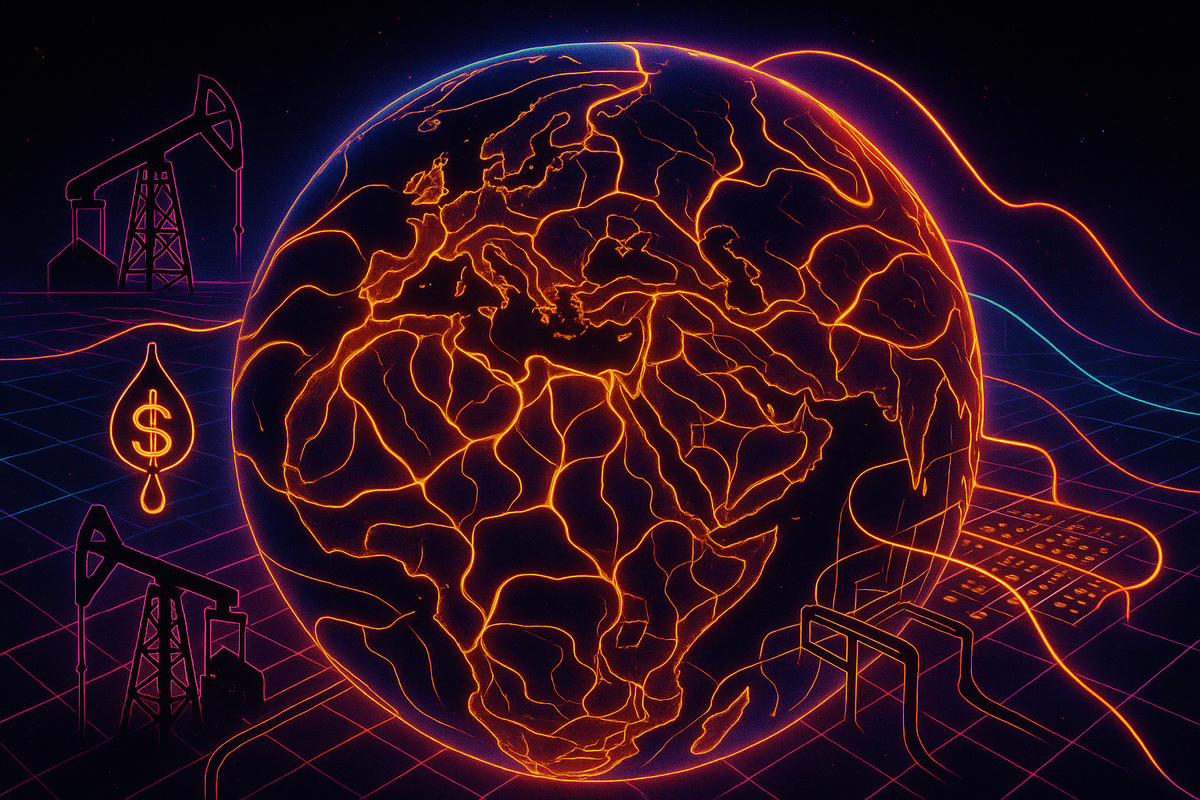
No substance reshaped human civilization faster than oil. It built the suburb, powered the tank, created the petrodollar, and handed unprecedented leverage to whoever sat on top of a reservoir. The 20th century wasn't just influenced by oil — it was built from it.
Oil and the 20th Century: Liquid Civilization
Coal powered the 19th century. Oil powered the 20th.
The shift wasn't just a change in fuel. It was a transformation in how energy could be stored, transported, and used. Oil is energy in its most convenient form: liquid, portable, energy-dense. This convenience reshaped everything from warfare to suburbs, from global trade to geopolitics.
To understand the modern world—including the predicament we're now in—you have to understand what oil made possible and what it made us dependent on.
What Makes Oil Special
Oil has remarkable properties that no other energy source matches:
Energy density: A gallon of gasoline contains about 34 kilowatt-hours of energy—roughly the same as running a 1,000-watt appliance for 34 hours. Batteries can't compete; even modern lithium-ion batteries store about 1/50th as much energy per unit weight. This is why we drive cars on gasoline rather than carrying enormous battery packs.
Portability: Oil is liquid at room temperature, flows through pipes, and pours into tanks. Coal has to be shoveled. Natural gas requires pressurized containers or pipelines. Oil goes anywhere a truck, ship, or tank can carry it.
Versatility: Oil isn't just fuel. It's feedstock for plastics, pharmaceuticals, fertilizers, and countless industrial chemicals. The petrochemical industry transformed oil from an energy source into a material substrate for modern life.
Storability: Unlike electricity, which must be used as it's generated, oil can be stored indefinitely. This allows strategic reserves, supply chain buffers, and decoupling of production from consumption.
These properties made oil the perfect energy carrier for a mobile, global, industrial civilization. Coal built factories; oil built mobility.
The Oil Age Begins
The modern oil age began in 1859 when Edwin Drake struck oil in Titusville, Pennsylvania. Initial uses were modest: kerosene for lighting, lubricants for machinery. Gasoline—a volatile byproduct of kerosene refining—was considered a nuisance, sometimes dumped into rivers.
The internal combustion engine changed everything. By the early 20th century, automobiles were transforming transportation. Aircraft—impossible without lightweight, energy-dense fuel—emerged. Ships converted from coal to oil, gaining speed and range.
World War I demonstrated oil's military significance. Tanks and trucks ran on gasoline. Aircraft provided reconnaissance and combat power. The British Navy's conversion from coal to oil, championed by Winston Churchill as First Lord of the Admiralty, proved strategically decisive.
By 1920, it was clear that oil would define the century. The race for control had begun.
Compressed Time
Here's a way to think about fossil fuels: they're compressed time.
A barrel of oil represents millions of years of photosynthesis—ancient marine organisms capturing sunlight, dying, accumulating on ocean floors, being buried and transformed by heat and pressure over geological time.
When you burn a gallon of gasoline in a 30-minute drive, you're releasing energy that took roughly 10,000 years of prehistoric sunlight to accumulate. You're spending geological savings at an astronomical rate.
This helps explain the 20th century's abundance. We weren't living within the energy income of current solar flux. We were drawing down an inheritance accumulated over hundreds of millions of years. The party was magnificent because we were spending capital, not income.
The question—which we're now confronting—is what happens when the inheritance runs low, or when spending it becomes too dangerous.
The Petrodollar World
Oil didn't just power the 20th century. It organized it.
The nations that controlled oil—or could project power to secure it—dominated global politics. The United States emerged as the world's largest producer in the early 20th century, giving it a decisive advantage in both world wars. When American production peaked in 1970, the center of gravity shifted to the Middle East.
The 1973 oil crisis demonstrated the new reality. Arab oil producers, acting through OPEC, embargoed exports to the United States and its allies. Oil prices quadrupled. Gas lines formed. Inflation surged. The world's most powerful economy was humbled by countries that controlled a liquid it couldn't do without.
In response, the United States struck a deal with Saudi Arabia: American security guarantees in exchange for oil priced in dollars. This "petrodollar" system meant that any country wanting to buy oil needed dollars first. This created permanent demand for American currency, allowing the US to run deficits that would have collapsed other economies.
The petrodollar system persists today, though it faces challenges. When countries like Iraq or Libya discussed pricing oil in other currencies, they drew American attention. The geopolitics of oil isn't just about who has it—it's about who controls the financial architecture around it.
Suburban Civilization
Oil didn't just shape geopolitics. It shaped geography.
The automobile enabled the American suburb: residential development spread across landscapes that would have been inaccessible without personal vehicles. Cities that had grown dense around streetcar lines and rail stations now sprawled along highways and arterials.
This wasn't inevitable. It was designed. The highway system was built with federal funds. Zoning laws mandated low density and separated land uses. Parking requirements ensured that every destination would accommodate cars. The automobile industry lobbied successfully against public transit.
The result: a built environment that assumes cars. American suburbs are difficult or impossible to navigate without one. The dependency is physical—distances that require wheels—and economic—infrastructure that assumes fossil fuel mobility.
Other countries made different choices. European cities maintained density. Asian cities invested in rail. But even they became dependent on oil for freight, aviation, and industrial processes. No modern economy functions without petroleum.
The Scale of Dependency
Consider some numbers:
Global oil consumption is about 100 million barrels per day. Each barrel contains about 1,700 kilowatt-hours of chemical energy. That's 170 billion kilowatt-hours daily—roughly equivalent to the continuous output of 7,000 nuclear reactors.
About 60% of oil goes to transportation. The rest goes to petrochemicals, heating, and industrial processes. Every plastic object, every synthetic fabric, every pharmaceutical capsule—all derive from oil.
Food production is particularly dependent. Modern agriculture runs on fossil fuels at every stage: tractors, harvesters, irrigation pumps, fertilizer production (which requires natural gas), pesticide manufacturing, refrigerated transport, packaging. One estimate suggests that 10 calories of fossil fuel energy go into producing every calorie of food that reaches your plate.
This isn't conspiracy or incompetence. It's thermodynamics and economics. Fossil fuels are cheap and energy-dense. Systems that use them outcompete systems that don't. Over time, this competition produces deep structural dependency.
Extracting ourselves from this dependency will be one of the great challenges of the 21st century. Not because we lack alternatives—renewables and nuclear can provide electricity, batteries are improving rapidly—but because the infrastructure, economic systems, and daily habits built around oil are vast and interlocking.
Peak Oil and Its Aftermath
In 1956, geologist M. King Hubbert predicted that American oil production would peak around 1970 and decline thereafter. He was right—production peaked in 1970 at about 10 million barrels per day.
Hubbert's broader prediction—that global oil production would peak and decline—became the "peak oil" hypothesis. Through the 2000s, as prices spiked and conventional fields matured, peak oil seemed imminent.
Then came fracking. Hydraulic fracturing and horizontal drilling unlocked oil and gas from shale formations that had been inaccessible. American production surged, reaching new highs by 2019. Global production continued to grow.
Peak oil didn't disappear—it was postponed. Shale wells deplete rapidly; maintaining production requires constant drilling. The easy oil is gone; what remains requires more effort and energy to extract. The energy return on energy invested (EROI) has declined from perhaps 100:1 for the first gushers to 10:1 or less for shale and tar sands.
We're not running out of oil. We're running out of cheap oil—oil that delivers high net energy with low effort. The transition from abundance to constraint is gradual but real.
The Carbon Problem
Even if oil remained abundant and cheap, we'd face another constraint: the atmosphere.
Burning fossil fuels releases carbon dioxide—the carbon that was sequestered by ancient organisms, returning to the air. Atmospheric CO2 has risen from about 280 parts per million before industrialization to over 420 ppm today. This increase drives global warming through the greenhouse effect.
The climate math is stark. To limit warming to 1.5°C—the ambitious target of the Paris Agreement—humanity can emit roughly 500 more gigatons of carbon. At current rates, we'll exhaust that budget in about 10 years. To stay within it, we'd need to cut emissions by half this decade and reach net zero by mid-century.
Oil combustion accounts for about 30% of global CO2 emissions. Eliminating it—or capturing and storing the carbon it releases—is essential to any climate solution.
This creates a predicament. Oil built modern civilization. Continuing to use oil threatens to destabilize the climate that civilization depends on. But stopping oil use threatens economic disruption on a massive scale. There are no easy paths.
This is the central tension of our moment: the fuel that enabled abundance is now threatening the conditions for that abundance to continue. The same energy density that made oil so useful makes its emissions so consequential. We're caught between the addiction and its side effects.
What Oil Teaches
The oil age offers lessons for understanding energy transitions:
Energy shapes society. The specific properties of oil—liquid, portable, dense—created specific social forms: automobiles, suburbs, global supply chains, petrostates. Different energy sources would have produced different civilizations.
Dependency sneaks up. No one decided to make the world dependent on oil. It happened incrementally, through millions of decisions that made local sense. The dependency became visible only after it was entrenched.
Transitions are hard. We've known about climate change for decades. Action has been slow because the systems that need to change are enormous, expensive, and embedded in daily life. The same properties that made oil successful make it hard to replace.
Abundance isn't permanent. The 20th century's abundance was drawn from geological inheritance, not sustainable production. What rises can fall. What seems permanent can prove fragile.
We're now attempting an energy transition under time pressure, with the added constraint that the new energy system must be cleaner than the old one. The outcome will shape the next century as profoundly as oil shaped the last.
Understanding oil's role in the 20th century isn't nostalgia. It's preparation. The patterns that played out with oil—the geopolitics of supply, the reshaping of landscapes, the entrenchment of dependency, the delayed reckoning with consequences—will play out again with whatever energy systems replace it.
The question isn't whether we'll transition away from oil. We will, whether by choice or by constraint. The question is whether we'll manage the transition or be managed by it.
Further Reading
- Yergin, D. (1991). The Prize: The Epic Quest for Oil, Money, and Power. Free Press. - Smil, V. (2017). Energy and Civilization: A History. MIT Press. - Mitchell, T. (2011). Carbon Democracy: Political Power in the Age of Oil. Verso.
This is Part 6 of the Energy of Civilization series. Next: "[Moore's Law: Energy Per Computation](/moores-law-energy/)."


Comments ()