Perfect Numbers and Number Patterns
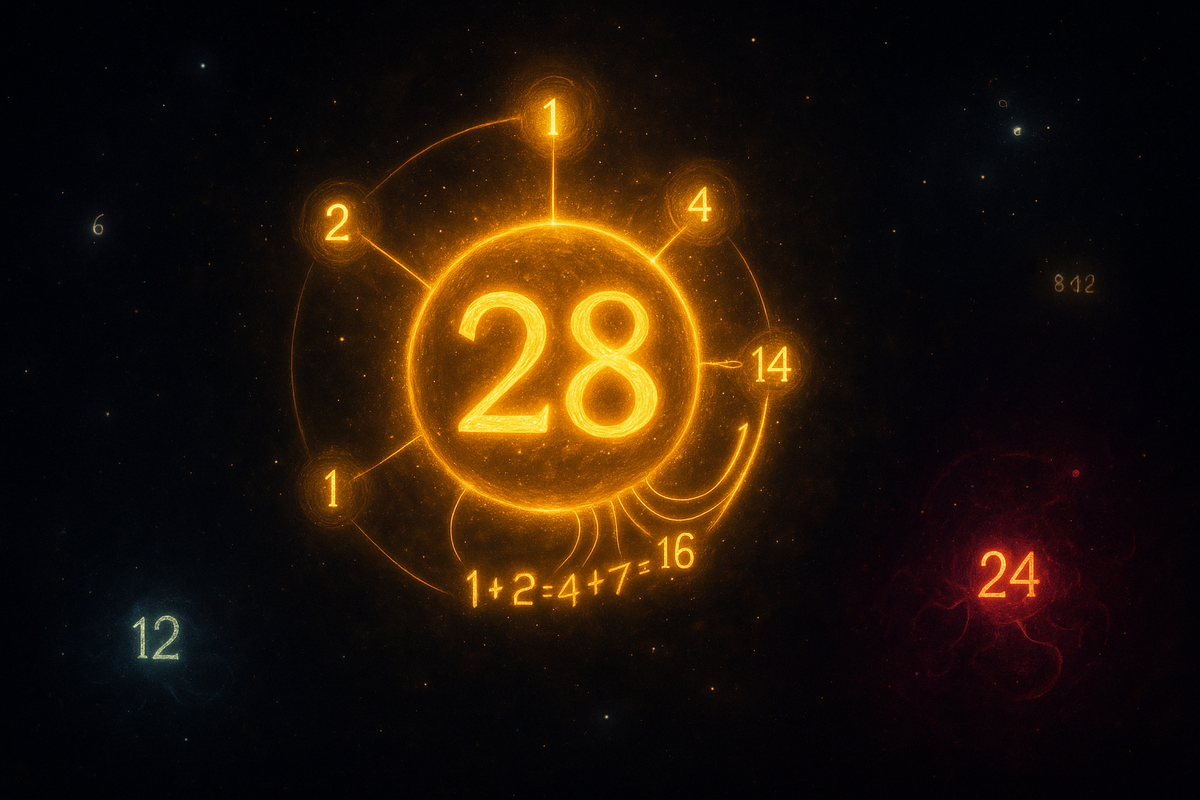
Six is perfect: its divisors (1, 2, 3) sum to exactly 6. The next perfect number is 28, then 496. After that, they get astronomical. Mathematicians have hunted them for 2,500 years and still can't say if infinitely many exist.
We've been searching for odd perfect numbers since Euclid. We've found exactly zero.
Every perfect number we know — all 51 of them — is even. The smallest is 6. The largest has over 49 million digits. Every single one follows the same formula that Euclid discovered around 300 BCE.
And nobody can prove that an odd perfect number doesn't exist.
This is one of the oldest unsolved problems in mathematics. Two millennia of searching, increasingly powerful computers, proofs that any odd perfect number must exceed 10^1500 and have over 100 prime factors — and still we can't rule them out.
What makes this strange is that we understand even perfect numbers completely. Euclid found the formula. Euler proved it's the only formula. Every even perfect number is triangular, ends in 6 or 8, and has a specific binary structure. We know everything about the even ones.
The odd ones? Maybe they don't exist. Maybe they do. We have no idea.
A perfect number equals the sum of its proper divisors.
6: divisors are 1, 2, 3. Sum: 1 + 2 + 3 = 6. 28: divisors are 1, 2, 4, 7, 14. Sum: 1 + 2 + 4 + 7 + 14 = 28.
The definition is simple. The mystery is deep.
Abundant, Deficient, and Perfect
Every positive integer falls into one of three categories based on its divisor sum.
Deficient numbers: The sum of proper divisors is less than the number itself.
8: divisors are 1, 2, 4. Sum = 7 < 8. Deficient. 14: divisors are 1, 2, 7. Sum = 10 < 14. Deficient.
Most numbers are deficient. All primes are deficient (their only proper divisor is 1).
Abundant numbers: The sum of proper divisors exceeds the number.
12: divisors are 1, 2, 3, 4, 6. Sum = 16 > 12. Abundant. 18: divisors are 1, 2, 3, 6, 9. Sum = 21 > 18. Abundant.
Perfect numbers: The sum of proper divisors equals the number exactly.
6: 1 + 2 + 3 = 6. Perfect. 28: 1 + 2 + 4 + 7 + 14 = 28. Perfect.
Perfect numbers sit precisely at the boundary between abundance and deficiency.
Euclid's Formula for Even Perfect Numbers
Around 300 BCE, Euclid discovered that whenever 2^p - 1 is prime, the number 2^(p-1) × (2^p - 1) is perfect.
Let's verify with p = 2:
- 2^2 - 1 = 3 (prime)
- 2^(2-1) × 3 = 2 × 3 = 6 ✓
With p = 3:
- 2^3 - 1 = 7 (prime)
- 2^(3-1) × 7 = 4 × 7 = 28 ✓
With p = 5:
- 2^5 - 1 = 31 (prime)
- 2^(5-1) × 31 = 16 × 31 = 496 ✓
Euclid's formula generates perfect numbers from Mersenne primes.
Mersenne Primes
Primes of the form 2^p - 1 are called Mersenne primes, after Marin Mersenne who studied them in the 17th century.
For 2^p - 1 to be prime, p itself must be prime. (If p = ab, then 2^p - 1 factors.)
But p being prime isn't sufficient:
- 2^11 - 1 = 2047 = 23 × 89 (not prime)
The known Mersenne primes correspond to: p = 2, 3, 5, 7, 13, 17, 19, 31, 61, 89, 107, 127, ...
Each Mersenne prime produces exactly one even perfect number via Euclid's formula.
The largest known primes are almost always Mersenne primes — their special structure makes them easier to test for primality using the Lucas-Lehmer test.
Euler's Converse
Two thousand years after Euclid, Euler proved the converse: every even perfect number has Euclid's form.
If n is an even perfect number, then n = 2^(p-1) × (2^p - 1) for some prime p, where 2^p - 1 is also prime.
This completely characterizes even perfect numbers. Finding them is equivalent to finding Mersenne primes.
Properties of Even Perfect Numbers
Every even perfect number has remarkable structure:
Triangular: Every even perfect number is a triangular number.
- 6 = 1 + 2 + 3 = T₃
- 28 = 1 + 2 + 3 + ... + 7 = T₇
- 496 = 1 + 2 + 3 + ... + 31 = T₃₁
Binary representation: In base 2, even perfect numbers are p ones followed by p-1 zeros.
- 6 = 110₂
- 28 = 11100₂
- 496 = 111110000₂
Sum of cubes: Every even perfect number (except 6) is the sum of consecutive odd cubes.
- 28 = 1³ + 3³
- 496 = 1³ + 3³ + 5³ + 7³
- 8128 = 1³ + 3³ + 5³ + 7³ + 9³ + 11³ + 13³ + 15³
Ends in 6 or 8: Every even perfect number ends in 6 or 8 (and the pattern 6, 8, 6, 8, ... continues).
Why This Pattern?
What makes 2^(p-1) × (2^p - 1) work when 2^p - 1 is prime?
The divisor sum function σ(n) is multiplicative: σ(ab) = σ(a)σ(b) when gcd(a,b) = 1.
For n = 2^(p-1) × (2^p - 1):
σ(2^(p-1)) = 1 + 2 + 4 + ... + 2^(p-1) = 2^p - 1
σ(2^p - 1) = 1 + (2^p - 1) = 2^p (since 2^p - 1 is prime)
So σ(n) = (2^p - 1) × 2^p = 2 × 2^(p-1) × (2^p - 1) = 2n.
Since σ(n) includes n itself, the sum of proper divisors is σ(n) - n = 2n - n = n.
The number equals the sum of its parts.
Related Classifications
Amicable numbers: A pair (a, b) where the divisors of a sum to b, and vice versa.
- 220 and 284 are amicable: divisors of 220 sum to 284, divisors of 284 sum to 220.
Sociable numbers: A cycle where each number's divisors sum to the next number in the cycle.
Multiply perfect numbers: Numbers where σ(n) = kn for some integer k > 2.
- 120 is 3-perfect: σ(120) = 360 = 3 × 120
Quasiperfect numbers: Numbers where σ(n) = 2n + 1. None are known to exist.
The Search Continues
The Great Internet Mersenne Prime Search (GIMPS) is a distributed computing project that has found the largest known primes — all Mersenne primes, each producing a new perfect number.
The 51st known perfect number, discovered in 2018, has over 49 million digits.
We still don't know:
- Are there infinitely many perfect numbers?
- Is there an odd perfect number?
- Is there a pattern to where Mersenne primes appear?
Perfect numbers are where ancient mysticism meets modern computation. The Greeks called them perfect for philosophical reasons. We're still trying to understand why they're so rare.
Part 11 of the Number Theory series.
Previous: Cryptography: Number Theory Protects Your Secrets Next: Synthesis: Number Theory as the Study of Structure in Integers
Comments ()