Phase Separation: The Liquid Physics of Cells
Cells were thought to compartmentalize everything in lipid membrane-bound organelles. Then biologists found that key gene-regulation hubs form as liquid droplets via phase separation — the same physics behind oil and water. It's reshaping cell biology.
Phase Separation: The Liquid Physics of Cells
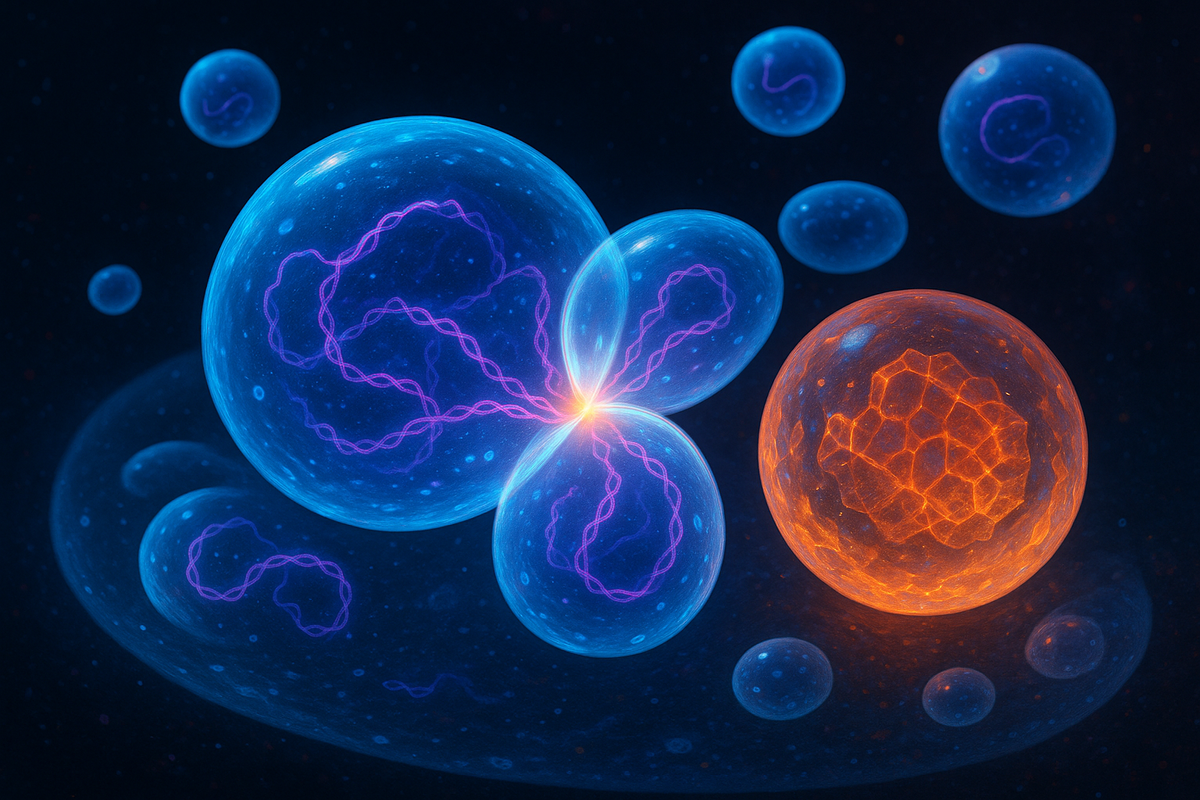
In 2009, Cliff Brangwynne and Tony Hyman published a paper that would quietly reshape cell biology. They were studying germline granules in C. elegans—small structures inside cells that contain RNA and proteins and are involved in early development. Scientists had known about these granules for decades. They'd been treated as vaguely-defined "organelles" without clear boundaries. Brangwynne and Hyman showed that the granules were liquid. Actual liquid droplets, inside the cell. They could fuse. They could drip. They were round because surface tension made them round—the same physics that makes raindrops round. This wasn't supposed to happen. Cells are organized by membranes—lipid bilayers that create compartments. The nucleus is bounded by a membrane. Mitochondria are bounded by membranes. Organelles have walls. That's how cellular organization works. Except there's another way: phase separation. Oil and water don't mix—they spontaneously separate into distinct phases. What Brangwynne and Hyman discovered was that the same thing happens with proteins and RNA inside cells. Molecules can concentrate themselves, forming droplets that exclude other components, without any membrane at all. Cells organize themselves using liquid physics. And RNA is at the center of it.
RNA as the Key Player
Here's where RNA enters the story. Many biomolecular condensates are built around RNA. The nucleolus, where ribosomes are assembled, contains concentrated RNA and RNA-binding proteins. Stress granules, which form when cells are under duress, are full of stalled mRNAs and the proteins associated with them. P-bodies, which are involved in mRNA degradation, are RNA-protein condensates. RNA isn't just a passenger in these structures. RNA helps nucleate them—provides the scaffold around which condensates form. Think about it: RNA is a long, negatively charged molecule with complex secondary structure. It can form base-pairs with itself and with other RNAs. It can bind multiple proteins simultaneously through different domains. It's the perfect multivalent scaffold. Several principles have emerged: RNA concentration matters. As RNA concentration increases, so does the tendency to form condensates. The nucleolus exists partly because ribosomal RNA genes are clustered together, creating a high local concentration of RNA that drives phase separation. RNA structure matters. Structured RNAs can create specific interaction interfaces. Unstructured RNAs can promote more liquid, dynamic condensates. The physical properties of the RNA affect the physical properties of the condensate. RNA-protein interactions are tunable. Different RNA-binding proteins have different affinities and valences. The mix of proteins and RNAs determines whether a condensate forms, how big it gets, and what it does. RNA is at the heart of cellular organization without membranes.
The Condensate Zoo
Once scientists knew what to look for, they found condensates everywhere. The nucleolus is the largest—where ribosomal RNA is transcribed and ribosomes assemble. Stress granules form when translation is inhibited, protecting stalled mRNAs during cellular stress. P-bodies are the recycling centers that degrade mRNA. Paraspeckles are built around the lncRNA NEAT1. Transcription condensates form at active genes, concentrating the transcription machinery. The list keeps growing. The organizational principle is general.
Why Phase Separation?
Why would cells use liquid physics instead of membranes? Speed. Membrane-bounded organelles take time to build. Phase-separated condensates can form in seconds. If conditions change—stress, signaling, cell cycle—condensates can assemble or dissolve almost immediately. Reversibility. Condensates form and dissolve depending on molecular concentrations, temperature, pH, and other variables. This dynamic behavior allows rapid responses to changing conditions. Selective enrichment. Condensates concentrate specific molecules while excluding others. This creates microenvironments where certain reactions are favored—without requiring the cell to build and maintain membrane-bounded compartments. Reaction control. By concentrating enzymes and substrates together, condensates can accelerate chemical reactions. Alternatively, by sequestering molecules, they can prevent reactions. It's a way to spatially control cellular chemistry. Simplicity. You don't need lipid synthesis machinery, membrane fusion systems, or protein transport complexes. Just the right mix of molecules with the right interaction properties, and organization emerges spontaneously. The membrane-based approach evolved first (probably) and remains essential. But phase separation adds flexibility. Cells use both.
The Physics of Droplets
Let's get a little more precise about the physics. Phase separation occurs when molecules prefer to interact with themselves rather than with the surrounding solvent. Below a critical concentration, molecules stay dispersed. Above it, they condense into a dense phase while the surrounding solution becomes dilute. The resulting droplets have properties characteristic of liquids: Surface tension keeps them spherical and causes small droplets to fuse into larger ones. Viscosity determines how easily molecules move inside. Some condensates are highly dynamic, with rapid internal mixing. Others are more gel-like, with slower diffusion. Interfacial energy determines how hard it is for molecules to cross the boundary between phases. Some condensates have permeable boundaries; others are more exclusive. These properties can be measured, and they matter. A condensate that's too viscous may not function properly. One that's too liquid may not concentrate molecules sufficiently. The cell tunes condensate properties through the molecules it includes and the conditions it maintains. Recent work has shown that condensates can undergo "maturation"—starting as liquid droplets but transitioning over time to more solid, gel-like, or even fibrillar states. This has disease implications, as we'll see.
Disease: When Condensates Go Wrong
Several neurodegenerative diseases involve pathological protein aggregates—amyloid plaques in Alzheimer's, Lewy bodies in Parkinson's, inclusions in ALS and frontotemporal dementia. The phase separation field has reframed how we think about these aggregates. Many of the proteins implicated in neurodegeneration—TDP-43, FUS, tau, huntingtin—have intrinsically disordered regions and can phase-separate in vitro. Under normal conditions, they may form functional, dynamic condensates. Under pathological conditions, those condensates may transition to solid, irreversible aggregates. Normal: liquid droplet, dynamic, functional. Pathological: solid aggregate, static, toxic. This suggests a model: disease-associated mutations or aging-related changes make condensates more prone to solidification. What starts as a normal phase-separation process tips into a pathological one. FUS and TDP-43 are particularly instructive. Both are RNA-binding proteins. Both are found in ALS-associated inclusions. Both can phase-separate in vitro, and ALS-linked mutations accelerate the transition from liquid to solid. The RNA binding matters too. RNA can keep these proteins in a dynamic, liquid state. Loss of RNA binding promotes aggregation. This suggests therapeutic strategies: stabilizing the liquid state, preventing the solid transition, maybe even using RNA to modulate condensate behavior. Neurodegeneration might be a phase transition problem. The droplets harden when they shouldn't.
Transcription: Where It All Comes Together
Gene expression requires assembling massive molecular machines at the right genes at the right times. Phase separation may explain how. Richard Young's lab has proposed that transcription occurs in condensates—liquid droplets at active promoters that concentrate the machinery. The intrinsically disordered C-terminal domain of RNA polymerase II may serve as a scaffold. Super-enhancers might work by creating condensates. Transcription bursts—the pulsatile, all-or-nothing pattern of gene expression—might reflect condensate formation and dissolution. This remains an active area with controversy. But the conceptual shift matters: instead of linear assembly (one factor binds, then another), transcription is a phase transition. Cross a threshold, the condensate forms. Drop below it, it dissolves. Regulation becomes controlling those thresholds.
RNA as Organizer
Let's bring it back to RNA. RNA is not just a product of transcription. It's an organizer of transcription. Long non-coding RNAs can nucleate condensates at specific genomic locations. The act of transcription produces RNA, which can in turn promote condensate formation, which can in turn boost transcription—a positive feedback loop. Some examples: XIST, the lncRNA that silences the X chromosome, forms a coating that may involve phase separation. The RNA recruits protein complexes that modify chromatin, and the resulting structure has condensate-like properties. NEAT1, the lncRNA that nucleates paraspeckles, is essential for paraspeckle formation. Without it, no paraspeckle. The RNA is the scaffold. Enhancer RNAs (eRNAs) are transcribed from enhancer regions and may help form transcription condensates at nearby genes. RNA isn't just being organized by condensates. RNA is helping organize the condensates. It's a two-way relationship. The transcriptome and the organization of the cell are coupled through liquid physics.
Therapeutic Implications
If condensates are involved in disease, can we target them therapeutically? The idea is appealing but challenging. Phase separation is driven by many weak interactions—hard to disrupt with traditional small molecules, which typically bind tight pockets. Several approaches are being explored: Preventing pathological transition. If disease involves liquid-to-solid transitions, maybe drugs can stabilize the liquid state. Chaperones, RNA mimics, or small molecules that interfere with aggregation might help. Modulating condensate formation. If a disease involves too much condensate formation (or too little), perhaps we can tune the interactions that drive phase separation—altering protein concentrations, modifying intrinsically disordered regions, changing RNA levels. Targeting condensate components. Rather than targeting the condensate itself, target proteins or RNAs that are essential for its formation or function. This is early-stage work. No phase-separation-targeting drugs are in clinical use. But the conceptual framework is influencing how researchers think about diseases from neurodegeneration to cancer.
A New Way of Seeing
Phase separation in biology is less than two decades old as a major research area. But it's already changed how cell biologists think about organization. The old view: cells are organized by membranes. Compartments are bounded structures. Organization requires building walls. The new view: cells are organized by chemistry and physics. Compartments can be bounded or phase-separated. Organization can emerge from molecular properties. RNA is central to both views. It's enclosed in membrane-bounded nuclei. It's concentrated in phase-separated condensates. It helps build the very structures that process it. The RNA renaissance isn't just about discovering new classes of RNA. It's about discovering that RNA is an organizer of cellular life—structurally, spatially, temporally. RNA molecules don't just carry information. They shape the environment in which information flows. Cells don't just have molecules. They have physics. And RNA is where the physics happens.
Further Reading
- Brangwynne, C. P., Eckmann, C. R., Courson, D. S., et al. (2009). "Germline P Granules Are Liquid Droplets That Localize by Controlled Dissolution/Condensation." Science.
- Banani, S. F., Lee, H. O., Hyman, A. A., & Rosen, M. K. (2017). "Biomolecular condensates: organizers of cellular biochemistry." Nature Reviews Molecular Cell Biology.
- Shin, Y., & Brangwynne, C. P. (2017). "Liquid phase condensation in cell physiology and disease." Science.
- Sabari, B. R., et al. (2018). "Coactivator condensation at super-enhancers links phase separation and gene control." Science.
This is Part 7 of the RNA Renaissance series. Next: "Synthesis: RNA as Information Processor."


Comments ()