Phase Transitions: Why Ice Melts at Exactly 0°C
Why does a phase transition happen at one exact temperature rather than a range? Gibbs free energy explains the thermodynamic tipping point where ice and water become equally stable — and then one wins.

Phase Transitions: When Free Energy Surfaces Cross
Water freezes at 0°C. This seems like a fact about water, but it's really a fact about free energy. At that precise temperature, the free energy curves of ice and liquid water cross. Above, liquid wins. Below, ice wins. At exactly 0°C, they tie.
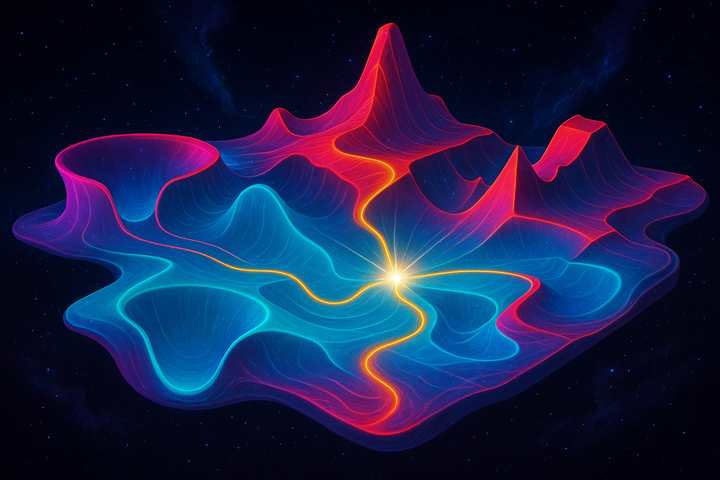
Phase transitions are moments when nature changes its mind about which state is best. They're not gradual—they're sharp. The free energy landscape reorganizes, and matter follows.
Understanding phase transitions through Gibbs free energy explains melting points, boiling points, sublimation, and the exotic transitions that shape materials science and condensed matter physics.
Free Energy of Phases
Each phase of matter has its own free energy:
G_solid(T, P) G_liquid(T, P) G_gas(T, P)
The stable phase at any temperature and pressure is whichever has the lowest G.
At low temperature, solids typically have lowest G—strong bonds mean favorable enthalpy. At high temperature, gases typically have lowest G—high entropy becomes dominant. Liquids occupy the middle ground.
The pebble: A phase transition occurs when two free energy curves cross. The system switches loyalty to whichever phase became lower. It's a competition, and temperature is the judge.
First-Order Phase Transitions
Most familiar transitions—melting, boiling, freezing—are first-order. They involve:
1. Discontinuous first derivative of G: Volume and entropy change abruptly 2. Latent heat: Energy absorbed or released without temperature change 3. Coexistence: Both phases can exist together at the transition
At the melting point: G_solid = G_liquid
But: S_liquid > S_solid (entropy discontinuity) V_liquid ≠ V_solid (volume discontinuity)
The latent heat of fusion: ΔH_fus = T_m × ΔS_fus
For ice: ΔH_fus = 6.01 kJ/mol. This energy goes into disrupting the crystal structure, not raising temperature.
The Clausius-Clapeyron Equation
How do melting and boiling points change with pressure?
dP/dT = ΔS/ΔV = ΔH/(TΔV)
This follows from requiring G_1 = G_2 along the phase boundary.
Water's anomaly: Ice is less dense than liquid water (ΔV < 0 for melting). Therefore dP/dT < 0 for ice melting. High pressure lowers the melting point.
This is why ice skating works—pressure under the blade slightly melts ice (though the effect is small; friction is more important). It's why glaciers flow—pressure at the base causes melting.
Normal liquids: ΔV > 0 for melting. High pressure raises the melting point. Squeeze harder, and the solid becomes more stable.
Boiling: ΔV is large and positive (gas expands). ΔH is large and positive (vaporization absorbs heat). Clausius-Clapeyron predicts boiling points increase with pressure—hence pressure cookers.
Phase Diagrams
A phase diagram maps stable phases across temperature and pressure:
- Triple point: Where solid, liquid, and gas coexist (G_solid = G_liquid = G_gas) - Critical point: Where liquid and gas become indistinguishable - Phase boundaries: Lines where two phases coexist
Water's phase diagram: - Triple point: 273.16 K, 611 Pa - Critical point: 647 K, 22.1 MPa - Normal melting: 273.15 K at 101.3 kPa - Normal boiling: 373.15 K at 101.3 kPa
The phase boundaries are determined entirely by the free energy functions. Thermodynamics draws the map.
Critical Points and Supercritical Fluids
Above the critical point, there's no distinction between liquid and gas. The first-order transition terminates.
Why? At high temperature and pressure, the densities of liquid and gas converge. At the critical point, they become equal. Above it, matter is a supercritical fluid—neither liquid nor gas, with properties of both.
Supercritical CO₂ is used for: - Decaffeinating coffee (dissolves caffeine, evaporates cleanly) - Dry cleaning (no toxic solvents) - Extraction of natural products
The critical point is where ∂²G/∂V² = 0. The free energy surface loses its double-well structure—the distinction between phases vanishes.
Second-Order Phase Transitions
Not all transitions have latent heat. Second-order (continuous) transitions have:
1. Continuous first derivatives of G: No latent heat, no volume jump 2. Discontinuous second derivatives: Heat capacity, compressibility change abruptly 3. Critical phenomena: Fluctuations diverge, correlation lengths grow
Examples: - Ferromagnetic transition (Curie point): Magnetization vanishes continuously - Superconducting transition: Resistance drops to zero - Superfluid transition: Helium-4 below 2.17 K
At second-order transitions, the system doesn't jump between distinct states. It evolves continuously while fundamental properties change. The free energy surface smoothly deforms, but its topology changes.
Order Parameters
Second-order transitions involve an order parameter—a quantity that's zero in one phase and nonzero in another:
- Magnetization (ferromagnetic transition) - Superfluid density (superfluid transition) - Cooper pair density (superconducting transition)
Near the transition, the free energy can be expanded in powers of the order parameter (Landau theory):
G = G₀ + a(T)φ² + bφ⁴ + ...
When a(T) changes sign at T_c, the minimum shifts from φ = 0 to φ ≠ 0. The transition occurs when the free energy landscape's shape changes.
The pebble: A second-order transition is the free energy surface changing topology. The minimum doesn't jump—it splits, or merges, or appears from nowhere.
Symmetry Breaking
Phase transitions often involve symmetry breaking:
Liquid → Crystal: Continuous translational symmetry breaks to discrete lattice symmetry.
Paramagnetic → Ferromagnetic: Rotational symmetry of spin orientations breaks; spins align along one direction.
Normal → Superconducting: Gauge symmetry breaks; the phase of the superconducting order parameter becomes defined.
The high-temperature phase has higher symmetry. The low-temperature phase has lower symmetry but lower free energy. Nature trades symmetry for stability.
This connects to particle physics: the Higgs mechanism is a phase transition where electroweak symmetry breaks, giving particles mass.
Nucleation and Metastability
Phase transitions don't always happen when thermodynamically favored. Kinetic barriers can prevent them.
Supercooled water can remain liquid below 0°C. The liquid phase is metastable—higher G than ice, but separated by an activation barrier.
Nucleation is the formation of a small region of the new phase. Creating a nucleus has costs (surface energy) and benefits (bulk free energy gain). Only nuclei above a critical size grow spontaneously.
ΔG_nucleus = (4/3)πr³ΔG_bulk + 4πr²γ
Small nuclei: surface term dominates, ΔG > 0, unstable Large nuclei: bulk term dominates, ΔG < 0, grow spontaneously Critical nucleus: ΔG maximum, unstable equilibrium
This is why clean water supercools—no nucleation sites. Add impurities (or ice crystals), and freezing happens instantly.
Glasses: Avoided Transitions
What if the transition never happens? If a liquid cools fast enough, it can bypass crystallization and become a glass—an amorphous solid.
Glass is not a phase. It's a kinetically trapped state, out of equilibrium. The free energy is higher than the crystal, but the system can't find the crystalline minimum on experimental timescales.
G_glass > G_crystal, but the glass persists.
Silica glass, metallic glasses, polymer glasses—all are metastable states that would crystallize if given infinite time. Thermodynamics says they should transform; kinetics says they won't.
The pebble: Glass is matter that forgot how to crystallize. It's a snapshot of liquid structure, frozen by kinetics while thermodynamics wasn't looking.
Quantum Phase Transitions
At absolute zero, classical phase transitions can't occur (no thermal fluctuations). But quantum phase transitions can.
These are driven by quantum fluctuations—uncertainty principle allowing the system to tunnel between configurations. Tuning parameters like pressure, magnetic field, or composition can drive quantum phase transitions at T = 0.
Near quantum critical points, exotic behavior emerges: - Non-Fermi liquid metals - Unconventional superconductivity - Strange metals with anomalous resistivity
Quantum phase transitions are frontiers of condensed matter physics, where thermodynamics meets quantum mechanics.
Biological Phase Transitions
Cells use phase transitions:
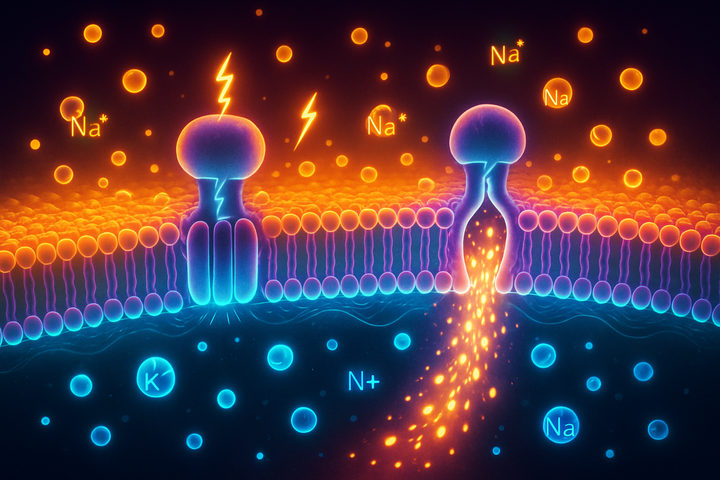
Membrane phase transitions: Lipid bilayers switch between gel (ordered) and fluid (disordered) phases. Cells tune lipid composition to maintain the right fluidity.
Protein condensation: Many proteins undergo liquid-liquid phase separation, forming membrane-less organelles (stress granules, nucleoli). This is like oil-water separation—driven by free energy.
DNA melting: Double helix separates into single strands at high temperature. The melting temperature depends on sequence (GC content) and conditions.
Life exploits phase transitions for regulation, compartmentalization, and response to environment.
Phase Transitions in Materials Science
Steel hardening: Rapid cooling traps carbon in a metastable phase (martensite), harder than the equilibrium structure.
Superconductors: Below critical temperature, electrical resistance vanishes—a phase transition to a quantum coherent state.
Shape-memory alloys: Martensitic transitions allow materials to "remember" shapes and return to them when heated.
Ferroelectrics: Polarization switches in response to electric field, useful for memory and sensors.
Engineering materials means engineering phase transitions—controlling when they happen, how fast, and what structures form.
Summary
Phase transitions are free energy crossings:
- First-order: Discontinuous, latent heat, coexistence - Second-order: Continuous, no latent heat, critical phenomena - Clausius-Clapeyron: How boundaries shift with pressure - Critical points: Where phase distinctions vanish - Metastability: When kinetics prevents thermodynamic transitions
The pebble: Every melting point is a truce. Above it, disorder wins by entropy. Below it, order wins by enthalpy. At exactly that temperature, free energy declares a tie, and both phases coexist in uneasy equilibrium.
Further Reading
- Stanley, H. E. (1971). Introduction to Phase Transitions and Critical Phenomena. Oxford University Press. - Goldenfeld, N. (1992). Lectures on Phase Transitions and the Renormalization Group. Addison-Wesley.
This is Part 9 of the Gibbs Free Energy series. Next: "[Diamonds and Graphite: Thermodynamics vs Kinetics](/diamonds-thermodynamics-kinetics/)"
Comments ()