Psychedelics and the Dissolution of the Interface
If perception is a user interface, what happens when psychedelics loosen the interface constraints? Geometric hallucinations, ego dissolution, and synesthetic overflow stop looking like glitches and start looking like interface degradation — with everything that implies.
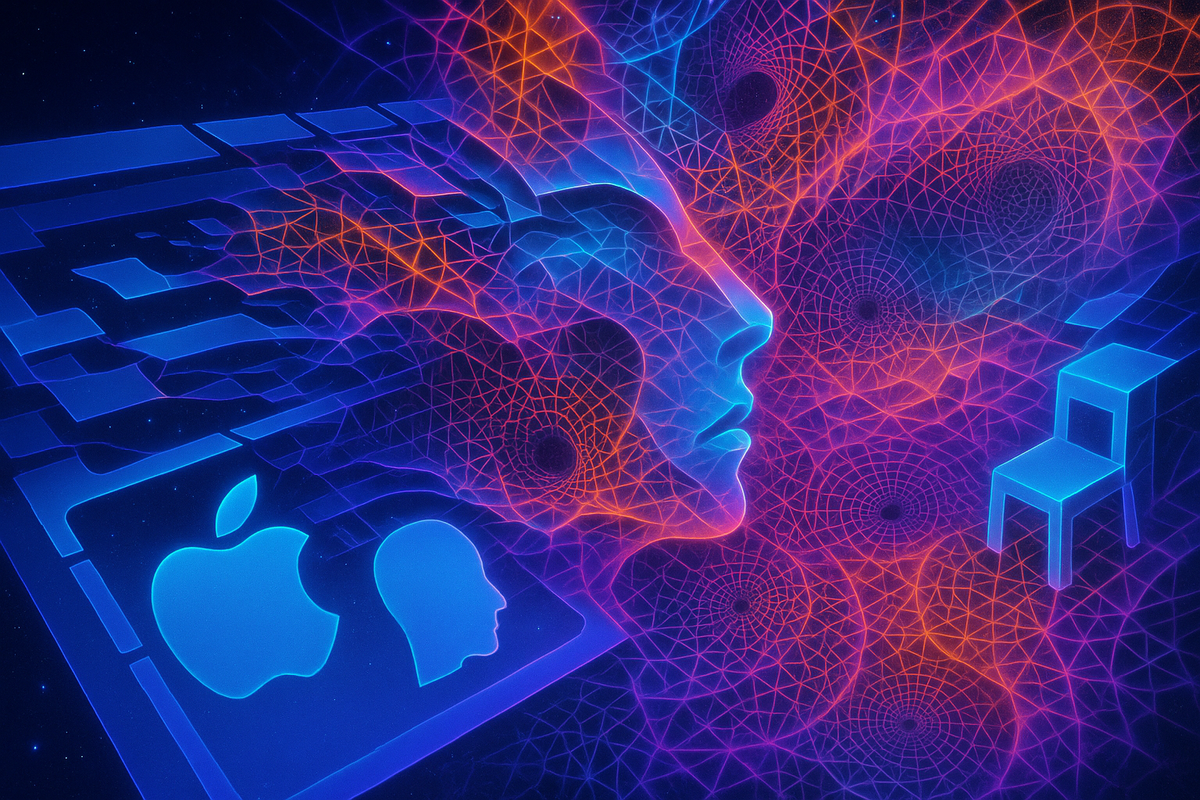
Psychedelics and the Dissolution of the Interface
Series: Interface Theory | Part: 7 of 10
If reality is a user interface—not the truth but a useful fiction shaped by evolutionary pressure—then what happens when that interface breaks down?
Psychedelic states offer something remarkable: not just altered perception, but systematic alterations that follow predictable patterns. Subjects report the dissolution of boundaries, the breakdown of object categories, geometric hallucinations that seem more real than real, and encounters with what feel like deeper layers of reality. If Hoffman is right that ordinary perception hides the truth behind a simplified interface, then psychedelics might relax those constraints—temporarily pulling back the veil.
This isn't mysticism. It's what happens when you perturb a system tuned by millions of years of natural selection to hide the truth in favor of fitness.
The Interface Under Normal Operation
Hoffman's Interface Theory of Perception argues that evolution shaped perception to maximize fitness, not to reveal truth. Your visual field isn't a window onto reality—it's a dashboard of fitness-relevant affordances. The apple looks red and round not because reality contains redness and roundness, but because those are useful tags your nervous system assigned to grab nutrients efficiently.
This interface is tuned for survival. It's compressed, reducing the dimensionality of reality's true state space to a manageable few dimensions. It's discrete, carving continuous distributions into bounded objects. It's stable, maintaining consistent categories across contexts so you can act without constant recomputation.
In AToM terms, the perceptual interface represents a low-curvature manifold—predictions align with sensations, categories remain coherent, actions produce expected outcomes. Meaning equals coherence over time. The interface works precisely because it's predictable.
But that stability comes at a cost: you're blind to whatever doesn't matter for fitness. And sometimes, what doesn't matter for survival is the actual structure of reality.
What Psychedelics Do to the System
Classic psychedelics—psilocybin, LSD, DMT, mescaline—are 5-HT2A receptor agonists. They don't just tweak neurotransmitter levels; they fundamentally alter the brain's hierarchical prediction machinery. The effects are weirdly specific and remarkably consistent across substances and subjects:
Boundary dissolution: The edges between self and world, subject and object, figure and ground become porous. You might feel yourself melting into the room, or experience the boundary of your body as arbitrary.
Category collapse: Objects stop belonging to stable categories. A chair might simultaneously be furniture, wood, potential, geometry, and none of these. The interface's discrete bins blur into continuous distributions.
Geometric hallucinations: Subjects report vivid geometric patterns—tunnels, grids, fractals, lattices—especially with closed eyes. These aren't random noise; they follow form constants documented across cultures and eras.
Synesthesia: Sensory streams cross-wire. Sound has color. Touch has taste. The normally segregated channels of the perceptual interface bleed together.
Encounter with "more": Many report a sense of accessing deeper reality, of seeing the scaffolding behind the interface, of meeting something intelligent and structured beneath the everyday.
Robin Carhart-Harris and Karl Friston's REBUS model (Relaxed Beliefs Under Psychedelics) explains this in predictive processing terms. Under normal conditions, high-level priors constrain low-level sensory signals. Your brain expects objects to be solid, categories to be stable, the self to be bounded. These strong priors sculpt perception, collapsing ambiguous inputs into fitness-relevant categories.
Psychedelics reduce the precision-weighting of those high-level priors. The normally dominant top-down predictions relax their grip. Bottom-up sensory signals—usually suppressed or overridden—flood upward with greater influence. The interface becomes less rigid, more responsive to the raw data it normally filters out.
In AToM terms, curvature increases. The manifold that was smooth and predictable develops steep gradients, unstable trajectories, sensitive dependence on initial conditions. Coherence over time becomes harder to maintain because predictions no longer reliably constrain experience.
This is why psychedelic states feel both more real and more chaotic. You're no longer held within the low-dimensional interface. You're seeing the higher-dimensional structure it was built to hide.
The Form Constants: Geometry as Perceptual Scaffolding
Here's where it gets interesting. Those geometric hallucinations—the tunnels, grids, spirals, lattices—aren't arbitrary. They're called form constants because they show up reliably across subjects, substances, and even neural conditions like migraine aura or near-death experiences.
Neurophysiologist Jack Cowan and mathematician Bard Ermentrout showed these patterns emerge from the brain's intrinsic architecture. The visual cortex has a specific topology: retinotopic maps, columnar organization, recurrent connectivity. Perturb the system—via psychedelics, epilepsy, sensory deprivation—and the cortex's structure generates characteristic patterns that get interpreted as geometric forms in perceptual space.
From an Interface Theory perspective, these geometries might be the underlying scaffolding. Ordinary perception hides the computational substrate, presenting you with a seamless world of objects and surfaces. Psychedelics might reveal the data structures—the grids, the lattices, the coordinate systems—that the interface uses to organize experience.
If your desktop interface crashes, you might see the file directory structure, the memory addresses, the machine code. Not the truth of computation—that remains hidden—but a deeper layer of organization than the user-facing graphics.
The form constants could be exactly that: the perceptual machinery laid bare, no longer disguised as a seamless phenomenal world.
Dissolution as Interface Relaxation
Boundary dissolution makes perfect sense if perception is interface-bound rather than truth-tracking. Boundaries—between self and world, between one object and another—aren't features of reality. They're fitness-relevant cuts the interface makes in continuous distributions.
Michael Levin's work on bioelectricity shows that even cellular boundaries are functional rather than ontological. Markov blankets define systems not by sharp edges but by statistical dependencies. What you are isn't a fixed entity with clear borders; it's a coherent process maintaining its own predictability.
The sense of self—the felt boundary of where you end and the world begins—is itself an interface phenomenon. It's useful to model the world as containing a persistent agent with goals and boundaries. But that agent isn't a foundational feature of reality. It's a control strategy.
Psychedelics relax the precision-weighting on self-models. The top-down prior that says "I am here, bounded and distinct" loses its authority. Bottom-up sensory evidence—proprioception, interoception, exteroception—flows more freely, no longer forced into the preexisting category of "self."
The result: ego dissolution, boundary collapse, unity experiences.
In Hoffman's framework, this isn't mystical union with the cosmos. It's the temporary suspension of the interface conventions that carved the cosmos into separate things in the first place. The distinctions were always pragmatic, not ontological. Psychedelics just make that obvious.
Encounters with the "More": Intelligent Structure Behind the Interface
One of the most provocative aspects of psychedelic phenomenology is the widespread report of encountering something intelligent. Not just patterns, not just feelings, but structured presence—sometimes described as entities, sometimes as a vast intelligence, sometimes as a sense that reality itself is aware.
Terence McKenna spoke of "self-transforming machine elves." DMT studies document consistent reports of autonomous beings. Even less dramatic trips often involve a feeling that something larger is communicating, that the geometry itself carries meaning.
Hoffman would argue this makes perfect sense. If conscious agents are the substrate—reality is minds all the way down—then perturbing the interface might allow glimpses of the deeper agent space. Not the ultimate truth, but a layer less compressed than ordinary perception.
Friston's Free Energy Principle models systems as hierarchies of Markov-blanketed agents, each inferring and acting to minimize surprise. Under this view, "you" are a nested structure of sub-agents (cells, organs, neural populations), all running active inference at their respective scales.
Psychedelics might relax the boundaries between these nested layers. The normally unified "self" becomes porous to its constituent processes. What feels like encountering alien intelligence might be encountering your own sub-personal agents—normally invisible because the interface abstracts them away into a single coherent narrative.
Or, if Hoffman's conscious realism holds, it might be genuine contact with the deeper agent space that spacetime and physical objects are themselves interfaces for.
Either way, the encounters aren't random hallucinations. They're structured, reproducible, and they follow the logic of what happens when an interface designed to hide complexity temporarily fails at its job.
The Therapeutic Window: Coherence Collapse as Repair Opportunity
Here's the paradox: psychedelic states increase curvature, destabilize coherence, and flood the system with prediction error—yet they're among the most effective interventions for depression, PTSD, and addiction.
How does breaking the interface help?
The answer lies in recognizing that some coherence is pathological. Depression isn't just low mood; it's a stable attractor with high curvature. Negative self-models, hopelessness, anhedonia—these aren't random symptoms. They're a coherent structure, self-reinforcing through top-down predictions that distort evidence in their own favor.
PTSD locks you into threat-detection modes, where innocuous stimuli get interpreted as danger because the prior on "the world is dangerous" has become too precise. Addiction involves compulsive behaviors sustained by strong priors about craving, relief, and identity.
In all these cases, the interface has become too rigid. The system can't update its models because the top-down predictions are too strong, the bottom-up signals too suppressed.
Psychedelics crack the interface open. They temporarily reduce the precision of maladaptive priors, allowing new evidence to reshape the model. The system becomes plastic again—able to revise its predictions, explore new configurations, find lower-energy attractors.
The therapeutic mechanism isn't the dissolution itself. It's the opportunity dissolution creates. Under normal conditions, you're trapped in your existing interface. Psychedelics provide a window where the interface is negotiable, where coherence can collapse and rebuild in healthier configurations.
This is why integration matters. The trip alone isn't enough. You need to use the flexibility—the window of high curvature and low rigidity—to encode new patterns, rehearse new responses, and let the system settle into revised trajectories.
In AToM terms, psychedelics transiently increase curvature to escape local minima. The goal is to find a new low-curvature manifold—one that supports sustainable coherence over time—rather than returning to the pathological attractor you started from.
The Limits of Interface Relaxation
Interface Theory predicts a crucial limitation: there's no final truth behind the interface. Hoffman argues that spacetime itself is a perceptual construct, not the bedrock of reality. Conscious agents generating spacetime via their interaction dynamics means even the most profound mystical experience is still an interface phenomenon—just a less compressed one.
Psychedelics might give you access to deeper layers. But those layers are still representations, still models, still pragmatic rather than veridical. The desktop crashes, you see the file directory structure—but the machine code is still hidden. Crash further, you see machine code—but the transistor-level physics is still abstracted. And even quantum field theory is likely interface-bound, not the final story.
This doesn't make psychedelic insights meaningless. Seeing a deeper layer is still seeing further. But it cautions against the naive realism that treats visionary states as unmediated access to ultimate truth.
The entities, the geometry, the intelligence—these are real features of a deeper level of the interface architecture. But they're not what reality truly is. Reality, in Hoffman's view, might not even be the kind of thing that supports "what it truly is" questions. There are agents, and there are the interfaces agents construct to interact. All the way down.
The practical upshot: psychedelic experiences are data about the structure of perception. They reveal the flexibility, the compression, the pragmatic nature of your perceptual machinery. That's profound and useful. But it's not metaphysical transparency.
Coherence as Navigation, Not Destination
So where does this leave us? If perception is interface-bound, if psychedelics relax those constraints, if even mystical states are still models rather than truth—what do we do with that?
The answer is coherence over time. Meaning isn't found by piercing the veil and reaching some final truth. Meaning emerges from navigating the interface in ways that sustain coherent trajectories—low prediction error, integrated models, aligned action.
Psychedelics offer a diagnostic tool. They reveal which aspects of your interface are adaptive and which are brittle. They show you where the rigidity is, where the priors have become too strong, where the system needs flexibility.
But the goal isn't to stay in dissolved states. The goal is to return with insight that allows the interface to reconfigure toward healthier coherence. Integration is the collapse back into lower curvature, but carrying information from the high-curvature exploration.
In Hoffman's framework, fitness beats truth. Your perceptual interface evolved to maximize evolutionary fitness, not to reveal ontology. But human fitness—especially in the context of complex meaning-making systems—includes psychological well-being, social coherence, and the ability to navigate uncertainty.
Psychedelics hack the system. They reduce fitness temporarily—dissolved boundaries and category collapse are maladaptive in the wild—to create space for reconfiguration. The trick is using that space to enhance long-term fitness by escaping pathological attractors and encoding more adaptive models.
It's a coherence technology, not a truth-revelation technology. And for creatures like us—interface-bound all the way through—that might be the best we can do.
The Desktop Crashes, Then Reboots
Hoffman's Interface Theory predicts that perception is a pragmatic construct, hiding the truth to serve fitness. Psychedelics are the controlled crash—the moment when the interface's constraints relax, revealing deeper layers of organization normally hidden beneath the dashboard of everyday experience.
The boundaries dissolve because they were always arbitrary cuts. The categories collapse because they were useful fictions, not natural kinds. The geometry appears because it's the scaffolding the interface uses to organize sensation. The intelligence emerges because conscious agents are the substrate, not an emergent property of meat.
But the crash isn't the endpoint. Reality doesn't unveil itself in full. There's just more interface, deeper layers, increasingly abstract models—all the way down, with no final truth waiting at the bottom.
The question isn't whether psychedelics show you reality. The question is whether they help you navigate the interface more skillfully—building coherence, escaping pathology, sustaining meaning over time.
For that, the answer seems to be yes. Not because they reveal the truth, but because they reveal the flexibility of the very machinery we use to make sense of anything at all.
Further Reading
- Carhart-Harris, R. L., & Friston, K. J. (2019). "REBUS and the Anarchic Brain: Toward a Unified Model of the Brain Action of Psychedelics." Pharmacological Reviews.
- Hoffman, D. D. (2019). The Case Against Reality: Why Evolution Hid the Truth from Our Eyes. W.W. Norton.
- Cowan, J. D., & Ermentrout, G. B. (1979). "A Mathematical Theory of Visual Hallucination Patterns." Biological Cybernetics.
- Timmermann, C., et al. (2023). "Neural Correlates of the DMT Experience Assessed with Multivariate EEG." Scientific Reports.
- Muthukumaraswamy, S. D., et al. (2013). "Broadband Cortical Desynchronization Underlies the Human Psychedelic State." Journal of Neuroscience.
- Carhart-Harris, R. L., et al. (2014). "The Entropic Brain: A Theory of Conscious States Informed by Neuroimaging Research with Psychedelic Drugs." Frontiers in Human Neuroscience.
This is Part 7 of the Interface Theory series, exploring Donald Hoffman's radical claim that perception is an evolutionary interface rather than a window onto reality.
Previous: Spacetime as Interface: How Physics Emerges from Conscious Agents
Next: Neurodiversity as Interface Variation: Different Perceptual Manifolds
Comments ()