Quantum Gravity: The Unfinished Revolution
Two theories. Both tested to extraordinary precision. Neither compatible with the other. Quantum gravity is the 100-year-old problem at the center of modern physics — and string theory, loop quantum gravity, and a dozen other candidates are still competing for the answer.
Quantum Gravity: The Unfinished Revolution
Series: Spacetime Physics | Part: 8 of 9 Primary Tag: FRONTIER SCIENCE Keywords: quantum gravity, string theory, loop quantum gravity, Planck scale, unification
Physics has two great theories of the 20th century: general relativity and quantum mechanics.
General relativity describes gravity as the curvature of spacetime. It works beautifully for planets, black holes, and the cosmos.
Quantum mechanics describes particles and forces at small scales. It works beautifully for atoms, electrons, and photons.
Both are extraordinarily well-tested. Both make predictions confirmed to many decimal places. They're among the most successful theories in the history of science.
And they don't work together.
When you try to apply quantum mechanics to gravity, the math breaks. When you try to understand spacetime at the smallest scales, contradictions emerge. Where both theories matter—at black hole singularities, at the Big Bang—we have no complete theory.
Quantum gravity is the unfinished revolution.
Why They Conflict
In quantum field theory, forces are mediated by particles. Electromagnetism is mediated by photons. The weak force by W and Z bosons. The strong force by gluons. These forces can be "quantized"—described in the language of quantum mechanics.
Gravity, you might think, should work the same way. Mediated by gravitons. Quantized like the others.
But when you try to quantize gravity using standard methods, you get infinities. Not the kind you can absorb through renormalization (a technique that works for other forces). Genuine, incurable infinities. The theory isn't mathematically sensible.
The problem traces to gravity's nature. In general relativity, gravity isn't a force; it's the geometry of spacetime itself. To quantize gravity is to quantize spacetime—to say that space and time are themselves subject to quantum fluctuations, superpositions, and uncertainties.
At ordinary scales, these quantum effects are vanishingly small. At the Planck scale—about 10^-35 meters and 10^-44 seconds—they dominate. Spacetime itself becomes a quantum foam of fluctuations.
We don't know how to describe this.
The Planck Scale
The Planck scale is where quantum mechanics and general relativity unavoidably collide.
Planck length: ~1.6 × 10^-35 meters (about 10^-20 times the diameter of a proton)
Planck time: ~5.4 × 10^-44 seconds (time for light to cross a Planck length)
Planck mass/energy: ~2.2 × 10^-8 kg / ~1.2 × 10^19 GeV (about 10^15 times higher than the LHC can reach)
At these scales, both quantum uncertainty and gravitational effects are significant. Neither theory alone is adequate. You need a unified theory of quantum gravity.
We've never probed the Planck scale directly. Our highest-energy experiments are ten orders of magnitude away. The Planck realm is empirically inaccessible with any foreseeable technology.
This makes testing quantum gravity theories... challenging.
String Theory
String theory is the most developed candidate for quantum gravity.
The core idea: fundamental particles aren't point-like. They're tiny vibrating strings. Different vibration modes correspond to different particles. And crucially, one of those vibration modes has the properties of the graviton—the hypothetical carrier of gravity.
String theory naturally includes gravity. It doesn't have the divergences that plague attempts to quantize point-particle gravity. Mathematically, it's self-consistent.
But it comes with baggage:
Extra dimensions: String theory requires 10 or 11 spacetime dimensions to be mathematically consistent. The extra dimensions must be "compactified"—curled up so small we don't notice them.
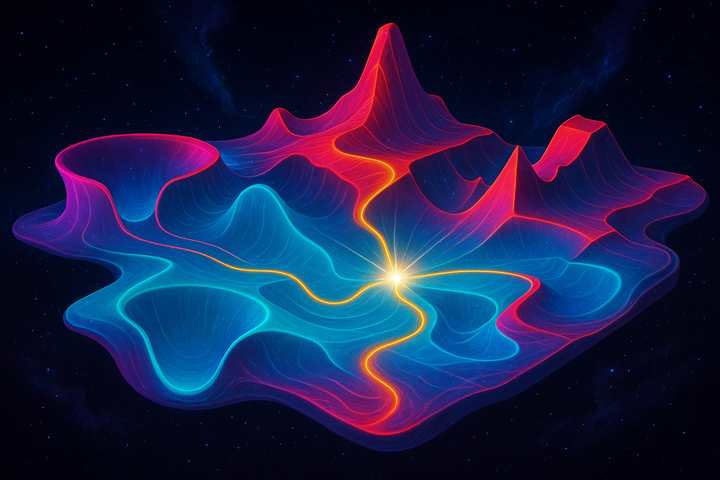
The landscape: Different ways of compactifying the extra dimensions give different physics. The number of possibilities is enormous—10^500 or more. This is the "landscape" of string theory, where our universe is one of countless possibilities.
No unique predictions: String theory hasn't produced clear, testable predictions that distinguish it from other theories. The landscape makes almost any outcome compatible with the framework.
Mathematical difficulty: String theory is fiendishly complex. Progress is slow because the calculations are hard.
String theory has ardent supporters and sharp critics. It might be the theory of everything. It might be a beautiful mathematical structure that doesn't describe our universe. We don't know yet.
Loop Quantum Gravity
Loop quantum gravity (LQG) takes a different approach. Instead of adding strings, it takes general relativity seriously and tries to quantize it directly.
In LQG, spacetime itself is quantized. At the smallest scales, space isn't continuous—it has a discrete structure. The "loops" are mathematical objects describing the quantum states of spatial geometry.
Key features:
Background independence: LQG doesn't assume a pre-existing spacetime in which physics happens. Spacetime geometry itself is a quantum variable. This is closer to general relativity's spirit than string theory (which often relies on background spacetimes).
Discrete spacetime: Space is made of tiny chunks with minimum possible volume. You can't subdivide space infinitely. The Planck scale is physically real.
Fewer dimensions: LQG works in 4 dimensions. No extra dimensions to hide.
Black hole entropy: LQG has had some success calculating black hole entropy, a key test case for any quantum gravity theory.
But LQG also has problems:
Recovering smooth spacetime: It's not entirely clear that LQG reproduces general relativity in the limit where quantum effects are small. The classical limit is harder to verify than you'd hope.
No matter: LQG describes quantum geometry. Adding matter (particles, forces) is less natural than in string theory, which includes matter automatically.
Few predictions: Like string theory, LQG hasn't produced unique, testable predictions that experiments could verify or falsify.
Other Approaches
String theory and LQG aren't the only games in town:
Causal Set Theory: Spacetime is fundamentally a discrete set of points with causal relationships. The continuum is an approximation. This approach is mathematically elegant but very early-stage.
Asymptotic Safety: Maybe gravity can be quantized using standard methods after all, if there's a fixed point in the renormalization flow. Research continues, with some encouraging signs.
Emergent Gravity: Maybe gravity isn't fundamental. Maybe it emerges from more primitive quantum information processes, the way temperature emerges from molecular motion. Erik Verlinde and others have explored this direction.
Twistor Theory: Roger Penrose's approach reformulates spacetime using different mathematical objects (twistors). It's produced insights but hasn't yielded a complete quantum gravity theory.
None of these are as developed as string theory or LQG, but they represent the creativity of the field.
The Experimental Problem
How do you test quantum gravity?
Direct experiments at the Planck scale are impossible with any conceivable technology. You'd need a particle accelerator the size of a galaxy.
But there might be indirect approaches:
Cosmology: The Big Bang approached Planck-scale conditions. Quantum gravity effects might leave imprints on the cosmic microwave background—subtle patterns in its fluctuations.
Black holes: Quantum gravity should determine what happens at black hole singularities and resolve the information paradox. Observations of black holes might reveal inconsistencies with classical predictions.
Gravitational waves: The merging of black holes might produce signatures of quantum spacetime effects if they exist at detectable levels.
Tabletop experiments: Some proposals suggest that quantum superpositions of massive objects might reveal gravitational quantum effects. These experiments are extremely difficult but not impossible in principle.
Violations of symmetries: Quantum gravity might subtly violate symmetries (like Lorentz invariance) that we can test at lower energies.
None of these have produced definitive quantum gravity evidence yet. The experimental program is in its infancy.
Why It Matters
Quantum gravity isn't just about Planck-scale physics that nobody will ever see.
Black hole physics: We don't understand what happens at black hole singularities or how information is preserved. Quantum gravity is essential.
The Big Bang: The origin of the universe is a quantum gravity event. Cosmological questions about the very early universe require it.
Unification: Physics has progressed by unifying apparently different phenomena. Electromagnetism unified electricity and magnetism. Quantum field theory unified quantum mechanics and special relativity. General relativity unified gravity and spacetime. Quantum gravity is the next unification—the final one at the level of known physics.
Foundational questions: What is spacetime made of? Is it fundamental or emergent? Is reality continuous or discrete at bottom? Quantum gravity addresses these deepest questions.
The State of the Field
Quantum gravity is one of the hardest problems in physics. Progress is slow. There's no consensus theory.
The field has been criticized for lack of empirical progress. Decades of work on string theory haven't produced testable predictions. LQG is similarly untested. Theoretical physics has arguably drifted from its experimental foundations.
But progress continues. New mathematical tools are developed. Connections between approaches are found (AdS/CFT, ER=EPR). Experimental techniques improve. The problem is so hard that patience is required.
The next breakthrough might come from an unexpected direction—a new mathematical framework, an unexpected experimental result, or an insight nobody has anticipated.
Or it might remain unsolved for generations. The Planck scale is very far from human experience.
What We're Waiting For
A complete theory of quantum gravity would tell us: - What spacetime is made of at the smallest scales - What happens at black hole singularities - What "before" the Big Bang means (if anything) - How gravity relates to other forces - Whether spacetime is fundamental or emergent
We might be close. We might be centuries away. We might be asking the wrong questions entirely.
The unfinished revolution continues.
Further Reading
- Rovelli, C. (2004). Quantum Gravity. Cambridge University Press. - Smolin, L. (2006). The Trouble with Physics. Houghton Mifflin. - Greene, B. (1999). The Elegant Universe. W.W. Norton. - Hossenfelder, S. (2018). Lost in Math. Basic Books.
This is Part 8 of the Spacetime Physics series. Next: "What We Know About Spacetime: A Synthesis."
Comments ()