Radians vs Degrees: Why Mathematicians Prefer Radians
360 degrees in a circle is a historical accident — probably from Babylonian astronomy. Radians are different: one radian is defined so that arc length equals radius. That definition makes the derivatives of sine and cosine work without ugly correction factors.
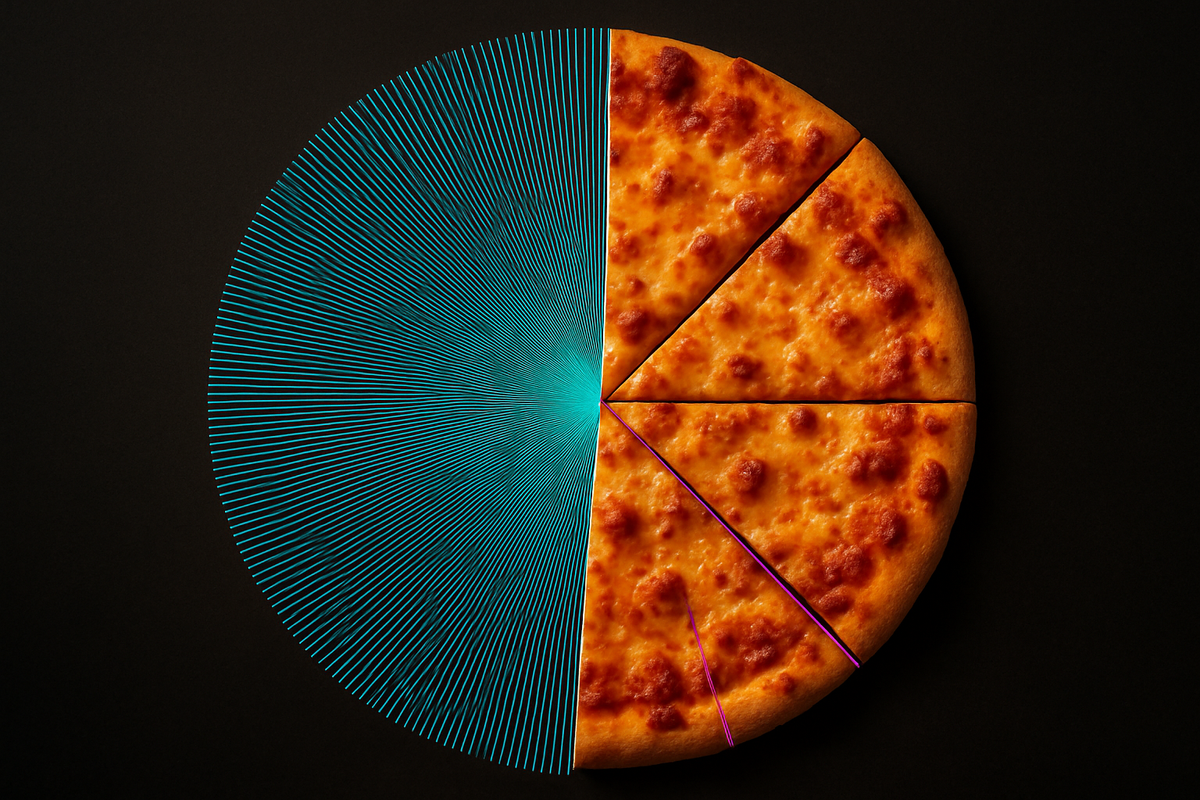
Degrees are arbitrary. Radians are natural.
Here's the unlock: one radian is the angle where the arc length equals the radius. That's not a convention — it's geometry. The radian measures angle in terms of the circle itself, not in terms of how Babylonians divided the sky.
This is why calculus only works cleanly in radians. When you write d/dx sin(x) = cos(x), that's only true when x is in radians. In degrees, you get an ugly constant factor. Nature speaks radians.
The Origin of Degrees
Ancient Babylonians used base-60 mathematics. A year is roughly 360 days. 360 is divisible by 2, 3, 4, 5, 6, 8, 9, 10, 12, 15, 18, 20, 24, 30, 36, 40, 45, 60, 72, 90, 120, 180.
So they divided the circle into 360 degrees. Convenient for mental math. Astronomically inspired.
But mathematically? Completely arbitrary.
The Definition of a Radian
Draw a circle of radius r. Start at one point on the edge. Walk along the circumference a distance equal to r.
The angle you've swept is one radian.
1 radian = the angle that subtends an arc length equal to the radius.
Since the circumference is 2πr, a full circle contains 2π radians.
360° = 2π radians
The Conversion
π radians = 180°
To convert:
- Degrees to radians: multiply by π/180
- Radians to degrees: multiply by 180/π
Examples:
- 90° = 90 × π/180 = π/2 radians
- 60° = 60 × π/180 = π/3 radians
- 45° = π/4 radians
- 30° = π/6 radians
Common Radian Values
| Degrees | Radians |
|---|---|
| 0° | 0 |
| 30° | π/6 |
| 45° | π/4 |
| 60° | π/3 |
| 90° | π/2 |
| 180° | π |
| 270° | 3π/2 |
| 360° | 2π |
Notice: all the "nice" angles involve simple fractions of π.
Why Radians Are Natural
Arc length formula: Arc length = radius × angle (in radians) s = rθ
In degrees, you'd need: s = (π/180) × r × θ_degrees
The extra factor disappears in radians because the radian is defined to make it disappear.
Radians and Calculus
The derivative of sin(x):
In radians: d/dx sin(x) = cos(x)
In degrees: d/dx sin(x°) = (π/180) cos(x°)
That π/180 contaminates every calculation. Chain rules multiply it. Integrals accumulate it.
In radians, the trig functions have clean derivatives. This isn't a choice — it's a mathematical fact. Radians are the units where the trigonometric functions behave naturally.
The Limit That Explains Everything
A key limit in calculus:
lim (x→0) sin(x)/x = 1 (when x is in radians)
In degrees: lim (x→0) sin(x°)/x = π/180 ≈ 0.0175
The clean limit only works in radians. This limit is the foundation of the derivative formula for sine.
Small Angle Approximation
When θ is small and in radians:
sin θ ≈ θ cos θ ≈ 1 tan θ ≈ θ
These approximations are crucial in physics and engineering. A pendulum with small swings has period T ≈ 2π√(L/g), derived using sin θ ≈ θ.
The approximations only work simply when θ is in radians.
Why Degrees Persist
Degrees are intuitive for everyday use:
- "Turn right 90 degrees" is clearer than "turn right π/2 radians"
- A 360° view is a complete circle
- Compass headings use degrees
Degrees are human-scale. Radians are math-scale.
Use degrees for communication. Use radians for calculation.
The Unit Circle in Both Systems
In degrees: Special angles are 0°, 30°, 45°, 60°, 90°, etc.
In radians: Special angles are 0, π/6, π/4, π/3, π/2, etc.
The same points, different labels. The radian labels reveal the fraction of π more directly.
Calculator Warning
Most calculators have a degree/radian mode.
Wrong mode = wrong answer.
sin(90) in degree mode = 1 sin(90) in radian mode ≈ 0.894
Always check your mode. Scientific and graphing calculators usually have a "DEG" or "RAD" indicator.
Other Angle Units
Gradians: 400 gradians = full circle. Used in some European surveying. A right angle is exactly 100 gradians.
Turns: 1 turn = full circle. Sometimes used in programming (turn = 2π radians).
But radians remain the mathematical standard because of their natural relationship to arc length and calculus.
Thinking in Radians
After practice, radians become intuitive:
- π is halfway around (a straight line)
- π/2 is a quarter turn (perpendicular)
- π/4 is an eighth turn (45°)
- 2π brings you back to start
The more calculus you do, the more natural radians feel. Eventually, you'll think of 180° as "about 3.14 radians" rather than the other way around.
The Core Insight
Radians measure angle in terms of the circle itself — arc length divided by radius.
Degrees measure angle in terms of an arbitrary division chosen by ancient astronomers.
Both work for measuring angles. But radians make calculus clean, arc length simple, and approximations elegant. They're not a convention — they're a discovery. This is how circles actually measure angle.
Use degrees for communication. Use radians for mathematics.
Part 10 of the Trigonometry series.
Previous: Trigonometric Identities: Why sin²θ + cos²θ = 1 Had to Be True Next: Waves and Oscillation: Why Sine Shows Up Everywhere
Comments ()