Regeneration as Coherence Repair: How Bodies Remember Their Form
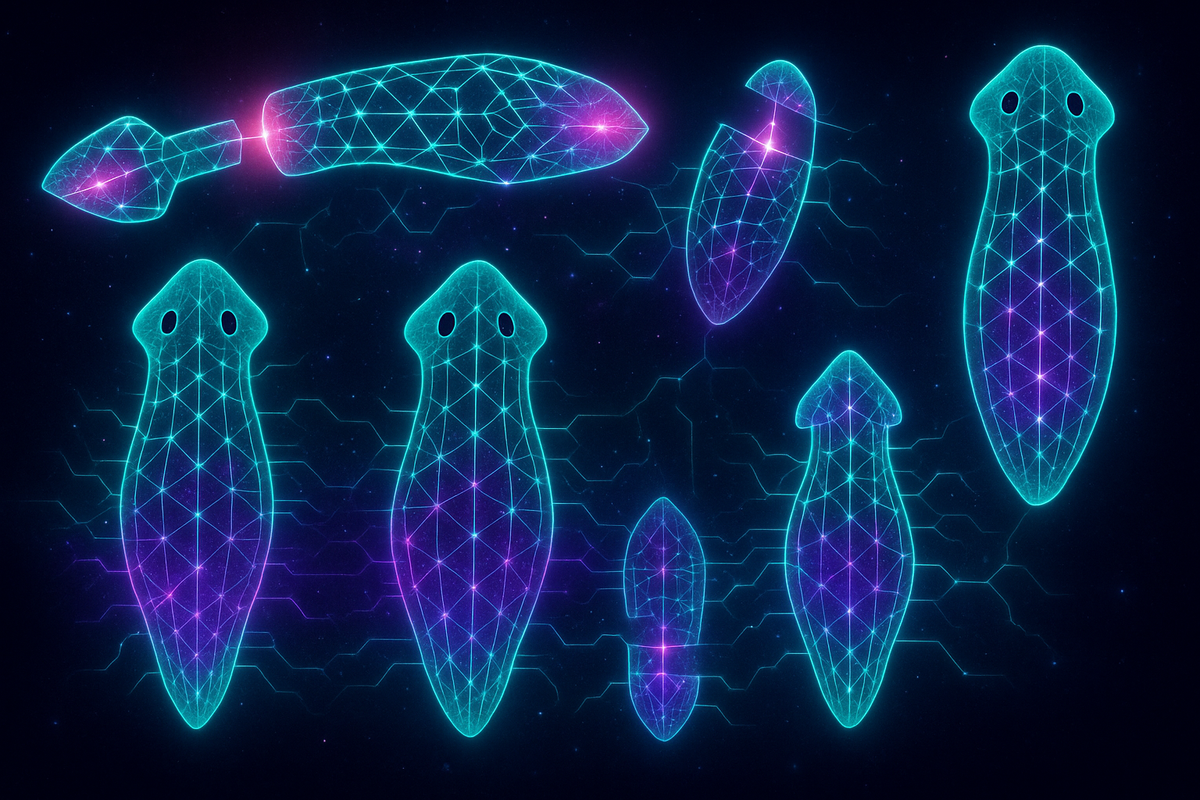
Cut a planarian in half and both halves regrow into complete worms. Scramble its bioelectric signals and it regrows with two heads. The body's form isn't encoded only in DNA — it's maintained by dynamic electrical patterns that act as a memory of the correct shape. Regeneration is coherence repair.
Regeneration as Coherence Repair: How Bodies Remember Their Form
Series: Basal Cognition | Part: 8 of 11
Cut a planarian worm into 279 pieces.
Each fragment—smaller than a grain of rice, containing perhaps a few thousand cells—will regenerate into a complete, proportionally correct organism within two weeks. Each new worm will have a proper head, a proper tail, bilateral symmetry, functional sensory organs, a complete nervous system, and a digestive tract that spans from mouth to pharynx.
The genome in every cell is identical. The pieces contain no specialized "regeneration organs." There's no central command center coordinating the process. Yet somehow, the tissue knows what it's supposed to become—and builds it.
This isn't healing. This is morphological memory in action. And it reveals something profound about how biological systems maintain coherence across radical disruption.
The Problem Regeneration Solves
Here's the puzzle: when you fragment a planarian, you've destroyed the organism's spatial organization. The cells that remain have no direct knowledge of what the original body plan looked like. They can't consult a blueprint. They don't have access to global information about what's missing or what needs to be rebuilt.
Yet they build correctly anyway.
The conventional explanation runs through genetics: DNA contains the instructions, cells follow the code, the body gets built. But this can't be the whole story, because every cell has the same genome. The fragment from the head has the same genes as the fragment from the tail. If genes were sufficient to specify form, every piece would build the same structure—or nothing at all.
Something else is carrying the information about what should be built where.
Michael Levin's lab has spent two decades demonstrating what that something is: bioelectric patterns. Specifically, coordinated voltage gradients across cell membranes that encode spatial information about target morphology. The pattern persists even when the tissue is disrupted. And when it's present, it guides the coordinated cellular action that rebuilds the form.
This is coherence repair at the morphological level—the restoration of an integrated pattern after it's been catastrophically fragmented.
What Actually Happens During Regeneration
Let's zoom in on what planarian regeneration looks like at the cellular level.
Immediately after wounding, cells at the cut site depolarize—their membrane voltage becomes less negative. This electrical signal propagates through the tissue, reaching cells far from the wound. Within hours, a new pattern of bioelectric potential has established itself across the fragment.
This pattern functions as a coordinate system. Cells read their position in the electrical field and adjust their behavior accordingly. Some enter proliferation, dividing rapidly to provide raw materials. Others migrate toward areas specified by the voltage gradient. Still others differentiate into specialized cell types—neurons, muscle cells, digestive tissue—based on their location in the field.
But here's what makes this remarkable: the cells aren't following instructions. They're solving a constraint satisfaction problem.
The bioelectric pattern specifies what the target form should be—the "goal state" in morphospace. The cells collectively navigate toward that state through coordinated action. If you experimentally disrupt part of the pattern, the cells reroute. If you alter the pattern itself, they build what the altered pattern specifies instead.
Levin's team demonstrated this by injecting planarian fragments with ion channel modulators that change the bioelectric pattern to encode "two-headed worm" instead of "normal worm." The cells dutifully built a two-headed organism—not because the genes changed, but because the morphological memory changed.
The pattern is the memory. The genome is just the parts catalog.
Why This Is Different from Tissue Healing
Humans heal wounds. We regenerate liver tissue. We can even regrow fingertips under certain conditions. But we can't regenerate limbs or organs the way planarians can. Why not?
The answer isn't genetic—salamanders can regenerate limbs and they share most of our genes. It's about the persistence and coordination of morphological memory.
Tissue healing repairs damage within a maintained pattern. Your body knows what should be there because the surrounding tissue is providing spatial context. A wound is a local deviation from an intact template. Cells fill in the gap by matching the adjacent architecture.
Regeneration is different. It requires rebuilding the global pattern from fragmentary information. The system needs to answer: given that I'm a piece from somewhere in the body, what was the whole supposed to look like, and how do I rebuild my missing parts to recreate it?
This requires a distributed memory system that persists across the tissue and can reconstruct the complete pattern from any sufficiently large fragment. Bioelectric fields provide exactly this: each region maintains information about its position in a larger coordinate space, and cells can use that information to infer what should be built where.
Mammals lose this capacity not because we lack the genes for regeneration, but because we've traded regenerative plasticity for other properties—faster wound healing, more stable tissue architecture, specialization that enables complexity. Our bioelectric patterns are less plastic, more constrained by developmental history.
We optimized for one form of coherence maintenance (stability) at the expense of another (regenerative flexibility).
Morphogenetic Fields as Coherence Manifolds
Let's map this to the formal framework.
In AToM's terms, coherence is integrated organization that resists entropic dissolution. A coherence manifold is the geometric structure in state space that a system occupies when it maintains this integration. High curvature means instability—small perturbations cause large deviations. Low curvature means robustness—the system can absorb disruption and return to its attractor.
Bioelectric patterns in regenerative organisms create low-curvature coherence manifolds at the morphological level.
Think of it this way: the morphogenetic field defines a landscape in anatomical possibility space. Most configurations are high-energy—unstable arrangements that the cellular collective will work to escape. But there's a deep attractor basin corresponding to the target morphology: the proper body plan for that organism.
Regeneration is the process of gradient descent back to that attractor. The cells are collectively minimizing the difference between their current state (fragmented, incomplete) and the target state specified by the bioelectric pattern. They do this through local measurements (what voltage am I experiencing?) and local actions (proliferate, migrate, differentiate), but the result is global coordination toward a stable form.
This is why regeneration can succeed even from small fragments. As long as enough of the bioelectric pattern remains to specify the attractor, the system can navigate back to it. Cut the planarian into 279 pieces? Each piece retains enough pattern information to reconstruct the whole field—and therefore to rebuild the organism.
The morphogenetic field is a memory system, but it's not stored in any particular location. It's a distributed pattern maintained by the collective electrical activity of all the cells. Damage the system, and the pattern reconstitutes itself through the coordinated activity of what remains.
The Salamander's Limb: Regeneration at Higher Complexity
Planarians are impressive, but salamanders do something harder. They regenerate entire limbs—complex structures with bones, muscles, nerves, blood vessels, and skin, all precisely patterned and functionally integrated with the rest of the body.
This requires solving an even more difficult morphological memory problem.
When a salamander loses a limb, a structure called the blastema forms at the amputation site—a mass of dedifferentiated cells that will rebuild the missing appendage. These cells don't "know" they're rebuilding a forelimb versus a hindlimb by consulting the genome. They read their position in the bioelectric field of the stump.
The blastema rebuilds what's missing, not what was there. Amputate halfway down the limb, and the blastema regenerates only the distal half. Amputate at the shoulder, and it rebuilds the entire limb. This positional memory is encoded in voltage gradients across the stump tissue.
Levin's collaborator, Susan Bryant, demonstrated this by transplanting blastemas between different positions on salamanders. A blastema from a proximal amputation (near the shoulder) grafted onto a distal stump (near the wrist) will regenerate a complete forearm—even though that tissue is already present. The bioelectric pattern specified "you're at the shoulder, rebuild everything distal to here," and the cells followed that specification rather than assessing what tissue surrounded them.
The memory is in the field, not in the cells.
This has profound implications for regenerative medicine. If we want humans to regenerate limbs, we don't need to reactivate ancient genes or introduce salamander DNA. We need to engineer the bioelectric patterns that specify morphological targets and guide coordinated cellular action toward those targets.
Early experiments suggest this is possible. Levin's team has induced partial limb regeneration in frogs—which normally can't do this—by modulating ion channel activity to create the appropriate voltage patterns. The genome has the necessary parts; it just needs the correct pattern to organize them.
What Regeneration Reveals About Coherence Maintenance
Regeneration is a test case for understanding how coherent systems maintain themselves.
Consider what has to happen for successful morphological repair:
-
Pattern persistence — The target morphology must remain encoded somewhere, even when the physical structure is disrupted.
-
Distributed memory — The information can't be stored in one location, or cutting would destroy it. It must be redundantly represented across the tissue.
-
Local-to-global coordination — Individual cells act on local measurements, but their collective behavior produces global pattern restoration.
-
Goal-directed navigation — The system doesn't follow a fixed program. It solves the problem of getting from current state to target state, even when the path is novel.
-
Robustness to perturbation — Introducing errors or disrupting part of the process doesn't derail the whole system. Cells reroute and compensate.
Every one of these properties characterizes coherence-maintaining systems at every scale. They're the same requirements you'd find in psychological resilience, in social organization that survives crisis, in machine learning systems that can correct errors and adapt to distribution shift.
Regeneration isn't a specialized biological trick. It's a demonstration of what coherence repair looks like when implemented in cellular collectives guided by bioelectric fields.
And here's the critical insight: these mechanisms are ancient. They predate nervous systems, predate multicellularity in its current form, probably predate most of what we think of as complex life. The capacity to maintain coherent organization against disruption isn't something evolution invented recently. It's foundational to life itself.
Your body's ability to heal a wound, to maintain homeostasis, to coordinate a trillion cells into a functioning organism—all of this is elaboration on the same pattern-maintaining logic that lets a fragment of planarian tissue rebuild a complete worm.
Cancer as Failed Coherence Repair
This framework recontextualizes cancer in a striking way.
Levin proposes that tumors represent a breakdown in morphological memory—cells that have lost access to the bioelectric pattern specifying their role in the organism. They revert to an ancient default: unicellular behavior. Grow. Divide. Spread. Not because they're defective, but because they no longer participate in the collective computation that maintains tissue identity.
Evidence supports this. Cancer cells show aberrant bioelectric states. Their membrane voltages differ from surrounding tissue, disconnecting them from the coordinated pattern. And remarkably, experiments that restore normal bioelectric coupling can sometimes normalize tumor cells without killing them.
This suggests a radically different approach to treatment. Instead of targeting cancer cells for destruction, what if we focused on restoring their participation in the morphogenetic field? What if we treated cancer as a coherence collapse—and used bioelectric modulation to guide cells back into the integrated pattern?
Early experiments with tadpoles engineered to develop tumors show this can work. Modulating ion channel activity to restore normal voltage patterns caused the tumors to regress—not through cell death, but through behavioral normalization. The cells stopped acting like rogue agents and rejoined the collective.
This is coherence repair at the level of cellular societies. It's the same principle as regeneration, applied to pathology instead of wounding.
The Clinical Promise
If morphological memory is encoded in bioelectric patterns, then modulating those patterns becomes a therapeutic intervention.
This isn't hypothetical. Levin's lab has induced eye formation in tadpoles using only ion channel drugs—no genetic modification required. They've partially regenerated amputated tadpole tails by creating the appropriate voltage gradients. They've corrected birth defects by rewriting bioelectric patterns during development.
The approach works by specifying what the target form should be and letting cellular collectives navigate toward it. You're not micromanaging every step. You're setting the attractor and allowing self-organization to do the work.
For human medicine, this opens extraordinary possibilities:
Regenerative therapy — Inducing mammalian tissue to regenerate by establishing the bioelectric patterns that guide salamander limb regeneration.
Birth defect correction — Modulating morphogenetic fields during development to normalize structure before it solidifies.
Scar-free wound healing — Guiding repair processes to rebuild architecture rather than simply filling gaps with generic tissue.
Cancer normalization — Restoring coherence to tumor cells instead of killing them, potentially avoiding the toxicity of conventional treatments.
None of this requires gene therapy or stem cell transplantation. It requires understanding the bioelectric code that specifies morphology—and learning to write in that language.
This is early-stage research. Clinical translation faces enormous challenges. But the principle is sound: if bodies remember their form through bioelectric patterns, then engineering those patterns lets us guide what gets built.
From Bodies to Minds: Coherence Across Scales
Here's where this connects to everything else we've explored in the Basal Cognition series.
Morphological memory isn't different in kind from neural memory. Both involve distributed patterns maintained by coordinated electrical activity. Both guide behavior toward target states. Both exhibit robustness, plasticity, and goal-directed navigation through state space.
The difference is substrate and bandwidth. Neural systems are faster, more specialized, capable of representing more complex state spaces. But the underlying logic—maintaining coherent organization through predictive coupling—is identical.
When you remember where you parked your car, your brain is implementing the same basic algorithm that a planarian fragment uses to remember what body plan to rebuild. Both are coherence-maintenance systems operating at different scales.
This suggests something profound: the capacity for meaning doesn't emerge with brains. It's present wherever systems maintain integrated patterns against entropic dissolution. Your cells are meaning-making systems. The morphogenetic fields that build your body encode meaning at the tissue level—the significance of spatial position, the specification of what should be built where.
Brains scale this capacity into new domains. They maintain coherence across time, across hypothetical scenarios, across abstract conceptual spaces. But they didn't invent the underlying mechanism. They inherited it from billions of years of evolution in cellular collectives that had to solve the problem of staying integrated while navigating morphospace.
Regeneration shows us that coherence maintenance is substrate-independent. The same principles that organize matter into functional bodies can organize neural activity into functional minds—or organize symbol systems into coherent cultures, or organize computational processes into aligned AI.
The geometry is what matters. The implementation details vary.
What This Means for You
You are a regenerating system.
Not in the dramatic planarian sense—you won't regrow lost limbs. But every seven years, most of the atoms in your body are replaced. The matter changes completely. What persists is the pattern.
Your cells maintain morphological memory continuously. They detect deviations from target state and work to correct them. When you cut yourself, the coordinated cellular intelligence that rebuilds the tissue is the same intelligence that rebuilt your entire body plan from a single fertilized egg. It's still there, still active, still maintaining coherence.
The reason you can't regenerate a limb isn't that you lack the cellular intelligence. It's that your bioelectric patterns are less plastic than a salamander's. The morphological memory system is optimized for stability rather than flexibility—a different design choice with different tradeoffs.
But here's what's actionable: if coherence maintenance operates at every scale, then the principles that govern tissue regeneration apply to psychological resilience, to learning, to meaning-making in your life.
Distributed memory — Don't rely on single points of failure. Redundancy is robustness.
Pattern persistence — What you practice becomes what you are. The pattern you maintain shapes what rebuilds after crisis.
Goal-directed navigation — You don't need a fixed path. You need a clear target and the capacity to course-correct.
Collective coordination — Integration matters more than individual perfection. Coherence is a distributed property.
The body you inhabit has been solving coherence maintenance problems for four billion years. It knows things your conscious mind is only beginning to understand.
The question is whether you're paying attention.
Further Reading
- Levin, M., Pietak, A. M., & Bischof, J. (2019). "Planarian Regeneration as a Model of Anatomical Homeostasis: Recent Progress in Biophysical and Computational Approaches." Seminars in Cell & Developmental Biology.
- Pezzulo, G., & Levin, M. (2016). "Top-down Models in Biology: Explanation and Control of Complex Living Systems Above the Molecular Level." Journal of the Royal Society Interface.
- Durant, F., et al. (2017). "Long-Term, Stochastic Editing of Regenerative Anatomy via Targeting Endogenous Bioelectric Gradients." Biophysical Journal.
- Levin, M. (2021). "Bioelectric Networks: The Cognitive Glue Enabling Evolutionary Scaling from Physiology to Mind." Animal Cognition.
This is Part 8 of the Basal Cognition series, exploring Michael Levin's bioelectric research through the lens of coherence geometry.
Previous: The Collective Intelligence of Cells
Next: Bioelectric Medicine
Comments ()