Related Rates: How Changes Propagate Through Systems
A ladder slides down a wall. As the base moves outward, the top drops — but not at the same speed. Related rates problems capture these coupled changes using the chain rule, turning geometric or physical constraints into precise equations about rates.
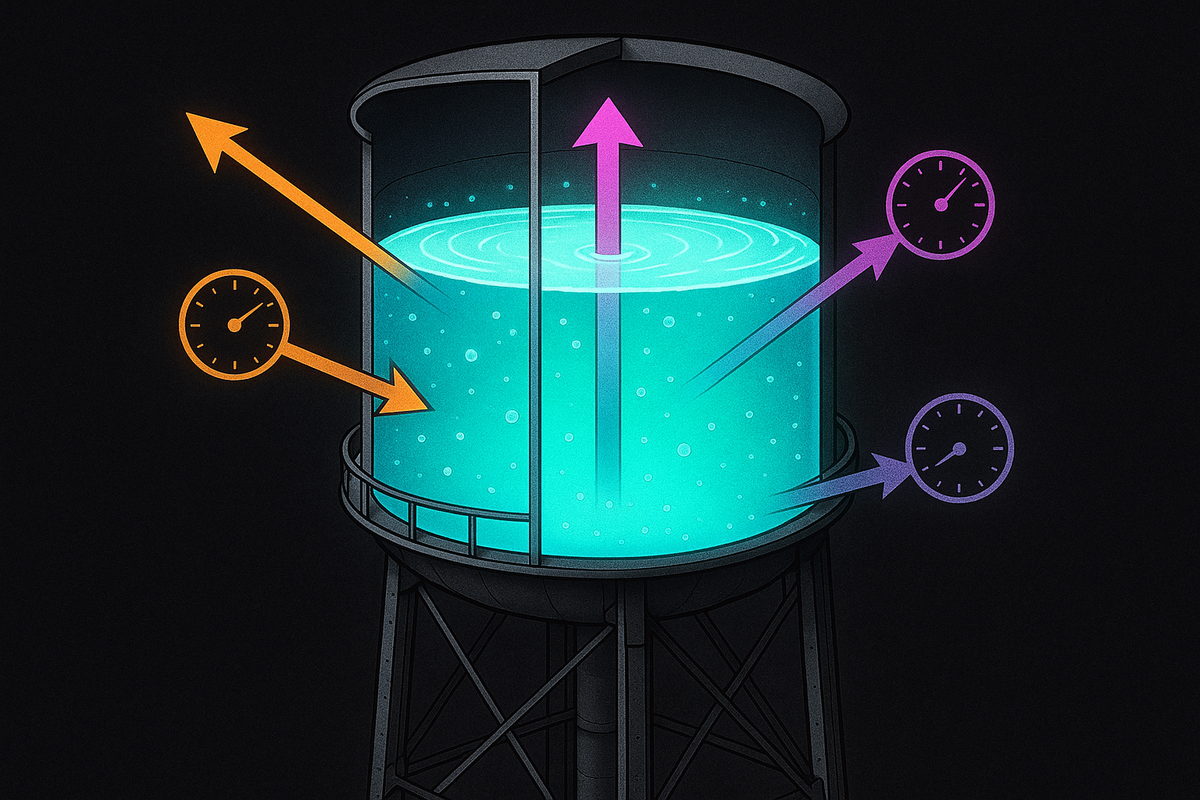
When one quantity changes, others connected to it change too.
A balloon inflates. As the radius grows, the volume grows faster. A ladder slides. As the base moves out, the top slides down. A shadow lengthens. As you walk, your shadow stretches.
Here's the unlock: related rates are implicit differentiation with time. Write an equation relating the quantities. Differentiate with respect to time. Every variable gets a d/dt. Plug in what you know, solve for what you need.
Changes propagate through equations. Calculus tracks how.
The Setup
- Draw a picture and label all quantities with variables
- Write an equation relating the quantities
- Differentiate with respect to time t (implicit differentiation)
- Substitute known values and known rates
- Solve for the unknown rate
The key: rates of change become derivatives with respect to time.
Example: Expanding Balloon
A spherical balloon is inflated at 50 cm³/s. How fast is the radius increasing when the radius is 10 cm?
Variables: V = volume, r = radius Given: dV/dt = 50 cm³/s, r = 10 cm Find: dr/dt when r = 10
Equation: V = (4/3)πr³
Differentiate with respect to t:
dV/dt = (4/3)π · 3r² · dr/dt = 4πr² · dr/dt
Substitute dV/dt = 50 and r = 10:
50 = 4π(10)² · dr/dt 50 = 400π · dr/dt dr/dt = 50/(400π) = 1/(8π) ≈ 0.04 cm/s
The radius is increasing at about 0.04 cm/s.
Example: Sliding Ladder
A 10-foot ladder leans against a wall. The base slides away from the wall at 2 ft/s. How fast is the top sliding down when the base is 6 feet from the wall?
Variables: x = distance from wall to base, y = height of top Given: dx/dt = 2 ft/s, x = 6 ft, ladder = 10 ft Find: dy/dt
Equation: x² + y² = 100 (Pythagorean theorem)
When x = 6: y² = 100 - 36 = 64, so y = 8 ft
Differentiate:
2x · dx/dt + 2y · dy/dt = 0
Substitute:
2(6)(2) + 2(8) · dy/dt = 0 24 + 16 · dy/dt = 0 dy/dt = -24/16 = -1.5 ft/s
The top is sliding down at 1.5 ft/s. (Negative because y is decreasing.)
Example: Growing Shadow
A 6-foot person walks away from a 15-foot lamp post at 4 ft/s. How fast is their shadow lengthening?
Variables: x = distance from lamp post, s = shadow length Given: dx/dt = 4 ft/s Find: ds/dt
Set up similar triangles:
The lamp, the person, and the shadow tips form similar triangles.
15/6 = (x + s)/s
Cross multiply: 15s = 6(x + s) = 6x + 6s 9s = 6x s = (2/3)x
Differentiate:
ds/dt = (2/3) · dx/dt = (2/3)(4) = 8/3 ft/s
The shadow lengthens at 8/3 ≈ 2.67 ft/s.
(Note: this rate is constant — it doesn't depend on x!)
Example: Filling a Cone
Water fills a cone-shaped tank (point down) at 2 m³/min. The tank has height 10 m and top radius 4 m. How fast is the water level rising when the water is 5 m deep?
Variables: V = volume, h = water height, r = water radius Given: dV/dt = 2 m³/min, h = 5 m Find: dh/dt
Relationship between r and h: By similar triangles, r/h = 4/10, so r = 2h/5.
Volume formula: V = (1/3)πr²h = (1/3)π(2h/5)²h = (4π/75)h³
Differentiate:
dV/dt = (4π/75) · 3h² · dh/dt = (4πh²/25) · dh/dt
Substitute dV/dt = 2, h = 5:
2 = (4π(25)/25) · dh/dt = 4π · dh/dt dh/dt = 2/(4π) = 1/(2π) ≈ 0.16 m/min
Common Types
Geometric: Ladders, shadows, balloons, tanks, moving objects Distance: Two objects moving, finding how fast the distance between them changes Angles: Rotating objects, searchlights, angle of elevation problems
Distance Problems
Two cars leave an intersection. Car A goes north at 30 mph, Car B goes east at 40 mph. How fast is the distance between them increasing after 2 hours?
Variables: a = A's distance, b = B's distance, d = distance between Given: da/dt = 30 mph, db/dt = 40 mph, t = 2 hours Find: dd/dt
At t = 2: a = 60 mi, b = 80 mi
Equation: d² = a² + b² (Pythagorean theorem)
d = √(60² + 80²) = √(3600 + 6400) = √10000 = 100 mi
Differentiate:
2d · dd/dt = 2a · da/dt + 2b · db/dt
Substitute:
2(100) · dd/dt = 2(60)(30) + 2(80)(40) 200 · dd/dt = 3600 + 6400 = 10000 dd/dt = 50 mph
Strategy Tips
Choose variables carefully: Name everything that changes.
Find the right equation: It should relate the variables (not their rates).
Don't substitute values too early: Substitute after differentiating, not before.
Watch signs: Rates can be positive (increasing) or negative (decreasing).
Check units: If you're getting m/s, make sure everything was in meters and seconds.
Why "Related"?
The quantities are related by an equation.
The rates of change are related by the derivative of that equation.
If you know how some quantities change, you can determine how the others must change to maintain the relationship.
The Core Insight
Related rates problems are implicit differentiation with time as the hidden variable.
Write an equation relating your quantities. Differentiate everything with respect to t. Each variable becomes a rate: x becomes dx/dt, y becomes dy/dt.
Then it's algebra: substitute what you know, solve for what you don't.
The underlying principle is that equations must remain true as quantities change. The derivative of that truth tells you how the rates relate.
Part 8 of the Calculus Derivatives series.
Previous: Implicit Differentiation: When y Hides Inside the Equation Next: The Derivative of eˣ: The Function That Is Its Own Rate of Change
Comments ()