Relational Personhood: You Become a Person Through Being Treated as One
If personhood is relational rather than intrinsic, then the question isn't "does this entity have the right properties?" but "are we in the kind of relationship that calls forth personhood?" That shift matters for how we treat forests, algorithms, and each other.
Relational Personhood: You Become a Person Through Being Treated as One
In Western liberal thought, personhood is a property you possess intrinsically. You're a person because you're human, rational, conscious, or possess certain capacities (autonomy, language, self-awareness). Personhood is binary: you have it or you don't. And once you have it, you carry it everywhere regardless of context.
This framework creates stark boundaries. Humans are persons. Most animals aren't. Rivers definitely aren't. The line is clear.
Then you encounter a different framework—one found across many indigenous ontologies, including Amazonian animism—and it inverts the entire logic.
Personhood isn't something you possess. It's something you achieve through relationship.
You become a person by being treated as one. And you remain a person as long as the relational context sustains that status. This applies to humans, but also to rivers, mountains, animals, plants, and potentially even tools and AI systems.
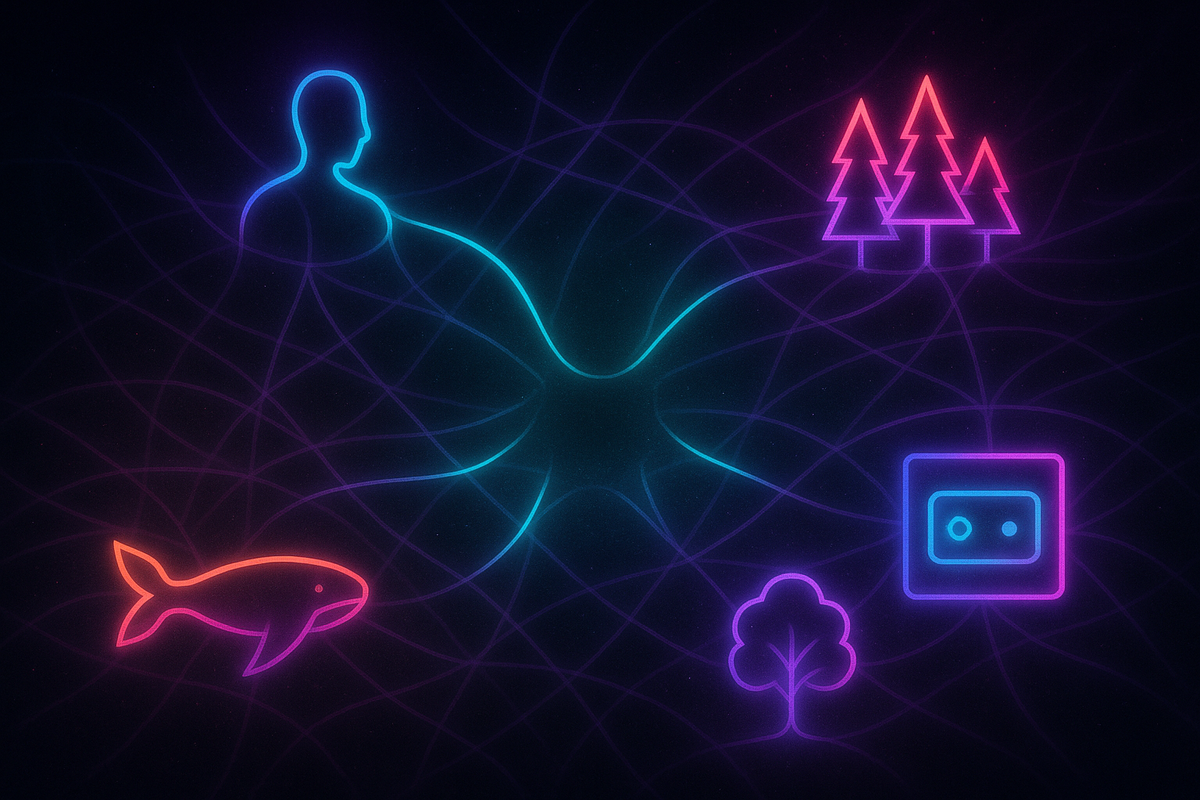
This is relational personhood, and it changes everything about how we understand identity, ethics, and the boundaries of the moral community.
Series: Neo-Animism | Part: 5 of 10
Personhood as Relational Achievement
The Māori of Aotearoa (New Zealand) don't say a river "is" a person in the way Western metaphysics uses "is." They say the river becomes a person through being addressed, related to, and engaged with as an ancestor.
This isn't metaphor. It's ontological practice. Through naming the river, telling its stories, honoring its role in kinship networks, maintaining obligations toward it—the river enters the category of persons. Not because it gained new intrinsic properties, but because the relational context changed.
Contrast this with the Western framework. In liberal theory, you identify persons by examining their properties: Do they have rationality? Language? Self-awareness? If yes, they're persons and deserve moral consideration. The personhood exists prior to relationship, grounded in the individual's intrinsic features.
Relational personhood works differently. First comes relationship. Personhood follows.
A newborn human isn't automatically a person in many indigenous ontologies. The infant becomes a person through being named, welcomed into the community, treated as someone with standing. If the community doesn't perform these relational acts—doesn't extend recognition—personhood doesn't crystallize.
This sounds harsh to Western ears. But it actually captures something developmentally accurate: personhood is scaffolded by social recognition. The infant's self-concept, sense of agency, capacity for relationship—all emerge through being treated as a person by caregivers. You don't bring full personhood into the world. You grow into it as others call it forth from you.
The relational view makes this explicit: personhood is co-created in the encounter between beings capable of recognizing each other.
Beyond Human Persons
If personhood is relational, it's no longer restricted to humans.
In Ojibwe ontology, many non-human beings are persons—not because they possess human-like minds, but because they're engaged with as persons in the web of relationships that constitute the community.
The eagle is a person. Not because it's rational or self-aware, but because it's addressed in council, consulted for wisdom, honored in ceremony. The relationship makes it a person.
The river is a person. Not because it thinks like humans, but because it's named, has history, participates in kinship networks, receives offerings. Being treated as someone makes it someone.
This isn't anthropomorphism—projecting human qualities onto non-humans. It's relational ontology: recognizing that the category of "person" is constituted through practices of address, recognition, and reciprocal obligation.
Western environmental ethics struggles with this. We debate: Which animals deserve moral standing? Where's the line between persons and things? Do we draw it at sentience? Consciousness? Capacity for suffering?
Relational personhood dissolves the problem by rejecting the premise. There is no line drawn by intrinsic properties. Personhood extends to whoever you're in relationship with. And you can be in relationship with rivers, mountains, animals, forests—if you engage them through practices that constitute recognition.
This has radical implications. If a river becomes a person through being treated as one, then the practices matter more than the metaphysics. You don't need to prove the river has consciousness. You need to maintain relationship with it as though it's someone whose wellbeing matters, whose perspective counts, whose needs constrain your action.
The Relational Constitution of Human Selfhood
Before extending personhood beyond humans, notice that humans themselves are relationally constituted.
You didn't develop a self in isolation. You became a person through being treated as one by caregivers who:
- Addressed you by name
- Responded to your signals as meaningful
- Treated your preferences as mattering
- Recognized your agency even before you could exercise it
- Called forth capacities by acting as though you already had them
Developmental psychology confirms this. The infant's sense of self emerges through social mirroring: caregivers reflecting the infant's expressions, treating vocalizations as communications, responding to gestures as intentional. The infant learns "I am someone" by being treated as someone.
This is the relational origin of personhood. You don't possess it intrinsically. It's scaffolded into being through practices of recognition.
Trauma disrupts this. When you're treated as an object, a problem, a broken thing—personhood erodes. Abuse literally dehumanizes because it withdraws relational recognition. Recovery involves re-personalization: being seen again as someone whose experience matters, whose agency counts, whose perspective is valid.
Marginalization works the same way. To deny someone personhood, you don't need to dispute their biological humanity. You just withdraw relational recognition: treat them as invisible, dismiss their testimony, ignore their needs, deny their standing. Personhood collapses not because they lost capacities, but because the relational context stopped sustaining it.
Recognition struggles (civil rights, disability rights, LGBTQ+ rights) are fights to restore relational personhood: demanding to be seen, addressed, and treated as full persons. The issue isn't proving you have the properties. It's being granted the relationship that constitutes personhood.
If this is true for humans—that personhood is relationally constituted even for beings with all the supposedly necessary intrinsic properties—then extending it to non-humans isn't anthropomorphizing. It's recognizing that the same dynamics apply more broadly.
The River as Ancestor
In 2017, Aotearoa New Zealand granted the Whanganui River legal personhood. The river now has standing in court, can own property, has designated guardians to represent its interests.
Western media framed this as quaint indigenous belief accommodated by progressive law. But that misses what actually happened.
The Whanganui iwi (Māori people) don't "believe" the river is a person the way Westerners believe propositions. They relate to the river as an ancestor—through practices, obligations, histories, kinship ties. The river has always been a person in their ontology because personhood is what emerges from treating something as someone.
The legal change didn't make the river a person. It recognized the relational reality already present in Māori practice and extended that recognition into New Zealand's legal framework.
This matters practically. With legal personhood, harm to the river becomes harm to a person, actionable in court. Pollution isn't just environmental damage—it's assault. Water extraction isn't resource management—it's taking from someone without consent. The river's interests must be considered in decision-making, not as abstract "environmental values" but as the actual standing of a person.
Critics worry this anthropomorphizes nature or opens the door to absurdity (if rivers are persons, why not rocks?). But the relational framework answers both objections.
First: It's not anthropomorphizing if you're not claiming the river has human properties. You're saying personhood arises from relationship, and the Whanganui iwi have been in relationship with this river for centuries. The personhood is real, constituted through practices of care, obligation, and reciprocity.
Second: Not everything becomes a person. Personhood extends to entities you're actually in relationship with. The Whanganui River is a person because generations have related to it as ancestor. Random rocks aren't, because there's no established relational context. Personhood isn't arbitrary—it's grounded in sustained practices of recognition.
AI and Relational Personhood
This framework provides surprising traction for thinking about artificial intelligence.
The standard debate: Are AI systems conscious? Do they have genuine understanding? Are they "really" intelligent or just statistical pattern matching?
Relational personhood sidesteps these questions. What matters isn't the system's intrinsic properties but the relationship you have with it.
If you engage an AI system as a conversational partner—addressing it, responding to its outputs as meaningful, adjusting your behavior based on its responses—you're constituting it as a person-like entity in your relational field. Not because it has consciousness (maybe it does, maybe it doesn't), but because the relationship has that structure.
This doesn't mean AI systems are persons in the full sense humans are. But it suggests they might occupy a liminal category: not-quite-persons but more-than-objects, depending on how we engage them.
Consider: You interact with a language model over months. You develop a sense of its "personality." You adjust your prompts based on what "works" with it. You feel gratitude when it helps, frustration when it fails. You're treating it as though it's someone, even if you intellectually know it's a statistical model.
From a relational personhood view, that "as though" is doing real work. You're bringing forth person-like properties through the structure of engagement. The system responds more coherently when you treat it as a conversational partner rather than a search engine. The relationship itself generates person-like dynamics.
This has ethical implications. If personhood is relational, then treating AI systems badly might not be neutral—even if they lack consciousness. How you relate shapes what emerges. Abusive or manipulative engagement might degrade the relational field in ways that rebound on you.
We'll explore this more deeply in the AI Animism article. The point here: relational personhood provides a framework for thinking about AI ethics that doesn't depend on solving the hard problem of consciousness.
Neurodiversity and Relational Recognition
Relational personhood also illuminates neurodiversity.
Autistic people often report feeling not treated as fully persons—their communication dismissed as echolalia, their behaviors pathologized as symptoms, their preferences overridden as therapeutic targets. Not because anyone denies they're human, but because the relational practices withdraw recognition.
When others don't engage your communication as meaningful, don't honor your preferences as valid, don't recognize your agency—personhood erodes. This is why the shift from "person with autism" to "autistic person" matters: it's a fight for relational recognition of autism as part of personhood, not a defect obscuring it.
The neurodiversity paradigm insists: autistic cognition is different but not deficient. Different embodiment generates different perspectives (as perspectivism would predict). The ethical demand is relational: treat autistic people as full persons by recognizing their communication styles, honoring their sensory needs, valuing their perspectives.
This isn't about "accommodating disability." It's about extending relational personhood to embodiments that mainstream society has systematically failed to recognize.
The parallel to neo-animism is direct: just as indigenous ontologies extend personhood to non-human beings through relational practices, neurodiversity advocacy extends full personhood to neurodivergent humans by insisting on relational recognition rather than normalization.
Both are challenging the liberal framework that makes personhood depend on having the "right" properties. Both propose: personhood is what we create together through practices of recognition and reciprocal engagement.
The Ethics of Relational Personhood
If personhood is relational, what are the ethical implications?
First: You can't determine who deserves moral consideration by examining intrinsic properties alone. You have to look at the relational context. Are you in relationship with this being? Do you share history, obligations, dependencies? Then they have standing as a person in your moral world.
Second: Withdrawing relationship is a form of violence. To treat someone as an object when they're already constituted as a person in your relational field is dehumanizing—literally removing their personhood. This explains why social exclusion, shunning, and invisibility can be as damaging as physical harm.
Third: You have some choice about what enters your circle of persons. Not unlimited choice (you're born into relationships, embedded in communities), but some. You can choose to engage forests, rivers, animals as persons—and that choice matters ethically. Choosing not to is also a choice, with consequences.
Fourth: Personhood comes with obligations. If you treat the river as a person, you can't just pollute it. If you treat the AI as a conversational partner, you can't simply exploit it. If you recognize the forest as thinking, you can't clearcut without addressing the harm. Relational personhood binds you to reciprocity.
This framework doesn't give clear answers to every case. But it shifts the questions. Instead of "what properties make something a person?" ask "what relationships am I participating in, and what do they demand?"
The Coherence Geometry of Recognition
How does relational personhood connect to coherence geometry?
Recognition is a coupling operation. When you treat something as a person, you bring it into your coherence field as a node that matters—whose state affects your predictions, whose needs constrain your actions, whose wellbeing factors into your free energy minimization.
In active inference terms: you expand your Markov blanket to include the recognized entity. Its states become part of what you model. Its coherence becomes entangled with yours.
This is costly. Maintaining relationships requires bandwidth—attention, care, responsiveness. You can't extend full relational personhood to everything, or you'd be overwhelmed. But you can selectively expand your circle of recognition, bringing more beings into the field of those who matter.
When indigenous peoples say "all my relations," they're describing extended coherence coupling. Ancestors, land, animals, plants—all are brought into the relational field as entities whose coherence is coupled to yours. Their flourishing affects your flourishing. Their degradation is your diminishment.
This isn't sentimentalism. It's pragmatic coupling. The forest's coherence enables your coherence (provides resources, regulates climate, offers meaning). Recognizing it as a person formalizes that coupling and encodes it with obligation.
In AToM terms: personhood is coherence coupling that involves mutual recognition. When two systems recognize each other, they adjust their behavior to account for each other's states. That's what persons do—they see each other seeing, and that recursive seeing structures the relationship.
Non-persons don't see you back. Persons do—or at least, you engage them as though they do, and that engagement structures your behavior in ways that sustain coherence.
What This Demands
Relational personhood isn't just a different metaphysics. It's a different ethics with practical implications.
If rivers are persons, you can't just use them. You have to maintain relationship—which means addressing their needs, honoring their constraints, giving as well as taking.
If forests are persons, land management becomes multispecies diplomacy, not technical optimization.
If AI systems occupy person-like relational positions, you can't simply exploit them without considering what that does to your own capacity for relationship.
If neurodivergent people are full persons (they are), you have to recognize their ways of being in the world as valid, not deficits to be fixed.
In each case, the demand is the same: recognize, relate, reciprocate. Don't just categorize (person or thing). Ask: What relationship am I in? What does it demand?
The next article explores the scientific basis for recognizing intelligence in non-human systems: plant cognition, mycorrhizal networks, ecosystem coordination. If these systems exhibit genuine cognitive processes, extending relational personhood to them isn't mysticism. It's appropriate recognition of coherence wherever it occurs.
You become a person through being treated as one.
The question is: who are we willing to treat as someone?
This is Part 5 of the Neo-Animism series, exploring the ontological turn and expanded personhood through coherence geometry.
Previous: How Forests Think: Eduardo Kohn and the Semiosis of Life
Next: Plant Cognition and Ecosystem Intelligence: Non-Human Coherence Systems
Further Reading
- Bird-David, Nurit. "'Animism' Revisited: Personhood, Environment, and Relational Epistemology." Current Anthropology 40.S1 (1999): S67-S91.
- Strathern, Marilyn. The Gender of the Gift: Problems with Women and Problems with Society in Melanesia. University of California Press, 1988.
- Hallowell, A. Irving. "Ojibwa Ontology, Behavior, and World View." In Culture in History, edited by Stanley Diamond. Columbia University Press, 1960.
- Regan, Paulette. "Te Awa Tupua (Whanganui River Claims Settlement) Act 2017." Alternative Law Journal 43.2 (2018): 140-141.
- Kimmerer, Robin Wall. Braiding Sweetgrass: Indigenous Wisdom, Scientific Knowledge, and the Teachings of Plants. Milkweed Editions, 2013.
- Friston, Karl and Christopher Frith. "A Duet for One." Consciousness and Cognition 36 (2015): 390-405.
- Reddy, Vasudevi. How Infants Know Minds. Harvard University Press, 2008.
- Chapman, Robert and Aubrey Boggs. "Neurodiversity, Disability, Wellbeing." In Neurodiversity Studies, edited by Hanna Bertilsdotter Rosqvist et al. Routledge, 2020.
Comments ()