Relationship Anxiety: What Your Nervous System Is Actually Doing
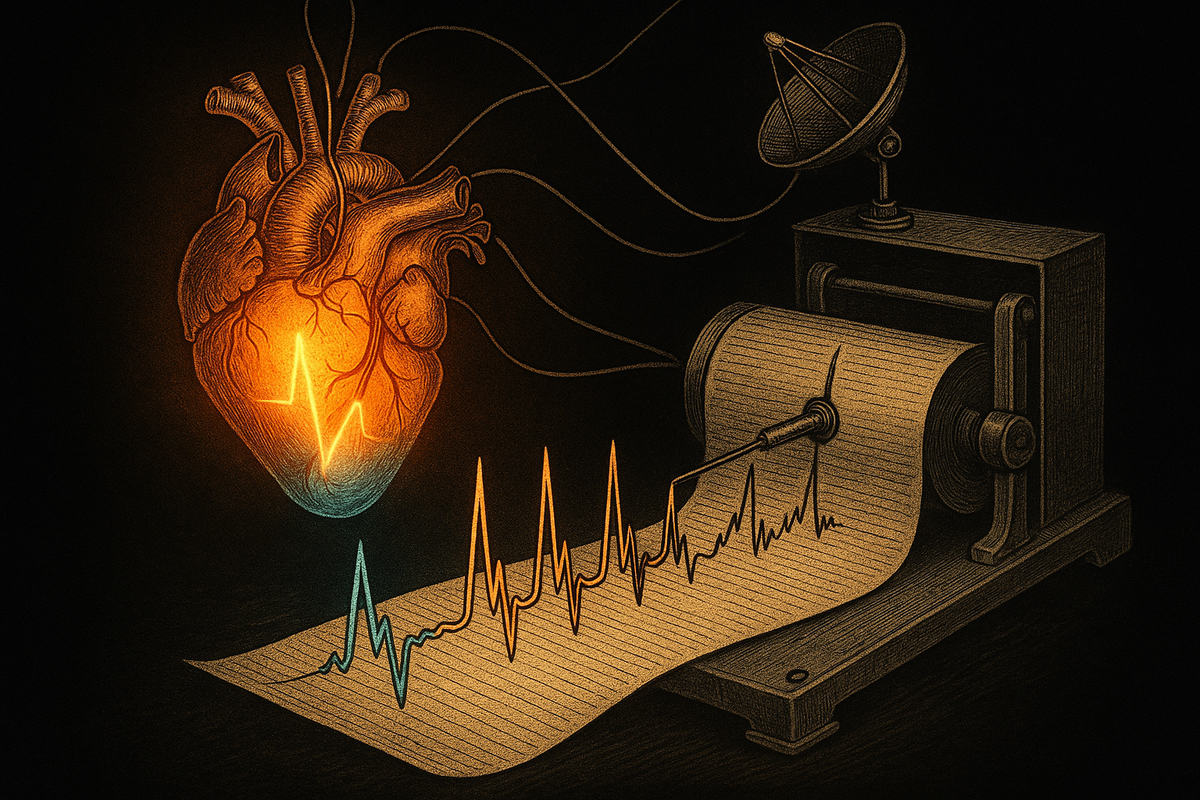
Relationship anxiety feels like fear of the future. It's actually the past. Your nervous system has built a predictive model from every attachment experience you've had — and it runs that model constantly, flagging threats before they materialize. The good news: models can be updated.
Relationship Anxiety: What Your Nervous System Is Actually Doing
Your partner doesn't text back for three hours. Your nervous system kicks into overdrive. Heart racing, stomach tight, mind spinning through worst-case scenarios—they're losing interest, they're mad at you, they're about to leave.
This isn't irrational. It's not even really about the text message.
Your nervous system is doing exactly what it was designed to do: running threat simulations based on learned prediction models. The problem isn't that you're anxious. The problem is that your nervous system has been trained on data that makes abandonment feel more probable than it actually is.
Welcome to relationship anxiety—not as a character flaw, but as a prediction error signal your body can't ignore.
The Prediction Machine
Your brain isn't a passive receiver of information. It's a prediction machine constantly generating expectations about what happens next, then comparing those predictions against incoming sensory data.
This is the core insight of predictive processing (also called active inference)—a framework developed by Karl Friston, Anil Seth, Andy Clark, and others that's reshaping how we understand perception, cognition, and emotion.
The model works like this:
1. Your brain generates predictions about the state of the world 2. Sensory data flows in 3. The brain compares prediction to reality 4. Any mismatch creates prediction error 5. Your system either updates the prediction or takes action to make the world match the prediction
Most of the time, this works beautifully. You predict your coffee mug is where you left it, reach for it without thinking, drink your coffee. Prediction confirmed, no conscious awareness required.
But when predictions fail—when the world doesn't match your model—you get an error signal. A surprise. A violation of expectation.
And when those predictions involve attachment threats, the error signal doesn't arrive as a polite notification. It arrives as full-body alarm.
Relationship Anxiety Is a Prediction Error
When you feel relationship anxiety, you're not hallucinating a threat. You're experiencing a prediction error about attachment security.
Your nervous system has generated a prediction: my partner is available, responsive, emotionally present. This prediction comes from your attachment model—the learned template for how relationships work, built from thousands of hours of early caregiving interactions and relationship experiences.
Then something happens: - Your partner doesn't text back - They seem distracted during dinner - They need alone time when you want connection - They don't respond with the enthusiasm you expected
These events create mismatches between your predicted model and observed reality. Your nervous system registers this as prediction error.
But here's where it gets interesting: the size of the error signal isn't determined by the objective size of the mismatch. It's determined by your prior expectations.
If your attachment model says "caregivers are reliably available," a three-hour text delay registers as minor noise—easily explained, not worth updating your entire model.
If your attachment model says "caregivers are inconsistently available and connection is fragile," that same three-hour delay becomes a massive prediction error—potentially signaling imminent abandonment, demanding immediate attention and action.
The anxiety you feel is your nervous system's estimate of how big a problem this mismatch represents.
Why Your Body Runs Threat Simulations
Prediction error doesn't just create anxiety. It triggers your nervous system to run simulations—mental models of what might happen next.
This is adaptive. When your brain detects a pattern violation, it needs to figure out: - Is this a one-off anomaly or the start of a new pattern? - What are the possible trajectories from here? - What actions might prevent the worst outcomes?
Your nervous system doesn't wait for certainty. It acts on probability estimates.
And if your learned model says "small signs of distance often precede abandonment," your nervous system will prioritize simulations where absence → disinterest → departure.
This is why relationship anxiety often involves: - Catastrophizing — jumping to worst-case scenarios - Hypervigilance — scanning for more evidence of distance - Reassurance-seeking — testing whether the connection is still intact - Pre-emptive withdrawal — protecting against anticipated rejection
These aren't conscious choices. They're inference strategies your nervous system deploys to minimize future prediction error. Your body is trying to figure out what model best explains the data—and to prevent outcomes that would shatter your model entirely.
Stephen Porges's Polyvagal Theory adds a crucial layer here: your autonomic nervous system is constantly assessing neuroception—subconscious detection of safety or threat. When relationship cues suggest danger (even ambiguously), your system shifts into sympathetic activation (fight-or-flight) or dorsal vagal shutdown (collapse, freeze).
You're not choosing to feel anxious. Your nervous system has detected what it interprets as a survival-relevant threat to attachment security. And it's responding accordingly.
The Model Behind the Model
If relationship anxiety is a prediction error, the obvious question is: where did the prediction come from?
The answer: your attachment history.
Attachment theory—originally developed by John Bowlby and Mary Ainsworth—maps perfectly onto predictive processing. Your attachment style is essentially your learned prior distribution for how relationships work.
Secure attachment develops when caregivers are consistently responsive. Your nervous system learns: - Connection is reliable - Bids for closeness are usually met - Ruptures get repaired - Distance doesn't equal abandonment
Result: Low prediction error when partners need space. High confidence that connection will restore. Anxiety stays manageable because your model can accommodate temporary disconnection without catastrophe.
Anxious attachment develops when caregivers are inconsistently responsive—sometimes available, sometimes not, in ways that felt unpredictable. Your nervous system learns: - Connection is fragile and requires constant monitoring - Availability can vanish without warning - Bids for closeness sometimes work, sometimes don't - Absence might mean permanent loss
Result: High prediction error for any sign of distance. Your model says connection is unstable by default, so even small cues trigger alarm. Your nervous system hasn't learned that temporary absence is safe.
Avoidant attachment develops when caregivers are consistently unavailable or dismissive. Your nervous system learns: - Connection is unreliable and potentially threatening - Vulnerability leads to rejection or overwhelm - Independence is safer than dependence - Closeness generates prediction error
Result: Anxiety doesn't show up as clinging—it shows up as preemptive distance. Your model predicts that closeness will lead to disappointment or engulfment, so your nervous system creates space before the threat materializes.
These aren't personality traits. They're learned inference patterns—probabilistic models your nervous system constructed to navigate the relational environments you actually experienced.
And they operate mostly outside conscious awareness, in the autonomic substrate Porges describes.
Updating the Prediction
So if relationship anxiety is your nervous system making predictions based on old data, the question becomes: Can you update the model?
The answer is yes—but not through rationalization.
You can't talk yourself out of prediction error. You can't convince your autonomic nervous system with logic that your partner's three-hour text delay is fine. Your nervous system updates on evidence, not arguments.
This is why "just calm down" or "you're being irrational" doesn't work. Your body isn't irrational—it's making inferences based on the best model it has. The model is just trained on different data than your current reality.
To update the model, you need to:
1. Accumulate Disconfirming Evidence
Your nervous system will update its priors when it gets repeated experiences that violate the old model without catastrophe.
- Your partner is distant → you don't immediately seek reassurance → they reconnect later → the predicted abandonment doesn't happen - You express a need → your partner responds with attunement → the predicted rejection doesn't happen - There's a rupture → it gets repaired → the predicted permanent disconnection doesn't happen
Each of these experiences is a data point your nervous system can integrate. Over time, with enough repetitions, your model shifts. Distance stops triggering five-alarm panic because your accumulated evidence says "distance is temporary and doesn't mean danger."
This is why secure relationships are regulating. They provide the repeated, disconfirming data that updates anxious priors.
2. Co-Regulate with Safe Others
Your nervous system doesn't update in isolation. It updates through co-regulation—the process of your autonomic state synchronizing with another person's.
When your partner (or therapist, or trusted friend) can hold a ventral vagal state (Porges's term for social engagement, calm presence) while you're in sympathetic activation, your nervous system gets new information: I can be dysregulated and the other person stays regulated. Connection doesn't collapse when I feel anxious.
Over time, your nervous system learns to borrow their regulation. You internalize the experience of being held through distress. Your prediction model updates: distress doesn't equal abandonment.
This is what secure attachment looks like in practice—not the absence of anxiety, but the expectation that anxiety can be held.
3. Increase Interoceptive Awareness
Interoception—your brain's sense of what's happening inside your body—is the substrate of emotion. Relationship anxiety shows up first as autonomic activation: racing heart, tight chest, shallow breathing, gut tension.
Most people experience this activation and immediately interpret it through their attachment model: I feel this way because my partner is pulling away.
But with practice, you can learn to notice the activation before the narrative:
My heart is racing. My chest is tight. These are sensations. My nervous system is in threat mode. What prediction error is it responding to?
This creates a gap—a moment where you can recognize that you're experiencing a prediction, not a fact. Your body is generating a model of what might happen. That model might be wrong.
This doesn't make the anxiety go away. But it changes your relationship to it. You stop treating the anxiety as evidence that your partner is leaving. You start treating it as information about your nervous system's current state.
Practices that build interoceptive awareness—somatic therapy, mindfulness, breathwork, body scans—aren't woo. They're literally retraining the pathway between autonomic activation and conscious interpretation.
4. Titrate Tolerable Prediction Error
Your nervous system learns by experiencing manageable amounts of prediction error.
Too much error too fast → overwhelm → your system doubles down on the old model for safety.
Too little error → no new data → the model never updates.
The sweet spot: tolerable challenge. Situations where: - Your old model predicts threat - But the actual outcome is safe - And your nervous system can integrate the mismatch without collapsing
Example: Your partner needs space. Your model predicts abandonment. Instead of immediately reaching for reassurance, you sit with the discomfort for 20 minutes. Then you check in—not from panic, but from curiosity. Your partner responds warmly. Your nervous system logs: I felt abandoned, but I wasn't actually abandoned. Distance didn't equal loss.
Do this 100 times, and your model starts shifting.
This is why exposure + safety is the mechanism of change in trauma therapy, attachment repair, and anxiety treatment. You need to experience the thing you predict will be catastrophic—and discover it's survivable.
When the Anxiety Won't Update
Sometimes relationship anxiety persists even in secure relationships. You accumulate disconfirming evidence, your partner is consistently responsive, and still your nervous system won't update the model.
This usually means one of two things:
Your Current Relationship Actually Isn't Safe
Your nervous system might be right. If your partner is: - Inconsistently responsive - Dismissive of your bids for connection - Unable or unwilling to repair ruptures - Creating ambiguity about commitment
...then your anxiety isn't a prediction error. It's accurate threat detection.
Anxious attachment gets pathologized, but sometimes anxiety is telling the truth: this relationship isn't providing the safety signals my nervous system needs to regulate.
The question isn't "How do I stop being anxious?" It's "Is this relationship actually secure enough to update my model?"
Your Trauma History Overrides Present Data
If your early attachment environment was severely inconsistent, frightening, or chaotic, your nervous system might have learned that safety itself is a threat—because safety was always the prelude to betrayal.
In these cases, your prediction model isn't just "connection is fragile." It's "safety is a trap."
When this is the substrate, even the most secure relationship will trigger anxiety—because your nervous system has learned to predict catastrophe especially when things seem stable. Stability becomes a cue for hypervigilance, not relief.
This is the territory of disorganized attachment and complex trauma. Updating this model usually requires therapeutic support—ideally with someone trained in somatic, attachment-informed, or polyvagal approaches. The work isn't about convincing yourself you're safe. It's about slowly, incrementally rewiring the autonomic pathways that generate the predictions in the first place.
The Coherence Underneath
Relationship anxiety, at its core, is a coherence problem.
Your nervous system is trying to maintain a coherent model of how relationships work while navigating new data that doesn't fit. The anxiety is the friction—the system trying to reconcile:
- Old model: "Connection is fragile, absence means danger" - New data: "My partner is consistently available"
As long as the two are in tension, you experience prediction error. Your nervous system is computing: Which model should I trust?
Over time, if the new data keeps coming—if safety becomes the reliable pattern—the model updates. The prediction error shrinks. The anxiety fades.
But this isn't instant. It's not a decision. It's a learning process happening in the autonomic substrate of your body.
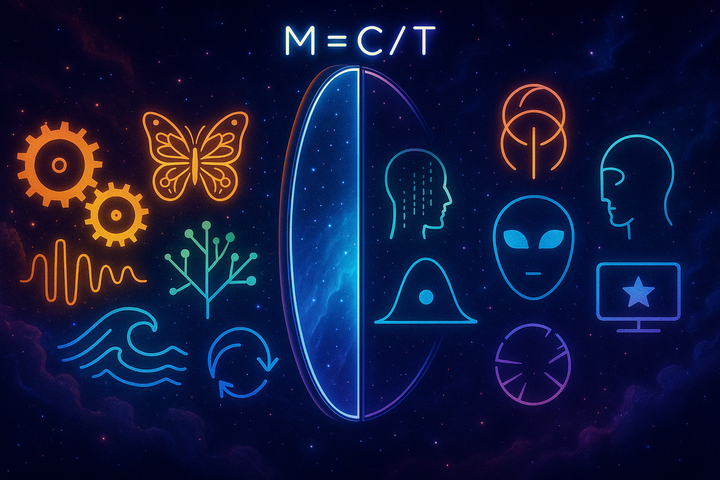
In the language of the AToM framework (Attractor Theory of Meaning): anxiety is a high-curvature state—a region of state-space where your nervous system has low confidence in its predictions and is scanning for the attractor to settle into. As you accumulate evidence, the trajectory stabilizes. The curvature flattens. You find coherence.
Meaning, in relationships as everywhere else, is coherence over time. The question isn't whether you feel anxious in a given moment. The question is: Can your nervous system find a trajectory where connection feels stable enough to trust?
What to Do
If you experience relationship anxiety, here's what actually helps:
1. Recognize it as prediction error, not reality - Your anxiety is your nervous system's model of what might happen, not evidence of what is happening - The feelings are real. The prediction might be wrong.
2. Notice the autonomic signature - Heart rate, breathing, gut tension—these are the upstream signals - The story your mind tells is downstream - Learn to catch the body response before the narrative takes over
3. Seek tolerable amounts of disconfirming evidence - Practice sitting with the anxiety without immediately seeking reassurance - Let your nervous system discover that distance ≠ danger - Small doses, repeated. This is how the model updates.
4. Co-regulate with secure others - Your nervous system updates fastest in the presence of someone who can stay regulated while you're activated - This might be your partner, a therapist, a trusted friend - Borrowed regulation becomes internalized regulation
5. Ask whether the relationship is actually safe - If your partner is inconsistent, dismissive, or unwilling to engage with your attachment needs, your anxiety might be accurate - The goal isn't to eliminate anxiety in an unsafe relationship. It's to find relationships where your nervous system can actually update.
6. Get support if the model won't budge - If your anxiety persists despite accumulated evidence of safety, you might need trauma-informed therapy - Somatic, EMDR, IFS, polyvagal-informed approaches can address the autonomic substrate where the predictions are generated
The Long Game
Updating your attachment model isn't a weekend project. Your nervous system learned these predictions over years of experience. Unlearning them takes time.
But the process is real. Your nervous system can update its priors. Secure attachment can be earned. Relationship anxiety can soften.
Not through willpower or positive thinking—but through accumulated evidence that connection is safe, that ruptures repair, that absence doesn't mean abandonment.
Your nervous system is doing its job. It's keeping you alive by running the best models it has.
The work is giving it new data—slowly, patiently, one safe connection at a time.
Further Reading
- Friston, K. (2010). "The free-energy principle: a unified brain theory?" Nature Reviews Neuroscience. - Porges, S. (2011). The Polyvagal Theory: Neurophysiological Foundations of Emotions, Attachment, Communication, and Self-regulation. W.W. Norton. - Ainsworth, M., Blehar, M., Waters, E., & Wall, S. (1978). Patterns of Attachment. Lawrence Erlbaum. - Clark, A. (2015). Surfing Uncertainty: Prediction, Action, and the Embodied Mind. Oxford University Press. - Seth, A. (2021). Being You: A New Science of Consciousness. Dutton.
This is Part 8 of the Polyvagal & Attachment series, exploring the neuroscience of relational coherence. Next: "Attachment Issues: When Relationships Feel Impossible."

Comments ()