Synthesis: RNA as Information Processor
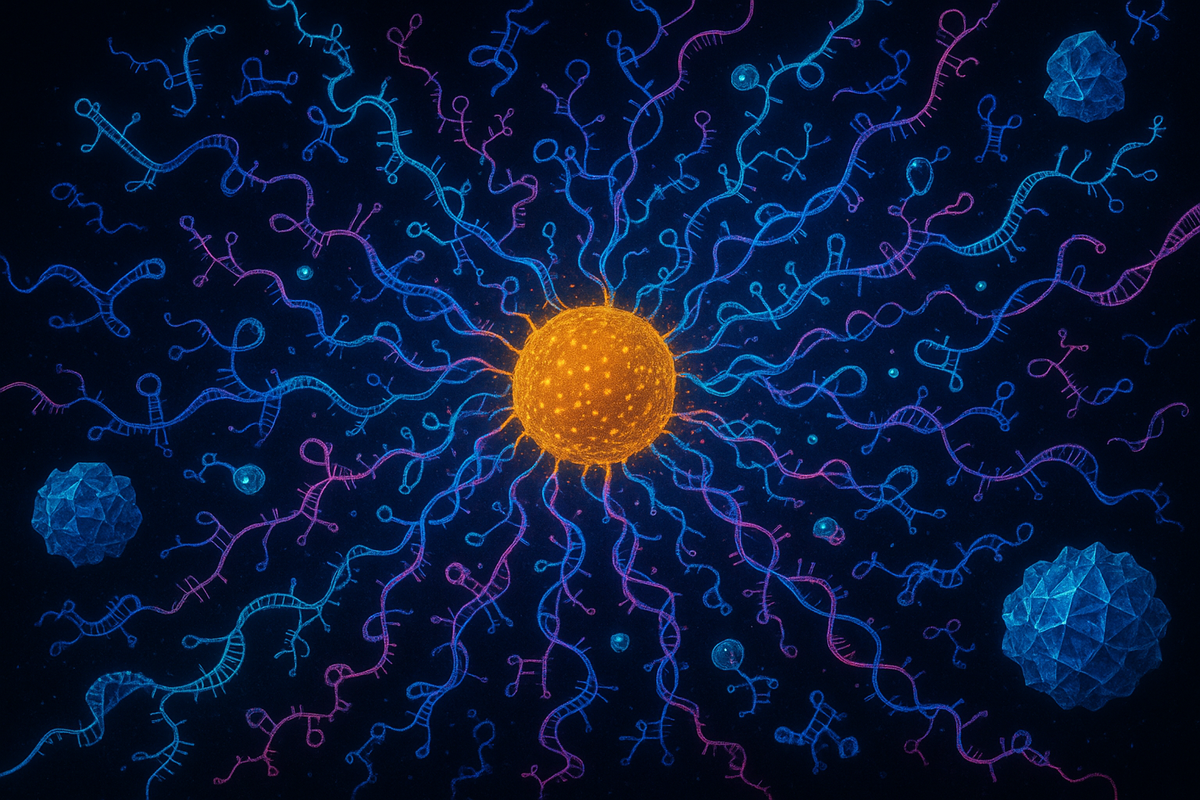
If DNA is the genome's hardware, RNA is closer to firmware. It reads context, makes decisions, amplifies signals, and silences genes — all without protein intermediaries. The full picture of RNA's information-processing role makes the old 'messenger' label look almost comically inadequate.
Synthesis: RNA as Information Processor
Let's pull it together. Over the past seven articles, we've traced the RNA renaissance from its roots to its frontiers. We've seen RNA transform from a simple messenger—a tape carrying instructions from DNA to ribosomes—into something vastly more complex: a regulator, a modifier, a scaffold, a controller. Now the synthesis: what does it mean to say RNA is an information processor? Not a messenger. Not a middleman. A computational layer in its own right.
What We've Learned
mRNA vaccines showed synthetic RNA can reprogram cellular output. Epitranscriptomics revealed 170+ modifications that regulate every aspect of RNA fate. RNA interference demonstrated that small RNAs silence genes—microRNAs regulate the majority of human genes. Long non-coding RNAs emerged as the dark matter of the genome. Circular RNAs were hiding in plain sight. Phase separation showed RNA scaffolds cellular organization. Each discovery expanded what RNA is. The sum is more than the parts.
The Computational Metaphor
Let me propose a way to think about this. If DNA is the genome—the complete instruction set, the source code—then RNA is the runtime. It's what the cell actually executes, moment to moment. The genome sits in the nucleus, mostly static. It contains all the instructions the cell might ever need, but only a fraction are relevant at any given time. Which genes should be active? At what level? In response to what signals? RNA is where those decisions get made. Transcription decides which genes produce RNA at all. Splicing decides which version of the RNA gets assembled from the available exons. Modification (epitranscriptomics) decides how that RNA is annotated—marked for stability or degradation, efficient translation or sequestration. Localization decides where in the cell the RNA goes—nucleus, cytoplasm, specific subcellular compartments. Translation decides how much protein gets made from the RNA. Degradation decides when the RNA gets recycled. At each step, decisions. Regulatory inputs. Computational logic. The transcriptome isn't a printout of the genome. It's an active, regulated, dynamically updated representation of what the cell is actually doing.
Information Integration
Here's what makes RNA especially suited for computation: it integrates information from multiple sources. A single mRNA can be regulated by:
- Transcription factors binding to its gene's promoter
- Chromatin state affecting accessibility
- Alternative splicing controlled by splice factors
- Epitranscriptomic modifications by writer enzymes
- MicroRNA binding in its 3' UTR
- RNA-binding proteins affecting stability and translation
- Localization signals directing its transport
- Condensate dynamics concentrating or dispersing it
Each of these regulatory inputs can be independently controlled. The cell can adjust each one in response to different signals. The final output—how much protein gets made, where, and when—is an integration of all these inputs. This is combinatorial control. The same gene can produce vastly different outputs depending on the cell type, developmental stage, and environmental conditions—not because the DNA changed, but because the RNA processing changed. RNA is the integration layer. The place where signals converge and decisions get computed.
The RNA World Connection
There's a deeper story here. The RNA World hypothesis proposes that early life was based on RNA alone. Before DNA existed for information storage. Before proteins existed for catalysis. RNA could do both jobs—store genetic information (like DNA does now) and catalyze chemical reactions (like proteins do now). If this is true, then RNA isn't just central to modern biology—it's the original substrate of life. The molecule that figured out how to make copies of itself, how to catalyze useful reactions, how to evolve. Over billions of years, RNA outsourced its jobs. DNA took over long-term information storage—it's more stable, more easily replicated with high fidelity. Proteins took over catalysis—the 20 amino acids provide more chemical diversity than the 4 nucleotides of RNA. But RNA never fully retired. It kept regulatory control. It remained at the center of the ribosome (the ribosome's catalytic core is made of RNA, not protein). It maintained its role as the intermediary between genome and proteome—and, we now know, much more than an intermediary. The RNA renaissance is partly a rediscovery. RNA has always been central. We're just now seeing how central.
Coherence: The AToM Framework Connection
Let's connect this to the AToM framework that runs through Ideasthesia. Meaning emerges from coherence—from patterns that integrate information across scales and maintain themselves over time. The equation M = C/T suggests that meaningful systems are those that sustain coherence against the disintegrating pressure of time. Cells face this challenge continuously. They must maintain their identity despite constant molecular turnover. They must respond to signals without losing their coherence. They must differentiate during development while remaining viable. RNA is one of the key mechanisms for maintaining cellular coherence. Homeostasis requires detecting deviations and correcting them. RNA-based feedback loops—microRNAs that respond to protein levels, modification enzymes that respond to metabolic state—are the sensing and correction circuits. Identity requires expressing the right genes in the right patterns. Long non-coding RNAs that establish chromatin states, transcription condensates that concentrate machinery at specific genes—these are the identity maintenance systems. Adaptation requires responding to environmental changes. Stress granules that form in response to challenges, epitranscriptomic reprogramming that adjusts the transcriptome—these are the adaptive systems. The transcriptome isn't static. It's a dynamic equilibrium, constantly adjusting to maintain coherence in changing conditions. RNA doesn't just carry information—it processes information in service of the cell's ongoing coherence. Coherence, at the cellular level, is maintained by RNA-based computation.
Therapeutic Implications
If RNA is an information processor, then RNA therapeutics are a form of reprogramming. mRNA vaccines reprogram cellular output temporarily, teaching the immune system to recognize new targets. siRNA drugs silence specific transcripts, reducing the production of disease-causing proteins. Antisense oligonucleotides redirect splicing, forcing cells to produce functional proteins from mutant genes. Future possibilities might include:
- Modulating epitranscriptomic modifications to adjust transcript stability and translation
- Engineering long non-coding RNAs to reprogram chromatin states
- Designing circular RNAs for long-lasting therapeutic effects
- Targeting phase-separation dynamics to prevent pathological aggregation
The common thread: intervening in the computational layer. Not changing the genome (as CRISPR does), but changing how the genome is interpreted. Editing the software without touching the hardware. This may be the sweet spot for many diseases. Genetic disorders often involve too much or too little of something—problems of dosage, timing, or localization. RNA therapeutics can address these without permanent genetic modification. Medicine is becoming programmable. RNA is the programming language.
The Limits of the Metaphor
The computational metaphors—runtime, processing—are useful but imperfect. RNA participates in continuous biochemical reactions, not discrete instructions. The system evolved through natural selection, not design. Still, the metaphor captures something true: cells process information. They take inputs and produce outputs. The mechanisms connecting them are, functionally, computational—even if the substrate is chemistry rather than silicon. RNA is where much of that computation happens. Not despite being chemistry, but through chemistry.
The Ongoing Renaissance
We're in the middle of the RNA story, not the end. New RNA classes continue to be discovered. New technologies—single-cell transcriptomics, long-read sequencing, spatial transcriptomics—reveal what we couldn't see before. New therapeutics keep emerging: mRNA, siRNA, and ASOs are established; circular RNA therapeutics and CRISPR-based RNA targeting are coming. The RNA renaissance is a phase transition in our understanding—from passive transcript to active controller. The transition is ongoing. We're still learning what RNA does.
The Message
Here's what the RNA renaissance tells us: Biology is more complex than we thought. The simple DNA-RNA-protein model captured something real but missed most of the story. Layers of regulation, modification, and organization pervade the cell, and RNA is at the center of all of them. Information processing is fundamental. Cells don't just execute genetic programs—they compute responses to conditions, integrating signals through RNA-based regulatory circuits. The computational metaphor isn't just a metaphor; it's a description of what cells actually do. RNA is not passive. It regulates, organizes, and structures. It's modified, localized, and degraded in controlled ways. It scaffolds condensates and guides protein complexes. The messenger became the message processor. Therapeutic possibilities are expanding. We can now write RNA, deliver RNA, and target RNA in ways that weren't possible twenty years ago. Diseases that were untreatable are becoming treatable. The mRNA vaccines proved the concept at scale. The story isn't over. New classes, new functions, new mechanisms continue to emerge. The RNA renaissance is ongoing, and the next decade will bring discoveries we can't currently anticipate.
Conclusion
The Central Dogma said: DNA makes RNA makes protein. The RNA renaissance says: DNA makes RNA, and RNA does everything else. The genome is the archive. The proteome is the machinery. But the transcriptome—in all its modified, regulated, organized complexity—is where the cell actually thinks. Fifty years ago, we thought we understood RNA. A transcript. A messenger. A temporary copy of genes on its way to becoming protein. We were wrong. RNA is far more interesting than that. RNA is the computational heart of the cell. And we're only beginning to understand what that means.
Further Reading
- Cech, T. R., & Steitz, J. A. (2014). "The Noncoding RNA Revolution—Trashing Old Rules to Forge New Ones." Cell.
- Mattick, J. S. (2023). "The RNA World is here." Nature Reviews Genetics.
- Brangwynne, C. P., Tompa, P., & Pappu, R. V. (2015). "Polymer physics of intracellular phase transitions." Nature Physics.
- Sahin, U., Karikó, K., & Türeci, Ö. (2014). "mRNA-based therapeutics—developing a new class of drugs." Nature Reviews Drug Discovery.
This concludes the RNA Renaissance series. The molecule we thought we understood turned out to be the molecule we'd barely begun to explore. The renaissance continues.

Comments ()