RNA Isn't Just a Messenger—It's Making Decisions
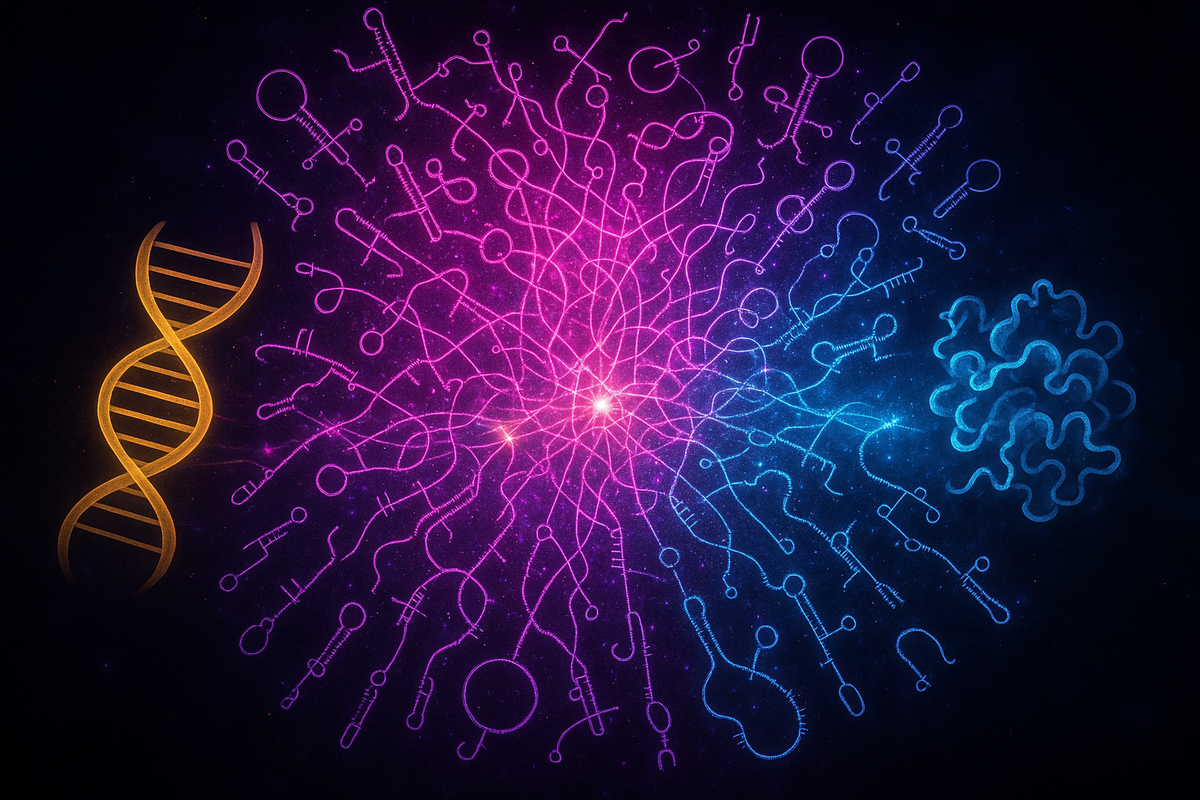
The Central Dogma cast RNA as a middleman: DNA sends a message, RNA carries it, proteins do the work. That picture is incomplete. Most of the genome transcribes RNA that never becomes protein — and those non-coding RNAs turn genes on and off and run regulatory networks of startling complexity.
RNA Isn't Just a Messenger—It's Making Decisions
In 1958, Francis Crick declared what he called the "Central Dogma" of molecular biology. Information flows in one direction: DNA makes RNA makes protein. That's it. The blueprint encodes the messenger, the messenger directs the factory, the factory builds the parts. Clean, elegant, hierarchical. For about forty years, this picture seemed basically right. DNA was the code. RNA was the tape that carried instructions from the code vault to the assembly line. Proteins did everything interesting—catalysis, structure, signaling. RNA was necessary but boring. A middleman. A courier. Then the twenty-first century happened, and the courier turned out to be running the operation. The Central Dogma isn't wrong, exactly. It's just spectacularly incomplete. What we're discovering is that RNA doesn't just carry messages. It regulates which messages get read and which get ignored. It can silence genes, activate genes, modify itself, and build structures that organize the cell's interior. Far from being a passive transcript, RNA is an active participant in cellular decision-making—maybe the active participant. This is the RNA renaissance. And it's rewriting our understanding of how cells actually work.
The Zoo of Non-Coding RNAs
Once scientists started looking, they found RNA molecules everywhere, doing things nobody expected. MicroRNAs are tiny—about 22 nucleotides long. They don't code for proteins. Instead, they bind to messenger RNAs and prevent them from being translated. One microRNA can target hundreds of different mRNAs. There are over 2,000 microRNAs in humans, and together they regulate something like 60% of all protein-coding genes. Let that sink in. These little snippets of RNA control the majority of gene expression. Long non-coding RNAs (lncRNAs) are longer—over 200 nucleotides—and even more mysterious. There are at least 16,000 of them in humans, maybe more. They don't code for proteins, but they're not random noise either. Many are precisely regulated, tissue-specific, and essential for development. One lncRNA called XIST is responsible for silencing one of the two X chromosomes in female mammals. Another called HOTAIR helps establish body axis during development. These molecules are doing something crucial. We're still figuring out exactly what. Circular RNAs weren't even known to exist until about a decade ago. They're RNA molecules that loop back on themselves, forming closed circles. They can't be degraded the normal way (the cell's cleanup machinery looks for loose ends, and circles don't have them). Thousands of them exist in human cells. Some act as "sponges" that soak up microRNAs. Some might code for proteins after all. We're still in early days. Small interfering RNAs (siRNAs) can silence genes with exquisite precision. This discovery won a Nobel Prize in 2006 and launched an entire industry of RNA therapeutics. The messenger myth didn't just miss one alternative. It missed an entire kingdom.
RNA as Regulator
Here's the conceptual shift: RNA isn't downstream of the interesting stuff. RNA is the interesting stuff. Think about what a cell has to do. It has the same genome in every cell—about 20,000 genes. But a neuron and a liver cell are completely different. They express different proteins, have different shapes, respond to different signals. Development requires turning the right genes on and off in the right cells at the right times. How do you coordinate that? The old answer was transcription factors—proteins that bind to DNA and activate or repress genes. That's still true. But transcription factors are a relatively blunt instrument. You need something more nuanced. RNA provides the nuance. MicroRNAs can fine-tune protein levels, turning a gene not fully off but down—reducing production by 50%, or 70%, or 90%. They create gradients. They enable analog control in a system that otherwise looks digital. Long non-coding RNAs can recruit chromatin-modifying complexes to specific locations in the genome, turning entire regions on or off. They can bridge distant parts of the genome together, creating three-dimensional structures that bring regulatory elements into contact. RNA isn't just the tape that carries instructions. It's the volume knob, the mixer board, the production engineer deciding what gets emphasized and what gets cut.
The Epitranscriptome: RNA's Own Modification Layer
In the 1970s, scientists discovered that DNA gets chemically modified. Methyl groups get attached to certain bases, changing how genes are expressed without changing the underlying sequence. This is epigenetics—information beyond the genetic code. It turns out RNA has its own version. There are over 170 known chemical modifications that can occur on RNA. The most common is m6A—N6-methyladenosine—where a methyl group gets stuck onto adenosine bases. This modification affects how the RNA gets processed, translated, and degraded. This is the epitranscriptome. A regulatory layer on top of the transcriptome. A modification on top of a modification. The implications are staggering. When we sequence RNA to figure out what genes are active, we get the text. But we miss the formatting—the bold, the italics, the track changes. The modifications tell the cell not just what the RNA says but how to interpret it. And the modifications are dynamic. They can be added and removed. The cell is editing its own RNA in real-time, adding and removing chemical marks that change how each molecule behaves. The message isn't just the sequence. The message includes how the sequence is marked up. This is still a young field. We're only beginning to understand which modifications matter, how they're regulated, and what happens when they go wrong. But already, epitranscriptomic changes have been linked to cancer, neurological disease, and immune dysfunction.
Why RNA? Why Now?
If RNA is so important, why did it take so long to figure out? Partly technology. RNA is fragile, hard to study, and abundant in ways that make it noisy. DNA is stable; RNA degrades. DNA is present in two copies per cell; different RNAs are present in copies ranging from a handful to hundreds of thousands. Characterizing the transcriptome required sequencing technologies that only became affordable in the 2000s. But it was also conceptual. We weren't looking because we thought we already knew the answer. Central Dogma. DNA to RNA to protein. Case closed. Science often works this way. The framework is so elegant, so apparently complete, that it blinds you to what's outside it. Then some weird observation—why do worms have as many genes as humans?—forces you to look again, and the framework cracks open. The crack opened around 2001-2003, with the Human Genome Project completion and the discovery of RNA interference. Since then, the flood: microRNAs, lncRNAs, circRNAs, epitranscriptomics, RNA modifications, RNA structures, RNA phase separation. Every year brings new classes of RNA doing new things. We're not adding footnotes to the Central Dogma. We're discovering that the footnotes are longer than the main text.
RNA World and the Origin of Life
Here's a wild implication: RNA's versatility might not be an accident of evolution. It might be the original condition. There's a hypothesis called the RNA World. Early life, before DNA or proteins existed, might have been based entirely on RNA. RNA can store information like DNA. RNA can catalyze chemical reactions like proteins (certain RNAs called ribozymes act as enzymes). RNA can do both jobs simultaneously. If this is right, then RNA was the first molecule of life. DNA and proteins came later, specializing in storage and catalysis respectively, but RNA came first—and never fully ceded its role. The cell isn't a hierarchical factory with DNA at the top. The cell is a regulatory network with RNA at the center, using DNA for archival storage and proteins for specialized chemistry, but keeping the integration and decision-making for itself. RNA isn't the middleman. RNA is the boss.
Therapeutic Implications
If RNA is where decisions get made, then RNA is where you want to intervene. Traditional pharmaceuticals target proteins. That's like trying to control a company by negotiating with the factory workers. It works, but it's indirect. What if you could talk to management? RNA therapeutics talk to management. mRNA vaccines give your cells instructions to produce a protein—like the COVID-19 spike protein—so your immune system can learn to recognize it. The mRNA degrades in days. The immunity persists for months or years. You're temporarily reprogramming the cell's output. siRNA drugs silence specific genes. The first approved siRNA drug, patisiran, treats a hereditary disease called transthyretin amyloidosis by preventing the liver from making a misfolded protein that would otherwise kill you. It works by destroying the mRNA for that protein before it can be translated. Antisense oligonucleotides (ASOs) bind to RNAs and modify their behavior—changing splicing, promoting degradation, or blocking translation. There are ASO drugs for spinal muscular atrophy, Duchenne muscular dystrophy, and hereditary high cholesterol. We're not just studying RNA. We're learning to write it. The implications extend to everything: cancer, genetic disease, aging, neurodegeneration. If a disease has a molecular cause, and that cause involves gene expression, then RNA-based approaches might be able to address it. The mRNA vaccines proved the approach works at scale. Now the floodgates are opening.
What This Series Covers
This is the RNA renaissance, and we're going to explore it. Next: We'll dive into the mRNA vaccine story—how Katalin Karikó spent decades in obscurity solving a problem nobody thought was important, and then a pandemic proved her right. It's one of the great science stories of the century. Then: Epitranscriptomics, the hidden modification layer. RNA interference and its therapeutic applications. The dark matter of long non-coding RNAs. The strange new world of circular RNAs. The physics of phase separation—how cells organize without membranes, with RNA at the center. Finally: A synthesis. What it means for RNA to be an information processor, not just an information carrier. How this changes our understanding of cellular intelligence. The old picture: DNA is the code, RNA is the messenger, proteins are the workers. The new picture: DNA is the archive, proteins are the tools, RNA is the operating system. The Central Dogma isn't wrong. It's just the executive summary. And the full report is stranger, more interesting, and more powerful than Francis Crick ever imagined.
Further Reading
- Cech, T. R., & Steitz, J. A. (2014). "The Noncoding RNA Revolution—Trashing Old Rules to Forge New Ones." Cell.
- Mattick, J. S. (2023). "The RNA World is here." Nature Reviews Genetics.
- Roundtree, I. A., Evans, M. E., Pan, T., & He, C. (2017). "Dynamic RNA Modifications in Gene Expression Regulation." Cell.
- Fire, A., & Mello, C. (2006). Nobel Prize lecture: "Gene Silencing by Double-Stranded RNA." Nobel Foundation.
This is Part 1 of the RNA Renaissance series, exploring RNA's emerging role as the operating system of cellular life. Next: "mRNA Vaccines: How COVID Changed Everything."

Comments ()