Roots of Unity: Complex Numbers That Equal One When Powered
Raise a root of unity to the nth power and you get 1. That elegant constraint forces n points to sit perfectly evenly around a circle — connecting abstract algebra, geometry, and the mathematics of signals in one clean idea.
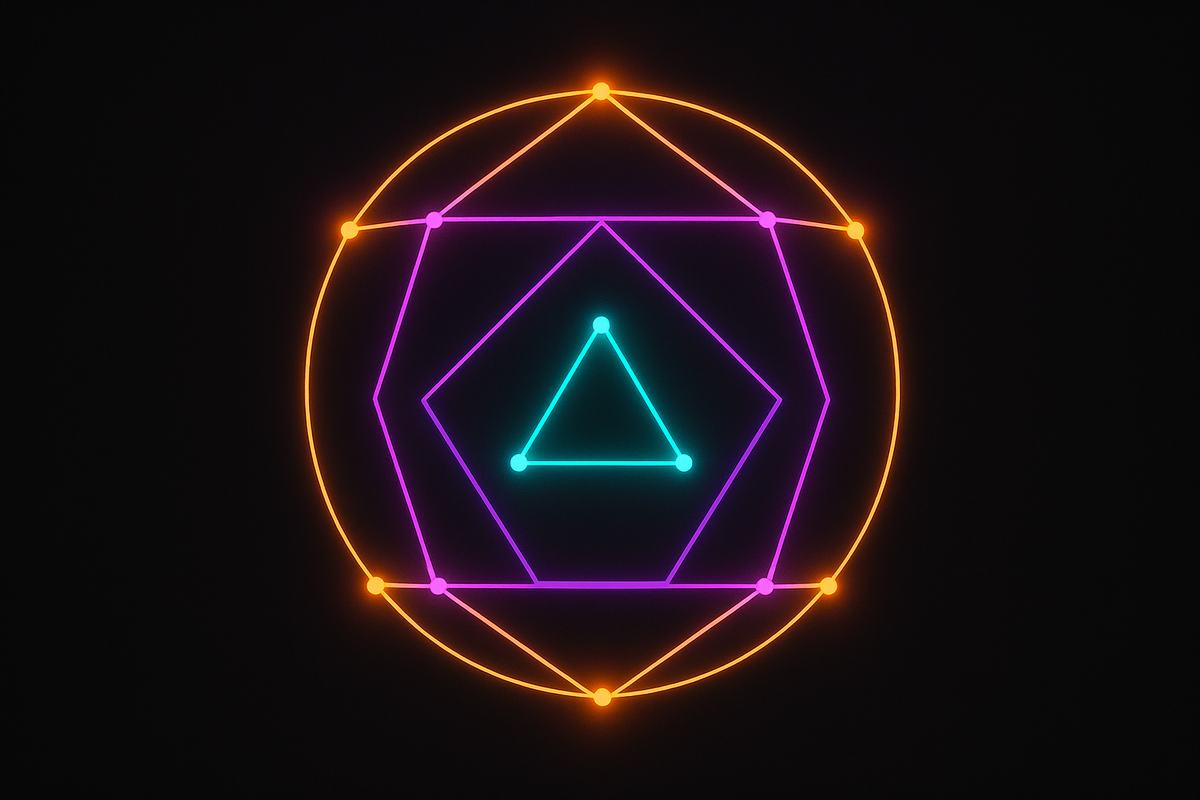
The equation x³ = 1 has three solutions, not one.
You know x = 1 works. But in the complex numbers, there are two more: the cube roots of unity. They're evenly spaced on the unit circle, forming an equilateral triangle.
This pattern generalizes. The nth roots of unity are n complex numbers, evenly spaced around the unit circle, that all satisfy xⁿ = 1.
Regular polygons encoded in algebra.
The Definition
The nth roots of unity are the solutions to:
xⁿ = 1
There are exactly n of them (counting multiplicity), given by:
ωₖ = e^(2πik/n) = cos(2πk/n) + i sin(2πk/n)
for k = 0, 1, 2, ..., n-1.
Why There Are n Roots
In the real numbers, x² = 1 has two solutions: ±1. In the complex numbers, every degree-n polynomial has exactly n roots.
For xⁿ - 1 = 0, that's n roots.
The Fundamental Theorem of Algebra guarantees this. What's special about roots of unity is that we can write them all explicitly using Euler's formula.
The Formula
xⁿ = 1 in polar form means:
rⁿ e^(inθ) = 1 · e^(i·0) = e^(i·0)
So rⁿ = 1 (hence r = 1) and nθ = 0 + 2πk for some integer k.
Thus θ = 2πk/n.
The n distinct values occur for k = 0, 1, ..., n-1. After that, the angles repeat (mod 2π).
Examples
Square roots of unity (n = 2):
- ω₀ = e^0 = 1
- ω₁ = e^(iπ) = -1
Two points on the unit circle: 1 and -1.
Cube roots of unity (n = 3):
- ω₀ = 1
- ω₁ = e^(2πi/3) = -1/2 + i√3/2
- ω₂ = e^(4πi/3) = -1/2 - i√3/2
Three points forming an equilateral triangle.
Fourth roots of unity (n = 4):
- 1, i, -1, -i
Four points forming a square: the vertices at compass directions.
Sixth roots of unity (n = 6):
- 1, e^(iπ/3), e^(2iπ/3), -1, e^(4iπ/3), e^(5iπ/3)
Six points forming a regular hexagon.
The Primitive Root
The primitive nth root of unity is:
ω = e^(2πi/n)
All other roots are powers of ω:
ω⁰ = 1, ω¹ = ω, ω² = ω², ..., ωⁿ⁻¹
And ωⁿ = 1, completing the cycle.
ω is called "primitive" because its powers generate all the roots.
The Geometric Picture
The nth roots of unity are the vertices of a regular n-gon inscribed in the unit circle, with one vertex at 1.
- n = 3: equilateral triangle
- n = 4: square
- n = 5: regular pentagon
- n = 6: regular hexagon
- n = 8: regular octagon
Regular polygons are complex number algebra made visible.
Key Properties
Sum equals zero (for n > 1):
ω⁰ + ω¹ + ω² + ... + ωⁿ⁻¹ = 0
Proof: Let S = 1 + ω + ω² + ... + ωⁿ⁻¹. This is a geometric series: S = (1 - ωⁿ)/(1 - ω) = (1 - 1)/(1 - ω) = 0.
Geometrically: the vertices of a regular polygon centered at the origin sum to zero by symmetry.
Product:
ω⁰ · ω¹ · ω² · ... · ωⁿ⁻¹ = ω^(0+1+2+...+(n-1)) = ω^(n(n-1)/2)
For even n, this equals (-1)^(n-1). For odd n, it equals 1 or -1 depending on specifics.
Conjugate pairs:
For real coefficients, complex roots come in conjugate pairs. Indeed, ωₖ and ωₙ₋ₖ are conjugates.
Cyclotomic Polynomials
The polynomial xⁿ - 1 factors over the rationals:
x² - 1 = (x - 1)(x + 1) x³ - 1 = (x - 1)(x² + x + 1) x⁴ - 1 = (x - 1)(x + 1)(x² + 1) x⁶ - 1 = (x - 1)(x + 1)(x² + x + 1)(x² - x + 1)
The cyclotomic polynomial Φₙ(x) is the minimal polynomial for primitive nth roots of unity.
Φ₁(x) = x - 1 Φ₂(x) = x + 1 Φ₃(x) = x² + x + 1 Φ₄(x) = x² + 1 Φ₆(x) = x² - x + 1
These polynomials have integer coefficients and are irreducible over the rationals.
Applications
Discrete Fourier Transform:
The DFT uses nth roots of unity as basis vectors. When you decompose a signal into frequencies, you're projecting onto powers of ω = e^(2πi/n).
This is why the FFT (Fast Fourier Transform) is so efficient — it exploits the algebraic structure of roots of unity.
Solving polynomial equations:
The roots of xⁿ - a are a^(1/n) times the nth roots of unity. Finding one root gives you all of them.
Constructing polygons:
A regular n-gon is constructible by compass and straightedge if and only if n is a product of a power of 2 and distinct Fermat primes. This was proven by Gauss using roots of unity.
The Group Structure
The nth roots of unity form a cyclic group under multiplication.
- Closed: product of two roots is a root
- Identity: 1
- Inverses: ω⁻ᵏ = ωⁿ⁻ᵏ
- Associative: inherited from complex multiplication
This group is isomorphic to ℤ/nℤ (integers mod n under addition).
The generator ω corresponds to 1 in ℤ/nℤ. Adding 1 repeatedly cycles through all elements, just as multiplying by ω cycles through all roots.
Why "Unity"?
"Unity" means 1.
Roots of unity are numbers that, when raised to some power, equal 1.
The term dates to the 18th century when mathematicians first systematically studied these algebraic structures.
The Filter Property
For any nth root of unity ω ≠ 1:
1 + ω + ω² + ... + ωⁿ⁻¹ = 0
But for ω = 1:
1 + 1 + 1 + ... + 1 = n
This "filters" multiples of n: the sum over roots of unity picks out the constant term in Fourier analysis.
Summary
The nth roots of unity are:
ωₖ = e^(2πik/n) for k = 0, 1, ..., n-1.
They form:
- The vertices of a regular n-gon on the unit circle
- A cyclic group under multiplication
- The basis for Fourier analysis
- The algebraic key to polynomial roots
Regular polygons, group theory, and signal processing all meet at the roots of unity.
Further Reading
- Cox, D. Galois Theory. Cyclotomic fields and constructibility.
- Artin, M. Algebra. Group structure of roots of unity.
- Cooley & Tukey. "An Algorithm for the Machine Calculation of Complex Fourier Series." The FFT paper.
This is Part 7 of the Complex Numbers series. Next: "Synthesis: The Completion of Algebra" — why complex numbers make every polynomial solvable.
Part 7 of the Complex Numbers series.
Previous: Euler's Identity: When e π i 1 and 0 Meet Next: Synthesis: Complex Numbers as the Completion of Algebra
Comments ()