Science and Fiction as Mirrors
Science fiction isn't prediction — it's reflection. The physics each era's stories borrow reveals what that era takes to be the deep structure of reality. Newtonian determinism begat one kind of hero; quantum mechanics begat another entirely.
Science Fiction as Mirror
How Fiction Reveals What a Culture Believes About Reality
Here's an observation that will change how you read science fiction: the physics determines the plot.
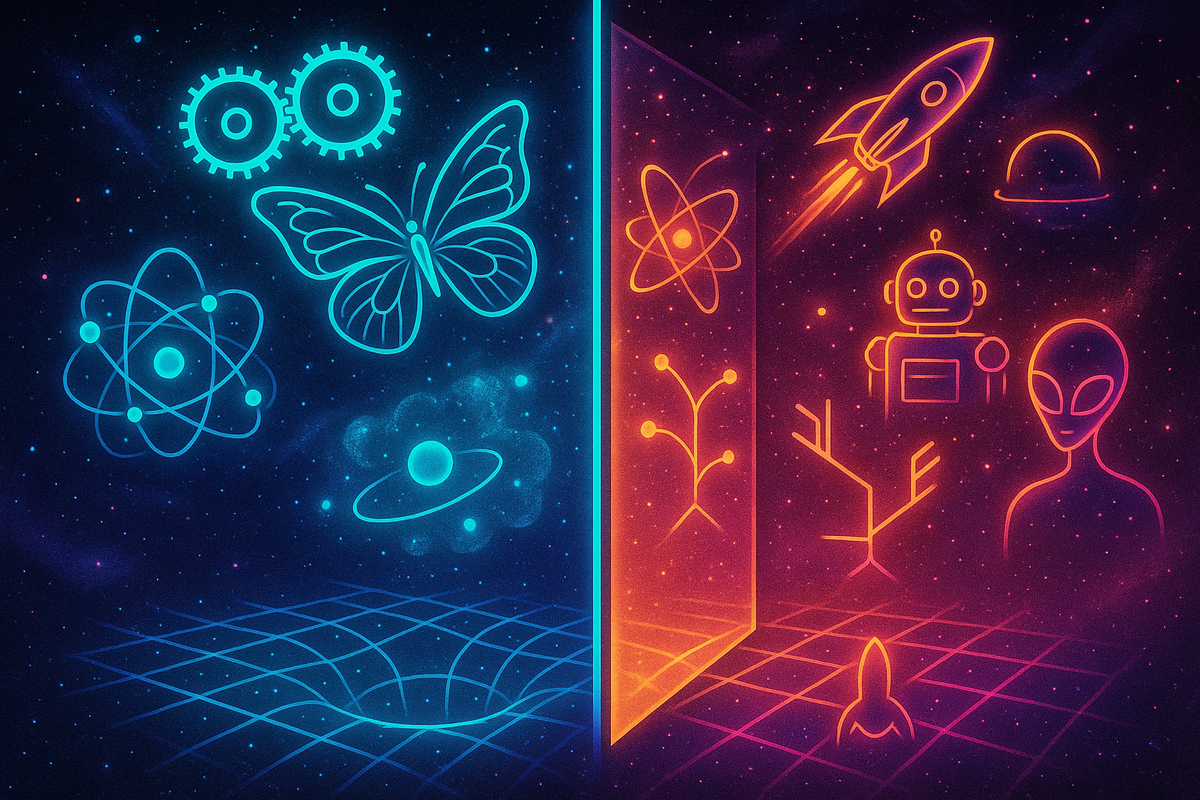
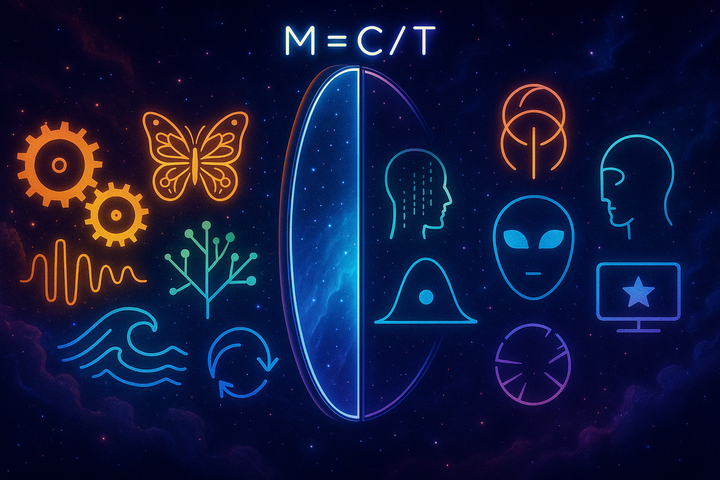
When Newtonian mechanics dominated, fiction gave us clockwork universes—determined, predictable, mechanical. Heroes discovered their fates rather than choosing them. The universe was a machine; you could only watch its gears turn.
When chaos theory emerged, fiction gave us butterfly effects and sensitive dependence. Small choices cascade into massive consequences. Jurassic Park isn't really about dinosaurs—it's about nonlinear dynamics wearing reptile costumes.
When quantum mechanics became cultural property, fiction gave us branching timelines and observer-dependent reality. The multiverse isn't just a Marvel plot device—it's what happens when "the measurement problem" becomes a storytelling convention.
Science fiction doesn't predict the future. It reveals the present.
The stories a culture tells about possibility expose what that culture believes about causality, agency, and the nature of reality itself.
The Core Insight
Fiction is where scientific paradigms become intuitions.
Most people will never read a physics textbook. But they'll watch movies, read novels, play games. The metaphysics of those stories seeps in—slowly, unconsciously—until it shapes how they think about choice, fate, and consequence.
Determinism versus free will. Individual agency versus systemic constraint. Prediction versus emergence. These aren't abstract philosophical questions. They're the operating assumptions of every plot. And the plots track the physics.
This series reads science fiction as data about scientific paradigms. Not to predict technology, but to understand what physics means for how we imagine being human.
The Series
[Fiction as Imagination Technology](/fiction-imagination-technology/) — Why societies tell stories about possibility. The function of speculative narrative in culture.
[Determinism to Chaos: How Physics Changed Plot](/determinism-chaos-plot/) — The paradigm shifts in narrative structure. From clockwork to contingency.
[Dune and Attractor Basins](/dune-attractor-basins/) — Frank Herbert's complexity-theory prescience. Paul didn't have a choice—the attractor basin was too deep. The Jihad was necessary, not chosen.
[The Matrix and Expanded Choice](/matrix-wormholes-choice/) — 1999 physics meets 1999 anxiety. Neo as quantum observer. The One as measurement device.
[The MCU and Quantum Branching](/mcu-quantum-branching/) — Maximum optionality as narrative philosophy. When every choice creates a universe, what does choice even mean?
[Asimov's Psychohistory](/asimov-psychohistory-statistics/) — Large-N determinism in Foundation. Statistical mechanics as prophecy. Can you predict a civilization?
[Lem and Solaris: The Unknowable Other](/lem-solaris-unknowable/) — The limits of scientific comprehension. What happens when the alien is actually alien—incomprehensible by design?
[Black Mirror and Feedback Loops](/black-mirror-feedback-loops/) — Systems thinking as cautionary tale. Technology as trap. The loop you can't escape.
[Synthesis: What Our Fiction Says About Our Science](/fiction-science-synthesis/) — Reading cultural imagination through speculative narrative. What the stories reveal.
Why This Matters
We're living through a paradigm shift. Machine learning, complex systems, emergence, network effects—the physics of the 21st century is different from the physics of the 20th. And the stories are already changing.
Determinism is out. Probability is in. Individual heroes are yielding to ensemble casts. Linear plots are yielding to branching narratives. The protagonist who controls their fate is giving way to the protagonist who navigates constraint.
Watch the fiction. See the physics.
The stories we tell about possibility are the stories we tell about ourselves.
Begin with [Fiction as Imagination Technology](/fiction-imagination-technology/) to understand why speculative narrative matters.
Comments ()